

U.S. Rep. Daniel Webster enters contest for House speaker
Florida Republican calls for decentralizing power, empowering backbenchers
♦By Rich Shumate, Chickenfriedpolitics.com editor
 WASHINGTON (CFP) — U.S. Rep. Daniel Webster of Florida has announced he will run for House speaker to replace outgoing Speaker John Boehner on a platform of decentralizing the GOP leadership’s control of the House agenda by pushing down “the pyramid of power.”
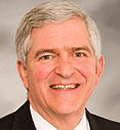
U.S. Rep. Daniel Webster
“What I want to see is a principle-based, member-driven Congress,” Webster said in a September 28 appearance on Fox News where he announced his candidacy. “We don’t have that now. I’d like to have us have it.”
“We can show ourselves as leaders by opening up the process, by allowing lots of debate and lots of amendments and lost of opportunities for members,” he said.
Webster, 66, from Winter Haven in Central Florida, is serving his third term in the House. Prior to his service in Congress, Webster served 28 years in the Florida legislature and was state House speaker from 1996 to 1998.
Webster is running to replace Speaker John Boehner, who announced September 25 that he was stepping down amid conflict within the Republican House conference between Boehner’s allies and conservative backbench critics.
Earlier this year, Webster ran against Boehner in an unsuccessful attempt to bounce him from the speaker’s chair. Afterward, Boehner removed Webster from the powerful House Rules Committee.
Conservative critics of Boehner have complained about attempts to punish members who defied the House GOP leadership.
Webster will face one of those leaders, House Majority Leader Kevin McCarthy of California, in the race for speaker.
On The Trail: Rand Paul pitches smaller government, constitutional rights at New Hampshire event
Kentucky senator says labeling genetically modified foods would be overregulation
♦By Patrick Scanlan, Chickenfriedpolitics.com contributor
 SALEM, New Hampshire (CFP) — Before an enthusiastic crowd of about 75 voters, U.S. Senator Rand Paul of Kentucky took his GOP presidential campaign to the first-in-the-nation primary state of New Hampshire, offering up his critique of a government that he says has become too large, spends too much money and is too oppressive toward its citizens.
In a September 25 town hall event organized by the Greater Salem Chamber of Commerce, Paul expressed his wish that “our government should be minding their own business more,” citing examples of NSA spying, welfare programs, and Planned Parenthood funding.

Rand Paul in Salem, New Hampshire
He did not, however, place the blame solely on Democrats, saying these problems aren’t solely the fault of one party. He said the first priority of the national government should be defense, while most other programs, especially social programs, should be left up to state governments to design and implement.
Paul also said the Republican Party can attract younger voters by advocating strict protection of constitutional guarantees in the Bill of Rights. In that regard, he highlighted his support for the Second Amendment right to keep and bear arms, touching on another issue important to conservative voters.
Paul also answered questions from attendees at the event, who hailed from New Hampshire as well as neighboring Massachusetts.
One question concerned dealing with undocumented immigrants, to which Paul responded by saying that “immigrants who came to the U.S. are by and large good people, but we must secure the border.”
A woman representing group supporting labeling of genetically modified foods asked Paul how he would vote on current legislation imposing such labeling, an issue important to many New Hampshire residents who are part of local and sustainable food movements. He responded that if the movement is popular, then labeling should be left up to the marketplace because he views this, and other similar issues, as overregulation.
When asked about Iran, Paul reiterated that negotiations and open communication are essential to maintaining an effective relationship with Iran. He said that sanctions have gone a long way to pushing Iran in the right direction, but he still does not trust the Tehran regime.
Florida Republicans discuss how new non-voting prisoners might sink U.S. Rep. Corinne Brown
Court-ordered redistricting has moved a number of state prisons into Brown’s district, decreasing the minority voting population
♦By Rich Shumate, Chickenfriedpolitics.com editor
JACKSONVILLE (CFP) — Florida Republicans are hoping that court-ordered congressional redistricting will pack enough non-voting prisoners in U.S. Rep. Corinne Brown’s district to imperil the 12-term Democratic lawmaker.

U.S. Rep. Corrine Brown
Attendees at a meeting of North Florida Republicans held in August discussed the implications of a new configuration for Brown’s district that includes a number of prisons, which will drop the African-American voting population in the district and improve GOP prospects.
A recording of the meeting was originally obtained by Politico Florida.
Prefacing her remarks by making sure there were no reporters in the room, State Rep. Janet Adkins, R-Fernadina Beach, called the redistricting “a perfect storm” for Brown.
Adressing a Republican official from a Baker County, which is being added to Brown’s district and has a large prison population, she said, “You can be the person who can help get rid of Corrine Brown.”
“We do not take into consideration where these people live. It would not be constitutional to take into consideration where they live.”
Adkins later issued an email apologizing if her remarks “offended anyone,” explaining that the conversation was her attempt to explain the ongoing controversy over reapportionment.
Adkins comments were not new. In fact, they echo complaints Brown herself has made about including 18 state prisons in the newly configured 5th District. She has filed suit in U.S. District Court to block the redistricting, which had been ordered by the Florida Supreme Court after it stuck down the current congressional map in July.
A circuit court judge in Tallahassee began a hearing September 24 to choose among seven competing maps. The state Supreme Court will make the final decision.
State lawmakers were unable to agree on a redrawn map during a special session in August. However, both the House and Senate versions of the map change Brown’s district from a north-south configuration to an east-west alignment stretching from central Jacksonville west through counties along the Georgia border to the Tallahassee area.
That change would add rural areas of North Florida, including four counties that are home to a number of state prisons. Adkins alluded to that fact in her remarks at the meeting, asking the other attendees, “What’s the primary industry in North Florida?” The answer was “prisons.”
Because prisoners count toward the population size of a district but cannot vote, including the prisons will reduce the overall size of the voting age population. And to the degree that prison populations are disproportionately made up of minorities, the minority population of the district will drop as a result.
Brown’s current district has a black voting age population of 50 percent. The new district’s black voting age population is 45 percent, including the new felons who cannot vote.
The state Supreme Court ruled in July that Brown’s north-south district—which snaked through northeast and central Florida from Jacksonville to Orlando to pick up black voters and was at one point the width of a highway—violated two anti-gerrymandering amendments Florida voters added to the state constitution in 2010. It also struck down seven other districts, leading to a wholesale redrawing of the congressional map.
The high court ruled that lawmakers in the GOP-controlled legislature impermissibly drew the lines to improve their party’s electoral prospects, something the anti-gerrymandering amendments forbid.
Listen to a recording of the Republican meeting:
On The Trail: U.S. Senator Rand Paul barnstorms key early presidential caucus state of Nevada
Kentucky senator makes pitch to Latino libertarian group in Las Vegas
♦By Andy Donahue, Chickenfriedpolitics.com contributor
 LAS VEGAS (CFP) – Just hours after CNN’s Republican presidential debate, U.S. Senator Rand Paul of Kentucky barnstormed Nevada, taking his presidential campaign on a four-city sweep of the key early caucus state.
Paul began his Nevada tour in Carson City before attending events in Reno and Ely and wrapping up with an appearance at a Latino public policy forum at the College of Southern Nevada near Las Vegas on September 17.
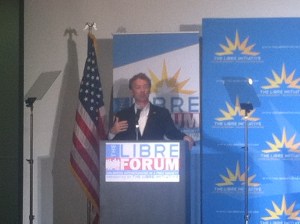
Rand Paul addresses Latino group in Las Vegas.
The event was hosted by the LIBRE Initiative, a non-partisan group that advocates limited government and free enterprise, providing a congenial and receptive audience for Paul, who hails from the libertarian wing of the GOP
Paul made frequent, poignant allusions to Spanish literature throughout his address while telling his own narrative of learning small amounts of Spanish from immigrant children his own age while growing up in Texas. He said the vast wealth and income discrepancies between him and these children were instrumental in his dedication to immigration and border security solutions.
To address these inequalities, Paul is campaigning on an immigration plan built on the economics of supply and demand, advocating for job specific visas that are “proportional” to the number of openings for each job.
Paul saluted the Latino community’s shared commitment to hard work, telling the audience that he “never sees a Hispanic pan-handler.”
Paul also quoted Colombian writer and Nobel laureate Gabriel Garcia Marquez as a source of “advice Republicans might consider,” reciting a line from “Love in the Time of Cholera” to call on his country and his party to seek renewal:
“Human beings are not born once and for all on the day their mothers give birth to them … Life obliges them over and over again to give birth to themselves.”
Nevada will hold its presidential caucuses on February 23, 2016, with 30 delegates at stake. It is the fourth event in the 2016 primary calendar–after Iowa, New Hampshire and South Carolina–and the first test of strength in the West.
Paul is one of eight Southern candidates in the GOP race. The others are U.S. Senators Ted Cruz of Texas, Marco Rubio of Florida and Lindsey Graham of South Carolina; former governors Jeb Bush of Florida, Mike Huckabee of Arkansas and Jim Gilmore of Virginia; and Governor Bobby Jindal of Louisiana.
The lone Southern seeking the Democratic nomination is former U.S. Senator Jim Webb of Virginia.
Rick Perry bows out of 2016 White House race with veiled shot at Trump
Former Texas governor says “no room” for “nativist appeals” in GOP race
♦By Rich Shumate, Chickenfriedpolitics.com editor
 ST. LOUIS (CFP) — Four months before the first vote is cast, former Texas Governor Rick Perry has suspended his campaign for the 2016 GOP presidential nomination — but not before taking a veiled blast at front-runner Donald Trump over his negative comments about Latino immigrants.

Former Texas Governor Rick Perry
“We cannot indulge nativist appeals that divide the nation further,” Perry said, without mentioning Trump by name. “There is no room for debate that denigrates certain people based on their heritage or their origin.”
“We can secure the border of this country and reform our immigration system without inflammatory rhetoric … Demeaning people of Hispanic heritage is not just ignorant, it betrays the example of Christ.”
Perry, who has languished near the bottom of the polls in the crowded GOP field, announced the end of his campaign September 11 in an appearance before the Eagle Forum, a conservative women’s group. The decision to drop out came after news reports that his campaign no longer had enough money to pay staff.
Saying “some things have become clear to me,” Perry went on to laud what he termed “a tremendous field of candidates.”
“I step aside knowing our party’s in good hands as long as we listen to the grassroots, listen to the cause of conservatism,” he said.
Perry, 65, a former Air Force officer who was a cotton farmer in West Texas before getting into politics, left office in January after serving 14 years as governor, the longest tenure in the state’s history.
This was his second try for the White House. He ran in 2012, entering the campaign as one of the favorites only to see his stock plummet after a series of of gaffes, including a moment in a debate when he could not remember the name of a federal agency he had previously pledged to abolish. He later blamed his faltering performance on lack of preparation and the aftereffects of back surgery.
Perry had hoped for political redemption in the 2016 race, but his candidacy never caught fire in the polls. He was one of the most outspoken critics of Trump, particularly over his assertions that many illegal migrants from Mexico were criminals.
Perry was one of nine Southern Republicans seeking the nomination. The other candidates are U.S. Senators Ted Cruz of Texas, Marco Rubio of Florida, Rand Paul of Kentucky and Lindsey Graham of South Carolina; former governors Jeb Bush of Florida, Mike Huckabee of Arkansas and Jim Gilmore of Virginia; and Governor Bobby Jindal of Louisiana.
The lone Southern seeking the Democratic nomination is former U.S. Senator Jim Webb of Virginia.
Watch video of Perry’s withdrawal announcement:
 Chicken Fried Politics