
Home » 2016 (Page 13)
Yearly Archives: 2016

New U.S. House map sets off scramble in Florida
As many as seven seats could be in play after a court-ordered redraw
By Rich Shumate, Chickenfriedpolitics.com editor
 GAINESVILLE, Florida (CFP) — The weather may not be the only thing that’s hot this summer in Florida.
Thanks to new House map ordered by the Florida Supreme Court, as many as seven of the state’s 27 U.S. House seats might be in play as the filing period for congressional races begins June 24.
Republicans appear poised to take away one seat that’s now Democratic; Democrats are likely to capture two GOP-held seats. Further complicating the mix are the departure of four sitting House members who are all running for an open Senate seat.
Although Florida is a quintessential swing state, Republicans hold a 17-10 advantage in the congressional delegation, thanks to maps drawn by the GOP-controlled legislature.
The Supreme Court struck down the previous map on the grounds that it violated a state constitutional amendment prohibiting gerrymandering. The new map ordered by the high court had a domino effect on districts statewide, although it put relatively few safe seats into play.
Here are seven seats to watch in November:

Graham
Florida 2: This seat, anchored in the Florida Panhandle around Tallahassee, is currently held by Democratic U.S. Rep. Gwen Graham. The court removed a chunk of black voters and part of Tallahassee from the district in order to redraw the adjacent 5th District, making what had been a swing seat substantially more Republican.
Graham, the only Democrat to take away a Republican seat anywhere in the South in 2014, looked at her odds and decided not to run again. The GOP seems poised to pick up a seat here.

Brown
Florida 5: This seat, which belongs to Democratic U.S. Rep. Corrine Brown, was the primary offender in the Supreme Court ruling that the House map was unconstitutional. As drawn by legislators, it began in Jacksonville and snaked down to Orlando–at one point, the width of a highway–to maximize its black population.
Over Brown’s strenuous objections, the justices ordered an extreme makeover; the district now starts in Jacksonville and heads due west to Tallahassee, making it less black and more Republican. But Brown is running again, and it remains to be seen whether the changes will be enough to sink her. She faces the additional hurdle of two Democratic primary challengers in the reconfigured district.

Mica
Florida 7: Republican U.S. Rep. John Mica is running again in this district in suburban Orlando. But he now has some of the Democratic voters who used to be in Brown’s 5th District, making this district much less safe that it was. The question will be whether any brand-name Democrats will file to take on the 11-term lawmaker. If not, he’s probably headed back to Washington.

Webster
Florida 10: This Orland0-area district, now held by Republican U.S. Rep. Daniel Webster, was made substantially more Democratic in the redraw–so much so that Webster opted to run for re-election in the adjacent 11th District, where U.S. Rep. Rich Nugent is retiring. This seat will most likely flip Democratic.
Florida 13: This swing district in the Tampa Bay area, now held by Republican U.S. Rep. David Jolly, was also redrawn to add a portion of St. Petersburg with a large minority population, making it more Democratic. Rather than try to defend it, Jolly opted to run for the U.S. Senate.

Crist
The big name in this race is former Florida Governor Charlie Crist, the Republican-turned-independent-turned-Democrat who is trying to make a political comeback after losing the governor’s race in 2014. Crist would seem to be the favorite here, although his recent lack of electoral success should give Republicans some hope.

Murphy
Florida 18: This seat, which includes part of Palm Beach County and the Treasure Coast, is a classic swing district now held by Democratic U.S. Rep. Patrick Murphy. Murphy is giving it up to run for the U.S. Senate, which has put this seat at the top of the GOP’s target list. Depending on who emerges from crowded primaries on both sides, this race should be a toss-up come November.

Taddeo

Garcia

Curbelo
Florida 26: Like the 18th District, this seat, which includes southwest Miami-Dade County and the Florida Keys, has gone back and forth between the parties in recent cycles. The incumbent, Republican U.S. Rep. Carlos Curbelo, is likely to face a rematch against the man he beat in 2014, former Democratic U.S. Rep. Joe Garcia, although Garcia is going to have to get past Annette Taddeo in the primary.
In what was seen as a major snub of Garcia, the Democratic Congressional Campaign Committee, the fundraising arm of House Democrats, is backing Taddeo, a party leader from Miami who was the Democratic nominee for lieutenant governor in 2014.
Democrats need to make a net gain of four seats in order to secure a majority in the Florida delegation. If the 2nd, 10th, and 13th districts flip as expected, that would give Democrats a net gain of one seat. So they would have to defeat Mica, keep Brown’s seat and take the toss-up seats in the 18th and 26th districts in order to flip control their way.
That would seem to be a tall order, although the unpredictability of the presidential race could make the improbable probable.
Clinton ekes out win in Democratic presidential primary in Kentucky
Lexington Mayor Jim Gray wins Democratic nomination to face Republican Rand Paul in U.S. Senate race
♦By Rich Shumate, Chickenfriedpolitics.com
 LOUISVILLE (CFP) — Hillary Clinton scored a narrow victory over U.S. Senator Bernie Sanders of Vermont in the Kentucky Democratic presidential primary, the last stop in the Southern primary season.
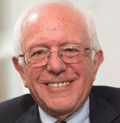
U.S. Senator Bernie Sanders
Clinton took 46.8 percent of the vote in the May 17 vote, compared to just 46.3 percent for Sanders. a margin of just 1,900 votes. That was a stark reversal from eight years ago, when Clinton walloped Barack Obama by more than 35 points in the Bluegrass State.
With the results in Kentucky, Clinton ends the Southern primary season by nearly running the table, taking 12 out of 14 contests. Sanders won only Oklahoma and West Virginia.

Lexington Mayor Jim Gray
Meanwhile, in Kentucky’s U.S. Senate primary, Lexington Mayor Jim Gray won the Democratic nomination over a crowded field, taking 58 percent of the vote. He will now face Republican U.S. Senator Rand Paul in November.
Given Kentucky’s Republican tendencies in federal elections, Paul, seeking his second term, is considered a prohibitive favorite, although Gray, as mayor of the commonwealth’s second-largest city and the wealthy owner of a family construction business, poses a credible challenge.
Gray is also trying to become the first openly gay man ever elected to the Senate.
State of the Races: Governor 2016
Competitive chief executive races on the ballot in North Carolina, West Virginia
♦By Rich Shumate, Chickenfriedpolitics.com editor
 (CFP) — In 2016, just two Southern states will be holding races for governor, and the races in both North Carolina and West Virginia are expected to be close, hard-fought affairs.
Heading into the election, Republicans hold 11 of 14 governorships in the South, in all but Louisiana, Virginia and West Virginia.
Here are this year’s races:

McCrory

Cooper
North Carolina: Incumbent Republican Gov. Pat McCrory is running for a second term against the Tar Heel State’s Democratic attorney general, Roy Cooper. McCrory rode a GOP wave into office in 2012, but the Republican-controlled legislature’s passage of a controversial voter ID law and measures favored by religious conservatives have made the governor a lightning rod. The issue dominating the race is McCrory’s decision to sign a law requiring transgendered students to use bathrooms that match their gender of birth, rather than their gender of identity. Cooper not only opposed the measure, but he also refused to defend it in court. Expect massive amounts of outside cash to be poured into this race, which has become the latest battle in the culture wars. RATING: TOSS-UP

Justice

Cole
West Virginia: Democrats in the Mountaineer State, who have seen their once dominant hold on state politics slip away, are hoping to revive their fortunes with Jim Justice, a billionaire coal mine owner best known for his efforts to revive the state’s famed Greenbrier Resort. He faces Republican State Senate President Bill Cole, who became leader of the chamber in 2015 after the GOP captured a Senate majority for the first time in 83 years. Cole, an auto dealer from Bluefield, is hoping to become the first Republican elected governor in West Virginia since 1996. To get there, he’ll have to overcome Justice’s deep pockets. This seat is open because Democratic Governor Earl Ray Tomblin is term-limited, putting this race near the top of the GOP’s target list. RATING: TOSS-UP
Debbie Wassermann Schultz’s primary challenger raises eye-popping pile of cash
Tim Canova’s campaign raises $1 million in four months
♦By Rich Shumate, Chickenfriedpolitics.com
HOLLYWOOD, Florida (CFP) — U.S. Rep. Debbie Wasserman Schultz may be in for the fight of her political career against a Democratic primary challenger who is raising a small mountain of cash to use against her.

Congressional candidate Tim Canova
Tim Canova, a law professor from Hollywood who criticizes Wasserman Schultz for being insufficiently liberal, has broken the $1 million mark in campaign fundraising, his campaign has announced.
He described his campaign as a “grassroots movement that will restore a voice in our democracy to everyday people and demand accountability from our leaders.”
If that sounds a lot like Bernie Sanders, it is by design. Canova has tied himself firmly to the Vermont senator’s coattails in his effort to oust Wasserman Schultz, who is also chair of the Democratic National Committee.

U.S. Rep. Debbie Wasserman Schultz
Sanders partisans have been critical of Wasserman Schultz and the DNC, complaining they are showing partiality to Hillary Clinton in the Democratic presidential race. Now, that anger has spilled over into the primary in Florida’s 23rd District, which takes in southern Broward County and Miami Beach.
While Canova has raised enough money to be competitive, he still trails Wasserman Schultz in the money chase. She has raised $1.77 million as of March 15, the last time candidates reported fundraising numbers to the Federal Election Commission.
In fact, Wasserman Schultz has already spent more money on her campaign–$1.3 million–than Canova has raised for the August 30 primary.
And in the presidential primary back in March, Clinton pummeled Sanders by more than 30 points in Broward County, which does not bode well for Canova’s chances in a similar proxy fight with Wassserman Schultz.
Still, the primary challenge is proving something of a headache for the DNC chair, with South Florida media noting an uptick in her campaigning for what had been considered an unassailable seat. This is the first time in her 12-year congressional career that she has faced primary competition.
Canova has also been criticizing Wasserman Schultz for not yet accepting his offer to debate.
However, in addition to her fundraising advantage, Wasserman Schultz also has another big gun in her arsenal–a highly touted endorsement from President Barack Obama.
Bernie Sanders cruises to big win in West Virginia primary
Democrat Jim Justice wins Democratic governor’s race, will face Republican Bill Cole in November
♦By Rich Shumate, Chickenfriedpolitics.com editor
 CHARLESTON, West Virginia (CFP) — U.S. Senator Bernie Sanders of Vermont easily won the Democratic presidential primary in West Virginia, notching a rare victory in the South.
Sanders took 51.4 percent of the vote in Mountaineer State, compared to just 35.9 percent for Hillary Clinton. On the Republican ballot, Donald Trump–now unopposed for the nomination–scored an easy victory, taking 77 percent in the May 10 vote.
Meanwhile, in the state’s gubernatorial primaries, political newcomer Jim Justice won the Democratic nomination and will face Republican State Senate President Bill Cole in the general election. The incumbent Democrat, Governor Earl Ray Tomblin, is term limited.
A Republican hasn’t won the governorship in West Virginia since 1996. However, the state’s recent GOP trend, which including capturing the state legislature in 2014, has given Republicans high hopes for taking the state’s top office.
But they will have to get past the deep pockets of Justice, a billionaire farmer and coal mine owner who was a registered Republican until 2015. Justice has gotten the coveted endorsement of the politically powerful United Mine Workers of America and other labor groups., as well as conservative Democratic U.S. Senator Joe Manchin.
Sanders’ victory in West Virginia is just his second win in the South this primary season. With only Kentucky left to vote on May 17, Clinton has swept everything in the region except Oklahoma, most by wide margins.
Speaking to jubilant supporters in Salem, Oregon, as the results came in, Sanders pointedly noted that Clinton carried West Virginia by more than 40 points when she ran against Barack Obama in 2008
“West Virginia is a working class state and like many other states … in this country, working class people are hurting,” Sander said. “And what the people of West Virginia said tonight, and I believe the people of Oregon and Kentucky will say next week, is that we need an economy that works for all of the people, not just the 1 percent.”
Clinton was dogged by a remark she made in March that “we’re going to put a lot of coal miners and coal companies out of business,” which went over badly in coal-producing West Virginia. She later apologized for what she termed a “misstatement.”
Kentucky, the last Southern state left in the Democratic primary calendar, is also a coal-producing state. Both Sanders and Clinton have been campaigning hard in the Bluegrass State.
West Virginia was the final Southern stop for Republicans. Trump won every state in the region except for Oklahoma and Texas, which went to U.S. Senator Ted Cruz.
 Chicken Fried Politics