
Home » 2016 (Page 3)
Yearly Archives: 2016

South Carolina Governor Nikki Haley to be U.N. ambassador
Haley will be replaced in Columbia by Lieutenant Governor Henry McMaster
♦By Rich Shumate, Chicken Fried Politics.com editor
 WASHINGTON (CFP) — South Carolina Governor Nikki Haley has been nominated by President-elect Donald Trump to be the U.S. ambassador to the United Nations, despite her earlier criticism of him and endorsements of two of his Republican rivals.
If Haley is confirmed, Republican Lieutenant Governor Henry McMaster will take over the Palmetto State’s governorship until a new governor is elected in 2018, keeping the seat in GOP hands.
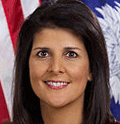
South Carolina Governor Nikki Haley
Although Haley has little foreign policy experience, Trump, in a statement announcing her nomination, said she “has a proven track record of bringing people together regardless of background or party affiliation to move critical policies forward for the betterment of her state and our country.”
“She is also a proven deal maker, and we look to be making plenty of deals,” Trump said.
Haley, 44, the daughter of Sikh immigrants from India, is in her second term, having been elected in 2010 and re-elected in 2014. She is the first woman ever elected as governor in South Carolina.
In a statement, she said the decision to leave the governorhsihp was “difficult” but that she accepted the U.N. ambassadorship out of “a sense of duty.”
“When the president believes you have a major contribution to make to the welfare of our nation, and to our nation’s standing in the world, that is a calling that is important to heed,” she said.
Haley is best known nationally for her handling of the aftermath of a shooting at an African-American church in Charleston in 2015 that left nine people dead. Amid national attention to racial tension in her state, Haley persuaded state legislators to remove the Confederate battle flag from the top of the State House in Columbia.
Haley’s decision to take a spot in the Trump administration marks a turn away from her previously frosty relationship with the incoming president; less than a month ago she called him “irresponsible” for suggesting that the election would be rigged.
Last January, as the presidential race was heating up, Haley delivered the Republican response to President Barack Obama’s State of the Union address and gave what was seen at the time as a thinly veiled shot at Trump: “During anxious times, it can be tempting to follow the siren call of the angriest voices. We must resist that temptation.”
Then, just before the South Carolina presidential primary in February, Haley endorsed one of Trump’s GOP rivals, U.S. Senator Marco Rubio of Florida. When Rubio dropped out in March, she then endorsed U.S. Senator Ted Cruz of Texas. Trump responded with a blast on Twitter in which he called her an embarrassment to the people of her state.
Haley never explicitly endorsed Trump during the campaign, although she did tell reporters at the Republican National Convention in July that she intended to vote for her party’s nominee.

Lieutenant Governor Henry McMaster
McMaster, 69, served as the U.S. attorney in South Carolina from 1981 to 1985 and as state attorney general from 2003 to 2011. After an unsuccessful run for governor against Haley in 2010, he returned to statewide office by being elected lieutenant governor in 2014.
Unlike Haley, McMaster was an early and enthusiastic supporter of Trump, delivering one of his nominating speeches at the convention. After Trump won, he told the Associated Press that he had been contacted by Trump’s transition team as a possible pick for attorney general, a post which eventually went to U.S. Senator Jeff Sessions of Alabama.
McMaster had been expected to run for governor in 2018 to succeed the term-limited Haley. His ascension to the governorship is likely to give him a significant advantage over any GOP rivals.
Under South Carolina’s Constitution, McMaster’s post of lieutenant governor would normally be filled by the state Senate’s president pro tempore, Senator Hugh Leatherman, R-Florence. However, when the lieutenant governorship became open after a resignation in 2014, Leatherman and the rest of the Republicans in the Senate refused to take the job, which has limited powers, and it eventually went to Democrat Yancy McGill.
McGill subsequently switched parties and has announced plans to run for governor in 2018 as a Republican.
Pat McCrory continues to fight election challenge in North Carolina
State Board of Elections refuses to intervene in canvass; Cooper’s lead grows in governor’s race
♦By Rich Shumate, Chicken Fried Politics.com editor
 RALEIGH (CFP) — The GOP-controlled North Carolina State Board of Elections has refused to intervene in a canvass of votes in the state’s hotly contested race for governor, a blow to Republican Governor Pat McCrory’s quest to challenge results showing him trailing Democratic Attorney General Roy Cooper.
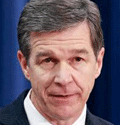
Attorney General Roy Cooper
Meanwhile, Cooper has appointed a transition team and dismissed claims by McCrory and his campaign of voter fraud as “the same kind of misleading and dishonest rhetoric that they’ve used throughout the campaign, rhetoric meant to cause confusion.”
“Governor McCrory is doing everything he can to undermine the results of this election and the will of the people, but we won’t let him,” Cooper said in a video statement posted on Facebook.
But a spokesman for McCrory, Ricky Diaz, said the campaign was trying to ensure that voter fraud had not tainted the process and that “every legal vote is counted properly.”
“Why is Roy Cooper so insistent on circumventing the electoral process and counting the votes of dead people and felons?” Diaz said in a statement. “It may be because he needs those fraudulent votes to count in order to win. Instead of insulting North Carolina voters, we intende to let the process work as it should.”
Should Cooper hang on, North Carolina would be the only state where Democrats flipped a governorship in 2016 and would give them a third Southern governorship, compared to 11 for Republicans.
The latest unofficial vote total from the State Board of Elections shows Cooper with a lead of 6,500 votes, up from the 4,700 vote total Cooper held on election night. Election boards in all of the state’s 100 counties have been adding provisional and absentee ballots to the total.
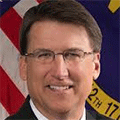
North Carolina Governor Pat McCrory
The McCrory campaign has filed protests in 50 counties, alleged fraudulent absentee ballots and votes by felons and dead people. It asked the state elections panel to oversee official county canvasses across the state, the results of which are scheduled to be certified by the state on November 29. But the board voted to let the counties continue the process on their own.
So far, 40 counties have completed their canvasses and certified final results. However, none of those were large metropolitan counties with vote totals large enough to conceivably allow McCrory to make up ground.
If Cooper’s lead is less than 10,000 votes when the final canvasses are completed, McCrory could request a statewide recount.
In North Carolina, the State Board of Elections and all 100 county boards are appointed by the governor, with the governor’s political party holding a majority on all of those panels, regardless of the political leanings of the county.
The McCrory campaign suffered a major blow when the board in Durham County, despite being controlled by members of his own party, turned down a challenge alleging possible fraud.
On election night, 90,000 votes from the heavily Democratic county came in late, propelling Cooper into the lead and prompting McCrory to cry foul. However, elections officials in Durham said the votes were reported all at once because a technical problem forced them to enter the results from voting machines by hand.
A different technical problem with computerized voter roles in Durham County led the State Board of Elections to extend voting by up to an hour in eight precincts on election day.
While turning down McCrory’s request to get involved in canvasses statewide, the state board did agree to look at allegations of voter fraud in Bladen County, in the southeastern party of the state. However, McCrory actually won in Bladen County and less than 16,000 people voted, making any change there unlikely to alter Cooper’s lead.
McCrory rode a GOP wave into office in 2012, but the Republican-controlled legislature’s passage of a controversial voter ID law and measures favored by religious conservatives made the governor a lightning rod.
The issue that dominated the race was McCrory’s decision to sign a law requiring transgendered students to use bathrooms that match their gender of birth, rather than their gender of identity, in public facilities.
McCrory continued to defend the law, even after a number of businesses scuttled expansion plans and the NCAA, NBA and ACC pulled events from the state.
Cooper not only opposed the measure, but he also refused to defend it in court when students and the federal government took legal action to overturn it.
Democratic VP nominee Tim Kaine rules out 2020 White House run
Kaine tells Richmond newspaper he is content representing Virginia in the Senate
♦By Rich Shumate, Chicken Fried Politics.com editor
 RICHMOND (CFP) — U.S. Senator Tim Kaine of Virginia says he is through with presidential-level politics and will not run for the Democratic nomination in 2020.

Tim Kaine
Kaine made those remarks in a November 17 interview with the Richmond Times-Dispatch, his first in-depth interview since he and Hillary Clinton went down to defeat on November 8.
“I want to run and serve in the Senate for a long time,” Kaine said. “I was really honored to be asked by Hillary, and it was a history-making race to be the first woman nominated. And for her to do well in Virginia and win the popular vote, that is all to her credit. And I was really proud to be part of it. But I think the Catholic in me likes to go to the place where there is the most work to be done.”
Kaine told the newspaper that he would like to emulate the career path of former U.S. Senator John Warner, who represented Virginia in the Senate for 30 years before retiring in 2009. Warner never sought the presidency.
Had Kaine been willing to seek the presidency in 2020, he would have been a leading contender on the Democratic side, given his name recognition from the 2016 race.
Kaine is up for re-election in 2018. While Republicans would likely make a charge at him, Virginia has been trending Democrat in statewide races, with the governorship and both U.S. Senate seats in Democratic hands.
The Clinton-Kaine ticket carried Virginia by 5 points. It was the lone Southern state that they won.
Kaine was the only Southerner to make the ticket of either major political party this year, although 10 Southerners unsuccessfully sought their party’s nomination, including two Virginians, former Democratic U.S. Senator Jim Webb and former Republican Governor Jim Gilmore.
Alabama U.S. Senator Jeff Sessions nominated for U.S. attorney general
Appointment could trigger a special election for Session’s Senate seat
♦By Rich Shumate, Chicken Fried Politics.com editor
 WASHINGTON (CFP) — President-elect Donald Trump has picked U.S. Senator Jeff Sessions of Alabama as his choice for attorney general.
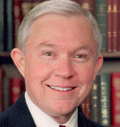
U.S. Senator Jeff Sessions
If Sessions is confirmed by the Senate, where he has served for the past 20 years, his vacant seat will be filled temporarily by Alabama Governor Robert Bentley. State law then requires that a special election be called for voters to select a permanent replacement for the remainder of Session’s term, which ends in 2020.
As Bentley and Sessions are both Republicans, the seat will remain in GOP hands.
In a November 18 statement announcing the pick, Trump called Sessions “a world-class legal mind” who is “greatly admired by legal scholars and virtually everyone who knows him.”
Sessions, who was a federal prosecutor in Alabama from 1975 to 1983, said he was looking forward to returning to the Justice Department.
“I love the department, its people and its mission. I can think of no greater honor than to lead them,” he said in a statement. “With the support of my Senate colleagues, I will give all my strength to advance the department’s highest ideals.
Sessions, 69, who was first elected to the Senate in 1996, was the first senator to endorse Trump and has become a close adviser. He shares with Trump a hard-line stance on immigration, opposing a path to citizenship for undocumented immigrants.
In 1986, President Ronald Reagan nominated Session to serve as a federal judge in Alabama. But his nomination was killed in the Senate Judiciary Committee after several lawyers who worked with Sessions claimed he had made racist statements, which Sessions denied.
That controversy is likely to be resurrected during Session’s confirmation because the Justice Department is the key enforcement agency for civil rights.
Sessions was elected Alabama’s attorney general in 1994 and went to the Senate two years later, becoming only the second Republican elected from the Yellowhammer State since Reconstruction.
U.S. Senate, House races will be decided in Louisiana runoff
Democrats face uphill climbs in 2 races; 2 Republicans face off in the other
♦By Rich Shumate, Chickenfriedpolitics.com editor
 NEW ORLEANS (CFP) — Voters in Louisiana will go to the polls one more time on December 10 to choose a new U.S. Senator and two members of the U.S. House for the northwestern and southwestern parts of the state, in the last federal elections of the 2016 cycle.
After the state’s all-party “jungle” primary on November 8, the Senate race features Republican State Treasurer John Kennedy and Democratic Public Service Commissioner Foster Campbell, pitting two of the state’s longest serving and best-known politicians against each other.

State Treasurer John Kennedy
Kennedy came in first in the primary with 25 percent, with Campbell at 18 percent. Because Republicans have already secured their 51-seat Senate majority, the Louisiana runoff will not affect the balance of power.
Kennedy, 64, from Madisonville near New Orleans, has been Louisiana’s treasurer for nearly 17 years, winning statewide office five times. In 2004, he made an unsuccessful bid for the Senate as a Democrat and tried again in 2008, after switching parties and becoming a Republican. He lost to Democrat Mary Landrieu.
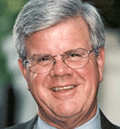
Public Service Commissioner Foster Campbell
Campbell, 69, from Elm Grove near Shreveport, has represented northwestern Louisiana on the Public Service Commission since 2003, a post he won after making three unsuccessful attempts to win a seat in the U.S. House. He also ran for governor in 2007, coming in fourth place in the primary.
The seat opened up after Republican U.S. Senator David Vitter decided not to seek re-election and run instead for governor, a race he lost to Democratic Governor John Bel Edwards. Given the Pelican State’s Republican tilt, Kennedy is considered the favorite in the race.
In addition to the Senate race, voters in the 3rd U.S. House District, which takes in southwestern Louisiana, and the 4th District, which takes in the northwest, will choose new congressmen.
In the 3rd District Republican Public Service Commissioner Scott Angelle from Breaux Bridge will face fellow Republican Clay Higgins, a former sheriff’s deputy from St. Landry Parish who became well known for tough-talking anti-crime videos that have gone viral on the Internet.
The seat opened when GOP U.S. Rep. Charles Boustany of Lafayette left to make an unsuccessful bid for the U.S. Senate seat, finishing third, just behind Campbell.
In the 4th District, Republican State Rep. Mike Johnson of Bossier Parish will face Democrat Marshall Jones, an attorney from Shreveport, in the runoff, which will be the last House pickup opportunity for Democrats.
The seat opened when U.S. Rep. John Fleming of Minden also decided to run for the Senate, where he finished fifth. Republicans have held this seat since 1988, making Johnson a prohibitive favorite.
 Chicken Fried Politics