

Trump nominates Florida law school dean Alex Acosta as labor secretary
Acosta selected after Trump’s first nominee for labor post, Andrew Puzder, pulled out
♦By Rich Shumate, Chickenfriedpolitics.com editor
 WASHINGTON (CFP) — Alex Acosta, the dean of Florida International University’s law school and a former federal prosecutor in Miami, has been named by President Donald Trump to be the nation’s next labor secretary.
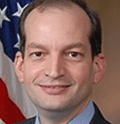
FIU Law Dean Alex Acosta
The selection of Acosta to head the U.S. Department of Labor came a day after Trump’s first pick for the post, fast food magnate Andrew Puzder, withdrew from consideration after it became clear that he lacked enough votes for Senate confirmation.
Trump made the announcement February 16 during a media appearance at the White House, which Acosta did not attend.
“I think he’ll be a tremendous secretary of labor,” Trump said, after briefly ticking off items from Acosta’s resume, including the fact that he had already been confirmed by the U.S. Senate to three executive department posts.
If confirmed, Acosta will be the first, and so far only, Latino in the Trump cabinet.
Acosta, 48, a Cuban-American, has been dean at FIU’s law school since 2009. From 2005 to 2009, he served as U.S. attorney for the Southern District of Florida, which comprises nine counties in the southeastern part of the state.
From 2003 to 2005, Acosta headed up the U.S. Department of Justice’s Civil Rights Division in Washington, the first Latino to serve in that position. From 2002 to 2003, he was a member of the National Labor Relations Board.
Acosta was also a law clerk to now-U.S. Supreme Court Justice Samuel Alito from 1994 to 1995, when Alito was serving on the 3rd U.S. Circuit Court of Appeals.
His two positions in the Justice Department and his stint at the NLRB all required Senate confirmation. One of the senators who will decide on Acosta’s nomination for the labor post, Florida’s Marco Rubio said he was “a phenomenal choice” and predicted he would be approved.
“I look forward to his confirmation hearing, where I’m confident he will impress my colleagues and secure the support necessary to be the next secretary of labor,” Rubio said in a statement.
18 candidates qualify in race for Tom Price’s former U.S. House seat in Georgia
Democrats have hopes for a breakthrough in a district Trump barely carried
♦By Rich Shumate, Chickenfriedpolitics.com
 ROSWELL, Georgia (CFP) — A gaggle of 18 candidates qualified for the April 18 special election for Georgia’s 6th District U.S. House seat, kicking off a wide-open race to succeed Health and Human Services Secretary Tom Price in the suburban Atlanta district.

HHS Secretary Tom Price
A Republican field of 11 includes former Secretary of State Karen Handel and two former state senators, Judson Hill and Dan Moody, as well as two candidates, Bob Gray and Bruce LeVell, who are aligning themselves with President Donald Trump
The Trump factor could prove interesting in this race. While the 6th District trends Republican (Price was re-elected with 62 percent in November), Trump carried it by a scant 1.5 percent in November, on his way to losing all three of the counties that make up parts of the district.
Trump’s weak showing in the district has drawn five Democrats into the race to succeed Price, including former State Senator Ron Slotin from Sandy Springs and Jon Ossoff, a filmmaker and former congressional aide who has snagged high-profile endorsements from U.S. Reps. John Lewis and Hank Johnson.
A crowd-funding effort launched through Daily Kos has raised more than $760,000 for Ossoff, whose campaign website features a banner headline reading “Georgia: Stand Up To Trump.”
The district includes East Cobb, North Fulton and northern DeKalb Counties and has been held in the past by former House Speaker Newt Gingrich and U.S. Senator Johnny Isakson. The April election will be the first U.S. House contest since Trump was elected in November.
In addition to the 11 Republicans and five Democrats running, two independents also qualified. All candidates will run together in the same race; if no one clears a majority, the top two candidates regardless of party will meet in a June 20 runoff, a process likely to help Democrats with a smaller number of top-flight candidates.
Handel, who chaired the Fulton County Commission before becoming secretary of state, is perhaps the best known of the Republican candidates, having narrowly lost races for governor in 2010 and U.S. Senate in 2014. In 2012, she made national headlines after resigning from the Susan G. Komen for the Cure Foundation after it reversed a decision to cut off funds to the abortion provider Planned Parenthood.
However, she will be competing for the North Fulton share of the 6th District vote with Moody, who represented the area in the Georgia Senate; Gray, a former city councilman in Johns Creek; and Kurt Wilson, a Roswell businessman who is making imposition of term limits a centerpiece of his campaign.
Hill will have the advantage of being the only major GOP candidate from East Cobb. He has been raising money for the race since Price was nominated for HHS secretary and resigned from the Senate after qualifying for the 6th District race.
LeVell, a businessman from Sandy Springs and former chairman of the Gwinnett County GOP, was executive director of the National Diversity Coalition for Trump during the presidential campaign. His campaign website features a photo of him standing next to the president.
Also in the running is Mohammad Ali Bhuiyan, an economist from Cobb County who is trying to become the first Muslim Republican in the House.
The election is April 18, with the top two candidates regardless of party meeting in a June 20 runoff if no one clears a majority.
Jeff Sessions confirmed as U.S. attorney general; Luther Strange picked for Sessions Senate seat
Governor Robert Bentley appoints Strange amid investigation into purported affair
♦By Rich Shumate, Chickenfriedpolitcs.com editor
 MONTGOMERY (CFP) — A day after U.S. Senator Jeff Sessions was confirmed to be U.S. attorney general on a mostly party-line vote, Alabama Attorney General Luther Strange was picked to fill Sessions’s vacant Senate seat.

U.S. Senator Luther Strange
However, Strange’s elevation to the Senate post by Governor Robert Bentley on February 9 is already generating controversy because of the outgoing attorney general’s involvement in an investigation into Bentley’s relationship with a former staffer.
Strange has not confirmed if his office has been investigating Bentley’s conduct with Rebekah Mason, who served as one of the governor’s top aides and to whom he has been linked romantically. However, the attorney general had asked a state House committee considering Bentley’s impeachment to suspend its proceedings while his office conducted “necessary related work.”
By sending Strange to Washington, Bentley will now get to pick his replacement as attorney general.
State law also calls for a temporary appointment to fill a Senate vacancy, followed by a special election. But the law leaves the specific timetable for the special election in hand of the governor, and Bentley decided to hold it during the general election in 2018 to avoid the costs of a special election in 2017.
Strange had already announced that he would run in 2018 for the final two years of Session’s current term.
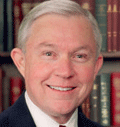
U.S. Attorney General Jeff Sessions
Sessions, who had represented Alabama in the Senate for 20 years, was confirmed as attorney general after a contentious debate during which Democrats questioned his commitment to upholding civil rights. In the end, only one Democrat–Joe Manchin of West Virginia–voted for his confirmation.
Three other Southern Democrats–Bill Nelson of Florida and Mark Warner and Tim Kaine of Virginia–voted against confirming Sessions.
Strange, 63, is in his second term as attorney general. He is known in Alabama as “Big Luther,” a reference to the new senator’s height of 6-feet 9-inches. He was a basketball standout at Tulane University in the 1970s.
In a statement, Strange said he was “greatly honored and humbled” by his appointment to the Senate.
“I pledge to the people of Alabama to continue the same level of leadership as Jeff Sessions in consistently fighting to protect and advance the conservative values we all care about,” he said.
As attorney general, he developed a reputation for rooting out official corruption, including his office’s successful prosecution of Mike Hubbard, the Republican speaker of the Alabama House who was sentenced to four years in prison.
The extent of his investigation of Bentley remains unclear, although his request to stop impeachment proceedings has been widely interpreted as an indication that such an investigation is underway.
In March 2016, an audio tape surfaced in which the governor expresses “love” to an unidentified party in a telephone conversation and talks about how much he enjoys touching her breasts. Bentley denied having an affair, although he apologized to the people of Alabama for making “inappropriate” comments to Mason, who resigned from his staff a short time later.
The controversy escalated when Bentley fired Spencer Collier, the head of the Alabama Law Enforcement Agency, who said he warned the governor that using state resources to carry on an affair would violate state law.
Collier claimed Mason exhibited so much influence over Bentley that she was “the de facto governor.” He said he had received complaints about Mason from other law enforcement officials, as well as members of Bentley’s cabinet and members of his family.
Bentley has resisted calls for his resignation, despite an ethics complaint and a federal grand jury investigation into his relationship with Mason.
Bentley. now in his second term, is barred from seeking re-election in 2018.
Virginia Governor 2017: Contested primaries shaping up in both parties
Northam, Gillespie face challenges from anti-establishment rivals
♦By Rich Shumate, Chickenfriedpolitics.com editor
 RICHMOND (CFP) — Any hopes Democratic and Republican leaders in Virginia had of avoiding contentious primaries in the governor’s race this year have been dashed, with both parties facing the same establishment-versus-insurgent battles that characterized the 2016 presidential contest.
With two months to go before the filing deadline for the June primary, the Democratic race has already drawn two major contenders, while the Republican race has four. All are vying to replace Democratic Governor Terry McAuliffe, who is barred by state law from seeking re-election.
On the Democratic side, Lieutenant Governor Ralph Northam appeared to be cruising to his party’s nomination unmolested until January, when former U.S. Rep. Tom Perriello jumped into the race and began casting himself as anti-establishment, in contrast to the well-connected Northam.
On the Republican side, Ed Gillespie, a former Republican National Committee chairman who ran a surprisingly strong race for U.S. Senate in 2014, is being challenged by Donald Trump’s former Virginia campaign chairman, a veteran state senator who also worked for Trump, and a Tea Party-aligned distillery owner who has hired the campaign manager who helped take down Eric Cantor in 2014.
A poll from the Wason Center for Public Policy at Christopher Newport University, released February 2, shows both primary races are fluid, with Gillespie and Northam leading but most voters undecided.
The governor’s battle takes place amid changing political currents in the Old Dominion. Once reliably Republican, Democrats have carried the state in the last three presidential elections and hold both U.S. Senate seats. Three of the last four governors have been Democrats.
Virginia also doesn’t have primary runoffs, which means that on the Republican side, the winner is likely to have garnered significantly less than 50 percent of the vote.

Ed Gillespie
Gillespie, 55, from Fairfax County, is a former top lieutenant to President George W. Bush who has run both the national and state GOP. In 2014, he came within 18,000 votes of unseating Democratic U.S. Senator Mark Warner, in what was considered one of the biggest surprises of that election cycle.
Standing in Gillespie’s road to the nomination are Corey Stewart, 48, chairman of the Prince William County Board of Supervisors, who ran Trump’s campaign in Virginia until being fired a month before the 2016 election; State Senator Frank Wagner, 61, from Virginia Beach, a former U.S. Navy officer who has served in the the state legislature for 25 years; and Denver Riggleman, a distillery owner and former Air Force intelligence officer from Afton.

County Supervisor Corey Stewart
Stewart, who instigated a crackdown on undocumented immigrants as county chairman, has boasted that “I was Trump before Trump was Trump.” However, he was removed from the Trump campaign last October after organizing a protest outside of Republican National Committee headquarters demanding that the GOP hierarchy not abandon Trump in the wake of the release of an audiotape in which Trump made sexually suggestive comments.
A key question in the GOP primary will be the extent to which Trump might assist Stewart — and how much good that would actually do in a state Trump lost.
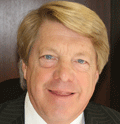
State Senator Frank Wagner
Stewart will also have competition for the pro-Trump banner from Wagner, who was co-chair of Trump’s campaign in southeast Virginia. He has remained a Trump defender, endorsing the president’s controversial ban on refugees from seven predominantly Muslim countries and criticizing Gillespie for not following suit.
In his campaign, Wagner is also touting his legislative experience and the fact that he is the only Republican candidate who is a native Virginian.

Denver Riggleman
Riggleman, the least well-known among the Republican candidates, has hired the campaign manager used by U.S. Rep. Dave Brat in his upset win over then-House Majority Leader Eric Cantor in a GOP primary 2014. Backed by Tea Party activists and talk radio hosts, Brat tossed the powerful Cantor from Congress, in what is now seen as a prelude to the political earthquake that brought Trump to power two years later.
The Wason Center poll found that Gillespie was the choice of 33 percent of Republican or Republican-learning voters, with Wagner at 9 percent, Stewart at 7 percent and Riggleman at 1 percent. However, 50 percent remain undecided.
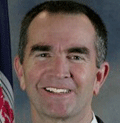
Lieutenant Governor Ralph Northam
On the Democratic side, Northam, 57, a doctor and former U.S. Army major from Norfolk, served in the state senate before winning the lieutenant governorship in 2013. He has the backing of most of the commonwealth’s Democratic leadership, including McAuliffe, Warner and U.S. Senator Tim Kaine.
Perriello, 42, from Charlottesville, served a single term in Congress before being swamped in the Tea Party wave of 2010. His tenure was noteworthy for his vote in favor of Obamacare, which didn’t go down well in the more conservative parts of his central Virginia district.

Former U.S. Rep. Tom Perriello
After leaving Congress, Perriello worked at the Center for American Progress, a liberal think tank, and was appointed by President Obama as a State Department envoy to Africa.
While Perriello’s voting record in Congress was moderate for a Democrat, he has been staking out ground on the progressive left in the governor’s race, saying he wants to make Virginia “a firewall against hate, corruption and an assault on the Virginia values of decency and progress.” He has also changed his position on using federal funds to pay for abortions, which he once voted against but now supports.
The Democratic primary race is likely to feature some of the remaining currents from the bruising 2016 battle between Hillary Clinton and Bernie Sanders.
Northam’s most prominent backer, McAufliffe, is a close confidant of the Clintons, and Northam endorsed Clinton over Sanders in the commonwealth’s presidential primary. That could provide an opening for Perriello, who is also close to Obama and members of the former president’s political brain trust.
The Wason Center poll shoed Northam at 26 percent and Perriello at 15 percent among Democratic and Democratic leaning voters, with 59 percent undecided.
Virginia is one of four Southern states that hold gubernatorial elections in off years but is the only one voting in 2017. Louisiana, Kentucky, and Mississippi will have elections in 2019.
 Chicken Fried Politics