
Home » 2017 (Page 5)
Yearly Archives: 2017

Alabama GOP U.S. Senate primary runoff battle heads down to the wire
A Roy Moore victory would be win for religious conservatives — and a loss for Trump and McConnell
♦By Rich Shumate, Chickenfriedpolitics.com editor
 BIRMINGHAM (CFP) — With just a week to go before Alabama Republicans decide on their U.S. Senate nominee, the burning political question across the Yellowhammer State is, can Roy Moore really pull it off?

Former Alabama Chief Justice Roy Moore
Polls show Moore — an unapologetic culture warrior twice elected and twice removed as chief justice of the Alabama Supreme Court for defying federal courts — has a clear shot at knocking off U.S. Senator Luther Strange, which would be politically embarrassing for both President Trump and Senate Majority Leader Mitch McConnell, who have backed Strange to the hilt.
Trump, who despite his political difficulties nationally remains popular in Alabama, will campaign with Strange in Huntsville on the Friday before the runoff, even though Moore — who has said he believes God put Trump in the White House — has also cast himself as a solid supporter of the president’s agenda.

U.S. Senator Luther Strange
Five statewide polls taken since the first round of primary voting in August have shown Moore with a lead beyond the statistical margin of error; in three others, the margin between the candidates was not large enough to draw inferences about the state of the race.
The latest poll, a September 18 survey from JMC Analytics, showed an inconclusive margin between the candidates. However, that was a marked shift from the same poll in August, which had Moore with a 19-point lead over Strange.
About 13 percent of voters polled in the survey said they were still undecided.
Moore got a major boost on when he was endorsed by the candidate who placed third in the first round of voting on August 15, U.S. Rep. Mo Brooks.
“We are in an epic battle between the people of Alabama who put America first and the Washington swamp that hopes to buy our Senate seat and put America last,” Brooks said at a September 16 Moore campaign rally in Huntsville.
The battle in Alabama has become a proxy war between the Senate GOP leaders and their intra-party critics, who have embraced the Moore candidacy as a way of giving McConnell a black eye — and possibly saddling him with a Republican caucus member who has publicly and repeatedly called for McConnell’s ouster.
Most recently, Breitbart News, the website run by Trump’s former chief strategist, Steve Bannon, has been boosting Moore, even as the president has waded further into the fray for Strange.
A victory by the Moore would also cheer Democrats, who haven’t won a Senate race in Alabama in 25 years. Waiting in the wings for the GOP runoff winner is Doug Jones, a former federal prosecutor from Birmingham, whose uphill task in deep red Alabama might be less uphill against someone with Moore’s controversial past.
Strange, 64, was appointed to the Senate in February by former Governor Robert Bentley after Jeff Sessions was named as Trump’s attorney general.
At the time, Strange was Alabama’s attorney general, and his office had been involved in investigating the governor’s conduct. Bentley also handed Strange another gift, delaying a special election to permanently fill the Senate seat until November 2018, which would have given Strange nearly two years of incumbency before he had to face voters.
But after a sex scandal forced Bentley from office, new Alabama Governor Kay Ivey reversed course and ordered a special election.
The circumstances of Strange’s appointment, and the perception that it might have been the result of a political deal with the disgraced Bentley, have dogged the senator throughout the campaign, even though he has strongly denied any impropriety and no evidence of a corrupt bargain has surfaced.
Moore, 70, first gained national notoriety as a local judge in 1995 after battling the ACLU over his practice of opening court sessions with a prayer and hanging the Ten Commandments in his courtroom.
He parlayed that prominence into election as chief justice in 2000 but was forced out in 2003 after he had a display of the Ten Commandments installed in the rotunda of the state judicial building and then defied a federal judge’s order to remove it.
Moore was once again elected chief justice in 2012, but in 2016, he was suspended by a judicial disciplinary panel for the rest of his term for ethics violations after urging local officials to defy the U.S. Supreme Court decision legalizing same-sex marriage.
After losing an appeal of his suspension, Moore resigned from the Supreme Court to run for the Senate.
Roy Moore, Luther Strange advance to Alabama U.S. Senate runoff
Former federal prosecutor Doug Jones wins Democratic nod
♦By Rich Shumate, ChickenFriedPolitics.com editor
MONTGOMERY (CFP) — U.S. Senator Luther Strange has survived the first hurdle in his quest to hang on to his seat but must now overturn a lead opened up by conservative culture warrior Roy Moore in the first round of voting in an Alabama GOP special election primary.
U.S. Senator Luther Strange
Moore, the former chief justice of the Alabama Supreme Court, won 39 percent of the vote in the August 15 vote, to 33 percent for Strange, who got the benefit of a late-stage endorsement by President Trump to edge out U.S. Rep. Mo Brooks of Huntsville for second spot in the September 26 runoff.
Brooks won 20 percent, and the question now is where his voters go after an acrimonious campaign, during which groups aligned with the Senate Republican leadership poured in millions of dollars to bolster Strange by targeting both Brooks and Moore.
After conceding defeat, Brooks offered no formal endorsement, but he complained to reporters that “the non-stop carpet bombing of my reputation and Roy Moore’s reputation, quite frankly, it took a toll in the parts of the state where I was not very well known.”
Former Alabama Chief Justice Roy Moore
In his victory speech, Moore made a directly play for the votes of the six candidates eliminated in the first round of voting, saying “the attempt by the silk-stocking Washington elitists to control the vote of the people of Alabama has failed.”
“I extend my hand of friendship to my fellow candidates who did not make this runoff,” he said. “Those candidates ran an honorable and ethical campaign. They ran on their own merits and not on the negative attack ads of (Strange).”
A runoff victory by Moore — twice thrown off Alabama’s highest court for defying federal court rulings on same-sex marriage and display of the Ten Commandments — would present a challenge to the GOP’s image nationally and would also be a rebuke to Senate Majority Leader Mitch McConnell, whom Moore has disparaged on the campaign trail.
Trump, too, has a vested interest in Strange’s survival after endorsing him a week before the primary, even though Moore — who has said he believes God put Trump in the White House — has cast himself as a solid supporter of the president’s agenda.
Meanwhile, in the Democratic primary, the victor was Doug Jones, a former federal prosecutor from Birmingham, who took 65 percent of the vote to win over seven other candidates.
The Democratic winner will face an uphill climb in a state where a Democrat hasn’t won a Senate seat in 25 years, although the prospect of facing Moore in the general election may give Democrats a glimmer of hope.
Addressing supporters after his win, Jones tried to contrast himself with the Republican candidates by casting himself as “an independent voice.”
“I’m not going to be beholden to a president or a party leader. I’m going to be beholden only to the state of Alabama,” he said. “Tonight we have taken that first step.”
Strange, 64, was appointed to the Senate in February by former Governor Robert Bentley after Jeff Sessions was named as Trump’s attorney general.
At the time, Strange was Alabama’s attorney general, and his office had been involved in investigating the governor’s conduct. Bentley also handed Strange another gift, delaying a special election to permanently fill the Senate seat until November 2018, which would have given Strange nearly two years of incumbency before he had to face voters.
But after a sex scandal forced Bentley from office, new Alabama Governor Kay Ivey reversed course and ordered a special election. And although Strange has strongly denied any impropriety, the unusual circumstances of his appointment by the disgraced Bentley have dogged him in the Senate race.
Moore, 70, first gained national notoriety as a local judge in 1995 after battling the ACLU over his practice of opening court sessions with a prayer and hanging the Ten Commandments in his courtroom.
He parlayed that prominence into election as chief justice in 2000 but was forced out in 2003 after he had a display of the Ten Commandments installed in the rotunda of the state judicial building and then defied a federal judge’s order to remove it.
Moore was once again elected chief justice in 2012, but in 2016, he was suspended by a judicial disciplinary panel for the rest of his term for ethics violations after urging local officials to defy the U.S. Supreme Court decision legalizing same-sex marriage.
After losing an appeal of his suspension, Moore resigned from the Supreme Court to run for the Senate.
Luther Strange gets Trump endorsement in Alabama U.S. Senate primary
Opponent Mo Brooks says president was “misled” into endorsing Jeff Sessions’s successor
MONTGOMERY (CFP) — A week before Alabama Republicans go to the polls to decide a hotly contested U.S. Senate primary, U.S. Senator Luther Strange has snagged a coveted endorsement from President Trump, in a race where a host of GOP candidates have been vying to claim the Trump mantle.
U.S. Senator Luther Strange
“Senator Luther Strange has done a great job representing the people of the Great State of Alabama. He has my complete and total endorsement!” Trump said in an August 8 tweet.
One of the men Strange is battling for a spot in a likely Republican runoff, U.S. Rep. Mo Brooks, reacted by firing off a statement suggesting Trump has been misled into supporting Strange by the Washington establishment, led by Senate Majority Leader Mitch McConnell.
“I respect President Trump, but I am baffled and disappointed Mitch McConnell and the Swamp somehow misled the president into endorsing Luther Strange,” Brooks said. “While Mitch McConnell and the Swamp managed to mislead the president last night, I still support the America First Agenda. … We believe our message will win out over the Swamp and Lyin’ Luther.”
Strange was appointed to the Senate temporarily in February after Jeff Sessions was named as Trump’s attorney general. He is running in an August 15 special election primary to fill the seat permanently, a race that has attracted eight GOP candidates

U.S. Rep. Mo Brooks
All three of the leading Republicans — Strange, Brooks and former Alabama Supreme Court Chief Justice Roy Moore — have emphasized their support for the president on the campaign trail. But Brooks, who initially supported U.S. Senator Ted Cruz in last year’s presidential race, may have run afoul of Trump in July by coming to Sessions’s defense after the president made noises about firing the attorney general.
Brooks offered to drop out of the race and let Sessions have his Senate seat back, provided the other candidates also agreed to withdraw. None of them did, and, in the end, Trump did not fire Sessions.
Former Alabama Chief Justice Roy Moore
Moore, who has said he believes God put Trump in the White House, joined Brooks in attributing his endorsement of Strange to the Washington establishment.
“The people of Alabama know me and know that I will stand for the principles which made this country great,” Moore said in the statement. “All of the money, power and prestige of Washington D.C. will not determine who the people will elect as the next senator.”
Polls have shown the race headed to a September 26 runoff, with Moore in the lead and Strange and Brooks battling for second place.
Strange’s pitched battle to stay in the Senate is not what he expected when he was appointed to the post in February by former Governor Robert Bentley. Although state law mandates that Senate vacancies be filled “forthwith,” Bentley delayed a special election until November 2018, giving Strange nearly two years of incumbency before he had to face voters.
But after a sex scandal forced Bentley from office, new Alabama Governor Kay Ivey reversed course and ordered a special election, which opened the floodgates for candidates eager to send Strange back home.
McConnell has backed Strange, and a PAC affiliated with the Senate leader has run ads against both Brooks, a House Freedom Caucus member who has called for McConnell’s ouster, and Moore, whose controversial past has made him a darling of the religious right but a polarizing figure both nationally and in Alabama.
In 1995, Moore, then a little-known circuit court judge in Etowah County, shot to national notoriety after battling the ACLU over his practice of opening court sessions with a prayer and hanging the Ten Commandments in his courtroom.
He parlayed that prominence into election as chief justice in 2000 but was forced out in 2003 after he had a display of the Ten Commandments installed in the rotunda of the state judicial building and then defied a federal judge’s order to remove it.
Moore was once again elected chief justice in 2012, but in 2016, he was suspended by a judicial disciplinary panel for the rest of his term for ethics violations after urging local officials to defy the U.S. Supreme Court decision legalizing same-sex marriage.
While Strange and the other Republicans battle for their party’s nomination, seven Democrats are vying for a spot in the general election against the winner. Limited polling in the Democratic race has shown a lead for Robert Kennedy, Jr. — not the son of the slain U.S. senator but a Mobile businessman and former naval officer who appears to be benefiting from name misrecognition, in a race full of little known candidates.
Former U.S.Attorney Doug Jones of Birmingham, the choice of Democratic party leaders, is in the second spot in the polls.
West Virginia Governor Jim Justice switches from Democrat to Republican
Governor makes dramatic announcement at Donald Trump rally
♦By Rich Shumate, ChickenFriedPolitics.com editor
 HUNTINGTON, West Virginia (CFP) — Just nine months after winning West Virginia’s top job as a Democrat, Governor Jim Justice has switched to the Republican Party, telling his voters that “I can’t help you anymore being a Democrat governor.”

Governor Jim Justice
Justice made his announcement in the most public way possible — at August 3 campaign-style Donald Trump rally in Huntington, with the president looking on. And the newly minted Republican, a longtime friend of Trump and his family, offered an unqualified endorsement of his new party’s standard-bearer.
“This man is a good man. He’s got a backbone,” Justice said. “He’s got real ideas. He cares about America. He cares about us in West Virginia.”
Trump carried West Virginia by 42 points in November, his biggest margin of victory in any state except Wyoming, at the same time Justice was keeping the statehouse in Charleston in Democratic hands.
However, Justice told the crowd in Huntington that the decision to bolt to the GOP also stemmed from a dispute he had with Democrats in the legislature after a tax plan he crafted with Republican help went down to defeat.
“At the altar, when we had it done, like or or not, but the Democrats walked away from me,” he said.
In response to Justice’s announcement, West Virginia Democratic chairwoman Belinda Biafore issued a statement accusing the governor of caring more about his own political future than the people of his state.
“During his campaign for governor, Jim Justice said he would never lie to the public; he said he would never be a politician, and he would definitely be a full-time governor. None of those promises were kept,” she said.
“Jim Justice took advantage of Democrats by taking our money and our votes. It’s a slap in the face to all of us who believed in what he was promising. I never thought I would see Jim Justice be anyone’s puppet. Shame on him.”
Republicans control both house of the West Virginia legislature, which means Justice will now be titular head of a party that has complete control of state government for the first time since at least 1931.
Justice, noting that his late parents were both “staunch Republicans,” said he imagined that his mother was in heaven “saying ‘Jimmy, it’s about damn time you came to your senses.”
He also took a shot at those focusing on the investigation into Russian meddling in the presidential election, which has been dominating the conversation in Washington.
“Haven’t we heard enough about the Russians?” Justice said, drawing thunderous applause from the pro-Trump crowd. “I mean, to our God in heaven above, think about it. The stock market’s at 22,000. And this country has hope. And we’re on our way.”
Like Trump, Justice, 66, was a billionaire businessman with no political experience before being elected, a fact the governor also noted while announcing his switch.
“This man and myself are not politicians. We ran to get something done,” he said. “We ran because we want nothing. We ran as our Founding Fathers did years and years ago, to serve.”
A sitting governor changing parties during his term in office is extraordinarily rare. The only recent precedent was former Florida Governor Charlie Crist, who switched from Republican to independent in 2010 during an unsuccessful run for U.S. Senator. Crist is now a Democratic member of the U.S. House.
Justice’s switch means that Democrats now hold just three of 14 Southern governorships, in North Carolina, Louisiana and Virginia. Nationwide, Republicans hold the governor’s office in 34 states, matching their all time high.
U.S. Rep. Diane Black will run for Tennessee governor in 2018
House Budget Committee chair is now the third woman vying for her state’s top job
♦By Rich Shumate, ChickenFriedPolitics.com editor
 NASHVILLE (CFP) — U.S. Rep. Diane Black will give up the chairmanship of the powerful House Budget Committee to make a run for Tennessee’s open governorship in 2018.
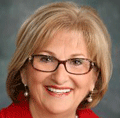
U.S. Rep. Diane Black, R-Tennessee
In an announcement video posted August 2, Black burnished her conservative bona fides as she prepares to battle two other Republican women also vying to be the first female governor in state history.
“In Tennessee, we’re conservative, and we do things the right way, no matter what Hollywood or Washington thinks about it,” Black said. “We believe in absolute truths — right is right, wrong is wrong, truth is truth, God is God, and a life is a life. And we don’t back down from any of it.”
And although, as a committee chairman, Black is part of the House GOP leadership team, she also touted her independence, insisting that “I wasn’t afraid to stand up to the weak-kneed people in my own party when I had to.”
“I believe in secure borders and tough choices in cutting spending and beating the liberals instead of caving in to them.”
Black, 66, who worked as a nurse before getting involved in politics, served in both houses of the Tennessee legislature before winning her seat in Congress, representing the Volunteer State’s 6th District. She became chair of the budget committee earlier this year when former chair Tom Price left to join President Trump’s Cabinet.
Her decision to run for governor opens up what is likely to be a lively Republican primary in the 6th District, which stretches from Nashville’s eastern suburbs across a swath of north-central Tennessee. The district is heavily Republican, making a Democratic pickup of the open seat unlikely.
The governorship is open in 2018 because incumbent Republican Governor Bill Haslam is term-limited.
For the last 220 years, every Tennessee governor has been a man. But Black is now the third prominent Republican woman in the governor’s race, joining State Senator Mae Beavers from Mt. Juliet, who has been in the Senate since 2002, and State House Speaker Beth Harwell from Nashville, who in 2011 became the first female House speaker in state history.
Two businessmen are also in the GOP race: Randy Boyd from Knoxville, who owns two minor league baseball teams and served as an adviser to Haslam, and Bill Lee, a Franklin rancher who owns a home services company.
On the Democratic race, former Nashville Mayor Karl Dean is running and may face State House Minority Leader Craig Fitzhugh of Ripley, who is considering a run.
While Tennessee has trended Republican in recent presidential elections and Republicans dominate the state’s congressional delegation, neither party has been able to win the governorship for more than two terms in a row since Democrats did so in 1966.
 Chicken Fried Politics