
Home » 2017 (Page 7)
Yearly Archives: 2017

Democrat Northam, Republican Gillespie will face off in Virginia governor’s race
Northam wins easily among Democrats; Gillespie barely edges out Trump-aligned candidate
♦By Rich Shumate, ChickenFriedPolitics.com editor
 FAIRFAX, Virginia (CFP) — Lieutenant Governor Ralph Northam easily won the Democratic nomination for Virginia governor, brushing aside an anti-establishment challenge from former U.S. Rep. Tom Perriello.
But on the Republican side, former Republican National Committee chairman Ed Gillespie could only squeak out a narrow win over Corey Stewart, Donald Trump’s one-time Virginia campaign director, in a race that turned out to be much closer than pre-election polls had forecast.
The results of the June 13 primary now set up what is likely to be an expensive and hard-fought race in the fall for the South’s only open governorship.
Among Democrats, North won 55 percent, to 45 percent for Perriello. On the Republican side, Gillespie was at 44 percent, just ahead of Stewart, chair of the Prince William County Board of Supervisors, at 43 percent. State Senator Frank Wagner from Virginia Beach brought up the rear at 14 percent.
Unofficial results from the Virginia Department of Elections put Gillespie’s margin over Stewart at just 4,200 votes out of nearly 366,000 votes cast. The margin would have to be within 1 percent of the total votes cast — 3,660 — in order to trigger a recount under state law.
Because Virginia does not have primary runoffs, Gillespie only had to win a plurality to advance to the general election.
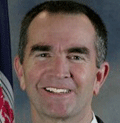
Lieutenant Governor Ralph Northam
Northam, a pediatric neurologist from Norfolk who has spent a decade in state politics, had the backing of most of Virginia’s Democratic political establishment and appeared to be cruising to an easy nomination until Perriello jumped into the race in January.
Perriello’s campaign was endorsed by 2016 presidential candidate U.S. Senator Bernie Sanders and U.S. Senator Elizabeth Warren of Massachusetts, along with a slew of former officials from Barack Obama’s administration, in which Perriello served after losing his House seat in 2010.
While Obama did not offer an endorsement, Perriello frequently reminded voters of his connection to the former president. But in the end, Perriello’s insurgent passion could not overcome Northam’s organizational and fundraising advantages.

Ed Gillespie
The Republican race also featured an outsider-versus-insider narrative, with Stewart wrapping himself in the mantle of Trump and vowing to “take back Virginia from the establishment” — a not-so-veiled shot at Gillespie, who served as a White House aide under President George W. Bush before leading the RNC.
One curious feature of the campaign was the decision by Stewart — an native of Minnesota — to publicly decry efforts to remove Confederate monuments from public spaces, which have sparked controversy in Charlottesville and other cities in the South.
The governor’s race in the Old Dominion is one of only two being held this year; the other is in New Jersey. Democratic Governor Terry McAuliffe is barred from seeking re-election.
Once reliably Republican, Virginia is the only Southern state that Hillary Clinton carried in 2016, and it has now gone to the GOP in three successive presidential elections.
Three of the commonwealth’s last four governors have been Democrats, and it is is among just three of the 14 Southern states with a Democratic chief executive, the others being West Virginia and Louisiana.
Primaries for Virginia governor echo 2016 presidential race
Establishment-versus-insurgent contests featured on both GOP and Democratic ballots
♦By Rich Shumate, ChickenFriedPolitics.com editor
RICHMOND (CFP) — The calendar may read 2017, and the names on the ballot may not be the same, but voters in Virginia can be forgiven if the commonwealth’s primaries for governor seem vaguely reminiscent of last year’s presidential contest.
On the Republican side, a party stalwart and former aide in the George W. Bush White House is running against Donald Trump’s one-time Virginia campaign director. On the Democratic side, a Bernie Sanders-backed candidate is offering a stiff challenge to a veteran officeholder who was considered to be a shoo-in just six months ago.
As voters prepare to go to the polls June 13, polls show that many voters in both races are undecided, providing a level of uncertainty and suspense in the South’s only governor’s race this year.
Polls will be open from 6 a.m. to 7 p.m.
Lieutenant Governor Ralph Northam
On the Democratic side, Lieutenant Governor Ralph Northam appeared to be cruising to his party’s nomination unmolested until January, when former U.S. Rep. Tom Perriello jumped into the race and began casting himself as the anti-establishment alternative, in contrast to the well-connected Northam.
Northam has the backing of Democratic Governor Terry McAuliffe, who is barred by Virginia law from running for re-election, along with both of the commonwealth’s U.S. Senators, Mark Warner and Tim Kaine.

Former U.S. Rep. Tom Perriello, D-Virginia
Perriello has countered with endorsements from Sanders, U.S. Senator Elizabeth Warren of Massachusetts and a slew of former officials from Barack Obama’s administration, in which Perriello served. And while Obama has not offered an endorsement, Perriello has been reminding voters of his connection to the former president every chance he gets.
Polls have shown a close race, although the large numbers of undecided voters means there is no clear leader heading into election day.
Ed Gillespie
On the Republican side, Ed Gillespie, a former Republican National Committee chairman and Bush aide who ran a surprisingly strong race for U.S. Senate in 2014, has held a lead in the polls over his two challengers, Corey Stewart, chairman of the Prince William County Board of Supervisors, and State Senator Frank Wagner, from Virginia Beach, a former U.S. Navy officer who has served in the the state legislature for 25 years.
Because Virginia does not have primary runoffs, Gillespie only has to win a plurality to advance to the general election.

GOP candidate Corey Stewart
Stewart, who was once Trump’s Virginia state chairman, has wrapped himself in the Trump mantle, positioning himself as the man who can “take back Virginia from the establishment,” a not-so-veiled reference to Gillespie.
Stewart lost his job in the Trump campaign in October 2016 after organizing a protest outside of Republican National Committee headquarters demanding that the GOP hierarchy not abandon Trump in the wake of the release of an audiotape in which Trump made sexually suggestive comments. But he still continued to support Trump.
During the campaign, Stewart — an native of Minnesota — has also come out against efforts to remove Confederate monuments, which have sparked controversy in Charlottesville and other cities in the South.
The winners of both primaries will advance to the general election, which is one of only two governor’s races being held this year. The other is in New Jersey.
Once reliably Republican, Virginia is the only Southern state that Hillary Clinton carried in 2016, and it has now gone to the GOP in three successive elections.
Three of the commonwealth’s last four governors have been Democrats — Warner, Kaine and McAuliffe — and Virginia is among just three of 14 Southern states with a Democratic chief executive, the others being West Virginia and Louisiana.
South Carolina U.S. Rep. Trey Gowdy picked to head powerful oversight panel
Gowdy will head House Oversight and Government Reform Committee
♦By Rich Shumate, ChickenFriedPolitics.com editor
 WASHINGTON (CFP) — U.S. Rep. Trey Gowdy, who gained national prominence for his dogged investigation of the 2012 terrorist attack in Benghazi, Libya, has been selected to be the new chair of the House committee charged with investigating the executive branch.

U.S. Rep. Trey Gowdy, R-South Carolina
Gowdy was selected June 8 by the Republican Steering Committee to chair the Oversight and Government Reform Committee, replacing U.S. Rep. Jason Chaffetz of Utah, who is resigning from Congress.
“Oversight is constitutionally authorized and important to ensure branch integrity and equilibrium,” Gowdy said in a statement after his selection. “I look forward to working alongside the other committee members, as well as any member of Congress, as we discharge the jurisdiction assigned to us.”
Gowdy, 52, a former federal and state prosecutor in South Carolina, is in his fourth term representing the state’s 4th District, which includes the Greenville-Spartanburg metro area.
After four Americans died in a terrorist attack on a U.S. diplomatic compound in Benghazi in 2012, Gowdy was appointed by House GOP leaders to head a special committee to investigate the attack.
The primary target of that probe was Hillary Clinton, who was secretary of state at the time of the attack. Gowdy’s investigation eventually led to the disclosure that Clinton had used a private email server, which prompted an FBI investigation and dogged her throughout the 2016 presidential campaign.
After Donald Trump defeated Clinton, House Republicans shut down the Benghazi committee.
U.S. Supreme Court upholds ruling invalidating North Carolina’s congressional map
Decision could affect current challenge in Texas and future GOP efforts to pack black voters into districts
By Rich Shumate, ChickenFriedPolitics.com editor
 WASHINGTON (CFP) — The U.S. Supreme Court has upheld a lower court ruling striking down the congressional map approved by North Carolina lawmakers after the 2010 census because it relied too heavily on racial considerations in drawing the new lines.
The May 22 ruling will have little impact in North Carolina because lines were already redrawn after the state lost the case in the lower court. But in the long term, it could limit the ability of Republican majorities in Southern statehouses to pack black voters into a small number of districts, thereby maximizing the number of safe GOP seats.
It could also have an impact on pending litigation in Texas, where the U.S. House map is being challenged by Latino and Democratic groups over alleged racial gerrymandering.
After the high court’s ruling, a federal judge in San Antonio overseeing the case asked Texas’s lawyers to consider whether legislators might “voluntarily” meet in special session to consider changes to the state’s map. There was no immediate response from state leaders.
The case in North Carolina was the high court’s latest attempt to resolve the tension between the 14th Amendment, which forbids using race as the primary consideration in drawing political lines, and the Voting Rights Act, which requires legislators in most Southern states to maximize the potential of minority voters to elect candidates of their choice.
At issue were the 1st and 12th districts, which were changed substantially after the 2010 census as part of an effort to make the state’s districts equal in population, as required by earlier Supreme Court rulings.
Under the new lines, the black voting age population in the 1st District rose from 48.6 percent to 52.7 percent, largely by adding majority-black areas of Durham into the district. The black voting age population in the 12th District also rose from 43.8 percent to 50.7 percent, which was done by replacing existing white voters with black voters not previously in the district.
The state had defended the changes by arguing they were made to comply with the Voting Rights Act. But the Supreme Court’s majority opinion, authored by Justice Elena Kagan, rejected that argument, noting that both seats had already been represented by African-American Democrats without the addition of more black voters.
Kagan wrote that the Voting Rights Act “gave North Carolina no good reason to reshuffle voters because of their race.”
Kagan was joined in the opinion by her fellow liberal justices, Ruth Bader Ginsburg, Sonia Sotomayor and Stephen Breyer, along with conservative Clarence Thomas, the only African-American on the court.
Three other conservatives justices — Samuel Alito, John Roberts and Anthony Kennedy — agreed with the majority that the 1st District had been impermissibly drawn but disagreed about the validity of the 12th District. The court’s newest justice, Neil Gorsuch, did not take part in the case.
After losing the case at U.S. District court, North Carolina’s legislature redrew the state’s entire map, which was used in the 2016 elections. African-American incumbents in the 1st and 12th districts — G.K. Butterfield and Alma Adams — both won, although Adams was forced to move to Charlotte and run in new territory after her home in Greensboro was drawn out of her previous district.
The new map did not change the political balance in the state’s congressional delegation, which remained at nine Republicans and three Democrats. Its only significant effect was forcing two Republican incumbents — George Holding and Renee Ellmers — to run against each other. Holding won.
Over the last 30 years, as Republicans have taken control of state legislatures across the South, majority black districts created to comply with the Voting Rights Act have sent African-American representatives to Congress, in many cases for the first time since Reconstruction.
However, the packing of black voters into these districts have reduced black voting age populations in surrounding districts, making them more Republican. One result has been that white Democrats, who were once the mainstay of Southern congressional delegations, have all but disappeared.
Only six Southern states — Florida, Texas, Tennessee, North Carolina, Kentucky and Virginia — are currently represented by any white Democrats. And out of 40 Southern Democratic representatives in Congress, only 15 are non-Latino whites, compared with 20 African Americans and five Latinos.
Out of 109 Republicans representing the region, 105 are white, three are Latino and just one, U.S. Rep. Will Hurd of Texas, is African-American.
Texas, where the congressional map is currently being challenged, presents a particular wrinkle in application of the Voting Rights Act because it contains large concentrations of both African-American and Latino voters.
While black voters tend to be strong, partisan Democrats, Latino voters are somewhat less so, which makes it difficult to advance the argument that lines are being drawn for political reasons, which is legal, rather than for racial considerations, which is not.
U.S. Rep. Mo Brooks jumps into Alabama’s U.S. Senate race
Four-term congressman says he offers “proven conservative leadership”
♦By Rich Shumate, ChickenFriedPolitics.com
 HUNSVILLE, Alabama (CFP) — Republican U.S. Rep. Mo Brooks has announced he will run in a special election to fill Alabama’s open U.S. Senate seat, adding a high-profile name to a crowded field trying to unseat the temporary incumbent, U.S. Senator Luther Strange.
 Announcing his candidacy in a series of events across the state on May 15, including in his hometown of Huntsville, Brooks touted himself as “the only candidate for the Senate who has a proven record of conservative leadership,” citing a list of accolades from business and conservative groups for his work in Washington.
“The solutions to America’s challenges are there. The roadblock to these solutions is all too often the U.S. Senate,” Brooks said. “We must elect senators with the understanding and backbone needed to face and defeat America’s challenges.”
Since 2011, Brooks, 63 has represented Alabama’s 5th District, which is anchored in Huntsville and takes in five counties in the northern part of the state along the Tennessee border.
During his announcement speech Brooks–who pointedly refused to endorse Donald Trump in last year’s presidential race–did not mention the president, a contrast with other candidates in the race who have embraced him.

U.S. Senator Luther Strange
Strange was appointed to the Senate seat in February by former Governor Robert Bentley after Jeff Sessions left to become U.S. attorney general. Although state law mandates that Senate vacancies be filled “forthwith,” Bentley delayed a special election until November 2018, giving Strange nearly two years of incumbency before he had to face voters.
But after a sex scandal forced Bentley from office, new Alabama Governor Kay Ivey reversed course and ordered a special election this year, which opened the floodgates for candidates eager to send Strange back home.
Brooks is the eighth Republican in the race, along with Roy Moore, the controversial favorite of the Christian right twice elected and twice ousted as Alabama’s chief justice; State Rep. Ed Henry, R-Hartselle, who launched the effort to impeach Bentley, and Randy Brinson, president of the Christian Coalition of Alabama.
Also expected to run is the top Republican in the Alabama Senate, Del Marsh from Anniston.
Two Democrats are also running, although any Democrat would be considered a longshot in a state where the party hasn’t won a Senate seat since 1992.
Party primaries are scheduled for August, with a runoff to follow if no candidate gets a majority. The general election is in December.
 Chicken Fried Politics