
Home » 2017 (Page 8)
Yearly Archives: 2017

Former U.S. Rep. Corrine Brown found guilty on fraud charges
Jurors decide former Jacksonville congresswoman looted scholarship charity
♦By Rich Shumate, Chickenfriedpolitics.com editor
 JACKSONVILLE, Florida (CFP) — Corrine Brown, an icon in North Florida’s African-American community who served 24 years in Congress, is likely headed to prison after being convicted of looting a fraudulent scholarship charity to pay personal expenses.

Former U.S. Rep. Corrine Brown. D-Florida
Brown was found guilty May 11 on 18 of the 22 charges against her, including conspiracy, wire and mail fraud and filing false tax returns. No sentencing date has been set, but, given the number and magnitude of the charges, the 70-year-old former Democratic congresswoman could potentially spend much of the rest of her life behind bars.
Brown made no comment as she left the federal courthouse in downtown Jacksonville, the funding for which, as she often noted, she was instrumental in pushing through Congress.
In a statement released later by her lawyer, Brown continued to maintain her innocence and vowed to fight on.
“This fight is not over, and as I’m sure you know, I will continue to fight to clear my name and restore my reputation,” she said.
In a statement, Kenneth Blanco, the acting assistant attorney general, said Brown had “violated the public trust, the honor of her position and the integrity of the American system of government.”
“She shamefully deprived needy children of hundreds of thousands of dollars that could have helped with their education and improved their opportunities for advancement, and she lied to the IRS and the American public about secret cash deposits into her personal bank accounts,” Blanco said.
Prosecutors said Brown and her associates operated a fraudulent private charity that purported to provide scholarships for needy students but instead diverted the money to their personal accounts to pay for luxuries and other expenses. Brown used her political connections to raise money for the charity, which took in more than $800,000 put paid out just $1,200 in scholarships, according to prosecutors.
Brown’s longtime former chief of staff, Ronnie Simmons, and the president of the charity, Carla Wiley, have both pleaded guilty to charges related to the scheme, and Simmons became the star witness against Brown.
Brown took the stand in her own defense, insisting that she did not know that Evans was diverting money from the charity.
The conviction marks a tragic fall for Brown, who in 1992 became part of the first group of African-Americans in Florida’s U.S. House delegation since Reconstruction.
With a political operation built on a flair for publicity and attention to constituent service — her campaign slogan was, “Corrine Delivers” — she was never seriously challenged, despite court-ordered changes in her district and efforts by Republicans to unseat her.
However, in 2015, the Florida Supreme Court dismembered her 5th District, ruling that it was gerrymandered based on racial considerations in violation of state law. Instead of taking in African-American communities in Jacksonville and snaking down the St. Johns River valley to Orlando, the new district heads straight west to Tallahassee, giving Brown a wide swath of unfamiliar territory to defend.
The new lines, coupled with her indictment on fraud charges, led to her primary loss to U.S. Rep. Al Lawson of Tallahassee, ending her 34-year political career.
West Virginia U.S. Rep. Evan Jenkins will challenge Joe Manchin in U.S. Senate race
Jenkins hopes to parlay state’s increasing GOP tilt to unseat venerable Democratic incumbent
♦By Rich Shumate, Chickenfriedpolitics.com editor
 HUNTINGTON, West Virginia (CFP) — In 2014, GOP U.S. Rep. Evan Jenkins toppled a West Virginia political giant to get to Congress. In 2018, he’ll try to be a giant killer again.
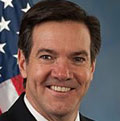
U.S. Rep. Evan Jenkins, R-West Virginia
Jenkins announced that he is giving up his House seat in an effort to defeat Democratic U.S. Senator Joe Manchin, in what is expected to become one of the South’s hottest Senate races.
In a campaign video released May 8, Jenkins went after Machin, accusing him of straying from the values he was elected to represent by supporting Hillary Clinton and Barack Obama.
“Joe changed when he got to Washington. West Virginia values? Not anymore,” Jenkins said. “Somewhere alone the way, Joe became one of them.”
Jenkins also tied himself firmly to Donald Trump, who won the Mountaineer State by a staggering 41 points in 2016, his second strongest showing in any state, behind only Wyoming.
“With Donald Trump in the White House, we’ve got a real chance to turn things around,” Jenkins said. “He needs our help, and I need your help … We can’t let liberal New York millionaires and D.C. lobbyists buy this race or the Senate.”
Jenkins, 56, was elected in 2014 to represent the 3rd District, which takes in the southern and western parts of the state. In that race, he unseated Nick Rahall, a Democrat who had been in Congress since 1977 and was, like Manchin, a political institution in West Virginia.
Jenkins had served 18 years in the state legislature as a Democrat before switching parties to run against Rahall.
West Virginia’s changing political climate has made Machin is a top Republican target in 2018. In 2014, the GOP captured all three U.S. House seats and a majority in the state legislature for the first time since 1931. In 2016, Shelley Moore Capito became the first Republican to win a U.S. Senate election since 1956.
Trump’s win was also the fifth in a row for Republican presidential candidate, in what had been considered a Democratic stronghold into the 1990s.

U.S. Senator Joe Manchin of West Virginia
However, Machin, 69, is a political institution in West Virginia, where he was first elected to political office in 1982 and was governor for six years before being elected to the Senate in 2010.
Manchin has styled himself as a political moderate, opposing legal abortion, supporting a balanced budget amendment and opposing efforts by the Obama administration to curtail use of coal, which is a mainstay of the West Virginia economy. He also broke ranks with other Democratic senators to support Trump’s Cabinet nominees and his selection of Neil Gorsuch for the U.S. Supreme Clourt.
One question mark in the race will be the issue of gun rights. Although Manchin has long received support from the National Rifle Association, he drew fire from some gun rights advocates after co-sponsoring legislation to strengthen background checks on firearms after the Sandy Hook school shooting in Newtown, Connecticut in 2012.
Jenkins took direct aim at Manchin on the gun issue in his opening campaign video, accusing the senator of violating a pledge he made in his first campaign to protect gun rights.
Jenkins’s decision to run against Manchin will open a House seat in West Virginia that could be a potential target for Democrats, although the GOP will be favored.
Jenkins may also have to survive a primary for the right to oppose Manchin, as state Attorney General Patrick Morrisey is thought to be eyeing the race.
5 Southern Republicans break ranks to oppose House Obamacare repeal
But 5 GOP lawmakers in other potential swing districts help pass new health care law
♦By Rich Shumate, Chickenfriedpolitics.com editor
 WASHINGTON (CFP) — Five Republican members of the U.S. House defied party leaders and President Donald Trump to oppose a bill to repeal Obamacare and replace it with a new blueprint for U.S. health care, but five other GOP lawmakers holding potentially vulnerable seats took a different tack and voted to go along with the American Health Care Act.
Two of the Southern GOP no votes on May 4 came from Will Hurd of Texas and Barbara Comstock of Virginia, who both represent districts that Hillary Clinton carried in 2016. A third lawmaker from a district Clinton carried, Ileana Ros-Lehtinen of Florida, also voted no but is retiring in 2018.

Hurd
Hurd, whose district stretches across a wide swath of West Texas, issued a statement after the vote saying the plan pushed by GOP leaders “does not address the concerns of many of my constituents, including adequate protections for those with pre-existing conditions and the challenges faced by rural healthcare providers.”

Comstock
Comstock, whose district is anchored in the Washington, D.C. suburbs, said in a statement that her “goals on healthcare reform are to provide patient-centered reforms that provide better access to high quality, affordable care and cover pre-existing conditions without lifetime limits. ”
“I did not support the AHCA today because (of) the many uncertainties in achieving those goals,” she said.
The other two Republicans who voted against the bill, Thomas Massie of Kentucky and Walter Jones of North Carolina, did so not out of any fear of Democratic competition but because they believe the repeal measure doesn’t go far enough.
“As recently as a year ago, Republicans argued that mandates were unconstitutional, bailouts were immoral and subsidies would bankrupt our country,” Massie said in a statement after the vote. “Today, however, the House voted for a healthcare bill that makes these objectionable measures permanent.”
Jones had earlier said the attempt by House Republican leaders to push an Obamacare bill repeal through the House on a rushed schedule was “shameful,” and he called for scrapping the bill in its entirety and starting over.
Of the 138 Southern Republicans in the House, 133 voted in favor of the AHCA. Five of those members represent districts where Democrats could conceivably use their votes for the new health care law to try to unseat them. In fact, if any one of them had voted no, the bill — which passed by just a single vote — would have failed, which will allow Democrats to make the argument that each of them bears responsibility for its passage.

Curbelo
This group of members who supported the bill includes two of the region’s most vulnerable House Republicans, Carlos Curbelo and Brian Mast, both from Florida. Curbelo represents a district in Miami-Dade and Monroe counties that Clinton carried; Mast’s district, which includes St. Lucie, Martin and northern Palm Beach counties, has changed parties in three of the last four election cycles.

Mast
In a statement, Mast said the GOP health care plan “returns control of health care from Washington back to you and restores access to quality, affordable options that are tailored to your individual needs.” He also pushed back against Democratic criticism that a provision in the new law allowing states to waive mandates for coverage of pre-existing conditions would imperil coverage for the sickest Americans.
“This bill mandates that people cannot be denied coverage because of pre-existing conditions and allocates almost $140 billion in additional funding that will subsidize coverage for people with pre-existing conditions to ensure they costs are low,” Mast said. “Those claiming otherwise are the same people who said ‘if you like your doctor, you can keep you doctor,” and they’re putting partisan politics ahead of the people in our community.”
Also voting yes were John Culberson of Texas, whose metro Houston House district was carried by Clinton; Mario Diaz-Balart, whose majority Latino district in metro Miami and southwest Florida went for Trump by less than 2 points; and Ted Budd of North Carolina, whose Greensboro-area district went for Trump by 9 points.
In a statement, Diaz-Balart conceded the AHCA was “far from perfect.” But he said the House needed to act because Obamacare “is collapsing,” leaving just one insurance provider in two of the three counties he represents.
“Knowing the people I represent could very well lose their coverage … is disturbing,” he said. “It would be irresponsible for Congress not to act in order to prevent this from happening.”
Budd also conceded in a statement that “the legislative process is a human process with all the flaws that entails. The results of that process are never perfect, and this bill isn’t either.”
“What I believe it will do is significantly reduce insurance premiums in our state, and help put the individual insurance marketplace on a more sound financial footing,” he said.
Also voting yes was Pete Sessions of Texas, whose metro Dallas district was also won by Clinton. However, Sessions, who has been in the House since 1997 and won re-election by more than 50 points in 2016, is not considered vulnerable to a Democratic challenge.
All 40 of the Democrats representing districts in the South voted against the AHCA.
GOP primary in South Carolina U.S. House special election heads to a runoff
Winner of Republican contest will face Democrat Archie Parnell in June 20 election for Mick Mulvaney’s former House seat
♦By Rich Shumate, Chickenfriedpolitics.com editor
 YORK, South Carolina (CFP) — State legislators Tommy Pope and Ralph Norman survived a crowded Republican field in the battle for South Carolina’s vacant 5th District U.S. House seat and will now face off in a May 16 runoff, with the winner facing Democrat Archie Parnell on June 20.

Pope

Norman
Pope narrowly edged out Norman in the first round of voting on May 2, with each taking about 30 percent of the vote against five other competitors. Parnell took 71 percent of the vote against two competitors in the Democratic primary, avoiding a runoff.
Given the district’s strong Republican lean, the winner of the GOP runoff will be considered a heavy favorite to capture the seat, which Mick Mulvaney gave up to become director of the Office of Management and Budget in the Trump administration.

Parnell
However, Parnell, who spend 20 years as a managing director at investment giant Goldman Sachs, brings a personal fortune to the race. He also has the endorsement of John Spratt, the Democrat who held this seat for 28 years before being ousted by Mulvaney in the Republican wave of 2010.
The 5th District takes in the north central part of the state, stretching along the I-77 corridor from the suburbs of Charlotte down to near Columbia.
Pope, 54, from York, is best known as the prosecutor in the trial of Susan Smith, who was convicted in 1995 of drowning her two young sons after first claiming they had been carjacked by a black man. He has served in the state House since 2010, rising to the position of speaker pro tempore in 2014.
Norman, 63, is a real estate developer from Rock Hill who served two stints in the state House, first from 2005 to 2007 and then from 2009 until he resigned to run for Mulvaney’s seat. He was the unsuccessful Republican nominee against Spratt in 2006.
Parnell, 66, from Sumter, is a South Carolina native who is currently a senior adviser to Goldman Sachs after working there as a managing director for 20 years. He is also a former tax attorney for ExxonMobil and worked in Washington as senior counsel for a House committee from 1976 to 1980.
Florida U.S. Rep. Ileana Ros-Lehtinen bowing out after three decades in Congress
Her departure opens up a prime opportunity for Democrats to pick up a GOP-held seat
♦By Rich Shumate, Chickenfriedpolitics.com editor
MIAMI (CFP) — U.S. Rep. Ileana Ros-Lehtinen, the dean of Florida’s House delegation, will not seek re-election in 2018 to her 27th District seat in Miami-Dade County, drawing down the curtain on three decades of service that have made her an icon in the state’s politically powerful Cuban-American community.

U.S. Rep. Ileana Ros-Lehtinen, R-Fla.
The decision means Republicans will now have to defend a seat from a district which Donald Trump lost by 20 points in 2016 but which had continued to return Ros-Lehtinen to office term after term.
“It’s a great job. But there comes a time when you say, you know, even though this is a wonderful life, and even though I’m doing what I love to do, there’s so many other wonderful things,” she said at a May 1 news conference announcing her retirement.
Ros-Lehtinen, a moderate Republican who has found herself at odds with Trump and other members of her own party, also insisted her departure is unrelated to the current political climate in Washington.
“I know it would be a great narrative to say people aren’t civil with each other and that there’s just a lot of infighting,” she said. “But I’ve been there so many years, I don’t recall a time when there hasn’t been infighting.”
“I’m not frustrated by that.”
Ros-Lehtinen, 64, who was born in Cuba and moved to Miami with her parents at the age of 7, won a House seat in a 1989 special election to fill the vacancy created by the death of Claude Pepper, who himself was a political icon in Miami. She became the first Cuban-American ever elected to Congress and the first Republican woman elected to Congress from Florida.
She has faced little opposition since that first election. However, as the Cuban-American community in Miami has become less monolithically Republican in the last 20 years and district lines have been been altered, the GOP has held on to the district largely because of Ros-Lehtinen’s popularity.
Still, in 2016, she won by just 10 points, as Hillary Clinton was pasting Trump in her district. Democrats were expected to try to contest the seat in 2018, although Ros-Lehtinen expressed confidence that she would have won if she had she run again.
Ros-Lehtinen has left signficant daylight between herself and Trump, refusing to endorse him and opposing both his plans to repeal and replace Obamacare and build a wall along the U.S.-Mexico border. As the mother of a transgender son, she has also been a champion for LGBT equality in Congress.
The 27th is one of just six Southern House seats held by Republicans that Clinton carried, and her margin there was the largest win in any GOP-held district in the country. Ros-Lehtinen’s departure means Democrats will have an opportunity to pick up the seat.
The race to replace Ros-Lehtinen will be a wide open affair, likely drawing a number of Cuban-American politicians from both parties into the mix. Among the Republicans being mentioned is Lieutenant Governor Carlos López-Cantera, who has run statewide and is closely allied with the state’s two top Republicans, Governor Rick Scott, and U.S. Senator Marco Rubio.
Several state legislators are also eyeing the race, which may mean that the field won’t begin to fill out until the legislature adjourns later in May.
 Chicken Fried Politics