
Home » 2018 (Page 16)
Yearly Archives: 2018

Georgia governor’s debate: Candidates clash over allegations of voter suppression
Kemp insists he is “absolutely not” trying to keep down the minority vote; Abrams says voters are “scared”
♦By Rich Shumate, ChickenFriedPolitics.com editor
 ATLANTA (CFP) — The charge that Georgia’s Republican Secretary of State Brian Kemp has been deliberately disenfranchising minority voters to gain an edge for his campaign for governor took center stage at a debate where he faced off with his Democratic challenger, Stacey Abrams.
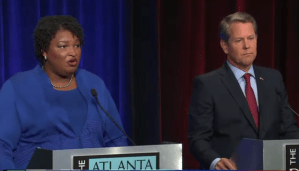
Abrams and Kemp square off in first debate (Courtesy GPB)
In their first face-to-face encounter, aired October 23 by Georgia Public Broadcasting, Kemp insisted that he has “absolutely not” been targeting voters based on race, a charge made by Abrams and other voting rights advocates amid news reports that more than 50,000 voter registrations are being held in Kemp’s office because of paperwork errors.
But Abrams said Kemp’s office, by systematically removing voters from the registration rolls and holding up new registrations, has created a climate of fear for potential voters.
“They’ve been purged, they’ve been suppressed, they’ve been scared,” she said. “Voting suppression is not only about blocking the vote. It’s about creating an atmosphere of fear, making people worry that their votes won’t count.
Kemp insisted that all of the voters with registrations pending will still be allowed to vote and called allegations of voter suppression “a distraction to take away from Ms. Abrams’s extreme agenda.”
He also charged that Abrams has been encouraging illegal immigrants to come out and vote for her, an allegation she denied.
“I only believe that those who have a legal eligibility to vote should cast a ballot,” she said.
Kemp, who oversees elections as secretary of state, also said that he would not recuse himself if the governor’s race ends in a recount because recounts are primarily the responsibility of county officials, not his office.
“I took an oath of office to serve as secretary of state, and that’s exactly what I’m going to continue to do,” he said
While the candidates had expected disagreements on immigration and expanding Medicare, the debate, sponsored by the Atlanta Press Club, began with a question about an incident from Abrams’s past that rocketed through cyberspace on the day for the debate – her participation in a 1992 protest where the Georgia state flag, which then featured the Confederate battle ensign, was set on fire.
“Twenty-six years ago, as a college freshman, I along with many other Georgians, including the governor of Georgia, were deeply disturbed by the racial divisiveness that was embedded in the state flag with that Confederate symbol,” she said.
“I took an action of peaceful protest. I said that that was wrong, and 10 years later, my opponent, Brian Kemp actually voted to remove that symbol (as a state senator).”
Although the flag burning issue has been gathering widespread attention, neither Kemp nor Libertarian nominee, Ted Metz, brought it up again during the rest of the debate. The Confederate emblem was removed from the state flag in 2001.
In her campaign, Abrams has been calling for expanding Medicaid under Obamacare, an idea that has been blocked by Republicans in the Georgia Legislature. In the debate, she touted Medicaid expansion as a way to spur economic development in rural areas.
“Rural Georgia has been losing hospitals at an alarming rate, and because of that loss we have companies leaving, we have people without access to health care, we’re not doing the kind of economic development work we can do,” she said, adding that expanding Medicaid would bring $3 billion in federal money to the state and create 56,000 jobs.
But Kemp, who opposes Medicaid expansion, said that “expanding a broken government program is no answer to solving the problem.”
He also pointed to a book Abrams wrote in which she called for a single-payer government health plan financed by tax increases and cuts in Medicaid and Medicare, an idea he called “radical.”
“Abrams’s plan will make your current insurance plan illegal. It will not allow you to choose your doctor, and she’s going to raise your taxes to pay for it,” he said. “And if you’re on Medicaid or Medicare, this should scare you to death.”
Kemp also criticized Abrams for wanting to extend the state’s HOPE scholarship program for high school students to Georgia graduates who were brought into the country illegally as children, commonly known as Dreamers. He said he also opposes allowing them to attend state colleges.
“I’ve been running my whole campaign on putting Georgians first. I think we need to continue to do that,” he said. “I think we need to continue to fight for our own people, our own state.”
But Abrams said, “I stand by believing that every Georgian who graduates from our high schools should be allowed to attend our colleges, and if they’re eligible, receive the HOPE scholarship.”
Abrams, 44, is an Atlanta attorney and former Democratic minority leader in the Georgia House of Representatives. Kemp is a former state senator from Athens who has served two terms as secretary of state.
They are scheduled to meet for a second and final debate on November 4, the Sunday before the November 6 election.
With polls showing a close race and Metz on the ballot, the governor’s race in the Peach State could be headed to a runoff.
Georgia is the only state that requires a general election winner to capture a majority of the vote. If neither Abrams or Kemp win a majority, a runoff between them will be held December 4.
In the last open race for governor, in 2010, the Libertarian nominee got 4 percent of the vote
General election runoffs, while rare, have proven to have unpredictable results. In 1992, Republican Paul Coverdell ousted Democratic U.S. Senator Wyche Fowler in a runoff, even though Fowler had come out slightly ahead in the initial vote.
We tweet @ChkFriPolitics Join us!
Florida governor’s debate: Gillum, DeSantis joust over Trump, racism and corruption
Gillum calls Trump “weak,” accuses DeSantis of injecting race into the campaign
♦By Rich Shumate, ChickenFriedPolitics.com editor
 TAMPA (CFP) — Meeting in their first face-to-face debate, Democrat Andrew Gillum and Republican Ron DeSantis disagreed as expected on hot-button issues such as immigration and taxes — but they threw their sharpest elbows over charges of racism and very divergent views of President Donald Trump.
In the October 21 debate in Tampa, televised nationally by CNN, Gillum, who is African American, accused DeSantis of trying to make his race an issue in the campaign, beginning with a comment on the day after he won the Republican nomination that Floridians shouldn’t “monkey up” their future prospects by electing Gillum.

Gillum and DeSantis meet for first debate in Tampa (Courtesy CNN)
“The congressman let us know exactly where he was going to take this race the day after he won the nomination. The ‘monkey up’ comment said it all. And he has only continued in the course of his campaign to draw all the attention he can to the color of my skin,” Gillum said.
“And the truth is, you know it, I’m black. I’ve been black all of my life. So far as I know, I will die black.”
If elected, Gillum would become Florida’s first African American governor.
But DeSantis insisted that his public record, including his service in the military and as a Navy prosecutor, demonstrated racial tolerance.
“Floridians can know that I’ll be a governor for all Floridians,” he said.
When it came to Trump, DeSantis — one of the president’s staunchest allies in Congress whose campaign benefited in the GOP primary from a Trump tweet — noted that Gillum has said publicly that he would support Trump’s impeachment, which would hinder his ability to get things done in Washington as governor.
“Andrew wants to lead the Trump impeachment from Tallahassee,” DeSantis said. “You need to be able to work with the administration to get the dollars we deserve … I think I will be better positioned to advance Florida’s priorities because I have a productive relationship with the administration.”
At that, Gillum doubled down on his biting criticism of Trump, who carried Florida in 2016.
“Donald Trump is weak, and he performs as all weak people do – they become bullies. And Mr. DeSantis is his acolyte. He’s trying out to be the Trump apprentice at every turn,” Gillum said.
“You shouldn’t have to kiss the ring of the president of the United States for the president to see to the good and the goodwill of the third-largest state in all of America.”
DeSantis, 40, served six years in the U.S. House representing a Jacksonville-area district. Gillum, 39, has been mayor of Tallahassee since 2014.
DeSantis took Gillum to task for his stewardship of Florida’s capital city, noting that it has an historically high murder rate. He also tried to associate the mayor with an ongoing FBI investigation into corruption that has ensnared a Gillum associate.
“Andrew’s a failed mayor. He’s presided over a crime-ridden city. He’s involved in corruption,” DeSantis said. “He’s not the guy to lead our state.”
But Gillum insisted that overall crime has actually dropped in Tallahassee and that neither he nor his administration are under investigation by the FBI.
DeSantis responded, “You went to a Broadway show with an undercover FBI agent,” a reference to a photograph that has emerged of a trip Gillum took to New York with an FBI agent who was investigating the corruption case.
When DeSantis repeatedly pressed Gillum on who had paid for tickets to the Broadway play “Hamilton,” the mayor did not answer. Instead, he tried to turn the tables by asking DeSantis to produce receipts for his travel as a congressman, which Gillum said about to become subject of an ethics investigation before DeSantis resigned in August.
“That’s a lie,” DeSantis said.
DeSantis also hit Gillum for wanting to raise taxes, pointing to his support for higher sales and property taxes as mayor. He also insisted that Gillum’s plans for expanding state spending would lead to a sharp increase in the state sales taxes or perhaps even imposition of an income tax.
“Andrew has a lifetime of supporting higher taxes,” DeSantis said. “If you believe with that record that he ain’t gonna raise your taxes, then I’ve got some ocean front property in Arizona that I’d like to sell you.”
Gillum quickly shot down any suggestion of an income tax, which would be politically explosive in the Sunshine State. He said his plan is to increase taxes on the wealthiest 3 percent of Florida businesses, who he charged had reaped a $5 billion windfall from the Republican tax cut plan that DeSantis supported in Congress.
“We’re going to take a billion of that and invest in public education in this state,” Gillum said.
The candidates also disagreed sharply on immigration, with DeSantis charging that Gillum and Democrats supported open borders, abolishing Immigration and Customers Enforcement and turning Florida into a sanctuary state, which DeSantis said would be “a wet kiss to the drug cartels.”
“Andrew during the primary said he wanted to abolish ICE, said he would not cooperate with the Trump administration vis-à-vis illegal immigration,” DeSantis said. “That means you’re going to have more crime in Florida.”
Gillum denied that he was for open borders and said he supported enforcement of immigration laws. But he took issue with the Trump adminsitration’s hard-line stance on immigration enforcement.
“What I’ve simply said is that what we’re not going to become here in the state of Florida is a state where basically become a show-us-your-papers state based on the color of somebody’s skin, the language that they speak, what neighborhood they live in,” he said. “That’s not the American way. That’s not who we are as Floridians.”
Gillum also criticized the Trump administration’s policy of separating migrant children from their parents at the U.S.-Mexico border, saying “we should not be terrorizing people who are here in this country who are babies that are nursing with their parents, with their mothers.”
Despite campaigning for the same office for nearly a year, Gillum and DeSantis had not actually met until just before the debate.
They are scheduled to meet for a second and final debate on October 24 in Davie.
We tweet @ChkFriPolitics Join us!
Watch full debate:
Insight: Donna Shalala poised to follow Hillary playbook and lose an unloseable race
Lack of Latino connection, combined with 2018’s worst political gaffe, could keep Florida’s 27th District in GOP hands
♦By Rich Shumate, ChickenFriedPolitics.com editor
MIAMI (CFP) — Miami Democrats may be about to learn that hard way that even in a race where the odds seem decidedly in your favor, your candidate and her campaign matter. A lot.

ChickenFriedPolitics.com editor Rich Shumate
On paper, Florida’s 27th U.S. House District should have been an easy layup for Democrats. Ileana Ros-Lehtinen, a fixture in Cuban-American politics for more than three decades, was retiring. Hillary Clinton carried the district by 20 points, giving the 27th the distinction of being the location of Donald Trump’s worst loss in a Republican-held congressional district anywhere in the country. And younger Cuban voters have been showing less fealty to the GOP in recent election than did their ferociously anti-communist elders.
Yet, despite all that, when the smoke clears on November 6, there is a very good chance that the new congresswoman from the 27th District will be a Republican, and a race Democrats thought they couldn’t lose will be lost.
So what happened? Donna Shalala happened.
After months of ambitious Miami-Dade Democrats plotting and jockeying for position in what was assumed to be a wide-open race for a sure seat in Congress, Shalala big-footed her way into the contest in March, deciding to enter elective politics at age 77 after a career spent in academia and eight years as Bill Clinton’s health secretary and two years as head of his foundation.
She instantly became the “big name” in the race and the favorite. Three Democratic rivals withdrew; another switched to a congressional race in another district.
Among the candidates who withdrew was popular State Senator José Javier Rodríguez, and his departure left Democrats with a handicap that has since turned into an albatross — he had been the only Latino Democrat running in a district in which seven out of 10 residents, and nearly six in 10 voters, are Latino.
In the end, the Democratic primary in August came down to a race between Shalala and State Rep. David Richardson, the first openly gay man to serve in the Florida legislature. She won, but with only 31 percent of the vote against a field of four rivals.
Meanwhile, in the Republican primary, Maria Elvira Salazar — running against eight rivals — was taking 40 percent of the vote, and her total vote was nearly 1,700 more than Shalala’s total, even though more people had voted in the Democratic primary than the Republican primary.
Salazar is no Trump-loving ideologue. As a journalist for 35 years, she has pushed back against the president’s characterization of the news media as the enemy of the people, and she is for immigration reform and a pathway to citizenship for Dreamers and against separating migrant families at the U.S.-Mexico border.
And perhaps more significantly, Salazar has three qualities Shalala can’t match: She’s a Latina. She speaks Spanish. And she has deep roots in Miami, where she was born and has been in the living rooms of her Latino constituents as an anchor and reporter on Spanish-language television.
Shalala’s inability to speak Spanish has given Salazar the advantage of being able to speak to Latino constituents in the district in their own language. And while someone entering a race in March probably can’t be expected to be fluent in October, those constituents probably found it telling that Shalala has lived in a bilingual city for 17 years, and served as president of its namesake university, without bothering to enough Spanish to give a simple speech. (Even George W. Bush speaks enough Spanish to make do in a pinch.)
More inexplicable was the decision by Shalala’s campaign not to begin running Spanish language ads until mid-October, an egregious oversight in a district where Spanish is ubiquitous.
And then, the campaign invited Democratic U.S. Rep. Barbara Lee appear at an event with Shalala and House Minority Leader Nancy Pelosi.
The same Barbara Lee who said, after Cuban dictator Fidel Castro died, “we need to stop and pause and mourn his loss.” The same Barbara Lee who wrote lobbied against placing sanctions on the socialist dictatorship in Venezuela, many of whose victims have sought refuge in Miami.
Shalala’s campaign managed to extricate themselves from Lee actually appearing, but the damage was already done. When Pelosi and Shalala arrived at a Miami restaurant for the October 18 event, they were greeted by protestors calling them “communists” and “witches” — and much worse that isn’t printable here.
After news broke of Lee’s aborted visit, Salazar and Shalala met in a Spanish-language debate, where Shalala had to rely on an interpreter for the particulars of a rather vigorous denunciation from her Republican rival — a scene that summed up all that has gone wrong for Democrats in the 27th District.
There is a curious echo here: A woman with an impeccable resume handed a Democratic nomination on the basis of her presumed invincibility, only to see it turn to ashes thanks to personal deficiency and questionable strategy.
After 2016, Democrats waxed wistful of the might-have-beens if Vice President Joe Biden or another big name Democrat had challenged Hillary Clinton for the nomination in 2016. If Shalala loses, we will see the same wistfulness for a different outcome with Rodríguez, or even Richardson who, although not Latino, has won election twice to a majority-Latino Florida House seat.
Perhaps Shalala will squeak through in the end. If so, she’ll have some serious fences to mend, not to mention a new language to learn.
But if she loses, Miami Democrats will have created a new Republican political star who will be exceedingly difficult to dislodge.
Your candidate and her campaign matter. A lot.
We tweet @ChkFriPolitics Join us!
Texas U.S. Senate debate: Cruz, O’Rourke clash on immigration, energy policy, taxes and Trump
Final face-off comes with President Donald Trump poised to head to Texas to campaign for Cruz
♦By Rich Shumate, ChickenFriedPolitics.com editor
Watch full debate on Twitter
 SAN ANTONIO (CFP) — Meeting to face-to-face for the second and likely last time, Republican U.S. Senator Ted Cruz and his Democratic challenger, U.S. Rep. Beto O’Rourke, sparred over immigration and border security, energy, health care, abortion, tax cuts and, no surprise, President Donald Trump, who is about to bring his rally roadshow to Texas on Cruz’s behalf.

O’Rourke and Cruz meet in Oct. 16 debate (Courtesy KENS)
Throughout the October 16 debate in San Antonio, Cruz painted O’Rourke as an extremist beholden to “left-wing national activists” who supports “socialized medicine” and whose views are out of step with most conservative Texans.
O’Rourke, in turn, accused Cruz of being “all talk and no action” and more interested in his national political ambitions and the welfare of corporate interests than representing the people of his state in the Senate.
The sharpest exchanges came when Cruz charged that O’Rourke supported a plan to impose a $10-a-barrel tax on oil, which he said would negatively impact the state’s oil and gas industry, and the congressman insisted that the senator was mischaracterizing his record.
“This is what you can expect over the course of this debate. Senator Cruz is not going to be honest with you,” O’Rourke said. “He’s going to make up positions and votes that I’ve never held or have never taken. He’s dishonest. It’s why the president called him ‘Lyin’ Ted,’ and it’s why the nickname stuck, because it’s true.”
Cruz fired back, saying “it’s clear Congressman O’Rourke’s pollsters have told him to come out on the attack.”
“If he wants to insult me and call me a liar, that’s fine. But John Adams famously said that facts are stubborn things,” said Cruz, who added that he would ”post proof of O’Rourke’s oil tax vote on his website. The explanation on Cruz’s website states that O’Rourke refused to support a resolution opposing President Barack Obama’s proposal for increasing the tax on oil.
Cruz also said O’Rourke, if elected, would push for Trump’s impeachment, which would lead to “two years of a partisan circus shutting down the federal government in a witch hunt on the president.”
O’Rourke retorted that it was “really interesting to hear you talk about a partisan circus after your last six years in the United States Senate.”
Cruz also touted his work on the tax cut bill recently passed by Congress, saying it had brought marked improvement to the Lone Star State’s economy.
“Texas is booming. We’ve got the lowest unemployment we’ve had in 49 years,” he said. “We’re seeing record growth.”
But O’Rourke, who opposed the tax cut plan, said it would add $2 trillion to the deficit. He said he supported a partial raise in the corporate tax rate, which could be used to improve universal access to health care through expanded access Medicare and Medicaid.
Cruz dismissed O’Rourke’s health care plan as “socialized medicine” and said income tax rates would have to be tripled to pay for it. He also noted his consistent support for repeal of Obamacare, although he pushed back when O’Rourke charged that he wanted to take away coverage for patients with pre-existing conditions mandated in the current health care law.
On abortion, Cruz said O’Rourke was on “extreme pro-abortion side” by not supporting restrictions on late-term abortions and supporting taxpayer funding of abortions through Medicaid. He also said the congressman would push for confirmation of “left-wing judicial activists who impose their own policy positions from the bench” on issues such as abortion and gun control.
O’Rourke did not back away from his support for legal abortion, telling the debate audience that would only vote to confirm Supreme Court justices who will support a woman’s right “to make her own decisions about her own body.”
The candidates also differed on Trump’s proposed physical border wall on the U.S-Mexico border, with Cruz in support and O’Rourke in opposition.
“No wall is going to solve legitimate security concerns,” O’Rourke said, calling for increased spending on customs infrastructure to improve the flow of goods and people across the border.
Cruz responded that O’Rourke “not only opposes a wall … he wants to tear down the ones we have.”
The candidates’ second encounter in San Antonio is the last scheduled debate between them before the November 6 election.
Cruz, 47, was elected to the Senate in 2012 on his first try for political office. In 2016, he made an unsuccessful run for the Republican presidential nomination, carrying 12 primaries and caucuses and finishing second in the delegate count behind Trump.
O’Rouke, 45, has represented metro El Paso in the House since 2013, after serving on the El Paso City Council. Although he is Irish and his given first name is Robert, he was nicknamed “Beto” — a Spanish nickname for Robert — from childhood.
His campaign has excited the Democratic base, drawing large crowds and media attention in a state that hasn’t seen a competitive Senate race in 30 years.
O’Rourke has also raised a staggering $51 million for the race, including $38 million in the last quarter, which set an all-time quarterly record for fundraising by a Senate candidate. Cruz has so far raised $35 million for the entire race.
Still, the odds against a Democrat in Texas are daunting. A Democrat has not won a Senate race since 1988; Republicans have won the last nine Senate races by an average margin of 19 percent.
The last five public polls in the race have shown Cruz with a lead, but none of those leads have been outside the poll’s margin of error, which indicates that the race is still too close to definitively say either man has a lead.
Despite an often contentious relationship between Cruz and Trump during the 2016 presidential race, the White House has announced that the president will travel to Houston on October 22 for a campaign rally with the senator.
We tweet @ChkFriPolitics Join us!
President Donald Trump stumps for U.S. Rep. Andy Barr in Kentucky
President calls Barr’s opponent in 6th U.S. House District an “extreme liberal” chosen by “Democrat mob”
♦By Rich Shumate, ChickenFriedPolitics.com editor
 RICHMOND, Kentucky (CFP) — President Donald Trump traveled to central Kentucky to excite his followers with a Make America Great Again rally in the commonwealth’s 6th U.S. House District, where Republican U.S. Rep. Andy Barr is in a political dogfight with his Democratic challenger, political newcomer Amy McGrath.
At an October 13 rally at Eastern Kentucky University in Richmond, Trump said re-electing Barr “could make the difference between unbelievable continued success and frankly failure where we fight for two more years with these people, with these obstructionists.”
He also blasted McGrath as an “extreme liberal” who was “chosen by Nancy Pelosi, Maxine Waters — that’s a real beauty — and the radical Democrat mob.”
“Amy supports a socialist takeover of your health care,” he said. “She supports open borders. She needs the tax hikes to cover the through-the-roof garbage that you want no part of.”
For his part, Barr lauded the president, calling him “a man of action.”
“Other people resist, but this president gets results,” he said. “Mr. President, I’m with you to fight for the American people.”
In addition to Barr, the Richmond rally drew all three of Kentucky’s top elected Republicans, U.S. Senators Mitch McConnell and Rand Paul and Governor Matt Bevin, who faces what is likely to be a touch battle for re-election in 2019.
In response to Trump’s characterizations of her, McGrath released a one-sentence statement to the media: “Mr. President, you clearly don’t know me. Yet.”
According to McGrath’s website, she supports reforms of the existing Affordable Care Act, commonly known as Obamacare, rather than its repeal, which Barr has voted for. She also supports the so-called “public option,” a government-run health insurance agency to provide an option for people who cannot get access through the ACA.
McGrath opposes Trump’s plan to build a physical wall at the U.S.-Mexico border, which Barr also supports, and has also criticized the administration’s policy of separating migrant children from their parents.
A day before Trump came to Richmond, former Vice President Joe Biden came to the district to campaign with McGrath.
McGrath, 43, who grew up in the Cincinnati suburbs of Northern Kentucky, is a retired Marine fighter pilot making her first bid for the political office against Barr in the 6th District, which includes Lexington, Frankfort, Richmond and adjacent portions of the Kentucky Bluegrass.
Barr, 45, has represented the 6th District since 2012. Prior to being elected to Congress, he was an attorney in Lexington.
McGrath has raised more than $3 million for the campaign, more than any other Democratic challenger in the South in 2018.
The race is rated as a toss-up by political analysts, although public polling has been sparse.
 Chicken Fried Politics