
Home » 2018 (Page 20)
Yearly Archives: 2018

Blow against corruption or power grab? West Virginia House impeaches entire Supreme Court
Senate removal of justices could allow Governor Jim Justice to cement GOP majority on court
♦By Rich Shumate, ChickenFriedPolitics.com editor
 CHALRESTON, West Virginia (CFP) — West Virginia’s Republican-controlled House of Delegates has voted to impeach all four members of the Supreme Court of Appeals over allegations of overspending and mismanagement — a move that could cement GOP control of state’s highest court.
The House approved 11 articles of impeachment against Chief Justice Margaret Workman and Justices Robin Davis, Beth Walker and Allen Loughry on August 13. The Senate will now decide whether to convict and remove the justices from office.
Republicans hold 23 of 34 seats in the Senate, one seat short of the two-thirds majority that would be needed to remove the justices.
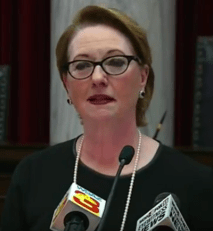
Justice Robin Davis announces her resignation (YouTube)
However, after the impeachment vote, Davis resigned to deprive Republican Governor Jim Justice of the opportunity to appoint a replacement who would sit in her seat without facing election until 2020. She and Democratic leaders blasted the impeachment vote as a partisan power grab.
“The majority members (of the House) have ignored the will of the people who elected the justices of this court,” Davis said at a news conference. “They have erased the line of separation between the branches of government. In fact, the majority in the legislature is positioning to impose their own party preferences.”
Both Workman and Davis said they do not plan to resign and will answer the House’s charges in the Senate
“There is no basis for my impeachment, and I will continue to do the work, both administrative and judicial, that the people of West Virginia elected me to do,” Workman said in a statement. “I look forward to putting all the facts before the Senate in the next phase of this process.”
Republican legislative leaders insisted that removal was warranted over revelations of lavish spending and mismanagement by the justices, which triggered state and federal investigations that have led to criminal charges against two justices.
“After reviewing all the evidence available to us, it became clear that a culture of entitlement and disregard for both the law and taxpayer funds have damaged the reputation of our judicial system – and that all justices had a part in violating the public’s trust,” said Delegate John Shott, R-Mercer, who chairs the House Judiciary Committee, in a statement.
Justice Menis Ketchum resigned in July after agreeing to plead guilty to one court of mail fraud for misusing a state-owned vehicle. Loughry, who has been suspended from the bench, is facing a 22-count federal indictment in addition to charges brought by the state Judicial Investigation Commission.
Workman, Davis and Ketchum were elected to the Supreme Court as Democrats. Loughry was elected as a Republican; Walker, who was elected after the state switched to non-partisan judicial elections in 2016, is also a Republican.
Ketchum’s resignation led to a 2-to-2 partisan split on the court, pending an election this fall to fill the remainder of his term.
However, if the justices were to be impeached, the justices appointed by Justice to fill those positions who would serve until the 2020 elections because, under state law, vacancies that occur less than 85 days before an election aren’t filled until the next general election.
Davis, by resigning, beat that deadline by one day, which means her seat will also be filled in a special election this fall.
If the three remaining impeached justices are removed and replaced by Justice with members of his party, Republicans would hold at least three of the five seats — and could possibly hold them all by winning the elections for the vacant seats in November.
Justice himself was elected governor as a Democrat in 2016, switching to the GOP in August 2017.
The impeachment votes in the House against Workman, Davis and Walker were along partisan lines, although some Democrats crossed the aisle to support impeaching Loughry.
The Senate is not currently in session, and Senate leaders have not announced a plan for how to proceed with the justices’ impeachment trial.
A flip toward Republicans on the Supreme Court would be the latest bad news for West Virginia Democrats, who have seen their once tight grip of state politics unravel.
Democrats controlled the legislature for more than 80 years before losing control to Republicans in 2014 and also dominated the state’s governorship and congressional delegation.
But the Mountaineer State has experienced a pronounced Republican shift in recent years, capped off by Donald Trump’s 40-point win in 2016, his best showing in any state except Wyoming.
The GOP now holds not only the governorship, but also six of seven statewide partisan offices, a U.S. Senate seat and all three U.S. House seats.
In addition to their margin in the Senate, Republicans control the House of Delegates 64 to 36.
Join the conversation! Leave a comment below …
Tennessee Primary: Bill Lee wins GOP nod for governor; Blackburn, Bredesen advance in U.S. Senate race
Freshman Republican U.S. Rep. David Kustoff survives challenge in West Tennessee
By Rich Shumate, ChickenFriedPolitics.com

 NASHVILLE (CNN) — Bill Lee, a cattle rancher making his first bid for political office, came from behind to easily beat two politically connected rivals to capture the Republican nomination for Tennessee governor.
Among the losers was U.S. Rep. Diane Black, who gave up chairmanship of the powerful House Budget Committee to seek the governorship and now finds herself out of politics.
As expected, voters in the August 2 primary also set up what will be a pitched U.S. Senate battle between Republican U.S. Rep. Marsha Blackburn and former Democratic Governor Phil Bredesen, who both easily won their primaries.
Republicans also settled primaries for four GOP-held U.S. House seats, including in West Tennessee’s 8th District, where freshman Republican U.S. Rep. David Kustoff turned back a self-funding challenger after getting an endorsement from President Donald Trump.

Gubernatorial nominee Bill Lee, R-Tennessee
In the governor’s race, Lee, 58, a businessman and rancher from Franklin, took 37 percent of the vote to 24 percent for Randy Boyd, an adviser to outgoing Governor Bill Haslam. Black finished third with 23 percent.
Because Tennessee doesn’t have primary runoffs, Lee won the nomination with a plurality.
“How overwhelming is this?” Lee told jubilant supporters at a victory party in his hometown of Franklin. “I could stand right here and not say anything for a long time.”
Lee started the race a virtual unknown, crisscrossing the state in an RV and telling voters how he was called to public service by the death of his first wife in a horseback riding accident in 2000.
But what may have helped Lee the most were his outsider persona and his decision to refrain from negative attacks on his opponents, even as Black and Boyd both turned their fire on each other and him.
“I’m a man who is not a politician, but I do have a vision for Tennessee to lead this nation,” Lee said. “Thank you for choosing leadership over politics.”

Former Nashville Mayor Karl Dean
In the fall, Lee will face former Nashville Mayor Karl Dean, who easily won the Democratic primary.
Black, 67, had once been considered the front-runner in the race but faded as Lee surged from the back of the pack. In the final insult, she lost most of the counties in the 6th District in Middle Tennessee, which she represented in Congress for the last eight years.
Despite Black’s ardent support for Trump and her work getting his tax cuts through Congress, she did not receive a coveted presidential tweet of endorsement, which has buoyed GOP candidates for governor in primaries in Georgia and Florida.
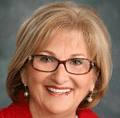
U.S. Rep. Diane Black, R-Tennessee
Giving a concession speech to supporters in Nashville, Black noted that this was the first time she had lost an election in 19 races over a 30-year political career.
“Sometimes God just sets a different course for you than what you set for yourself,” she said.
While the primaries narrowed the Democratic and Republican fields, the fall race for governor will still be a crowded affair, as 26 independents have qualified for the ballot, including 13 Libertarians. Because the Libertarian Party does not have official ballot access, the party has no primary, and all 13 candidates will appear on the ballot as independents.
In the U.S. Senate race, Blackburn took 85 percent in the Republican primary, while Bredesen took 92 percent of the Democratic vote. However, overall, she outpolled him by more than 260,000 votes statewide.
Democrats haven’t won a Senate race in the Volunteer State since 1990, when Al Gore won a second term. But recent polling shows a close race between Blackburn and Bredesen, and outside groups are expected to pour millions in a race that could decide control of the Senate.
The seat is being given up by Republican U.S. Senator Bob Corker, who opted not to seek re-election after become one of Trump’s strongest critics in Congress.

Former Governor Phil Bredesen
Bredesen, 74, served two terms as governor from 2003 to 2011 after serving as mayor of Nashville from 1991 to 1999. A political moderate, he was the last Democrat to win statewide in Tennessee when he was re-elected governor in 2006.
When Corker announced his retirement in September 2017, Bredesen initially said he would not run for the Senate seat, only to reverse course two months later after lobbying by national Democratic leaders. His entry in the race turned what looked like a long-shot for Democrats into a competitive contest.
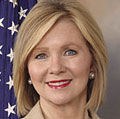
U.S. Rep. Marsha Blackburn, R-Tennessee
Blackburn, 66, from Brentwood, has served in the House since 2003 and is a deputy whip in the House leadership. In her announcement for the Senate, she described herself as a “hardcore card-carrying Tennessee conservative” with a gun in her purse. She has largely been supportive of Trump, who has endorsed her.
Both candidates have so far raised more than $8 million for the Senate battle, according to Federal Election Commission reports.
In U.S. House races, Kustoff was the only incumbent to face a significant challenge from George Flinn, a former Shelby County commissioner who poured more than $3 million of his own money in his fifth try for federal office. But Kustoff dispatched Flinn easily, taking 56 percent of the vote, 16 points ahead of his challenger.
In the Democratic race in the 8th District, the leader is Erika Stotts Pearson, the former assistant general manager of the WNBA’s Memphis Blues, who came in ahead of John Boatner, a social worker from Shelby County. However, only 284 votes separated the candidates, too close to declare a final winner.
In the 2nd District, which includes metro Knoxville and surrounding portions of East Tennessee, Knox County Mayor Tim Burchett won the Republican primary with 48 percent of the vote, defeating State Rep. Jimmy Matlock from Lenior City at 36 percent.
Burchett will now face Democrat Renee Hoyos from Knoxville, former director of the Tennessee Clean Water Network, who easily won her primary.
The seat opened when U.S. Rep. Jimmy Duncan retired. Burchett will be a prohibitive favorite in the heavily Republican district.
In the open race for Black’s 6th District seat, the Republican winner was John Rose from Cookeville, a former state agriculture commissioner, who took 41 percent to defeat Bob Corlew, a retired judge from Mount Juliet, with 31 percent.
In November, Rose will face Dawn Barlow, a physician from Livingston who carried 55 percent in the Democratic primary.
In the open race for Blackburn’s 7th District seat, which includes Nashville’s southern suburbs and west-central Tennessee, Democrats picked Justin Canew from College Grove, a digital media producer and two-time contestant on The Amazing Race. He will now face State Senator Mark Green from Ashland City, who was the only Republican to file.
In 2017, Trump nominated Green, a physician and West Point graduate, to be Secretary of the Army, but Green withdrew the nomination amid controversy of some of his previous public statements, including an assertion in 2016 that most psychiatrists believe being transgendered is a “disease.” (The American Psychiatric Association does not classify gender non-conformity as a mental illness).
New poll shows Texas U.S. Senate race shaping up as the most competitive in a generation
Quinnipiac poll finds Democrat Beto O’Rourke within striking distance of Republican incumbent Ted Cruz
♦By Rich Shumate, ChickenFriedPolitics.com editor
 AUSTIN (CFP) — The last time a Democrat was within striking distance in a U.S. Senate contest in Texas, Ronald Reagan was president, people rented movies from a store and tweeting was only for the birds.
Since the last Democratic victory in 1988, the party’s nominees have lost nine Senate races in a row, all by double digits. The average size of their loss? 19 points.

Ted Cruz

Beto O’Rourke
But a new poll shows Democratic U.S. Rep. Beto O’Rourke is closing in on Republican U.S. Senator Ted Cruz, cutting Cruz’s lead in half since May and raising the specter of seeing something this fall that hasn’t been seen deep in the heart of Texas for 30 years — a truly competitive Senate race.
A close race in Texas could also have national implications, as Republicans try to hang on to their slim one-vote majority in the Senate.
A Quinnipiac University poll released August 1 put Cruz at 49 percent and O’Rourke at 43 percent among registered voters in the Senate contest. With a sampling error of plus or minus 3.5 percent, that means that, statistically, Cruz’s lead is small enough to be the result of sampling error, rather than an actual lead.
But perhaps the most alarming bit of data in the poll for the Cruz campaign is that his 6-point lead now is down from an 11-point lead three months ago, and Cruz is now below 50 percent, a danger sign for an incumbent.
“O’Rourke has done a good job making the race competitive,” said Peter Brown, assistant director of Quinnipiac Poll in a statement. “He is clearly in contention. A Democratic victory in the Lone Star State would be a serious blow to GOP hopes of keeping their U.S. Senate majority.”
The poll of 1,118 registered voters found Cruz leading among men and white voters, while O’Rouke was leading among women and African-American voters. O’Rourke has a 12-point lead among Latino voters, and the two men are running even among voters who describe themselves as independent.
The poll found Texans generally have a good opinion of Cruz — 50 percent approve of his job performance and view him favorably, while 42 percent disapprove and view him unfavorably. However, he is polling far behind the Republican running in the other marquis statewide race, Governor Greg Abbott, who had a 13-point lead over his Democratic challenger, former Dallas County Sheriff Lupe Valdez.
By contrast, 43 percent of voters surveyed said the didn’t know enough about O’Rourke to offer an opinion of him, which means he remains something of an unknown quantity. And that could give the Cruz campaign an opening to try to define him negatively with voters over the rest of the campaign.
The poll also found that President Donald Trump’s approval rating in Texas was mixed, with 46 percent approving of his performance and 49 percent disapproving, which was within the margin of error.
The Quinnipiac poll surveyed registered voters rather than likely voters, making the results somewhat less indicative of what might happen on election day. However, two other polls taken in July that surveyed likely voters — by the Texas Lyceum and Gravis Marketing — also found Cruz’s lead in single digits.
Federal Election Commission reports also show that O’Rourke has been competitive with Cruz in fundraising. As of the end of June, he had raised $23.6 million to $23.4 million for Cruz and had $14 million in cash on hand, compared to $9.3 million for the incumbent.
The last time Cruz ran, in 2012, he outraised and outspent his Democratic opponent by a 2-to-1 margin, on his way to a 16-point victory.
O’Rouke, 45, has represented metro El Paso in the House since 2013, after serving on the El Paso City Council. Although he is Irish and his given first name is Robert, he was nicknamed “Beto” — a Spanish nickname for Robert — from childhood.
Cruz, 47, was elected to the Senate in 2012 on his first try for political office. In 2016, he made an unsuccessful run for the Republican presidential nomination, carrying 12 primaries and caucuses and finishing second in the delegate count behind Trump.
The Texas race is one of six Southern states with open seats in 2018; the others are Virginia, West Virginia, Florida, Tennessee and Mississippi, where both seats are on the ballot.
Four of those races are shaping up to be competitive — Florida and West Virginia, which are currently held by Democrats, and Texas and Tennessee, held by Republicans.
Tennessee Primary: GOP battle for governor, open U.S. House seats top ballot
U.S. Rep Diane Black tries to fend off two Republican rivals in governor’s race, without Donald Trump’s endorsement
By Rich Shumate, ChickenFriedPolitics.com
NASHVILLE (CNN) — Voters in Tennessee are heading to the polls for a unique Thursday primary in which the Republican race for the open governor’s seat is getting the lion’s share of attention.
U.S. Rep. Diane Black, who had been considered the front-runner earlier in the race, is now facing a battle with Randy Boyd, an adviser to outgoing Governor Bill Haslam, and Bill Lee, a businessman and rancher from Williamson County.
Despite her ardent support for President Donald Trump and her work getting his tax cuts through Congress, Black has not received a coveted presidential tweet of endorsement, which has buoyed GOP candidates for governor in primaries in Georgia and Florida.
Because Tennessee doesn’t have primary runoffs, the candidate who finishes first in the six-way primary will become the nominee.

Phil Bredesen

Marsha Blackburn
In the U.S. Senate race, Republicans are expected to nominate U.S. Rep. Marsha Blackburn to face Democratic former Governor Phil Bredensen in what’s likely to become one of the fall’s hottest Senate contests.
Parties are also picking nominees for U.S. House seats given up by Black and Blackburn and the 2nd District seat that opened with the retirement of U.S. Rep. Jimmy Duncan.
In West Tennessee’s 8th District, incumbent Republican U.S. Rep. David Kustoff is facing a strong primary challenge from George Flinn, a self-funding former Shelby County commissioner making his fifth try for federal office.
Tennessee is one of only two states that do not hold their primary elections on a Tuesday, a schedule dating back to its admission as a state in 1796; Louisiana holds its primaries for state and local offices on Saturdays.
Polls open in most of Tennessee at 7 a.m., although times may vary by county. Polls close at 8 p.m. in the Eastern time zone and 7 p.m. in the Central time zone.

Bill Lee

Randy Boyd

Diane Black
The governor’s race features six Republican candidates, including Black, 67, from Gallatin, who has spent the last eight years in Congress representing the 6th District, which includes the northern Nashville suburbs and north-central Tennessee; Boyd, 58, from Knoxville, who made his fortune with a company that makes electronic fences for dogs and was an adviser to Haslam on education policy and economic development; and Lee, 58, owner of a heating and air company making his first run for political office.
Also running on the Republican side is State House Speaker Beth Harwell, 60, from Nashville, although polls showed her slightly behind the three candidates at the front of the pack. She has been in the legislature for 20 years, culminating in her selection as the first woman speaker in state history.
While President Donald Trump has waded into Republican governor primaries in Georgia and Tennessee, he did not offer an endorsement in Tennessee, something of a blow to Black, who, as chairwoman of the House Budget Committee, helped shepherd the Republicans’ tax cut bill through the House.
However, Black has been using video of Trump praising her in one of her TV ads, and she did get the endorsement of Vice President Mike Pence.
Haslam is term-limited and hasn’t endorsed anyone in the race. However, Boyd — who, like Haslam, is from Knoxville — has served in his administration, and the New York Times has reported that the Republican Governors Association, which Haslam chairs, has been lobbying Trump not to endorse Black. (The governor’s office has refused to confirm that report.)

Karl Dean
The winner of the Republican primary is expected to face former Nashville Mayor Karl Dean, who is the favorite the three-way Democratic primary.
The fall race for governor will be a crowded affair, as 26 independents have qualified for the ballot, including 13 Libertarians. Because the Libertarian Party does not have official ballot access, the party has no primary, and all 13 candidates will appear on the ballot as independents.
In U.S. House races, Republicans will be settling contested primaries in four GOP-held districts in which the Republican winner will be favored in the fall.
In Duncan’s 2nd District seat, which includes metro Knoxville and surrounding portions of East Tennessee, the GOP race features Knox County Mayor Tim Burchett; State Rep. Jimmy Matlock from Lenior City; Jason Emert, a Bount County lawyer and former chairman of the Young Republicans National Federation; and Ashley Nickloes from Rockford, who is a lieutenant colonel in the Tennessee Air National Guard.
On the Democratic side, Renee Hoyos from Knoxville, former director of the Tennessee Clean Water Network, is facing Joshua Williams, a Knoxville psychologist.
In the open race for Black’s 6th District seat, the Republican race includes John Rose from Cookeville, who served as state agriculture commissioner; Bob Corlew, a retired judge from Mount Juliet; and State Rep. Judd Matheny from Tullahoma.
Democrats running include Merrilie Winegar, a Methodist minister from Hendersonville; Pete Heffernan, a management consultant from Gallatin; and Dawn Barlow, a physician from Livingston.
In the open race for Blackburn’s 7th District seat, which includes Nashville’s southern suburbs and west-central Tennessee, State Senator Mark Green from Ashland City was the only Republican to file.
In 2017, Trump nominated Green, a physician and West Point graduate, to be Secretary of the Army, but Green withdrew the nomination amid controversy of some of his previous public statements, including an assertion in 2016 that most psychiatrists believe being transgendered is a “disease.” (The American Psychiatric Association does not classify gender non-conformity as a mental illness).
Democrats in the 7th District race include Justin Canew from College Grove, a digital media producer and two-time contestant on The Amazing Race, and Matt Reel from Primm Springs, a congressional aide who serves in the Tennessee National Guard.
In the 8th District, which includes part of Memphis city, its eastern suburbs and the Mississippi Delta, Kustoff, a former federal prosecutor from Germantown, who was elected in 2016, is facing a challenge from Flinn, a physician who also owns a string of 40 radio and television stations.
Flinn, who lost to Kustoff in the GOP primary in 2016, is making his fifth run for Congress, having run twice in the U.S. House in the 8th District, once in the Memphis-based 9th District and for the U.S. Senate in 2014. He has poured more than $3 million of his own money into the campaign, giving him a signficant fundraising advantage over Kustoff.
However, Kustoff is likely to benefit from a last-minute endorsement by Trump, whom he called “a champion for the Trump Agenda.”
The Democratic race in the 8th District is between John Boatner, a social worker from Shelby County, and Erika Stotts Pearson, the former assistant general manager of the WNBA’s Memphis Blues.
Poll: Graham, DeSantis both now clearly front-runners in Florida governor primaries
Mason-Dixon poll shows DeSantis up by double digits in GOP contest; Graham leads by 9 points among Democrats
♦By Rich Shumate, ChickenFriedPolitics.com
 JACKSONVILLE (CFP) — With a month to go before Florida’s primaries for governor, a new poll shows that Democrat Gwen Graham and Republican Ron DeSantis have opened up leads over their party rivals in the chase to be the Sunshine State’s next chief executive.

Governor’s candidate Gwen Graham, D-Florida
The Mason-Dixon poll released July 27 found that Graham, a former congresswoman from Tallahassee and daughter of former U.S. Senator Bob Graham, was the choice of 27 percent of Democrats, leading former Miami Beach Mayor Philip Levine at 18 percent and Palm Beach billionaire real estate investor Jeff Greene at 12 percent.
Trailing in the crowded Democratic field were Tallahassee Mayor Andrew Gillum, at 10 percent, and Chris King, an attorney and real estate investor from Orlando, at 7 percent.
The margin of error in the poll of 500 likely Democratic voters was plus or minus 4.5 percent, which means Graham’s lead over Levin is statistically significant. However, 25 percent of voters said they were still undecided, indicating that the race still remains fluid.
Because Florida does not have primary runoffs, Graham could win the nomination with a plurality in the crowded Democratic field.
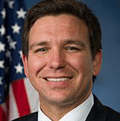
U.S. Rep. Ron DeSantis, R-Florida
On the Republican side, DeSantis, a congressman from metro Jacksonville, holds a more substantial lead over State Agriculture Commissioner Adam Putnam, 41 percent to 29 percent. However, 28 percent of likely Republicans in the poll said they were still undecided.
The margin of error in the poll of 500 likely Republican voters was also plus or minus 4.5 percent.
Putnam, a veteran of state politics from Polk County who served a decade in Congress before being elected agriculture commissioner in 2010, was considered the front-runner in the GOP race until DeSantis announced his run in January, backed with an endorsement from President Donald Trump.
A previous Mason-Dixon poll in February showed Putnam with a 4-point lead over DeSantis, indicating a shift of 16 points in the past five months.
Mason-Dixon did not pit the Republican and Democratic front-runners in a hypothetical matchup. However, the poll did find that among voters as a whole, Graham was viewed more favorably than DeSantis.
Among voters who recognized Graham, 35 percent had a favorable view of her, compared to just 5 percent who did not. For DeSantis, the figures were 32 percent approval and 21 percent disapproval.
The Florida primaries are August 28.
Incumbent Governor Rick Scott is term limited and running instead for the U.S. Senate against Democratic incumbent Bill Nelson.
 Chicken Fried Politics