
Home » 2018 (Page 29)
Yearly Archives: 2018

U.S. Senator Rand Paul’s neighbor faces federal assault charge in November attack
Rene Boucher faces possible prison time for injuring Kentucky lawmaker
♦By Rich Shumate, ChickenFriedPoiltics.com editor
 BOWLING GREEN, Kentucky (CFP) — A neighbor of U.S. Senator Rand Paul is facing a federal felony charge for tackling and injuring the Kentucky senator after a dispute over yard trimmings in November, according to the federal prosecutor handling the case.
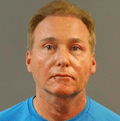
Mug shot of Rene Boucher (Warren Co. Sheriff’s Office)
Rene Boucher, 58, of Bowling Green, has been charged with assaulting a member of Congress resulting in personal injury, according to an announcement from John Minkler, the U.S attorney for the Southern District of Indiana.
Boucher has signed a plea agreement in the case, but no date has been set for taking his guilty plea and imposing a sentence, the statement said.
The charge carries a penalty of up to 10 years in prison and a fine of up to $250,000. Boucher’s attorney, Matt Baker, told the Bowling Green Daily News that Boucher is remorseful for the attack will ask for probation at sentencing.
Boucher has also been charged with fourth-degree assault in a state court.
The case was transferred to Minkler’ office in Indianapolis after the U.S. Attorney’s Office for the Louisville-based Western District of Kentucky recused itself from the case.

U.S. Senator Rand Paul
The statement from Minkler’s office shed new light on what happened on the afternoon of November 3 in a tony subdivision near Bowling Green, where Boucher and Paul–both medical doctors–were neighbors.
Boucher saw Paul “stack brush onto a pile near the victim’s property” and “had enough,” according to the statement. He then ran onto Paul’s property and tackled him.
The senator suffered multiple fractured ribs and later contracted pneumonia, the statement said.
At the time of the assault, speculation arose that Boucher’s assault on Paul might have been politically motivated. But according to Minkler’s statement, Boucher denied any political motivation, although he did admit to tackling the senator.
U.S. Supreme Court stays ruling striking down North Carolina U.S. House map
Decision means 2018 primaries can proceed in existing districts
♦By Rich Shumate, ChickenFriedPolitics.com editor
 WASHINGTON (CFP) – The U.S. Supreme Court has indefinitely stayed a ruling by a panel of three federal judges that invalidated North Carolina’s U.S. House map for unconstitutionally diluting the voting strength of Democrats.
The January 18 decision by the high court means state legislators will not have to redraw the map for the 2018 midterm election, a prospect that threatened to throw the election process into chaos.
The Supreme Court’s unsigned order stays the ruling “pending the timely filing and disposition of an appeal by this court.”
While the order did not indicate how many of the justices were in favor of granting a stay, it did note that two members of the court’s liberal bloc, Ruth Bader Ginsburg and Sonia Sotomayor, wanted to deny the application for a stay filed by Republican lawmakers.
Common Cause North Carolina and the League of Women Voters of North Carolina sued to invalidate the House map passed by the GOP-controlled legislature in 2016, arguing that the Republican majority improperly used political considerations in drawing the map.
No federal court had ever a stuck down a congressional map for being gerrymandered for political, rather than racial, reasons. But the majority opinion from three-judge panel who heard the case said partisan gerrymandering – a common political practice in many U.S. states – violates a “core principle of republican government” that “voters should choose their representatives, not the other way around.”
The January 9 ruling gave state lawmakers just 20 days to draw a new map, an order that is now on hold until the Supreme Court considers the appeal. Qualifying for the May 8 primary is scheduled to begin Feb. 28.
The high court is already considering similar cases involving state legislative districts in Wisconsin and Maryland that could set a precedent for the North Carolina case.
Should the ruling in North Carolina be upheld on appeal, it could have significant effects in other Southern states where Republican state legislative majorities have gerrymandered maps to their advantage, particularly Florida, Virginia and Texas.
Democrats cheered the ruling, which could help them make a dent in the GOP’s 10-to-3 advantage in North Carolina’s congressional delegation. But Republicans accused the judges of “waging a personal, partisan war” against the state GOP.
Ironically, what may have sunk the North Carolina map was the explicit admission by GOP lawmakers back in 2016 that they were drawing lines to maximize the number of Republican-friendly seats – an admission made to overcome objections to a previous map struck down for improperly using racial considerations.
After the map was redrawn in 2016, several incumbent lawmakers were forced to run in new territory and one, former U.S. Rep. Renee Ellmers, didn’t survive after she was forced to run against another incumbent in a Republican primary. However, the new map did not change the overall party composition in the state’s House delegation.
The 2016 map has allowed Republicans to hold on 77 percent of the state’s congressional seats, even though election results have been closely divided between the parties in recent statewide and presidential elections.
Donald Trump carried North Carolina by just 4 points in 2016, as Democrat Roy Cooper squeaked into the governorship by a margin of less than 1 percent.
The redistricting case was heard by James Wynn, a judge on the 4th U.S. Circuit Court of Appeals; W. Earl Britt, a senior U.S. District Court judge in Raleigh; and William Osteen Jr., a U.S. District Court judge in Greensboro.
Wynn and Britt were appointed by Democratic presidents; Osteen, who dissented from part of the ruling while concurring in striking down the map, is a Republican appointee.
Federal judges strike down North Carolina’s U.S. House map over gerrymandering
Ruling could have an impact on other Southern states with partisan maps
♦By Rich Shumate, ChickenFriedPolitics.com editor
RALEIGH (CFP) – In an unprecedented decision, a panel of three federal judges has struck down North Carolina’s U.S. House map, ruling that Republican lawmakers unconstitutionally diluted the voting strength of Democrats by gerrymandering the map for political reasons.
The panel’s majority opinion said partisan gerrymandering – a common political practice in many U.S. states – violates a “core principle of republican government” that “voters should choose their representatives, not the other way around.”
The January 9 ruling gives state lawmakers just 20 days to redraw the map; if they don’t, a new map will be redrawn by a special master appointed by the court. However, GOP legislative leaders are vowing to appeal the ruling to the U.S. Supreme Court, which could leave the current map in place until the appeal can be heard.
If the Supreme Court doesn’t issue a stay, significant chaos will be injected into the Tar Heel State’s 2018 election, with qualifying for candidates supposed to begin Feb. 28 for a May 8 primary.
The ruling marked the first time that a federal court has stuck down a congressional map for being gerrymandered for political, rather than racial, reasons. However, U.S. Supreme Court is currently considering similar cases involving state legislative districts in Wisconsin and Maryland that could set a precedent.
The judicial panel in the North Carolina case found unanimously that the map violated the equal protection clause of the Constitution and ruled 2-1 that it also violated the free speech rights of Democrats.
Should the ruling in North Carolina be upheld on appeal, it could have significant effects in other Southern states where Republican state legislative majorities have gerrymandered maps to their advantage, particularly Florida, Virginia and Texas.
Democrats cheered the ruling, which could help them make a dent in the GOP’s 10-to-3 advantage in North Carolina’s congressional delegation. But Republicans accused the judges of “waging a personal, partisan war” against the state GOP.
Ironically, what may have sunk the North Carolina map was the explicit admission by GOP lawmakers back in 2016 that they were drawing lines to maximize the number of Republican-friendly seats – an admission made to overcome objections to a previous map struck down for improperly using racial considerations.
After the map was redrawn in 2016, several incumbent lawmakers were forced to run in new territory and one, former U.S. Rep. Renee Ellmers, didn’t survive after she was forced to run against another incumbent in a Republican primary. However, the new map did not change the overall party composition in the state’s House delegation.
The 2016 map has allowed Republicans to hold on 77 percent of the state’s congressional seats, even though election results have been closely divided between the parties in recent statewide and presidential elections.
Donald Trump carried North Carolina by just 4 points in 2016, as Democrat Roy Cooper squeaked into the governorship by a margin of less than 1 percent.
The redistricting case was heard by James Wynn, a judge on the 4th U.S. Circuit Court of Appeals; W. Earl Britt, a senior U.S. District Court judge in Raleigh; and William Osteen Jr., a U.S. District Court judge in Greensboro.
Wynn and Britt were appointed by Democratic presidents; Osteen, who dissented from part of the ruling while concurring in striking down the map, is a Republican appointee.
U.S. Rep. Ron DeSantis announces run for Florida governor
DeSantis’s decision follows a favorable Twitter mention from Donald Trump
♦By Rich Shumate, ChickenFriedPolitics.com editor
 TALLAHASSEE (CFP) — Equipped with a favorable mention from President Donald Trump on Twitter, Republican U.S. Rep. Ron DeSantis has announced that he will run for Florida governor in 2018.
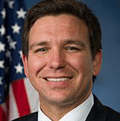
U.S. Rep. Ron DeSantis, R-Florida
DeSantis, who is serving his third term in Congress, made the announcement January 5 on the conservative-friendly confines of the Fox & Friends morning program on the Fox News Channel.
“I’m in a position to exercise the leadership that can build on the great work that Governor Rick Scott has done to advance economic opportunity, reform education and drain the swamp in Tallahassee, which needs to be drained just like Washington,” DeSantis said.
His decision to enter the race sets up a primary battle with Florida Agriculture Commissioner Adam Putnam, a former congressman who has the backing of much of Florida’s GOP establishment.
DeSantis, on the other hand, has the imprimatur of Trump, who offered an almost-endorsement of his candidacy December 22 on Twitter: “Congressman Ron DeSantis is a brilliant young leader, Yale and then Harvard Law, who would make a GREAT Governor of Florida. He loves our Country and is a true FIGHTER!”
Although Trump did not actually use the e-word, DeSantis is playing up the favorable mention, noting on his website that he has been “endorsed by President Trump.”
DeSantis, 39, a Harvard law graduate and former military prosecutor, was elected in 2012 from Florida’s 6th District, which stretches along the Atlantic coast from the Jacksonville suburbs to Daytona Beach. He is a member of the conservative, anti-establishment House Freedom Caucus.
In 2016, DeSantis ran for the GOP nomination for the U.S. Senate but abandoned his campaign when Marco Rubio decided to seek re-election after leaving the presidential campaign.
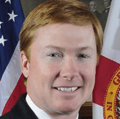
Florida Agriculture Commissioner Adam Putnam
The major obstacle in DeSantis’s way to becoming governor is Putnam, 43, the one-time boy wonder of Florida politics who was the elected to the legislature at age 22 and to Congress when he was just 26.
Putnam served five terms in the U.S. House, rising to chair the House Republican Conference, the No. 3 position in the House GOP hierarchy. before being elected as agriculture commissioner in 2010.
He was re-elected in 2014 with 58 percent of the vote and has already raised more $15 million for the governor’s race.
Also considering the governor’s race on the Republican side is Florida House Speaker Richard Corcoran, who represents a suburban Tampa district in the legislature and was elected speaker in 2016.
The Democratic primary for governor is shaping up as a battle between former U.S. Rep. Gwen Graham of Tallahassee, Tallahassee Mayor Andrew Gillum and Miami Beach Mayor Phillip Levine.
Graham, who served a single term in Congress before leaving after she was redrawn into a politically unfavorable district, is the daughter of former governor and U.S. senator Bob Graham. If elected, Gillum would be Florida’s first African American governor.
Scott, the incumbent Republican, is term-limited and considering a run for the U.S. Senate against Democrat Bill Nelson.
Random drawing gives GOP control of Virginia House of Delegates
Republican Delegate David Yancey declared winner in race tied after disputed recount
♦By Rich Shumate, ChickenFriedPolitics.com editor
 RICHMOND (CFP) — Republicans have retained control of the Virginia House of Delegates after a random drawing to settle a race in Newport News that remained tied after a disputed recount.

Va. Del. David Yancey, R-Newport News
Republican Delegate David Yancey will get to keep his seat after his name was drawn from a bowl by James Alcorn, chairman of the State Board of Elections, as Yancey’s Democratic challenger, Shelly Simonds, looked on.
With Yancey’s win, Republicans will hold 51 seats in the House of Delegates, to 49 for Democrats, although Democrats have gone to federal court to overturn another race in which their candidate lost narrowly in a recount.
Speaking to reporters after the January 4 drawing, Simonds refused to concede and said “all options are on the table,” including possible legal action to contest the outcome in District 94.
Yancey, who didn’t attend the drawing, issued a statement saluting Simonds on running a “great campaign.”
“The election is behind us, the outcome is clear, and my responsibility now is to begin the work I was re-elected to do,” he said.
Despite falling short of control, Democrats made an astonishing breakthrough in the November vote in Virginia, nearly overturning a 66-34 Republican House majority by flipping 15 seats and taking out 12 GOP incumbents, including many veteran lawmakers in the Washington, D.C. suburbs.
Democrats also carried all three statewide races, including a win by Governor-elect Ralph Northam, and only trail Republicans by one vote in the Senate, where the GOP holds a 21-19 majority. Northam takes office January 13.
The drawing to settle the contest in District 94 was the latest bizarre twist in the seesaw battle between Yancey and Simonds that has roiled Virginia politics for more than eight weeks.

Shelly Simonds
After the initial results were reported, Yancey held a 10-vote lead. Then, a December 19 recount overturned Yancey’s margin and showed Simonds ahead by one vote. But when a panel of judges met to certify the results the next day, they decided to count a ballot for Yancey in which the bubbles for both candidates had been filled in but the bubble for Simonds was crossed off.
With that ballot counted, Simond’s single vote lead became a tie, which, under Virginia law, had to be settled by drawing lots.
Simonds asked the judges who counted the disputed ballot to reconsider, but they refused, saying they had complied with state law in determining the intention of the voter who filled out the ballot, who had voted for the Republican candidates in all of the other races.
The unusual circumstances of the drawing drew a large crowd to the Patrick Henry Building in Richmond, despite a snow storm. Slips of paper with the names of both candidates were put inside film canisters and then placed in a large bowl and mixed, with Alcorn selecting the winner.
 Chicken Fried Politics