
Home » 2018 Primaries (Page 2)
Category Archives: 2018 Primaries

Poll: Graham, DeSantis both now clearly front-runners in Florida governor primaries
Mason-Dixon poll shows DeSantis up by double digits in GOP contest; Graham leads by 9 points among Democrats
♦By Rich Shumate, ChickenFriedPolitics.com
 JACKSONVILLE (CFP) — With a month to go before Florida’s primaries for governor, a new poll shows that Democrat Gwen Graham and Republican Ron DeSantis have opened up leads over their party rivals in the chase to be the Sunshine State’s next chief executive.

Governor’s candidate Gwen Graham, D-Florida
The Mason-Dixon poll released July 27 found that Graham, a former congresswoman from Tallahassee and daughter of former U.S. Senator Bob Graham, was the choice of 27 percent of Democrats, leading former Miami Beach Mayor Philip Levine at 18 percent and Palm Beach billionaire real estate investor Jeff Greene at 12 percent.
Trailing in the crowded Democratic field were Tallahassee Mayor Andrew Gillum, at 10 percent, and Chris King, an attorney and real estate investor from Orlando, at 7 percent.
The margin of error in the poll of 500 likely Democratic voters was plus or minus 4.5 percent, which means Graham’s lead over Levin is statistically significant. However, 25 percent of voters said they were still undecided, indicating that the race still remains fluid.
Because Florida does not have primary runoffs, Graham could win the nomination with a plurality in the crowded Democratic field.
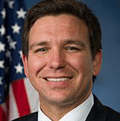
U.S. Rep. Ron DeSantis, R-Florida
On the Republican side, DeSantis, a congressman from metro Jacksonville, holds a more substantial lead over State Agriculture Commissioner Adam Putnam, 41 percent to 29 percent. However, 28 percent of likely Republicans in the poll said they were still undecided.
The margin of error in the poll of 500 likely Republican voters was also plus or minus 4.5 percent.
Putnam, a veteran of state politics from Polk County who served a decade in Congress before being elected agriculture commissioner in 2010, was considered the front-runner in the GOP race until DeSantis announced his run in January, backed with an endorsement from President Donald Trump.
A previous Mason-Dixon poll in February showed Putnam with a 4-point lead over DeSantis, indicating a shift of 16 points in the past five months.
Mason-Dixon did not pit the Republican and Democratic front-runners in a hypothetical matchup. However, the poll did find that among voters as a whole, Graham was viewed more favorably than DeSantis.
Among voters who recognized Graham, 35 percent had a favorable view of her, compared to just 5 percent who did not. For DeSantis, the figures were 32 percent approval and 21 percent disapproval.
The Florida primaries are August 28.
Incumbent Governor Rick Scott is term limited and running instead for the U.S. Senate against Democratic incumbent Bill Nelson.
Secretary of State Brian Kemp gets landslide win in GOP runoff for Georgia governor, will now face Stacey Abrams
Democrats pick nominees for two targeted GOP-held seats in Atlanta suburbs
♦By Rich Shumate, ChickenFriedPolitics.com editor

 ATLANTA (CFP) — With the backing of both President Donald Trump and Vice President Mike Pence, Secretary of State Brian Kemp has won the Republican nomination for Georgia governor, winning a runoff by nearly 40 points after a stunning collapse by Lieutenant Governor Casey Cagle.
Kemp’s win sets up one of the nation’s marquee governor’s races this fall against Democrat Stacey Abrams, the first African American woman ever nominated for governor by a major political party in a U.S. state, who won her nomination in May without a runoff.
Georgia Democrats have also settled on nominees for two Republican-held U.S. House seats in metro Atlanta being targeted this fall, picking Lucy McBath in the 6th District and Carolyn Bourdeaux in the 7th District.
McBath will now face U.S. Rep. Karen Handel, while Bourdeaux will take on U.S. Rep. Rob Woodall.
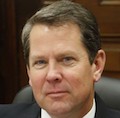
Secretary of State Brian Kemp
In the GOP governor’s race, Kemp took 69 percent of the vote in the July 24 runoff to 31 percent for Cagle, who had finished 13 points ahead of Kemp in the first round of voting in May but saw his support collapse in the final weeks of the race.
“We have earned a clear and convincing victory,” Kemp told supporters at a election night rally in Athens. “We had the momentum in this race, and those endorsements by the president and vice president — they poured gasoline on the fire.”
Although both men had vied for the Trump vote, the president endorsed Kemp a week before the runoff, and Pence traveled to Georgia to campaign with him. Cagle, serving his third term as lieutenant governor, was endorsed by incumbent Republican Governor Nathan Deal, who is term limited.
During the campaign, Kemp drew criticism for a humorous ad in which he points a shotgun at a young man who wants to date one of his daughters and gets him to acknowledge “a healthy appreciation for the Second Amendment, sir.” Kemp was unapologetic, saying in a statement that “liberal media and radical, left-wing activists — who have probably never even held a firearm — are freaking out and creating fake controversy.”
The National Rifle Association had earlier endorsed Cagle after the lieutenant governor proposed stripping a lucrative tax exemption from Atlanta-based Delta Airlines to retaliate against the company for ending a discount program for NRA members in the wake of the massacre of high school students in Parkland, Florida.
The turning point in the race may have been release of secretly recorded audio in June in which Cagle admitted that he had supported “bad public policy” in the legislature to undercut one of his primary rivals and complained that the Republican primary had devolved into a contest of “who had the biggest gun, who had the biggest truck and who could be the craziest.”
In a concession speech to supporters in Atlanta, Cagle promised his “full, undivided support” for Kemp in the general election.
“It didn’t turn out the way we wanted it, but at the end of the day, I can promise you my life is so rich,” he said.
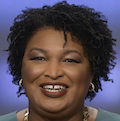
Democratic nominee Stacey Abrams
Democrats, who have not won a governor’s race in Georgia since 1998, are hoping to turn those fortunes around with Abrams, 44, a Yale-educated Atlanta lawyer who served six years as minority leader of the Georgia House.
During the Democratic primary, Abrams had argued that the way to reclaim the governor’s mansion was to energize and expand the electorate, rather than trying to appeal to Republican-leaning voters by offering more moderate stands. That strategy will be put to the test against Kemp, 54, a conservative businessman from Athens who has been secretary of state since 2011.
Kemp went after Abrams in his victory speech, calling her an “out-of-touch radical liberal who cares more for her billionaire backers than for you all.”
“This election is going to be for the soul of our state,” Kemp said. “It is going to be about our values, and it is going to be literally a fight for the future of the great state of Georgia.”
While Republicans have dominated Georgia politics for nearly two decades, demographic changes — particularly an influx of new minority voters — have begun to shift the political calculus. In 2004, George W. Bush carried Georgia by 16 points; Trump only won by 5 points in 2016, and he lost two large suburban Atlanta counties — Cobb and Gwinnett — that had not gone Democratic in a generation.
Both of the U.S. House races where Democrats may have a shot this fall are anchored in those same suburbs. In the 6th District, which takes in Cobb, North Fulton and North DeKalb counties, Trump won by just 1.5 points; in the 7th District, which includes Gwinnett and Forsyth counties, he won by just 6 points.

Lucy McBath

Karen Handel
Handel won the 6th District seat in a special election in 2017 that became nationalized amid rising resistance to Trump. More than $50 million was spent on that race, making it the most expensive House election in history.
The Democrat who Handel defeated in that race, Jon Ossoff, decided against a rematch, leaving her to face McBath, a retired flight attendant and gun control activist from Cobb County, who took 54 percent in the runoff to defeat Kevin Abel, a Sandy Springs businessman, who took 46 percent.
McBath’s son, Jordan Davis, was shot and killed in 2012 by a man at a gas station in Jacksonville, Florida, over a dispute over loud hip-hop music. His case became part of the nationwide campaign against deadly violence aimed at young African-American men. The shooter, Michael David Dunn, was later convicted of first-degree murder and sentenced to life without parole.

Rob Woodall

Carolyn Bourdeaux
In the 7th District, Woodall will face Bourdeaux, from Suwanee, a professor at Georgia State University and former budget analyst for the Georgia Senate. In the runoff, she took 52 percent of the vote to defeat Duluth businessman David Kim with 48 percent.
In the runoff, Republicans also settled on their nominees for the posts of lieutenant governor and secretary of state given up by Cagle and Kemp.
In the lieutenant governor’s race, former State Rep. Geoff Duncan from Cumming, a former professional baseball player, edged out State Senator David Shafer from Duluth. However, the two candidates were separated by less than 1,700 votes, which could trigger a runoff.
Duncan will now face the Democratic nominee, Kennesaw businesswoman Sarah Riggs Amico.
In the secretary of state’s race, State Rep. Brad Raffensperger from Johns Creek defeated Alpharetta Mayor David Belle Isle. He will now face former U.S. Rep. John Barrow from Athens, who was the last white Democrat left in Georgia’s congressional delegation until he was defeated in 2014.
U.S. Rep. Martha Roby survives GOP primary runoff in Alabama
Trump endorsement helps Roby overcome backlash for her criticism of him during 2016 campaign
♦By Rich Shumate, ChickenFriedPoitics.com editor
 MONTGOMERY (CFP) — Republican U.S. Rep. Martha Roby has easily survived a Republican runoff in her southeast Alabama district, overcoming a backlash over her critical comments of then-candidate Donald Trump in 2016 that threatened to bounce her out of Washington.

U.S. Rep. Martha Roby, R-Alabama
Roby took 68 percent in the July 17 runoff to 32 percent for Bobby Bright, a former Montgomery mayor who held the 2nd District seat as a Democrat before losing it to Roby in 2010. He switched to the GOP earlier this year to challenge her in the primary.
Roby will now face Democrat Tabitha Isner, a business analyst and pastor’s wife from Montgomery. Roby will be a prohibitive favorite in the heavily Republican district, which takes in much of Montgomery and its northern suburbs, along with the Wiregrass Country in the southeastern corner of the state.
In the first round of primary voting in June, Roby took just 39 percent of the vote, which was seen as a rebuke to Roby by Trump voters, who have been furious over her decision in October 2016 to rescind her endorsement of him after the infamous Access Hollywood tape surfaced in which Trump bragged about sexually accosting women.
At the time, Roby said she would not vote for Trump because his “behavior makes him unacceptable as a candidate for president.”
However, she has since tempered her criticism of the president, and he gave her a coveted tweeted presidential endorsement ahead of the runoff, in which he pointedly noted that Bright was “a recent Nancy Pelosi voting Democrat.”
Roby’s survival contrasts with the fate of another House member critical of Trump — U.S. Rep. Mark Sanford of South Carolina — who lost his primary in June. In that race, Trump endorsed his opponent, State Rep. Katie Arrington, on election day.
Roby, 41, is seeking her fifth term in Congress.
Primaries: Governor’s race tops ballot in Oklahoma; runoffs in South Carolina, Mississippi
South Carolina Governor Henry McMaster gets Donald Trump’s backing in quest to keep his job
OKLAHOMA CITY (CFP) — Oklahoma Republicans will go to the polls Tuesday to decide what is shaping up to be a tight three-way race for governor, picking a nominee to face a stronger-than-usual Democratic challenge in November in a political climate rocked by April’s statewide teachers’ strike.
In the state’s 1st U.S. House District in metro Tulsa, five Republicans and five Democrats are scrambling for spots in runoffs for an open seat.

Warren

McMaster
Meanwhile, in South Carolina, Republicans will decide a runoff between Governor Henry McMaster and Greenville businessman John Warren, with McMaster hoping for a last-minute boost from President Donald Trump, who visits the state Monday.
Upstate in the 4th U.S. House District, former State Senator Lee Bright from Spartanburg will face State Senator William Timmons from Greenville in the Republican runoff for the seat being vacated by retiring U.S. Rep. Trey Gowdy. Democrats in the district will choose between Doris Lee Turner, a Greenville tax accountant, and Brandon Brown, a college administrator from Greenville.
And in Mississippi, Democrats will decide a runoff to pick a nominee for the uphill task of trying to defeat Republican U.S. Senator Roger Wicker, while Republicans in the 3rd U.S. House District will settle a runoff for the seat being vacated by U.S. Rep. Gregg Harper, who is also retiring.
In the Senate runoff, Howard Sherman, a venture capitalist from Meridian who is married to actress and Meridian native Sela Ward, will face State House Minority Leader David Baria from Bay St. Louis.
In the 3rd District, Michael Guest, the chief prosecutor for the judicial district that includes Madison and Rankin counties, will face Whit Hughes, a hospital executive and aide to former Governor Haley Barbour.
Polls in all three states will be open from 7 a.m. to 7 p.m. local time.
 In Oklahoma, voters will be going to the polls in the first statewide election since a teachers’ strike in April over low pay and what teachers saw as inadequate state support for education. The strike ended after legislators raised taxes to improve pay and school funding.

Kevin Stitt

Mick Cornett

Todd Lamb
The open Republican race for governor, which drew 10 candidates, is shaping up as a battle between Lieutenant Governor Todd Lamb, former Oklahoma City Mayor Mick Cornett and Kevin Stitt, a wealthy Tulsa businessman who founded Gateway Mortgage Group.
Cornett, 59, a former television anchor in Oklahoma City, served 14 years as mayor and was president of the U.S. Conference of Mayors in 2016.
Lamb, 46, a former Secret Service agent, is finishing his second term as lieutenant governor, after previously serving in the Oklahoma Senate.
Stitt, running on a platform of reforming the political culture in Oklahoma City that came under fire during the teacher’s strike, surged in polls in the latter stages of the race after pouring in $2.2 million of his own money.
Oklahoma has primary runoffs, which means that a runoff between the top two vote-getters is likely. The runoff will be August 28.
Incumbent Republican Governor Mary Fallon is term limited.
While Republicans dominate Oklahoma politics — and Fallon won the last two races by double-digit margins — Democrats will have a viable nominee for governor, former Attorney General Drew Edmonson, who had raised $1.4 million heading into the primary, according to campaign finance reports filed with the Oklahoma Ethics Commission.
Edmundson, 71, comes from a prominent Oklahoma political family and served as attorney general from 1995 to 2011. His father was a congressman, his uncle a governor, and his brother, James, serves on the Oklahoma Supreme Court.
In Oklahoma’s 1st District, voters are picking a replacement for former Republican U.S. Rep. Jim Bridenstine, who resigned in April after he was confirmed as NASA administrator.
The Republican contest is shaping up as a battle between former Tulsa County District Attorney Tim Harris; Kevin Hern, a Tulsa McDonald’s franchisee; and Andy Coleman, an attorney and minister from Owasso.
On the Democratic side, the front runner is Tim Gilpin, a Tulsa attorney and former member of the state school board who has the backing of the Oklahoma Education Association.
 In South Carolina, McMaster — who inherited the office last year when former Governor Nikki Haley became UN ambassador — is trying to hold off Warren, a political newcomer who came from the back of the pack to win the second spot in the runoff.
McMaster was the first statewide elected official to endorse President Trump in 2016, and the president returned the favor by tweeting an endorsement and making an appearance on his behalf Monday at a suburban Columbia high school.
Vice President Mike Pence campaigned with McMaster Saturday in Myrtle Beach.
The winner of the GOP runoff will face State Rep. James Smith from Columbia. Democrats have not won a governor’s race in the Palmetto State in 20 years.
South Carolina Primary: U.S. Rep. Mark Sanford defeated; McMaster, Warren advance to GOP governor’s runoff
Democrat Archie Parnell survives 5th District U.S. House primary despite spouse abuse revelations
♦By Rich Shumate, ChickenFriedPolitics.com editor
CHARLESTON (CFP) — U.S. Rep. Mark Sanford has become the second incumbent to go down in a primary this year, losing the GOP nomination for his Lowcountry seat after President Donald Trump tweeted a last-minute endorsement of his opponent.
In another key race in the June 12 primary, Governor Henry McMaster secured a runoff spot and will now face John Warren, a Greenville businessman and Iraq war veteran making his first run for political office.
In the 5th U.S. House District, Democrat Archie Parnell advanced to the general election, despite pleas from party leaders to get out of the race over revelations about spousal abuse from four decades ago.
And upstate, in the 4th District, where 12 Republicans were fighting for spots in the runoff, former State Senator Lee Bright from Spartanburg snagged one spot, with State Senator William Timmons from Greenville holding on to second place by a narrow margin in unofficial results.

Sanford

Arrington
In the 1st U.S. House District, which includes Charleston and the Lowcountry along the Atlantic Coast, State Rep. Katie Arrington from Summerville took 51 percent to 46 percent for Sanford, who has held the seat since 2013.
She will now face Democrat Joe Cunningham, a Charleston attorney who swept to an easy victory in the Democratic primary with 71 percent of the vote.
Sanford’s demise could be good news for Cunningham, who will now be competing in an open seat against a lesser known, more conservative candidate. He has also raised more than $500,000 in a bid to flip the 1st District seat.
Trump loomed large in the GOP primary, with Arrington taking aim at Sanford for his previous critical comments about the president. Then, on election day, Trump administered the coup de grace on his Twitter feed: “Mark Sanford has been very unhelpful to me in my campaign to MAGA. He is MIA and nothing but trouble. He is better off in Argentina.”
The final sentence is a reference to a 2009 episode in which Sanford, then governor of South Carolina, disappeared for several days after telling the media he was hiking the Appalachian Trail, while he was actually out of the country with a Argentinian woman with whom he was having an extramarital affair.
Sanford has been one of the few Republicans in Congress to speak out against Trump, calling his behavior in office “weird,” criticizing Trump’s disparagement of Haiti and countries in Africa and calling his policy of imposing tariffs on steel and aluminum “an experiment with stupidity.”
In a concession speech before supporters in Mount Pleasant, Sanford stood by the criticisms that may have cost him his job.
“It may have cost me an election, but I stand by every one of those decisions to disagree with the president because I didn’t think they would be concurrent with the promises I made when I first ran for office and for the very voices of the people of the 1st District that I represent,” he said.
Sanford had never previously been defeated in a career that stretches back to his first election to the U.S. House in 1994 and includes two terms as governor.
The only other incumbent House member to fall this year so far was North Carolina’s U.S. Robert Pittenger. However, Alabama U.S. Rep. Martha Roby was forced in a July runoff against a challenger who made an issue of her decision to rescind her endorsement of Trump after the infamous Access Hollywood tape surfaced in October 2016, in which he bragged about groping women.
Warren
McMaster
In the governor’s race, McMaster — who inherited the office last year when former Governor Nikki Haley became UN ambassador — took 45 percent of the vote to 22 percent for Warren, who edged out Catherine Templeton, a Mount Pleasant attorney who served in two state executive positions under Haley.
The winner will face State Rep. James Smith from Columbia, who won the Democratic nomination outright with 62 percent of the vote. Florence lawyer Marguerite Willis came in second with 27 percent, while Phil Noble, a Charleston business consultant who was an adviser to former President Barack Obama, came in third with 22 percent.
Democrats have not won a governor’s race in the Palmetto State in 20 years.
McMaster — the first statewide elected official to endorse President Trump in 2016 — was boosted by a tweeted endorsement from the president. Warren was the dark horse in the race, putting in more than $3 million of his own money to be financially competitive with McMaster and Templeton.
Templeton had touted her connections with Haley and campaigned against what she called a “good ol’ boy” network running South Carolina politics — a shot at McMaster, who has been in state politics for more than 20 years. But in the end, she could not hold off a charge by Warren, who cast himself as the “conservative outsider” in the race.
In the 5th District, which stretches from the Columbia suburbs north toward Charlotte, Parnell took 60 percent, surviving a Democratic primary against three little-known challengers after divorce records came to light three weeks before the primary revealing that he physically abused his first wife in the 1970s.

Norman

Parnell
Democratic leaders have urged Parnell to quit, but he has refused. He will now face Republican U.S. Rep. Ralph Norman in November.
In a special election last year to fill the seat vacated when Mick Mulvaney became Trump’s budget director, Parnell, a former Goldman Sachs executive, shocked the political world by coming in just 2 points behind Norman in a district Trump carried by 19 points in 2016.
Based on the closeness of the special election, Parnell has raised more than $3.6 million for the rematch, putting him in the top 20 nationally among House candidates. But the abuse allegations likely extinguished any hope Democrats had of defeating Norman and flipping the seat.
Norman drew national headlines in April when he pulled out a loaded gun during a meeting with gun control advocates at a local diner. The incident came less than two months after the massacre at a high school in Parkland, Florida.
Norman defended his actions, saying he was “tired of guns being demonized.”
Upstate in the 4th District, which includes Greenville and Spartanburg, Bright, who unsuccessfully challenged U.S. Senator Lindsey Graham in a GOP primary in 2014, took 25 percent to secure a runoff spot for the seat being given up by the retiring U.S. Rep. Trey Gowdy.
Timmons was in second place with 19 percent, but he was only 350 votes ahead of State Rep. Dan Hamilton, also from Greenville, so news organizations did not make an immediate call for the second spot in the runoff.
Democrats in the district will also decide a runoff between Doris Lee Turner, a Greenville tax accountant, who took 29 percent, and Brandon Brown, a college administrator from Greenville, who took 28 percent.
 Chicken Fried Politics