
Home » Alabama (Page 2)
Category Archives: Alabama

West Virginia’s Jim Justice is South’s most popular governor; Georgia’s Brian Kemp the least
Morning Consult poll shows Democratic governors with aggressive COVID-19 strategies with higher approval than GOP governors who have resisted mandates
♦By Rich Shumate, ChickenFriedPolitics.com editor
 (CFP) – West Virginia Governor Jim Justice is the South’s most popular chief executive, with Alabama’s Kay Ivey close behind in new polls on gubernatorial approval from the polling firm Morning Consult.
The polls, taken over the course of the last four months and released November 11, also show that Georgia Republican Brian Kemp’s approval rating among registered voters was just 42%, making him the region’s least popular chief executive as he heads into what is expected to be a tough re-election battle next year against furious opposition from Donald Trump.
The poll in Kentucky had better news for Democrat Andy Beshear, whose approval rating stood at 54%, despite taking considerable fire from Republicans over his COVID-19 policies.
Beshear will face voters again in 2023, as will Mississippi Republican Tate Reeves. However, the approval rating for Reeves, who may face a primary challenge from House Speaker Philip Gunn, stood at just 49%, making him and Kemp the only two Southern governors with approval ratings below 50% ahead of a run for his third term.
Morning Consult did not report disapproval numbers, so it was unclear if Reeves and Kemp were actually under water in their approval numbers, with more people disapproving than approving.
The approval rating for Florida Republican Ron DeSantis, who has taken the leading in fighting mask and vaccine mandates, stood at 52% ahead of a Democratic challenge in 2022. Texas’s Greg Abbott, who has taken a similar line of resistance against mandates, had an approval rating of 50%.
Three of the region’s Democratic governors who have been more aggressive with COVID-19 mitigation measures – Beshear, North Carolina’s Roy Cooper and Louisiana’s John Bel Edwards – had higher approval ratings than DeSantis and Abbott, although within the poll’s margin of error.
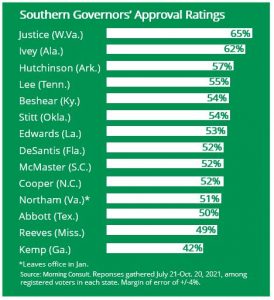 Justice’s approval rating stood at 65%, despite a string of headlines about financial and regulatory problems for companies owned by his family and an odd dispute about whether he should be hired to coach a boy’s high school basketball team.
Ivey, who became governor in 2017 when her predecessor resigned in a sex scandal, had an approval rating at 62%, as she heads into a re-election race in which she will be heavily favored.
However, she, too, has run afoul of Trump over cancellation of a June rally in Mobile, and he is reportedly trying to find a primary challenger to run against her.
Tennessee’s Bill Lee and Oklahoma’s Kevin Stitt also appear to be in strong shape for 2022, with Lee’s approval at 55% and Stitt’s at 54%.
The other Southern governor up next year, South Carolina’s Henry McMaster, stood at 52%.
Arkansas’s Asa Hutchinson has a 57% approval rating as he heads toward the exit due to term limits – despite being one of the very few elected Republicans willing to offer criticism of Trump.
Hutchinson has said he will not back Trump if he runs for the White House again in 2024 and that relitigating the 2020 election would be a “recipe for disaster.” He has raised his national profile in recent months, with numerous appearances on Sunday talk shows, prompting speculation that he might make his own presidential run in 2024.
Kemp has drawn Trump’s active wrath for refusing to go along with his efforts to overturn the 2020 election results in the Peach State. Former Republican U.S. Senator David Perdue is considering a primary challenge, and the GOP nominee will likely be facing Democrat Stacey Abrams, whom Kemp narrowly beat in 2018.
Two Southern Democratic governors who are in the middle of their second and final term – Edwards and Cooper – had positive approval ratings, at 53% and 52%, respectively.
Morning Consult gathered the responses from July 21 to October 20 among registered voters in each state. The margin of error was +/-4%.
We tweet @ChkFriPolitics Join us!
Conservative firebrand U.S. Rep. Mo Brooks enters Alabama U.S. Senate race
Announcement comes less than 3 months after Brooks exhorted pro-Trump crowd to “start kicking ass” prior to Capitol riot
♦By Rich Shumate, ChickenFriedPolitics.com editor
 HUNTSVILLE, Alabama (CFP) — Republican U.S. Rep. Mo Brooks entered the chase for Alabama’s open U.S. Senate seat Monday with a campaign kickoff where he wrapped himself firmly in the mantle of Donald Trump as he tries to navigate what is likely to become a crowded primary field.
Brooks announced his candidacy at a rally in Huntsville where shared the stage with Stephen Miller — a Trump aide who was the architect of Trump’s restrictive immigration policies — and continued to promote the former president’s unfounded claims of election fraud.
“In 2020, America suffered the worst voter fraud and election theft in history,” Brooks said. “And all Americans would know that if the news media was not suppressing the truth as they’re doing.”
Brooks also noted that he had been endorsed twice by Trump in his congressional campaigns and helped Trump fight what he termed “defamatory, hyper-partisan impeachment scams.”
“As President Trump can vouch, I don’t cut and run,” Brooks said. ” I stand strong when the going gets tough.”
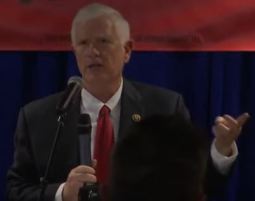
U.S. Rep. Mo Brooks, R-Alabama, announces campaign for U.S. Senate (WZDX News)
Brooks, 66, has represented Alabama’s 5th U.S. House District, which covers the northern part of the state, since 2011. He made an unsuccessful bid for the state’s other Senate seat in 2017, coming in third in the GOP primary.
The announcement of his latest campaign comes less than three months after Brooks addressed pro-Trump rally in Washington on January 6 in which he told the crowd, “Today is the day American patriots start taking down names and kicking ass.”
Members of the crowd later stormed the Capitol, resulting in at least five deaths and more than 400 people facing criminal charges.
Brooks has remained unrepentant and refused to apologize, saying he doesn’t believe there is any relationship between his remarks at the rally and the subsequent riot. However, he is facing at least one lawsuit so far over the speech.
Ironically, when Brooks ran for the Senate in 2017, he was criticized for being insufficiently supportive of Trump because of remarks he made about then-candidate Trump in 2016 after release of the infamous “Access Hollywood” tape, in which Trump bragged about being sexually aggressive toward women.
Since then, however, Brooks has been one of Trump’s staunchest and most outspoken defenders in Congress and supported Trump’s assertions of voter fraud in the 2020 election, which have been summarily rejected by courts and investigators.
The Senate seat is opening because of the retirement of Republican U.S. Senator Richard Shelby.
Lynda Blanchard, who served as Trump’s ambassador to Slovenia, is already in the race and, like Brooks, playing up her ties to the former president.
Also considering getting into the Republican primary are Secretary of State John Merrill and Katie Britt, the CEO of the Business Council of Alabama.
Democratic U.S. Rep. Terri Sewell, the lone Democrat in the Yellowhammer State’s congressional delegation, is also considering a run, although the race is likely to be an uphill battle for any Democrat.
We tweet @ChkFriPolitics Join us!

Alabama U.S. Senator Richard Shelby announces retirement
Shelby’s departure will likely spark Republican primary battle to be his successor
♦By Rich Shumate, ChickenFriedPolitics.com editor
 WASHINGTON (CFP) — Saying that “for everything there is a season,” Alabama Republican U.S. Senator Richard Shelby announced Monday that he will not seek re-election in 2022, bringing to a close a political career that has made him that longest-serving senator in his state’s history and triggering what is likely to be a pitched battle among Republicans to replace him.
“Serving in the U.S. Senate has been the opportunity of a lifetime,” Shelby said in a statement. “Although I plan to retire, I am not leaving today. I have two good years remaining to continue my work in Washington. I have the vision and the energy to give it my all. “
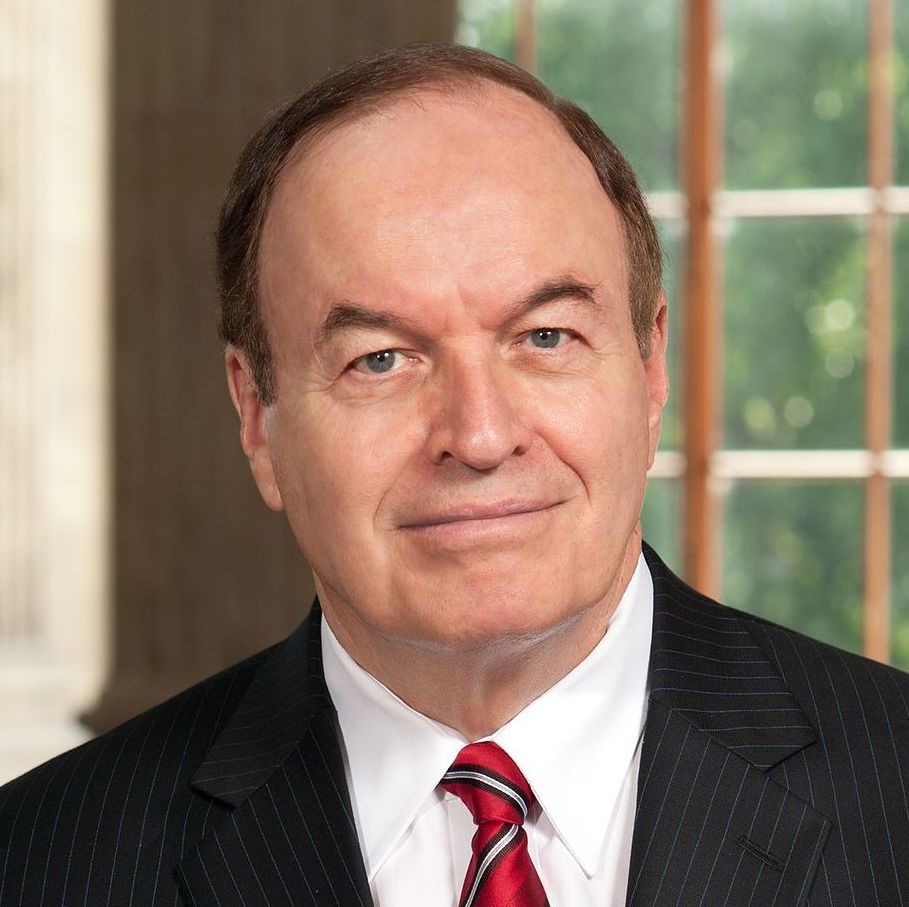
U.S. Senator Richard Shelby, R-Alabama
Shelby, 86, was elected to the U.S. House in 1978 and to the Senate in 1986, serving at various times as the chair of the appropriations, banking, intelligence and rules committees.
He was a Democrat until switching parties in 1994, as Alabama was transitioning from being solidly Democrat to solidly Republican and the GOP won control of Congress.
He routinely won re-election by large margins, mostly recently a 28-point win in 2016.
While his decision to retire is unlikely to open up a pickup opportunity for Democrats in solidly red Alabama, it is expected to trigger a free-for-all among Republicans vying to succeed him.
U.S. Rep. Mo Brooks from Huntsville and Secretary of State John Merrill have both indicated they are considering the race. Brooks ran unsuccessfully for the state’s other Senate seat in a special election in 2017; Merrill dropped out of the race for the same seat in 2020.
Other candidates being mentioned include U.S. Rep. Gary Palmer from Hoover; Katie Boyd Britt, a former Shelby aide who now runs the Business Council of Alabama; former U.S. Senator Jeff Sessions, who served a stormy tenure as attorney general in the Trump administration; and Bradley Byrne from Mobile, who gave up his U.S. House seat in 2020 to make an unsuccessful Senate run.
On key to the eventual make-up of the Senate field will be Governor Kay Ivey’s decision whether to seek another term as governor in 2022; if she doesn’t, some possible Senate candidates may opt for the governor’s race instead.
We tweet @ChkFriPolitics Join us!

25 new Southern U.S. House members, 2 senators sworn in Sunday
Freshmen group includes youngest member in nearly 60 years, wave of Republican women
♦By Rich Shumate, ChickenFriedPolitics.com editor
 WASHINGTON (CFP) — Members of the new 117th Congress will be sworn into office on Sunday, including 25 new Southern U.S. House members and two new Southern senators.
The Southern House freshmen include seven Republican women, part of a wave elected in November that more the doubled the number of GOP women in the chamber, and 25-year-old Madison Cawthorn of North Carolina, who is the youngest member of the House sworn in since 1965.
Also among the new Southern House members is former White House doctor Ronny Jackson, whom President Donald Trump tried unsuccessfully to elevate to Veterans Affairs secretary in 2018. He will represent now represent the Texas Panhandle.
Republican Stephanie Bice from Oklahoma City is making history as the first Iranian-American to serve in Congress. Her father emigrated from Iran in the 1970s.
Byron Donalds, the new member representing Southwest Florida, will be one of just two African American Republicans in the House and three in Congress overall.
Full list of new Southern House members at bottom of story
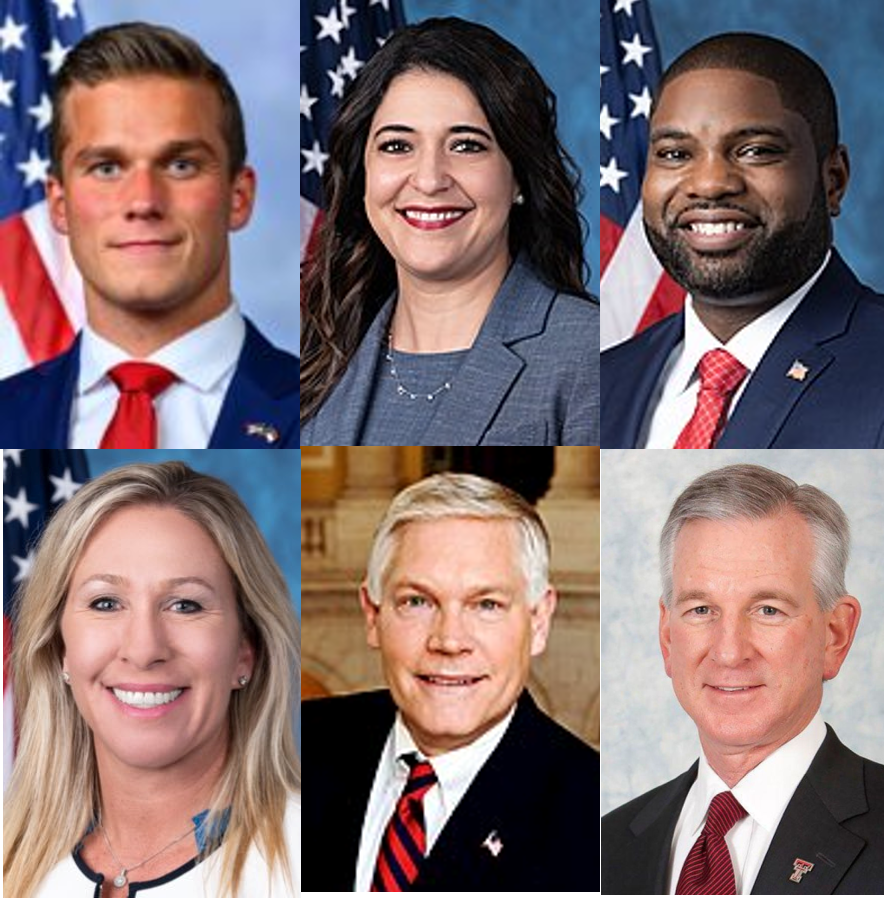
Clockwise from top left: Cawthorn, Bice, Donalds, Tuberville, Sessions, Greene
In the Senate, Tommy Tuberville, R-Alabama, and Bill Hagerty, R-Tennessee, will join a Southern contingent that now includes 25 Republicans and just three Democrats, after Tuberville defeated Doug Jones in November.
Lawmakers were sworn in during a rare Sunday session because the Constitution prescribes January 3 as the date for opening a new Congress.
Sunday’s House session is scheduled to include a moment of silence for Republican U.S. Rep.-elect Luke Letlow of Louisiana, who died from COVID-19 days before he was set to be sworn in.
While both the House and Senate were observing coronavirus precautions, including masks and social distancing, one new member from Georgia, Marjorie Taylor Greene, was spotted on the floor without a mask, prompting admonishment by House staff.
During orientation for new members, she had dismissed masks — which are required on the House floor — as “oppressive.”
Among the new members sworn in Sunday was one very familiar face — Republican Pete Sessions of Texas, who served 11 terms in the House before being defeated in 2018, then claiming a seat from a different district in November.
Sessions and Jackson are part of a group of seven new members from Texas, marking a turnover in nearly a fifth of the Lone Star State’s delegation amid a wave of retirements. All are Republicans.
Florida has five new members; Georgia, four; North Carolina, three; and Alabama, two. Oklahoma, South Carolina, Tennessee and Virginia each have one new member. Delegations from Arkansas, Kentucky, Mississippi and West Virginia were unchanged.
Eleven of the 25 new Southern members are women (seven Republicans and four Democrats), part of the largest group of women (121) ever sworn into a single Congress. The new Congress will also feature a record number of Republican women at 29, up from 13 in the last Congress.
The service of one Southern House member in the 117th Congress will be brief — Cedric Richmond, a New Orleans Democrat who will leave to become a senior aide to President-elect Joe Biden once he is sworn in on January 20.
Special elections will be held in Louisiana for Richmond and Letlow’s seats in March; neither are expected to change hands between parties.
The Constitution requires members of the House to be at least 25 years of age, a threshold Cawthorn met in August after winning the Republican primary in his Western North Carolina district. He will be the youngest House member since Jed Johnson Jr., a Democrat who represented Oklahoma for a single term between 1965 and 1967.
Sessions represented a Dallas-area seat during his first stint in the House, which he lost in 2018 to Collin Allred. Rather than try to reclaim it in 2020, he ran in a vacant seat in a district that includes Waco, where he grew up.
Of the 25 new Southern members, 21 were Republicans and just four were Democrats. Overall, Republicans hold 99 Southern seats and Democrats 52, with Letlow’s seat vacant.
Four Southern states — Arkansas, Oklahoma and West Virginia — have no Democrats in their House delegations, while five others — Alabama, Kentucky, Louisiana, Mississippi and South Carolina — have just one.
In only one Southern state do Democrats hold a majority of seats, Virginia, which is sending seven Democrats and only four Republicans to Washington.
Here is a list of new Southern House members, by state:
Alabama
Jerry Carl, R, 1st District (Mobile, South Alabama)
Barry Moore, R, 2nd District (Montgomery, southwest Alabama)
Florida
Kat Kammack, R, 3rd District (Gainesville, North-Central Florida)
Scott Franklin, R, 15 District (Lakeland, eastern Tampa suburbs)
Byron Donalds, R, 19th District (Fort Myers, Southwest Florida)
Carlos Giménez, R, 26th District (south Miami-Dade, Florida Keys)
Maria Elvira Salazar, R, 27th District (Miami-Dade)
Georgia
Nikema Williams, D, 5th District (Atlanta)
Carolyn Bourdeaux, D, 7th District (northeast Atlanta suburbs)
Andrew Clyde, R, 9th District (Gainesville, Northeast Georgia)
Marjorie Taylor Greene, R, 14th District (Rome, Northwest Georgia)
North Carolina
Deborah Ross, D, 2nd District (Raleigh)
Kathy Manning, D, 6th District (Greensboro)
Madison Cawthorn, R, 11th District (Western North Carolina)
Oklahoma
Stephanie Bice, R, 5th District (metro Oklahoma City)
South Carolina
Nancy Mace, R, 1st District (Charleston, Low Country)
Tennessee
Diana Harshbarger, R, 1st District (Tri-Cities, East Tennessee)
Texas
Pat Fallon, R, 4th District (Northeast Texas)
August Pfluger, R, 11th District (Midland, San Angelo, west-central Texas)
Ronny Jackson, R, 13th District (Amarillo, Wichita Falls, Panhandle)
Pete Sessions, R, 17th District (Waco, central-east Texas)
Troy Nehls, R, 22nd District (western Houston suburbs)
Tony Gonzales, R, 23rd District (West Texas)
Beth Van Duyne, R, 24th District (metro Dallas-Forth Worth)
Virginia
Bob Good, R, 5th District (Charlottesville, central Virginia)
We tweet @ChkFriPolitics Join us!

Most Southern Republican U.S. House members break with Trump on 2 key votes
Only 18 join Trump’s push for $2,000 coronavirus relief checks, while 51 vote to sustain veto of defense spending bill
♦By Rich Shumate, ChickenFriedPolitics.com editor
WASHINGTON (CNN) — Southern U.S. House Republicans were largely unswayed by President Donald Trump’s call for larger coronavirus relief checks in a key vote Monday, and most of them then voted to override the president’s veto of a defense spending bill that had passed earlier in the month with broad bipartisan support.
Trump had threatened to veto a coronavirus funding bill because it did not provide Americans with more generous relief checks, before signing it Sunday. But House Democrats brought a stand-alone bill to the floor to increase checks from $600 per person to $2,000, and 44 Republicans joined with almost all of the Democrats to pass it by a margin of 275 to 134 and send it to the Senate.
However, among the 99 Southern Republicans in the House, just 18 joined in the effort to make relief checks more robust — Reps. Robert Aderholt of Alabama; James Comer and Hal Rogers of Kentucky; Rick Crawford of Arkansas; Mario Diaz-Balart, Francis Rooney and John Rutherford of Florida; Michael Burgess, Kay Granger, Bill Flores, Will Hurd, Mike McCaul and Pete Olson of Texas; Clay Higgins of Louisiana; Tom Cole and Frank Lucas of Oklahoma; David McKinley of West Virginia; and Denver Riggleman of Virginia.
Hours later, the House, as expected, overrode Trump’s veto of the National Defense Authorization Bill, with 109 Republicans, including 51 Southern Republicans, voting in favor of the first successful veto override of his presidency.
Just 35 Southern Republicans voted to sustain the president’s veto including 12 Southern Republicans who had voted for the defense bill but switched sides on the override vote — Comer, Diaz-Balart, Burgess, McKinley, Rick Allen of Georgia, Scott DesJarlais of Tennessee, Kevin Hern of Oklahoma, Barry Loudermilk of Georgia, Carol Miller of West Virginia, Gary Palmer of Alabama, John Rose of Tennessee, and Bruce Westerman of Arkansas. Greg Steube of Florida, who did not vote when the bill came to the floor, also voted against the override.
Five other Southern Republicans who supported the bill’s passage opted not to oppose Trump on the veto override and did not vote — Reps. Andy Barr of Kentucky, Gus Bilirakis of Florida, Kenny Marchant of Texas, Markwayne Mullin of Oklahoma, and Phil Roe of Tennessee. Jody Hice of Georgia, who opposed the bill, also did not vote on the override.
Twenty-two Southern Republicans opposed both the original bill and the veto override, including House Minority Whip Steve Scalise of Louisiana and Trump’s most vocal defender in the House, Rep. Matt Gaetz of Florida.
All 50 Southern Democrats serving in the House voted for the $2,000 checks and the veto override.
Trump vetoed the defense spending bill because he objected to a provision requiring name changes for military bases named for Confederate officials, mostly in the South. He also wanted Congress to repeal an unrelated provision that protects digital media companies from liability for posting third-party content.
The veto put Republicans in the awkward position of choosing between loyalty to Trump and supporting a bill to fund military operations, including pay raises for the troops.
After the House override, Trump took to Twitter to denounce the action as “a disgraceful act of cowardice and total submission by weak people to Big Tech.”
The bill had passed December 8 by a veto-proof margin of 335 to 78, with the support from 140 Republicans. The veto override is expected to clear the Senate.
However, the boost in relief checks is expected to have a much more difficult time in the Senate, where members have expressed concerns about the $300 billion cost of nearly the tripling the amount of the payments.
 Chicken Fried Politics