
Home » Decision 2022 (Page 3)
Category Archives: Decision 2022


Bromance Bye: Donald Trump pulls Mo Brooks endorsement in Alabama U.S. Senate race
Trump says Brooks became “woke” in suggesting Republicans stop dwelling on 2020
♦By Rich Shumate, ChickenFriedPolitics.com editor
 MONTGOMERY (CFP) — Donald Trump has rescinded his endorsement of Alabama U.S Senate candidate U.S. Rep. Mo Brooks, accusing him of becoming “woke” for urging Republicans to put the results of the 2020 election behind them and focus on the future.
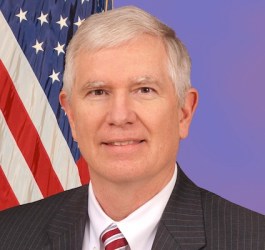
Alabama U.S. Senate candidate Mo Brooks
Trump’s decision is a blow to Brooks’s struggling campaign – but it could also save Trump from what increasingly looked to be an embarrassing defeat by his anointed candidate in the state’s May 24 primary.
It is also likely to set up a spirited chase to get Trump’s seal of approval between Brooks’s Republican rivals, Katie Britt and Mike Durant.
After the announcement, Brooks issued a statement calling Trump’s decision “disappointing” but insisting that he could not do what Trump wanted — try to overturn Joe Biden’s election win after Congress finalized it on January 6, 2021, when rioters stormed the U.S. Capitol.
“I’ve told President Trump the truth knowing full well that it might cause President Trump to rescind his endorsement,” Brooks said. “But I took a sworn oath to defend and protect the U.S. Constitution. I honor my oath. That is the way I am. I break my sworn oath for no man.”
Even after Trump voted him off the island, Brooks reiterated his allegiance to the former president, saying he was the “only proven America First candidate in this Senate race” and “the only candidate who fought voter fraud and election theft when it counted, between November 3 and January 6.”
He also accused Senate Republican leader Mitch McConnell of manipulating Trump into pulling the endorsement, although he didn’t explain how.
The denouement between Trump and Brooks is the end of what was once a fervent political romance, capped by Brooks’s fiery speech before the January 6th Capitol riot in which he told the crowd that “today is the day American patriots start taking down names and kicking ass.”
But things started to turn during a Trump rally last August in Cullman, when Brooks was booed by the crowd after saying that Trump partisans upset by the 2020 results should “put that behind you.”
In his statement withdrawing his endorsement, Trump said that when he heard that statement, “I said, ‘Mo, you just blew the Election, and there’s nothing you can do about it,” even though he continued supporting Brooks for seven more months.
Brooks had also refused for months to say he would oppose Trump nemesis McConnell as Senate party leader, before finally blasting him as “a weak-kneed, debt junkie, open-border RINO Republican” amid rumors that Trump was about to pull his support.
Brooks, 67, has represented North Alabama in the House since 2011. In 2017, he ran for Senate in a special election, coming in third in the Republican primary.
This time around, Brooks has lagged in polling and fundraising behind Britt, a former aide to retiring U.S. Senator Richard Shelby, and Durant, a businessman and former Army officer whose helicopter was shot down in Somalia in 1993, an episode immortalized in the film “Black Hawk Down.”
They are running to replace Shelby, an Alabama political legend retiring after six Senate terms. He has endorsed Britt.
In his statement pulling his Brooks endorsement, Trump said he expected to endorse a candidate in the race “in the near future.” Reuters reported that both Britt and Durant had met with Trump in recent days.
We tweet @ChkFriPolitics Join us!

Texas U.S. House Primaries: Incumbents Henry Cuellar, Van Taylor forced into runoffs
Republican U.S. Rep. Dan Crenshaw crushes opponents angry over his criticism of Donald Trump
♦By Rich Shumate, ChickenFriedPolitics.com editor
 AUSTIN (CFP) – Two incumbent Texas U.S. House members, Democrat Henry Cuellar and Republican Van Taylor, have been forced into primary election runoffs after narrowly failing to gain outright majorities in Tuesday’s primary.

U.S. Reps. Henry Cuellar and Van Taylor forced into primary runoffs
In District 28 in South Texas, Cuellar has an 800-vote lead over Laredo immigration attorney Jessica Cisneros, in a rematch of their 2020 contest. They will face each other again May 24, after neither cleared 50%.
In District 3 in suburban Dallas, Taylor –- under fire from Donald Trump supporters for voting to certify President Joe Biden’s Electoral College win and supporting a congressional investigation into the January 6th riot at the U.S. Capitol – came in 48.7% in a race against four challengers.
However, a day after the primary, Taylor withdrew from the race after admitting to an extramarital affair, which will give the nomination to the second place finisher, former Collin County Judge Keith Self.
In other U.S. House races Tuesday, Republican U.S. Rep Dan Crenshaw survived a challenge from primary opponents upset over his criticism of Trump. Crenshaw, a former Navy SEAL seen as one of the party’s rising stars since his election in 2018, took 75% to crush three opponents in District 2 in suburban Houston.
In District 8 in suburban Houston, Morgan Luttrell, a Navy veteran and former adviser in the U.S. Department of Energy who had the backing of Republican leaders in Washington, won 53% in the GOP primary to avoid a runoff.
The contest had been seen as a proxy fight over the future direction of the party between Luttrell and Christian Collins, a political consultant and podcaster who was backed by far-right voices in the House Freedom Caucus. In the end, Luttrell beat Collins by more than 30 points.
In District 28, which stretches from the suburbs of San Antonio to the U.S.-Mexico border, Cuellar took 48.5% of the vote to 45.6% for Cisneros.
Cisneros is running with strong backing of luminaries on the Democratic left in her bid to unseat the more conservative Cuellar, who opposes gun control and is the last pro-life Democrat left in the House.
While Cisneros swept the more urban parts of the district, Cuellar rolled in rural areas and in Laredo, where he has been a political fixture for decades. He went ahead when results from Starr County were finally reported early Wednesday, where he took 70% of the vote.
Cuellar is also running under the shadow of a January FBI raid on his home and office, related to an investigation of donations connected to Azerbaijan. He has denied any wrongdoing.
Republicans, buoyed by Trump’s strong showing among Hispanic voters in South Texas in 2020, have targeted the district as a pick-up opportunity.
The Republican race is headed to a runoff between Cassy Garcia, a former aide to Texas U.S. Senator Ted Cruz, and Sandra Whitten, who was the party’s nominee for the seat in 2020.
In Dallas, the Democratic race to replace retiring U.S. Rep. Eddie Bernice Johnson in District 30 is headed to a runoff between State Rep. Jasmine Crockett, who took 48%, and Jane Hope Hamilton, a former congressional aide who served as state director for the Biden campaign in 2020, who took 17%.
The winner is likely headed to Congress from the heavily Democratic district. Johnson has endorsed Crockett as her successor.
In Austin, in the Democratic primary for the open District 35 seat, Austin City Councilman Greg Casar won the race without a runoff, making him the favorite to win in November in the heavily Democratic district.
We tweet @ChkFriPolitics Join us!

Texas Primary: Attorney General Ken Paxton forced into runoff with George P. Bush
Republican Governor Greg Abbott and Democrat Beto O’Rourke win big in governor primaries, setting up November clash
♦By Rich Shumate, ChickenFriedPolitics.com editor
 AUSTIN (CFP) — Texas Attorney General Ken Paxton, facing criminal charges and an FBI investigation triggered by his own former aides, will now also have to survive a Republican runoff to keep his job after failing to capture a majority in Tuesday’s primary in his bid for a third term.
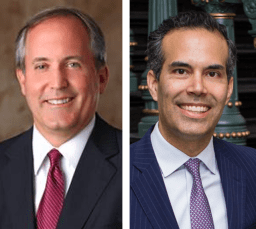
Ken Paxton and George P. Bush
His opponent in the May runoff will be Land Commissioner George P. Bush, setting up a high-voltage contest between one of Donald Trump’s most vocal supporters and a scion of a Texas political family known for holding the former president in minimum high regard.
Tuesday’s primary also set up, as expected, a high-profile November match-up between Republican Governor Greg Abbott and Democrat Beto O’Rourke, both of whom easily won their party’s primaries.
Republican Agriculture Commissioner Sid Miller also survived a primary challenge, defeating State Rep. James White with 59% of the vote, enough to avoid a runoff.
Miller had run into political headwinds after a series of battles with state legislators and the indictment of a former campaign consultant on bribery charges related to hemp licenses overseen by his office.
Republican Lieutenant Governor Dan Patrick also won renomination and will now face the winner of a Democratic runoff between Mike Collier, a former oil company executive from Georgetown who lost to Patrick by 5 points in 2018, and State Rep. Michelle Beckley from Carrollton.
Despite his legal and ethical problems, Paxton finished first among Republicans, buoyed by the endorsement of Donald Trump; Paxton had been a vocal supporter of Trump’s legal fights to overturn Joe Biden’s victory in the 2020 election.
Paxton received 42% of the primary vote, compared to 22% for Bush, the son of former Florida Governor Jeb Bush and nephew of former Texas governor and President George W. Bush. Former state Supreme Court Justice Eva Guzman came in third at 18%.
Tuesday’s primary ended, for the moment, the political career of U.S. Rep. Louie Gohmert, the controversial pro-Trump conservative voice who gave up his safe House seat to parachute into the attorney general’s race, where he got just 17% of the vote.
Paxton is under indictment for securities fraud and is also under investigation by the FBI after former top aides in his office accused him of bribery. They are also suing him after he fired them.
Trump, who has endorsed Paxton, has had a frosty relationship with the Bush family, particularly George P. Bush’s father, Jeb Bush, whom he defeated in the 2016 Republican presidential race.
However, George P. Bush has taken a different line from much of his family, casting himself as a Trump supporter in an effort to avoid fallout from his family name.
Democrats will also have a runoff for attorney general between Rochelle Garza, an immigration lawyer and former ACLU staff attorney from Brownsville, and former Galveston Mayor Joe Jaworski.
Paxton’s primary opponents have argued that given the ethical clouds that surround him, his nomination would risk losing the seat to Democrats in November.
No Democrat has won a statewide office in Texas since 1994.
In the governor’s race, Abbott will be seeking a third term against O’Rourke, a former congressman from El Paso who lost a close race for U.S. Senate in 2018 and then made an early exit from the 2020 Democratic presidential nomination after failing to gain traction.
Abbott had been challenged from the right by former State Senator Don Huffines and Allen West, who resigned as state GOP chair to run for governor. Both had criticized Abbott for his handling of the COVID-19 pandemic, but Trump’s early endorsement of the governor took the wind out of their anti-establishment campaigns.
We tweet @ChkFriPolitics Join us!
North Carolina Supreme Court strikes down Republican-drawn U.S. House, legislative maps
Court says politically gerrymandered maps violate state constitution, orders legislators to try again
♦By Rich Shumate, ChickenFriedPolitics.com editor
 RALEIGH (CFP) – North Carolina’s Supreme Court has struck down political maps drawn by Republican legislators to maximize their political advantage over the next decade, a victory for Democrats in one of the country’s most evenly divided swing states.
In a February 4 decision, the high court, which has a 4-to-3 Democratic majority, said maps drawn for U.S. House seats and state legislative districts were gerrymandered for political reasons in violation of the state constitution.
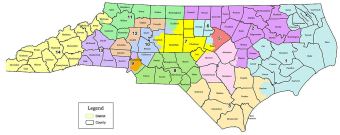 The court gave legislators just two weeks, until February 18, to redraw the maps, or a lower court will take over the process. It did not delay the scheduled May 17 primary but said that election must use the new maps.
“Achieving partisan advantage incommensurate with a political party’s level of statewide voter support is neither a compelling nor a legitimate governmental interest,” said the majority ruling, penned by Associate Justice Robin Hudson, a Democrat.
The court also ordered legislators to avoid chopping up counties into multiple districts whenever possible – a direct shot at the Republican map, which divided Mecklenberg and Guilford counties into three districts each to dilute the Democratic vote in Charlotte and Greensboro.
In a sharply worded dissent, Chief Justice Paul Newby, a Republican, accused the court’s Democratic majority of usurping the legislature’s power to decide redistricting, suggesting that amounted to “judicial despotism”
“A majority of this court … tosses judicial restraint aside, seizing the opportunity to advance its agenda,” Newby wrote.
North Carolina is one of just six states where judges are elected on a partisan basis.
Although North Carolina is closely competitive between Democrats and Republicans, the U.S. House map drawn by Republican legislators would have likely given the GOP 10 of the state’s 14 seats, compared to the current line-up of eight Republicans and five Democrats. (The state gained a new seat during reapportionment after the 2020 census.)
The legislative maps would also have cemented Republican control of both houses of the legislature over the next decade.
Democratic Governor Roy Cooper did not have the power to veto the maps, drawn by Republicans who control both houses of the legislature, forcing Democrats to go to court to try to reverse them.
The biggest beneficiary of the court’s decision may be freshman Democratic U.S. Rep. Kathy Manning, whose district in Greensboro and Winston-Salem was dismembered in the invalidated map. She had not announced her re-election plans, pending resolution of the legal challenge.
Another Democrat, U.S. Rep. G.K. Butterfield –- a former chair of the Congressional Black Caucus who sat on the state Supreme Court before his election to Congress — retired after legislators made his district in rural Eastern North Carolina more competitive by reducing its population of black voters.
Democratic U.S. Rep. David Price from Chapel Hill also announced his retirement, even though his district was left largely intact.
After Republican legislators passed their map, U.S. Rep. Madison Cawthorn announced that he would leave his current district in far Western North Carolina and run instead in a more Republican district just to the east that included suburban Charlotte. Those plans may be upended once the map is redrawn.
Another candidate who may be affected is Clay Aiken, the “American Idol” finalist who announced he would run as a Democrat for Price’s seat. Although the new map is not likely to change that district, had it stood, Aiken may have faced a primary contest against Manning, rather than a easier run for an open seat.
Cooper hailed the court’s decision in a statement, saying “a healthy democracy requires free elections and the NC Supreme Court is right to order a redraw of unconstitutionally gerrymandered districts.”
“More work remains and any legislative redraw must reflect the full intent of this decision,” he said.
But Republican State Senator Ralph Hise, chair of the Senate’s redistricting committee, called the decision a “perverse precedent” that will be “nearly impossible to unwind.”
“Democratic judges, lawyers, and activists have worked in concert to transform the Supreme Court into a policymaking body to impose their political ideas,” Hise said.
We tweet @ChkFriPolitics Join us!

Hot or not, in or out: Our forecast of 2022’s most interesting Southern political races
Trump’s sway will be key metric in outcome of midterm elections across region
♦By Rich Shumate, ChickenFriedPolitics.com editor
 (CFP) — 2022 has dawned, and with it a mid-term election year in which most Southern states will decide who gets to be their governor and congressional races across the region will play a key role in deciding which party controls Congress.
Of the eight Southern states with open races for governor this year, seven will feature incumbents seeking re-election, with the only open race in Arkansas, where former Donald Trump spokesperson Sarah Huckabee Sanders appears on her way to victory.
Nine U.S. Senate seats will be up, with open races in Alabama and North Carolina and Georgia Democratic U.S. Senator Raphael Warnock battling for a full term after winning a special election runoff in 2020.
Here is a look at some of the hottest races, and likely biggest political stories, of the upcoming year.
Reapportionment Primary-Palooza
The redrawing of new U.S. House maps after reapportionment has set up two Southern primary contests, one in each party, where incumbents will need to defeat a current colleague to stay in Congress.
In Georgia, Republican mapmakers have pitted Democratic U.S. Reps. Lucy McBath and Carolyn Bourdeaux against each other in Atlanta’s suburbs. McBath’s existing district in the northwest suburbs became too Republican for her to survive; Bourdeaux’s in the northeast suburbs actually became more Democratic with the addition of areas that had been in McBath’s orbit.
The two women — who campaigned with each other in 2018 and 2020 and differ little politically — will face off in what is likely to be an expensive primary. McBath has a stronger national profile and fundraising operation, but the district now centers on Gwinnett County, which Bourdeaux currently represents.
One caveat is that voting rights groups are suing the block the new map, which, if successful, could provide a wrinkle ahead of the March filing deadline.
In West Virginia, the loss of one of the state’s three U.S. House seats sets up a primary contest between Republican U.S. Reps. David McKinley and Alex Mooney for a new district that includes the northern half of the state.
However, this race will have more of an ideological flavor than the primary in Georgia. Mooney, a former Washington lobbyist who moved to the state in 2014 from Maryland to run for Congress, is a member of the ultra-conservative, anti-establishment Freedom Caucus. McKinley, a seventh-generation West Virginian and former state party chair, is more aligned with the Republican Party’s establishment wing.
Expect to hear a great deal in this race about McKinley’s vote in favor of establishing a bipartisan commission to investigation the January 6th attack on the U.S. Capitol, which Mooney opposed.
The Power of Trump
The former president has already been active in offering endorsements and pursuing revenge, particularly against Georgia Governor Brian Kemp and Secretary of State Brad Raffensperger for refusing to indulge his claims of widespread fraud in the state’s 2020 vote.
Trump recruited former U.S. Senator David Perdue to run against Kemp, setting off what is likely to be a bare-knuckled brawl in the Republican primary ahead of a stiff challenge from Democrat Stacey Abrams. He also endorsed U.S. Rep. Jody Hice’s bid to unseat Raffensperger.
And in one of the strangest early developments of the 2020 campaign, Trump also reportedly encouraged his former ambassador to Slovenia, Lindy Blanchard, to drop out of the U.S. Senate race to run instead against the very popular Alabama Governor Kay Ivey, in a fit of pique over cancellation of a July 4th Trump rally (a decision Ivey did not actually make.)
Trump has also waded into the attorney general’s race in Texas with an endorsement of incumbent Ken Paxton, who has drawn a gaggle of primary challengers (including Bush family scion George P. Bush and stalwart pro-Trump U.S. Rep. Louie Gohmert) after a criminal indictment and FBI bribery investigation.
Taking down Ivey would seem a long shot at this point; Kemp is holding his own against Perdue in early polls; and Paxton race seems likely to be headed to an unpredictable runoff in March. So it remains to be seen whether the Trump endorsement machine will produce results in 2022.
Trump has also endorsed in three U.S. Senate races. In Georgia, his nod put Herschel Walker on a glide path to the Republican nomination, but his chosen candidates in Alabama (U.S. Rep. Mo Brooks) and North Carolina (U.S. Rep. Ted Budd) are facing tough primary battles against more establishment candidates.
Adding to the MAGA Squad
Trump’s election has led to the rise of a core group of MAGA-philes in the House – social media savvy, outspoken, and willing to pounce on fellow Republicans who display the slightest scrap of bipartisanship. Among this group are Georgia’s Marjorie Taylor Greene, Florida’s Matt Gaetz, the aforementioned Gohmert and Brooks, and North Carolina’s Madison Cawthorn.
In 2022, they are hoping to add to their numbers by offering endorsements and fundraising help to like-minded candidates across the South and around the country, which will put them in position to be power brokers if Republicans take control of the House (a prospect likely to give House Republican leader Kevin McCarthy heartburn.)
Some of these candidates are little known and will face tough climbs against incumbent Republicans. But it is worth noting that both Greene and Cawthorn followed this same playbook successfully in 2020, going from unknowns to the halls of Congress with lightning speed.
Southern Black Woman in the U.S. Senate?
No black woman has ever been elected to represent a Southern state in the Senate. This year, Democrats are poised to pick two black women as their Senate nominees – U.S. Rep. Val Demings in Florida and Cheri Beasley in North Carolina.
Demings, the former police chief of Orlando who served on the first House impeachment committee that investigated Trump, faces an uphill climb against Republican U.S. Senator Marco Rubio, particularly with his strong core of support among Hispanic voters in South Florida. But with her national profile, she has been posting strong fundraising numbers that could make the race competitive.
Beasley, the former chief justice of the North Carolina Supreme Court, may have better prospects in running for an open seat in a race where Republicans are slogging through a multi-candidate race in which Trump has intervened in favor of Budd.
A victory by either in November will make history.
Palmetto State “RINOs”
The most serious insult that can be hurled in Republican politics these days is to call someone a RINO – a Republican in Name Only.
Two incumbent U.S. House members in South Carolina have been branded with the RINO label by their critics – Nancy Mace in the Lowcountry and Tom Rice in the Pee Dee – and are each facing multiple challengers in their respective Republican primaries.
Mace was among the few Republican House members to offer criticism of Trump after the January 6th Capitol attack, although she did not vote to impeach him. Rice did, which got him censured by the state’s Republican Party, and he compounded his sin among the MAGA fervency by supporting the bipartisan commission to investigate the attacks.
As a result, Mace has four GOP challengers; Rice has 12. Trump has encouraged their challengers but has yet to announce a favorite. His blessing may be good enough to earn a runoff slot against the incumbent.
Thinking Outside The Box
After Warnock won a January special U.S. Senate election runoff in Georgia, he immediately become the Republicans’ primary 2022 target. Yet, no sitting U.S. House member ventured to take him on, nor did the three Republicans who ran against him in 2020.
Enter Herschel Walker, University of Georgia football hero and NFL standout. Though he carries significant personal baggage and has not a whiff of political experience, he does have the one accessory every Republican candidate wants in 2022 – Trump’s blessing.
Trump’s endorsement didn’t clear the primary field, but it did get Republican Senate leaders in Washgington behind Walker’s candidacy – taking a significant leap of faith in a race against a charismatic Democrat with Obama-level political skills.
Is this a gamble that will pay off or blow up? The answer may decide control of the Senate.
Beto O’Crist for Governor
The good people of Texas told Beto O’Rourke that they didn’t want him to be their senator in 2018, even after he spent $80 million trying to persuade them otherwise. The good people of Iowa and New Hampshire told him they didn’t want him to be their president in 2020, without nearly as much money going down the drain.
But not willing to take no and no for an answer, O’Rourke is back again, running this time for governor against incumbent Republican Greg Abbott. Only this time, he’s running in the gun-loving Lone Star State after telling a Democratic presidential debate audience that he was in favor of confiscating their assault weapons.
But lest you think Beto is the region’s most resolute embracer of questionable causes, he pales in comparison to Florida’s well-tanned political chameleon Charlie Crist, who is running for governor again this year after losing two statewide races in the past eight years and metamorphosing from a conservative Republican into an independent and then into a liberal Democrat.
Which begs the question: What part of “no” don’t you understand?
 Chicken Fried Politics