
Home » Florida (Page 14)
Category Archives: Florida

Florida U.S. Rep. Ileana Ros-Lehtinen breaks ranks with GOP leaders on health care bill
Florida congresswoman says Obamacare replacement would leave too many of her constituents uninsured
♦By Rich Shumate, Chickenfriedpolitics.com editor
 MIAMI (CFP) — U.S. Rep. Ileana Ros-Lehtinen has become the first House Republican to break ranks with her party’s leadership to oppose a new plan to repeal and replace Obamacare.

U.S. Rep. Ileana Ros-Lehtinen, R-Fla.
R0s-Lehtinen, who represents the 27th District in Miami-Dade County, announced her decision to oppose the bill March 14 on her Twitter feed:
“I plan to vote NO on the current ACHA bill. As written the plan leaves too many from my SoFla district uninsured. As AHCA stands, it will cut much needed help for SoFla’s poor (and) elderly populations. Need a plan that will do more to protect them.”
ACHA stands for the American Health Care Act, which is the formal name of the GOP bill.
In a subsequent statement, Ros-Lehtinen said that after studying the bill and hearing from her constituents, she concluded “too many of my constituents will lose insurance and there will be less funds to help the poor and elderly with their health care.” However, she made it clear that she would support changes in the existing Affordable Care Act, commonly known as Obamacare.
“I voted to repeal Obamacare many times because it was not the right fix for our broken healthcare system and did not live up to its promise to the American people, but this plan is not the replacement South Florida needs,” she said. “We should work together to write a bipartisan bill that works for our community and our nation without hurting the elderly and disadvantaged among us.”
Democrats have not participated in crafting the Republican health care replacement bill, being pushed by House Speaker Paul Ryan. The plan has also run into opposition from his own caucus, both from more conservative members who feel it keeps too many features of Obamacare and more moderate members who fear its impact on Americans who have managed to gain coverage under the existing plan.
Ros-Lehtinen falls into the latter category. She is also one of only six Southern Republicans who represent a House district that Democrat Hillary Clinton carried in the presidential election last year.
Clinton carried the district by nearly 20 points, her largest margin of victory in any Southern GOP-held district. The majority-Latino district is anchored by Miami’s Cuban-American community.
Ros-Lehtinen became the first Cuban-American to serve in Congress when she was elected in 1989. She has broken with her party leadership in the past, most notably in her support for same-sex marriage.
Analysis: Results in Confederate namesake counties show role of race in Democratic decline
Trump accelerates Republican shift in counties named for Jefferson Davis and Robert E. Lee
♦By Rich Shumate, Chickenfriedpolitics.com editor
 (CFP) — Jefferson Davis and Robert E. Lee loom large as icons of the Southern Confederacy, so much so that 11 Southern counties and one Louisiana parish bear their names. But if these lions of the South are aware of what is happening in their namesake counties today, they may be rotating in their graves.
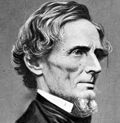
Confederate President Jefferson Davis
Changes in presidential voting in these counties over the past 40 years illustrate just how far the Black Republicans against which Lee and Davis fought are now transcendent—and the alarming (for Democrats) degree to which white Southerners have forsaken their traditional political roots.
Of course, the South’s march toward the GOP is not news. Today, the term “Solid South” has an entirely different connotation than it did during the days of FDR or Lyndon Johnson. However, these namesake counties do provide a window into how these shifts in party preference have occurred over time and the role that race played in them.

Confederate General Robert E. Lee
The 2016 presidential results also show that the Republicanization of the South is accelerating in these counties that bear the mark of Southern heritage, which bodes ill for future Democratic prospects.
In 1976, when Democrat Jimmy Carter became the first Southerner to win the White House since Zachary Taylor in 1848, he carried nine of the 12 Davis and Lee counties. By 1992, Bill Clinton and George H.W. Bush were splitting them six-to-six.
By 2000, Republican George W. Bush had flipped nine of the 12 namesake counties his way; his average share of the total votes cast for the two major party candidates in those counties that year was an impressive 64 percent. But in 2016, Trump trumped the younger Bush, carrying those same nine counties with an average of 70 percent of the two-party vote.
In 1976, Republican President Gerald Ford’s share of the two-party vote topped 50 percent in just three namesake counties (in Florida, Alabama, and Kentucky). But by 2016, Trump’s share of the two-party vote was more than 50 percent in nine counties and parishes; above 60 percent in eight; above 70 percent in four; and above a whopping 80 percent in two (Georgia and Kentucky).
The most dramatic changes were in Jeff Davis County, Georgia, where native Georgian Carter carried 79 percent of the vote in 1976 and Trump won 81 percent in 2016, and Jefferson Davis Parish, Louisiana, where Carter won 62 percent and Trump 75 percent. However, even in majority black Lee County, Arkansas, Trump’s 16-point loss in 2016 was less than half of Ford’s 38-point defeat.
In addition to Lee County, Arkansas, the only namesake counties Trump lost in 2016 were Jefferson Davis County, Mississippi, and Lee County, South Carolina, which are also majority black. However, even in these three counties, Trump carried a larger share of the two-party vote in 2016 than Mitt Romney did in 2012.
In fact, Trump improved on Romney’s result in 11 of the 12 namesake counties, save only Jeff Davis County, Texas, where Trump had to settle for merely matching Romney’s total.
The results in these namesake counties over time also illustrate the role race has played in the political realignment of the South.
In all seven of the overwhelmingly white namesake counties, the Republican share of the two-party vote was higher in 2016 than in 1976, by an average of 29 percent. Trump did better than Romney by an average of 4 percent.
By contrast, in majority-black Lee counties in Mississippi and South Carolina, the Republican two-party share fell by an average 2.5 percent from 1976 to 2016, but Trump outperformed Romney by the same 2.5 percent. These results indicate that the white Southern shift to the Republicans appears stronger than the corresponding black shift to the Democrats.
This is borne out by the results in Lee County, Arkansas, which has the smallest African-American population of any of the majority-black namesake counties (55 percent). There, the Republican share of the two-party vote actually climbed 11 percent between 1976 and 2016, and Trump beat Romney’s total by 5 percent.
Two of the namesake counties—Lee County, Florida, and Jeff Davis County, Texas—are outliers in that they have significant Latino populations. The Republican share of the two-party vote in both of those counties was higher in 2016 than it was in 1976, but Trump’s results were down from the numbers put up in 2000 and 2004 by George W. Bush, who, for a Republican, ran strongly with Latino voters.
The results in the namesake counties also illustrate the mountain which Democrats need to climb if they are to reduce Republican hegemony in the South.
The Democratic base once included small towns and rural areas across the Southern landscape, as well as urban areas. In 2016, Democrats still held the cities (with newfound and welcome signs of life in suburban Atlanta and Houston) and the mostly small rural counties with majority black populations, such as the namesake counties in Arkansas, Mississippi and South Carolina. Democrats also do well in college towns such as Athens, Georgia, and Gainesville, Florida.
But Democrats’ failure to compete for the votes of small town and rural white voters is what is killing them electorally, as the results in the Davis and Lee namesake counties without black majorities vividly illustrates.
Only one of these namesake counties is urban—Lee County, Florida, which includes Fort Myers—and Lee County, Alabama, contains Auburn University. The rest of these counties and parishes are all rural, white areas where Messrs. Davis and Lee are no doubt remembered fondly and Jimmy Carter ran reasonably well—and where Hillary Clinton couldn’t get elected dog catcher if she handed out $20 bills at the polling booth.
As a barometer of the past, these namesake counties illustrate how far Democrats have fallen in their former strongholds. But if Trump’s improved results over Romney’s are a barometer of the future, the bottom may not yet have been reached.
Trump nominates Florida law school dean Alex Acosta as labor secretary
Acosta selected after Trump’s first nominee for labor post, Andrew Puzder, pulled out
♦By Rich Shumate, Chickenfriedpolitics.com editor
WASHINGTON (CFP) — Alex Acosta, the dean of Florida International University’s law school and a former federal prosecutor in Miami, has been named by President Donald Trump to be the nation’s next labor secretary.

FIU Law Dean Alex Acosta
The selection of Acosta to head the U.S. Department of Labor came a day after Trump’s first pick for the post, fast food magnate Andrew Puzder, withdrew from consideration after it became clear that he lacked enough votes for Senate confirmation.
Trump made the announcement February 16 during a media appearance at the White House, which Acosta did not attend.
“I think he’ll be a tremendous secretary of labor,” Trump said, after briefly ticking off items from Acosta’s resume, including the fact that he had already been confirmed by the U.S. Senate to three executive department posts.
If confirmed, Acosta will be the first, and so far only, Latino in the Trump cabinet.
Acosta, 48, a Cuban-American, has been dean at FIU’s law school since 2009. From 2005 to 2009, he served as U.S. attorney for the Southern District of Florida, which comprises nine counties in the southeastern part of the state.
From 2003 to 2005, Acosta headed up the U.S. Department of Justice’s Civil Rights Division in Washington, the first Latino to serve in that position. From 2002 to 2003, he was a member of the National Labor Relations Board.
Acosta was also a law clerk to now-U.S. Supreme Court Justice Samuel Alito from 1994 to 1995, when Alito was serving on the 3rd U.S. Circuit Court of Appeals.
His two positions in the Justice Department and his stint at the NLRB all required Senate confirmation. One of the senators who will decide on Acosta’s nomination for the labor post, Florida’s Marco Rubio said he was “a phenomenal choice” and predicted he would be approved.
“I look forward to his confirmation hearing, where I’m confident he will impress my colleagues and secure the support necessary to be the next secretary of labor,” Rubio said in a statement.
13 Southern U.S. House Democrats bow out of Trump inaugural
All of the no-shows represent districts carried by Hillary Clinton
♦By Rich Shumate, Chickenfriedpolitics.com editor
WASHINGTON (CFP) — Thirteen of the 40 Southern Democrats in the U.S. House have announced that they will not take part in the January 20 inauguration of Donald Trump.
Lawmakers from Florida, Georgia, Florida, Kentucky, Mississippi, North Carolina, Tennessee, Texas and Virginia are among the no-shows. All of the boycotting members represent urban or black-majority districts that were carried by Democrat Hillary Clinton.
Trump’s tweets castigating U.S. Rep. John Lewis, D-Georgia, for announcing an inauguration boycott seemed to particularly rankle some of the members opting not to attend; Trump’s reaction was called “repugnant,” “ignorant,” and “insensitive and foolish.”
“We are sending a message to Mr. Trump. Respect, like Pennsylvania Avenue, is a two-way street,” said U.S. Rep. Lloyd Doggett, D-Texas, who will be among the no-shows.
However, none of the three other Democrats in Lewis’s own Georgia delegation have joined the boycott. Also not joining so far is U.S. Rep. Debbie Wasserman Schultz, who, as head of the Democratic National Committee during the presidential campaign, had been a sharp Trump critic.
As for the contention by Trump supporters that the inauguration is a celebration not of him but of the peaceful transfer of power, U.S. Rep. Julian Castro, D-Texas, said, “Every American should respect the office of the presidency and the fact that Donald Trump will be the 45th President of the United States. But winning an election does not mean a man can show contempt for millions of Americans and then expect those very people to celebrate him.”
U.S. Rep. Gerry Connolly, D-Virginia, said Trump’s “behavior and harmful words during and after the campaign have left the country I love with open, bleeding wounds. Instead of binding those wounds, he has poured salt on them. Instead of unifying us, he has reveled in driving wedges between us.”
Trump won 108 of the 154 congressional districts across the South in the November election; none of them are represented by Democrats.
Lawmakers boycotting the inaugural are unlikely to pay a political price, as all but two of them represent districts that Clinton carried with at least 60 percent of the vote. However, U.S. Reps. Darren Soto, D-Florida, and John Yarmuth, D-Kentucky, come from districts where Clinton’s share was just 55 percent.
The list of boycotting Democrats includes:
Georgia
- John Lewis, D-Atlanta
Florida
- Alcee Hastings, D-Fort Lauderdale
- Darren Soto, D-Orlando
- Frederica Wilson, D-Miami-Dade
Kentucky
- John Yarmuth, D-Louisville
Mississippi
- Bennie Thompson, D-Jackson
North Carolina
- Alma Adams, D-Greensboro
- G.K. Butterfield, D-Wilson
Tennessee
- Steve Cohen, D-Memphis
Texas
- Lloyd Doggett, D-Austin
- Al Green, D-Houston
- Joaquin Castro, D-San Antonio
Virginia
- Gerry Connolly, D-Fairfax County
Analysis: Election results show Democrats are still a long way from being competitive in the South
Clinton performed worse in the South than Barack Obama in 2012
♦By Rich Shumate, Chickenfriedpolitics.com editor
 (CFP) — Prior to the November 8 election, Democrats were publicly hopeful that they might finally be turning back Republican hegemony in the South, to the degree that pro-Hillary Clinton ads were running not only in the battleground states of Florida and North Carolina but also in reliably Republican Georgia and Texas.
Election results show that thinking was not just wishful, it was magical.
In fact, Clinton did comparatively worse in the South than Barack Obama did four years ago (which, oddly, seems to undercut the notion that the South’s resistance to Obama was based on his race.) A look at regional and state-by-state figures in the presidential race shows just how grim election night was for Southerners with a D attached to their name.
Donald Trump carried 53.3 percent of the vote and 13 out of 14 Southern states. That performance was not as good as Mitt Romney’s in 2012, when he came in with 54.4 percent (although Romney only carried 12 states.) However, the performance gap between Trump and Clinton was actually larger than the gap between Romney and Obama because Clinton’s underperformance was even worse.
She took just 42.5 percent of the Southern vote; Obama won 44.3 percent. Some of that was due to a larger third-party vote which, at 4.2 percent, was about 3 points more than it was in 2012. However, the gap between the Republican and Democratic share of the vote went up everywhere except Texas and Georgia and the lone Southern state Clinton carried, Virginia.
A look at raw vote totals shows the degree to which Clinton hemorrhaged Obama supporters.
In Mississippi, Clinton’s raw vote total was nearly 101,000 less than Obama’s in 2012, a huge shift in a state where less than 1.2 million votes were cast. Given that African-Americans play an outsized role in the state’s Democratic base, Clinton’s numbers are a clear sign that black voters did not turn out for her as they did for Obama.
But if Mississippi was bad for Clinton, Appalachia was even worse — down 51,000 votes in Kentucky, 92,000 in Tennessee, and 52,000 votes in West Virginia, where Trump’s percentage of the vote soared 15 points above Romney’s number. Those three states together have 270 counties; she carried exactly five.
In Arkansas, where Clinton was first lady and her husband governor for 10 years, she lost 16,000 votes and managed just 33.6 percent of the vote, 3.3 points lower than Obama’s vote in 2012. At the same time, Trump’s vote went up 34,000 over Romney’s, a net difference of nearly 50,000 votes.
Even in Virginia, which Clinton won, her vote total was 11,000 less than what Obama put up in 2016. She won because Virginia Trump’s vote total came in less than Romney’s by about 59,000 votes.
Meanwhile, as Clinton’s vote was fading, Trump’s was surging, beating 2012 GOP totals in every state except Virginia and Mississippi.
In Florida, where a growing Latino population was supposed to lead Clinton to victory, Trump added 442,000 votes to Romney’s tally, while Clinton added just 245,000 to Obama’s. In North Carolina, he added 69,000; she lost 16,000 in a battleground state she visited repeatedly.
In total across the South, Trump added more than 1 million votes to Romney’s haul; Clinton managed to add 448,000 by offsetting her losses in 11 states with gains in Texas, Florida and Georgia.
This led to some remarkable net vote changes between the two parties — 128,000 in Alabama, 166,000 in Kentucky, 150,000 in Tennessee and 118,000 in West Virginia.
The only glimmer of light at the end of this dark tunnel for Democrats was their improved performance in both Georgia and Texas.
In the presidential race, Democrats closed the gap with Republicans from 8 to 5 points in Georgia and 16 points to 9 points in Texas. Clinton also carried two big suburban counties in Atlanta, Cobb and Gwinnett, that had not gone Democratic in 40 years, along with Fort Bend County in suburban Houston, normally a no-man’s-land for a Democrat.
So perhaps Democratic wistfulness for those two states may not have been entirely misplaced, although that’s cold comfort when Trump carried Florida and North Carolina on his way to the White House.
And if the presidential results were grim, the U.S. Senate races were just as bad. Republicans went eight-for-eight, with a race in Louisiana heading for a December 10 runoff in which Republican State Treasurer John Kennedy is favored to keep the seat in GOP hands.
Democrats didn’t even bother contesting Alabama, Oklahoma or South Carolina; they did recruit credible candidates in the rest of the races, such as Conner Eldridge in Arkansas, Jim Barksdale in Georgia and Jim Gray in Kentucky. But all lost by double-digit margins.
The Democrats’ best shots to pick up GOP-held seats were thought to be in Florida, where U.S. Rep. Patrick Murphy was challenging Marco Rubio, and in North Carolina, where Deborah Ross was challenging Richard Burr. Murphy lost by 8 points; Ross, by 7. Both actually underperformed Clinton in their states.
The only good news for Democrats came in races for governor in West Virginia, where Jim Justice kept the office in Democratic hands, and in North Carolina, where Democratic Attorney General Roy Cooper appears to have ousted Republican Governor Pat McCrory, although that race may be headed for a recount.
 Chicken Fried Politics