
Home » Florida (Page 21)
Category Archives: Florida

Florida Republicans discuss how new non-voting prisoners might sink U.S. Rep. Corinne Brown
Court-ordered redistricting has moved a number of state prisons into Brown’s district, decreasing the minority voting population
♦By Rich Shumate, Chickenfriedpolitics.com editor
 JACKSONVILLE (CFP) — Florida Republicans are hoping that court-ordered congressional redistricting will pack enough non-voting prisoners in U.S. Rep. Corinne Brown’s district to imperil the 12-term Democratic lawmaker.

U.S. Rep. Corrine Brown
Attendees at a meeting of North Florida Republicans held in August discussed the implications of a new configuration for Brown’s district that includes a number of prisons, which will drop the African-American voting population in the district and improve GOP prospects.
A recording of the meeting was originally obtained by Politico Florida.
Prefacing her remarks by making sure there were no reporters in the room, State Rep. Janet Adkins, R-Fernadina Beach, called the redistricting “a perfect storm” for Brown.
Adressing a Republican official from a Baker County, which is being added to Brown’s district and has a large prison population, she said, “You can be the person who can help get rid of Corrine Brown.”
“We do not take into consideration where these people live. It would not be constitutional to take into consideration where they live.”
Adkins later issued an email apologizing if her remarks “offended anyone,” explaining that the conversation was her attempt to explain the ongoing controversy over reapportionment.
Adkins comments were not new. In fact, they echo complaints Brown herself has made about including 18 state prisons in the newly configured 5th District. She has filed suit in U.S. District Court to block the redistricting, which had been ordered by the Florida Supreme Court after it stuck down the current congressional map in July.
A circuit court judge in Tallahassee began a hearing September 24 to choose among seven competing maps. The state Supreme Court will make the final decision.
State lawmakers were unable to agree on a redrawn map during a special session in August. However, both the House and Senate versions of the map change Brown’s district from a north-south configuration to an east-west alignment stretching from central Jacksonville west through counties along the Georgia border to the Tallahassee area.
That change would add rural areas of North Florida, including four counties that are home to a number of state prisons. Adkins alluded to that fact in her remarks at the meeting, asking the other attendees, “What’s the primary industry in North Florida?” The answer was “prisons.”
Because prisoners count toward the population size of a district but cannot vote, including the prisons will reduce the overall size of the voting age population. And to the degree that prison populations are disproportionately made up of minorities, the minority population of the district will drop as a result.
Brown’s current district has a black voting age population of 50 percent. The new district’s black voting age population is 45 percent, including the new felons who cannot vote.
The state Supreme Court ruled in July that Brown’s north-south district—which snaked through northeast and central Florida from Jacksonville to Orlando to pick up black voters and was at one point the width of a highway—violated two anti-gerrymandering amendments Florida voters added to the state constitution in 2010. It also struck down seven other districts, leading to a wholesale redrawing of the congressional map.
The high court ruled that lawmakers in the GOP-controlled legislature impermissibly drew the lines to improve their party’s electoral prospects, something the anti-gerrymandering amendments forbid.
Listen to a recording of the Republican meeting:
Poll: Bush, Rubio open up lead over Hillary Clinton in Florida
Clinton’s unfavorable rating in Florida climbs to 55 percent
♦By Rich Shumate, Chickenfriedpolitics.com
 GAINESVILLE, Florida (CFP) — U.S. Senator Marco Rubio of Florida and former Florida Governor Jeb Bush have opened up big leads over Democratic frontrunner Hillary Clinton in the presidential race in the key swing state of Florida, a new poll shows.
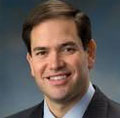
U.S. Senator Marco Rubio
The Quinnipiac Poll released August 20 also shows New York businessman Donald Trump and Bush leading among Florida Republicans; however, nearly 30 percent of state GOP voters say they would definitely not support the controversial Trump if he became the nominee.
In a hypothetical general election race, Bush bests Clinton 49 percent to 38 percent, well outside the poll’s margin of error of plus or minus 3 percent. Rubio does even better, 51 percent to 39 percent.

Former Secretary of State Hillary Clinton
The results are a marked change from the same poll in June, when Clinton held a slight lead over both Bush and Rubio. And in the latest poll, 55 percent of Florida voters had an unfavorable view of Clinton — up 10 points from June.
Nearly two-thirds of Florida voters — 64 percent — say Clinton is not honest or trustworthy.
Clinton even narrowly trails Trump, 43 percent to 41 percent, although that gap was within the margin of error.
In nine of the last 10 presidential elections, the winner of the presidential race in Florida also won nationally, making a victory in the Sunshine State vital for anyone who wants to capture the White House.
In the GOP primary race, Trump was the choice of 21 percent of Florida Republicans, with Bush at 17 percent, which was within the poll’s margin of error of plus or minus 4.5 percent. Rubio and retired neurosurgeon Ben Carson tied for third at 11 percent each.
However, 29 percent of Republican voters polled say they will definitely not support Trump if he is the nominee, a larger group than those now supporting him. And just 55 percent of the GOP voters polled view Trump positively, compared to 87 percent for Rubio and 81 percent for Bush.
Trump’s demeanor is also seen as a problem, with 64 percent saying he lacks the temperament and personality to handle an international crisis.
In the Democratic primary race, Clinton still maintains a wide lead in Florida, with support from 48 percent of Democrats polled. Senator Bernie Sanders of Vermont trails at 15 percent, and Vice President Joe Biden, who had yet to announce a 2016 White House bid, comes in at 11 percent.
In head-to-head matchups against Republicans, Biden runs slightly better against Rubio and Trump than does Clinton but slightly worse against Bush. The poll shows Sanders is weaker than Clinton against all three Republicans.
In the poll, 1093 Florida voters were interviewed, including 477 Republicans and 345 Democrats.
In 2016, the Florida primary will be held early in the primary calendar, on March 15, which is likely to give the state added prominence in the presidential nominating process.
The Florida GOP has also made its contest a winner-take-all affair, which means the winner gets a treasure trove of 99 delegates.
GOP U.S. Rep. David Jolly, facing a newly drawn district, switches to U.S. Senate race
Decision comes after the Florida Supreme Court orders changes likely to make Jolly’s district more Democratic
♦By Rich Shumate, Chickenfriedpolitics.com editor
ST. PETERSBURG, Florida (CFP) — In the wake of a Florida Supreme Court decision ordering changes in the state’s U.S. House map, Republican U.S. Rep. David Jolly has decided to jump into the open U.S. Senate seat in 2016, rather than face re-election in what will likely be a more Democratic district.
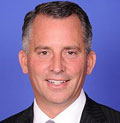
U.S. Rep. David Jolly
In a statement announcing his campaign July 20, Jolly, 42, who won his House seat in a special election in 2014, said he would run “on an unwavering platform that will reject the politics of division and class warfare that have defined the current administration.”
Lolly also called for creating “a new economy founded on the principle that individuals and families, not government bureaucrats, create success.”
Jolly’s entry into the Senate race adds to a crowded Republican field that already includes U.S. Rep. Ron DeSantis and Lieutenant Governor Carlos López-Cantera.
Jolly currently represents Florida’s 13th District seat in Pinellas County, in the Tampa Bay area. He succeeded the late GOP U.S. Rep. C.W. “Bill” Young, who held the seat for more than 42 years before his death in 2013.
Jolly’s win frustrated Democratic hopes of picking up one of only three Republican-held seats in the South that President Obama carried in 2012. He went on to re-election in the 2014 general election and was expected to run again in 2016.
But the Florida Supreme Court threw a monkey wrench into those plans July 9, ruling that the Republican-controlled state legislature unconstitutionally gerrymandered the map to help the GOP’s electoral prospects. The high court ordered the state legislature to redraw eight districts, including Jolly’s.
The Supreme Court objected to the legislature’s decision to shift African-American voters in St. Petersburg into the neighboring 14th District, across the bay in Tampa, to make the 13th more Republican-friendly, which justices said violated a requirement that districts be geographically compact wherever possible.
Shifting those voters back would have made Jolly’s swing district harder to retain.
The Supreme Court’s ruling might also force another U.S. House member into the Senate race on the Democratic side.
The court ruled that the 5th District — an oddly shaped district that snakes through northeast and central Florida from Jacksonville to Orlando to pick up black voters and is at one point the width of a highway — must be redrawn in an east-west configuration from Jacksonville towards the Panhandle.
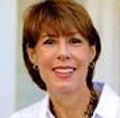
U.S. Rep. Gwen Graham
That change is likely to shift the Panhandle-based 2nd District , held by U.S. Rep. Gwen Graham, D-Tallahassee, to the south, which would make it more Republican and more difficult for her to carry. That prompted Democratic strategists to talk up a possible Graham Senate bid, although the congresswoman herself has remained non-committal.
Former Florida Governor Charlie Crist has announced he will seek the Democratic nomination for Jolly’s seat if the legislature, as expected, draws his St. Petersburg home into the district.
The Republican-turned-indepenent-turned-Democrat lost statewide races for the U.S. Senate in 2012 and for governor in 2014.
U.S. Rep. Alan Grayson off and running for Senate seat in Florida
Outspoken liberal firebrand’s campaign sets up a battle royale in the Democratic primary
♦By Rich Shumate, Chickenfriedpolitics.com editor
ORLANDO (CFP) — U.S. Rep. Alan Grayson, the firebrand liberal notorious for caustic comments about Republicans, has announced his candidacy for the U.S. Senate in 2016, setting up what is likely to be a bruising Democratic primary battle in the Sunshine State.
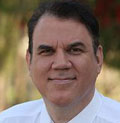
U.S. Rep. Alan Grayson
“I am unbought and unbossed,” Grayson, D-Orlando, said in a video announcing his Senate bid posted to his campaign website July 9. “I own nothing to anyone but the people.”
Grayson is running in defiance of Democratic party leaders, who are backing moderate U.S. Rep. Patrick Murphy, D-Jupiter and had hoped to avoid what is likely to be a divisive Democratic primary.
On the day of his announcement, Grayson provided a flavor of what’s to come in an interview with WKMG-TV in Orlando, in which he accused Murphy of being a closet Republican and said the Senate race “is going to live until the end of time.”
“People understand what I stand for. Patrick wants to cut Social Security, cut Medicare, and Patrick gave $2,300 to Mitt Romney’s campaign,” he said. “Patrick’s running in the wrong primary. He should be running as a Republican because that’s who he really is.”
To bring home the flavor of his political persona, Grayson is calling his campaign website SenatorWithGuts.com.
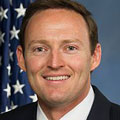
U.S. Rep. Patrick Murphy
For his part, Murphy greeted Grayson’s announcement by issuing a statement saying he was looking forward “to a clean, honest discussion of the issues in this primary.”
Grayson, 57, a Harvard-educated lawyer, burst onto the national scene after his election to Congress in 2008 with a floor speech in which he said the GOP’s health care plan was for the uninsured “to die quickly.” He has called Republicans “knuckle-dragging Neanderthals,” likened the Tea Party to the Ku Klux Klan and once compared former Vice President Dick Cheney to a vampire.
In 2009, he had to apologize after calling a female lobbyist “a K Street whore.” He is also known to subject reporters to profanity-laden tirades for stories he doesn’t like.
Grayson’s controversial profile cost him his House seat in 2010, a campaign in which he referred to his opponent, U.S. Rep. Daniel Webster, as “Taliban Dan” in a television ad. But Grayson returned to Congress in 2012, winning in a newly created Orlando-area district.
In addition to his hyperbolic comments, Grayson is also involved in a nasty divorce with his wife of 25 years, Lolita, whom he accused of bigamy and tried to have arrested for using a joint credit card to buy groceries. Lolita Grayson has charged that the congressman was unfaithful and abusive.
In his kickoff announcement, Grayson took an unabashed liberal line, calling for ending taxes on Social Security benefits, expanding Medicare to cover dental and vision care and ensuring that “every job should provide enough money to become part of the middle class.”
The Senate seat opened up when Republican U.S. Senator Marco Rubio decided to run for president. Democratic leaders are fearful that Grayson’s is too controversial and too liberal to win a statewide race in Florida — squandering an opportunity to pick up a seat that is vital to the party’s hopes of taking back the Senate.
The Democratic Senatorial Campaign Committee is backing Murphy, 32, who was a registered Republican until he switched parties to run for the House in 2012. He was re-elected in 2014 with nearly 60 percent of the vote in a competitive district.
On the Republican side, U.S. Rep. Ron DeSantis has jumped into the Senate race, and Lieutenant Governor Carlos López-Cantera is also expected to run.
Florida Supreme Court strikes down state’s congressional map
High court gives state legislature 100 days to draw new map to fix problems with eight districts
♦By Rich Shumate, Chickenfriedpolitics.com editor
GAINESVILLE, Florida (CFP) — The Florida Supreme Court has struck down the state’s map of congressional districts, ruling that the Republican-controlled state legislature unconstitutionally gerrymandered the map to help the GOP’s electoral prospects.
In a 5-to-2 ruling issued July 9, the high court agreed with a lower court ruling last year that the 2011 redistricting process had been “tainted” by partisan gerrymandering, which was outlawed by Florida voters in a constitutional amendment passed in 2010.
The trial court had ordered changes in two districts, but the Supreme Court went further, ruling that eight of the state’s 27 districts were improperly drawn and giving legislators 100 days to come up with a new map that complies with the anti-gerrymandering amendment. The new map will be in place for the 2016 elections.

U.S. Rep. Corrine Brown
While the high court did not order the entire map to be redrawn, reworking the eight districts in question is likely to have an impact on many of the surrounding districts, particularly in northeast Florida, where justices ordered an oddly shaped, black plurality district represented by U.S. Rep. Corrine Brown to be completely reconfigured.
Responding to testimony in the trial court that showed Republican legislators and consultants had met behind closed doors to draw the congressional maps, the Supreme Court majority also encouraged the legislature “to conduct all meetings in which it makes decisions on the new map in public and to record any non-public meetings for preservation.”
There was no immediate word from legislative leaders as to when a special legislative session might be convened to redraw the congressional map.
The ruling was a victory for the League of Women Voters and Common Cause, which filed suit to overturn the maps. Pamela Goodman, the president of the league, called the decision a victory “against devious political scheming.”
“The Florida Supreme Court took the Florida Legislature to the woodshed,” she said in a statement. “Their egregious behavior using partisan political operatives in the redistricting process was appropriately reprimanded.”
The Republican-controlled legislature decided not to appeal the trial court’s ruling in 2014, which led to a special session of the legislature to make minor changes in the map. But the League of Women Voters appealed to the Supreme Court, arguing that those changes didn’t go far enough.
The eight districts found to be unconstitutional are equally split between Democrats and Republicans. But the changes ordered by the court are giving Democrats hopes of making inroads in Florida’s congressional delegation. Despite the state’s even political split, Republicans hold a 17-to-10 advantage among House members.
The two biggest changes ordered by the high court are in the 5th District, represented by Brown, D-Jacksonville, and the 13th District, held by U.S. Rep. David Jolly, R-St. Petersburg.
The Supreme Court ruled that Brown’s north-south district — which snakes through northeast and central Florida from Jacksonville to Orlando to pick up black voters and is at one point the width of a highway — should be redrawn in an east-west configuration from Jacksonville towards the Panhandle. The current black voting age population in the district is 48 percent.
While moving the district could create an opening for a minority candidate in the Orlando area, it might also present problems for U.S. Rep. Gwen Graham, D-Tallahassee, whose 2nd District includes areas along the Georgia border that would be shifted into the 5th District.
Brown, one of just three African-Americans in Florida’s congressional delegation, had joined with Republicans in the legislature in defending the map. She blasted the high court’s decision in a statement, saying it was “seriously flawed and entirely fails to take into consideration the rights of minority voters.”
While Brown did not indicate if she might file a federal lawsuit to stop the court-mandated redistricting, she did say that “as a people, African-Americans have fought too hard to get to where we are now, and we certainly are not taking any steps backwards.”
U.S. Rep. David Jolly
In the 13th District, which takes in most of Pinellas County, the Supreme Court held that the legislature’s decision to shift African-American voters in St. Petersburg into the neighboring 14th District, across the bay in Tampa, to make the 13th more Republican-friendly violated a requirement that districts be geographically compact wherever possible.
Shifting those voters back into the 13th District could make life more difficult for Jolly, who won the seat in a special election last year. But Jolly’s office issued a statement after the ruling saying he was not concerned about the prospect that his district might be redrawn.
“The courts and the legislature will determine next steps, and Congressman Jolly will remain focused solely on doing his job and serving all of Pinellas County,” the statement said. “If he continues to do the job he was elected to do, the politics will take care of itself.”
Here are the other districts that are affected by the Supreme Court’s ruling:
21st District and 22nd District – These two districts, in Palm Beach and Broward counties in South Florida, run parallel to each other, one along the Atlantic Coast and the other inland. The Supreme Court agreed with the plaintiffs that these two districts would be more geographically compact if they were made wider and stacked on top of each other, although the high court stopped short of ordering the legislature to adopt that configuration. The 21st District is represented by U.S. Rep. Ted Deutch, D-Boca Raton; the 22nd District by U.S. Rep. Lois Frankel, D-West Palm Beach.
25th District – The court’s objection to this district was that legislators split Hendry County, a rural county with a majority minority population, between the 25th District and the adjacent 20th District, instead of putting the county entirely in the 25th. The legislature argued that it split the county to comply with the Voting Rights Act, but the high court said legislators had not proven that putting the county in a single district would compromise the electoral prospects of minority voters. The district, which would become more Democratic if all of Hendry County is included, is represented by U.S. Rep. Mario Diaz-Balart, R-Miami.
26h District and 27th District – The court objected to the legislature’s decision to split the city of Homestead, south of Miami, between these two districts, which had the effect of creating two Republican-leaning districts, rather than one safe district for each party. The high court ordered the legislature to put all of Homestead in one district. District 26 is represented by U.S. Rep. Carlos Curbelo, R-Miami; District 27 by veteran U.S. Rep. Ileana Ros-Lehtinen, R-Miami. Whichever of them gets Homestead will have to deal with more Democratic voters, although Ros-Lehtinen said she had “no worries” about the prospect that her district lines might shift.
 Chicken Fried Politics