
Home » Florida (Page 4)
Category Archives: Florida


Most Southern Republican U.S. House members break with Trump on 2 key votes
Only 18 join Trump’s push for $2,000 coronavirus relief checks, while 51 vote to sustain veto of defense spending bill
♦By Rich Shumate, ChickenFriedPolitics.com editor
 WASHINGTON (CNN) — Southern U.S. House Republicans were largely unswayed by President Donald Trump’s call for larger coronavirus relief checks in a key vote Monday, and most of them then voted to override the president’s veto of a defense spending bill that had passed earlier in the month with broad bipartisan support.
Trump had threatened to veto a coronavirus funding bill because it did not provide Americans with more generous relief checks, before signing it Sunday. But House Democrats brought a stand-alone bill to the floor to increase checks from $600 per person to $2,000, and 44 Republicans joined with almost all of the Democrats to pass it by a margin of 275 to 134 and send it to the Senate.
However, among the 99 Southern Republicans in the House, just 18 joined in the effort to make relief checks more robust — Reps. Robert Aderholt of Alabama; James Comer and Hal Rogers of Kentucky; Rick Crawford of Arkansas; Mario Diaz-Balart, Francis Rooney and John Rutherford of Florida; Michael Burgess, Kay Granger, Bill Flores, Will Hurd, Mike McCaul and Pete Olson of Texas; Clay Higgins of Louisiana; Tom Cole and Frank Lucas of Oklahoma; David McKinley of West Virginia; and Denver Riggleman of Virginia.
Hours later, the House, as expected, overrode Trump’s veto of the National Defense Authorization Bill, with 109 Republicans, including 51 Southern Republicans, voting in favor of the first successful veto override of his presidency.
Just 35 Southern Republicans voted to sustain the president’s veto including 12 Southern Republicans who had voted for the defense bill but switched sides on the override vote — Comer, Diaz-Balart, Burgess, McKinley, Rick Allen of Georgia, Scott DesJarlais of Tennessee, Kevin Hern of Oklahoma, Barry Loudermilk of Georgia, Carol Miller of West Virginia, Gary Palmer of Alabama, John Rose of Tennessee, and Bruce Westerman of Arkansas. Greg Steube of Florida, who did not vote when the bill came to the floor, also voted against the override.
Five other Southern Republicans who supported the bill’s passage opted not to oppose Trump on the veto override and did not vote — Reps. Andy Barr of Kentucky, Gus Bilirakis of Florida, Kenny Marchant of Texas, Markwayne Mullin of Oklahoma, and Phil Roe of Tennessee. Jody Hice of Georgia, who opposed the bill, also did not vote on the override.
Twenty-two Southern Republicans opposed both the original bill and the veto override, including House Minority Whip Steve Scalise of Louisiana and Trump’s most vocal defender in the House, Rep. Matt Gaetz of Florida.
All 50 Southern Democrats serving in the House voted for the $2,000 checks and the veto override.
Trump vetoed the defense spending bill because he objected to a provision requiring name changes for military bases named for Confederate officials, mostly in the South. He also wanted Congress to repeal an unrelated provision that protects digital media companies from liability for posting third-party content.
The veto put Republicans in the awkward position of choosing between loyalty to Trump and supporting a bill to fund military operations, including pay raises for the troops.
After the House override, Trump took to Twitter to denounce the action as “a disgraceful act of cowardice and total submission by weak people to Big Tech.”
The bill had passed December 8 by a veto-proof margin of 335 to 78, with the support from 140 Republicans. The veto override is expected to clear the Senate.
However, the boost in relief checks is expected to have a much more difficult time in the Senate, where members have expressed concerns about the $300 billion cost of nearly the tripling the amount of the payments.
We tweet @ChkFriPolitics Join us!
4 Southern U.S. House members break party ranks on bill to remove marijuana penalties
3 Southern Republicans vote in favor, 1 Democrat against removing marijuana from list of controlled substances
♦By Rich Shumate, ChickenFriedPolitics.com editor
WASHINGTON (CFP) — On a nearly party-line vote, the U.S. House approved landmark legislation Friday to remove federal criminal penalties for marijuana and erase past convictions for cannabus-related offenses.
Three Southern Republicans broke ranks with most of their party to support the measure — U.S. Reps. Matt Gaetz and Brian Mast of Florida and Denver Riggleman of Virginia. One Southern Democrat, U.S. Rep. Henry Cueller of Texas, was among just six Democrats who voted against the bill.
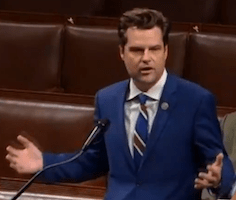
Gaetz speaks in favor of bill on House floor (From C-Span via Twitter)
While the bill is not expected to advance in the Senate, Friday’s 222-to-164 vote in represents a sea change in political attitudes toward marijuana, which will soon be legal for medical use in 36 states and for adult recreational use in 15.
Gaetz, the only Republican co-sponsor of the measure, gave a full-throated oration in favor of the bill on the House floor.
“The federal government has lied to the people of this country about marijuana for a generation,” Gaetz said. “We have seen a generation, particularly of black and brown youth, locked up for offenses that should not have resulted in any incarceration whatsoever.”
Noting that marijuana liberalization passed in every state where it was on the ballot in November, Gaetz said “the only thing that I know of that’s more popular than getting out of the war on drugs is getting out of the war in Afghanistan.”
In November, Mississippi voters approved a medical marijuana initiative, the last Southern state to approve medical cannabus use. However, no Southern state yet allows adult recreational use of marijuana.
Since 1970, marijuana has been categorized as a schedule one drug, in the same category as cocaine and heroin, which precludes medical use. The federal prohibition has created significant problems for people growing and selling marijuana in states where sale is authorized, including preventing them from using banks.
The new law would deschedule the drug, provide a process for people convicted of marijuana offenses to expunge their records, and impose a tax on marijuana sales. States would still be allowed to impose their own regulations.
We tweet @ChkFriPolitics Join us!
Decision 2020: Can Joe Biden break through and make the South matter?
Texas and Georgia join North Carolina and Florida on list of 2020 presidential swing states
♦By Rich Shumate, ChickenFriedPolitics.com editor
 (CFP) — Twenty years ago, George W. Bush became the first Republican to sweep the entire South in a non-landslide election, and in the five presidential elections since, a Democrat has carried Virginia three times, Florida twice, and North Carolina once.
Every other state in the region went for the Republican, every time. If you add it up, that’s 64 state wins for the Republican, to just six for the Democrat.

The candidates for president
But if the pre-election polls are correct, the GOP’s lock on the South — which has been a bedrock of the party’s Electoral College fortunes — appears to be loosening, albeit slightly, in 2020. So election night may not be as much of an afterthought in the South as it has been for the past two decades.
Indeed, the results in three Southern states that report results early could point toward who is going to win the White House, even as the rest of the country finishes casting ballots.
Virginia seems almost certain to go Democratic for the fourth election in a row. North Carolina and Florida are, as expected, toss-ups, as they have been in the last three elections. But in 2020, the races in both Texas and Georgia are within the margin of error, which could complicate–if not end–Donald Trump’s hopes of winning re-election if Joe Biden wins either one.
Polls even show that in South Carolina, which hasn’t gone for a Democrat since Jimmy Carter in 1976, Trump’s lead may be in single digits. And while a win in the Palmetto State still seems like a stretch, a close race between Trump and Biden would be a sign that the president’s political fortunes have dipped even in a region he swept four years ago.
The 2020 race is also unusual in another respect — it is the first presidential race since 1972 where neither party has a Southerner on its ticket.
The list of four Southern swing states in 2020 echoes 2016, when Trump took them by single-digit margins while rolling up double-digit victories everywhere else. He won Florida by 1 point, North Carolina by 4, Georgia by 5, and Texas by 9.
In the 2018 midterm elections, Democrats made gains in the suburbs around major cities in Georgia and Texas, which is the template Democrats are using for 2020. However, they had less success in North Carolina, where Republican candidates held up better.
The Biden campaign has been up with ads in Georgia and has spent a token amount in Texas, although it has yet to commit any substantial resources to either state. Both Biden and Trump have campaigned in Georgia, although they have not yet barnstormed Texas.
These Southern states are much more important to Trump than they are to Biden, who can win the White House without them if he flips Pennsylvania, Wisconsin and Michigan back into the blue column. While Trump could survive losing either Georgia or North Carolina, if he can hold the line in the Upper Midwest, a loss in either Florida or Texas would be catastrophic.
Florida and Georgia have two of the earliest poll closing times in the country, at 7 p.m. Eastern (the Florida Panhandle stays open another hour), and North Carolina closes a half hour later. So those three states could be among the first places where winners can be declared, unless the races are extremely close.
If Trump wins these states, the result won’t tell us much about the eventual outcome. But a Biden win in any of them — particularly Florida — will point to a Democratic victory, and we will likely know the Florida result before the results in Pennsylvania, Michigan and Wisconsin.
No matter what happens in 2020, the results will almost certainly change how the presidential game is played in the South in 2024.
Four years from now, Texas and Georgia will be seriously contested by both sides, particularly if Biden wins or comes close this year. That will add two new large states where campaigns have to add significant resources, particularly in Texas, which has more than 20 TV markets.
For Republicans, who have not had to worry about the South at the presidential level for decades, more competition in the region complicates their path to the White House. For Democrats, the ability to win in the South gives them additional paths to 270 that reduce the number of must-win states elsewhere. So the long-term consequences of this election could be enormous.
That’s why, on Nov. 3, the South will matter as it hasn’t mattered in the last 20 years.
We tweet @ChkFriPolitics Join us!
Decision 2020: Democrats trying to build on 2018 gains in battle for Southern U.S. House seats
6 freshmen Democrats are in tough races to defend their seats, while a dozen GOP incumbents are fighting off Democratic challengers
♦By Rich Shumate, ChickenFriedPolitics.com editor
 (CFP) — When the dust cleared after the 2018 midterm elections, Democrats had picked up 10 U.S. House seats across the South, climbing slightly out of a deep hole dug over the previous decade but still trailing Republicans by a better than 2-to-1 margin.
The question for 2020 will be whether Democrats can hang on to those gains and take advantage of an expanded map — particularly in Texas — to add to their numbers, or whether 2018 was a high-water mark for the party’s fortunes.
Six freshmen Democrats who flipped seats in 2018 are facing stiff challenges in November, five of whom represent districts that President Donald Trump carried in 2016. All of them have raised piles of money, outpacing their GOP opponents, but will have to hold their seats this time around with Trump at the top of the ballot.
Democrats are also contesting nine open Republican held seats without an incumbent. Four are competitive, Democrats are poised to flip three of them, and Republicans are favored to hold the other two, for a net Democratic gain of between three and seven seats.
In addition, 12 Republican incumbents targeted by Democrats are in potentially competitive races, though only four of them seem in significant jeopardy as of yet. Seven of those races are in Texas, where Republicans are playing defense after a slew of retirements by incumbents and Democratic gains in 2018.
The likely best case scenario for Democrats right now would be a gain of 11 seats, slightly better than they did in 2018, or as many as 19 if all of the Republican incumbents fall. The likely best case scenario for Republicans would be a net gain of three seats, if they topple all of the Democratic freshmen and elsewhere hold the line.
The result will probably be between those extremes, with biggest wildcard being what happens at the topic of the ticket. Will Trump propel Republicans in close races to victory in a region where he remains popular — or imperil more of them with a weaker-than-expected national performance?
Here is your guide to the 2020 Southern U.S. House races:
Democrats Fighting to Hold Seats
Virginia 2 (metro Norfolk): Democratic incumbent Elaine Luria is facing a rematch against the man she ousted in 2018, Republican Scott Taylor, in this Trump district. But she enjoys as 4-to-1 fundraising advantage and may also be helped by criminal charges lodged against Taylor’s 2018 campaign staffers for election fraud.
Virginia 7 (Richmond suburbs, central Virginia): Democratic incumbent Abigail Spanberger faces Republican State Delegate Nick Freitas. This district went for Trump by 7 points in 2018, but Spanberger has raised more than $5 million, giving her a significant financial edge.
Georgia 6 (Northwest Atlanta suburbs): Democratic incumbent Lucy McBath is also facing a rematch against her 2018 opponent, Republican Karen Handel. But this is a district that Trump barely carried, with diversifying demographics that could help McBath hang on in a race for which she’s raised more than $5 million.
Oklahoma 5 (Metro Oklahoma City): Democrat Kendra Horn’s win here in 2018 was among the biggest shocks of the election. She is facing Republican State Senator Stephanie Bice, who had to fight her way through a contentious primary runoff. This is a solidly Republican district in a solidly Republican state, which is why Horn is considered one of the nation’s most endangered Democratic incumbents.
South Carolina 1 (Lowcountry and Charleston): Incumbent Democrat Joe Cunningham faces Republican State Rep. Nancy Mace. While the district went for Trump by 13 points in 2016, some more recent local results showed some Democratic strength, and Cunningham has outraised her by more than 2-to-1. The other wildcard in this race is a highly competitive U.S. Senate race in the Palmetto State between Republican Lindsey Graham and Democratic Jaime Harrison, which could increase turnout.
Florida 26 (South Miami-Dade and Florida Keys): Trump lost by 16 points in this district in 2016, which should be good news for Democrat Debbie Mucarsel-Powell. However, she is facing a formidable opponent in Republican Miami-Dade Mayor Carlos Gimenez, who has his own political pedigree separate from Trump or his party. Gimenez has also benefited from being front-and-center in handling the coronavirus crisis in his perch as head of county government.
Open Republican Seats
Georgia 7 (Northeast Atlanta suburbs): This was the closest race in the country in 2018, with Republican Ron Woodall hanging on by a mere 400 votes. He retired, but his 2018 Democratic opponent, Carolyn Bourdeaux, is back, facing Republican Rich McCormick, a military doctor. This district was once a mostly white Republican bastion; it is now a majority minority district where Democrats have been making gains in local and legislative offices.
Virginia 5 (Central Virginia around Lynchburg): This district only became open when the Republican incumbent, Denver Riggleman, was bounced at a GOP party convention amid a controversy over his presiding over a same-sex wedding. The man who beat him, Bob Good, a social conservative county supervisor and former official at Liberty University, is facing Democratic doctor Cameron Webb, who has gotten increased party support in the wake of Riggleman’s demise.
Texas 22 (Southwestern Houston suburbs): Incumbent Pete Olson decided to retire rather than contest this seat in Houston suburbs, which showed a purple streak in 2016 when Hillary Clinton carried once solidly Republican Fort Bend County. Fort Bend County Sheriff Troy Nehls is trying to keep the seat for Republicans against Democrat Sri Preston Kulkarni, a former congressional aide who challenged Olson in 2018.
Texas 24 (Metro Dallas-Fort Worth): This is another suburban district where the Republican incumbent, Kenny Marchant, decided not to seek re-election in 2020. The Republican in the race is former Irving Mayor Beth Van Duyne, who faces Candace Valenzuela, a local school board member. Valenzuela has drawn national attention and endorsements since her win in the Democratic primary, including a nod from vice presidential nominee Kamala Harris. Black, Hispanic and Asian voters are now a majority here, which should work to Valenzuela’s advantage.
Open Seats/Likely to Flip: A court-ordered redrawing of North Carolina’s House map has tilted two Republican-held seats, North Carolina 2 (metro Raleigh) and North Carolina 6 (metro Greensboro), toward the Democrats, prompting both Republican incumbents to retire. In Texas 23 (West Texas), the retirement of the lone African-American Republican in the House, Will Hurd, has opened up a seat likely to flip to his Democratic opponent from 2018, Gina Ortiz Jones, in a district Hillary Clinton carried.
Open Seats/Republicans Favored: In Florida 15 (eastern Tampa Bay), Democratic hopes may have been dashed when the Republican incumbent, Ross Spano, mired in a criminal ethics investigation, lost his primary to Lakeland City Commissioner Scott Franklin, who appears poised to keep the seat. In North Carolina 11 (western mountain counties), the Republican nominee, Madison Cawthorn, just 25, has been facing questions about his finances and personal conduct since he won the primary, although this district is strongly Republican and his Democratic opponent, Moe Davis, has also been dealing with similar fallout from a colorful past.
Republican Incumbents in Competitive Races
Texas 3 (Northern Dallas suburbs): Incumbent Republican Van Taylor, who won this seat in 2018, is being challenged by Democrat Lulu Seikaly, an employment lawyer from Plano who is the daughter of Lebanese immigrants. Democrats have targeted this race, even though Taylor won it by 10 points and Trump by 14, because it is the type of suburban district where Democrats made gains in 2018, although Taylor holds a substantial financial advantage.
Texas 10 (North Austin suburbs, northwest Houston suburbs, areas between): Republican incumbent Mike McCaul faces a rematch with the Democrat he beat in 2018, Mike Siegel, a Austin civil rights lawyer. In 2018, McCaul only beat Siegel by 4 points, as Democrat Beto O’Rourke was carrying the district in the U.S. Senate race. But Siegel had to fight his way through an expensive Democratic primary runoff, leaving McCaul with a financial advantage.
Texas 21 (Austin and Hill Country/San Antonio suburbs): Incumbent Republican Chip Roy, a freshman who held this seat for Republicans in 2018, is facing former Democratic State Senator Wendy Davis, who built a national following with her unsuccessful campaign for governor in 2014. Davis represented Fort Worth in the legislature but decided to run in this Austin-area seat, and she’s used her national profile to raise more than $4.4 million, outpacing Roy by nearly $2 million Roy’s win in 2018 was by less than 3 points, which is why this seat is one of Democrats’ top targets in Texas.
North Carolina 8 (Piedmont between Fayetteville and Charlotte): Incumbent Republican Richard Hudson, who won the seat in 2012, is facing Democrat Pat Timmons-Goodson, a former state Supreme Court justice who has made the seat competitive by raising more than $1 million for the race. Democrats have targeted this seat as their best chance for an additional pickup in North Carolina, in addition to the two seats that are expected to shift their way under new court-imposed maps.
Republican Incumbents in Potentially Competitive races
Arkansas 2 (Metro Little Rock): Incumbent Republican French Hill is facing Democratic State Senator Joyce Elliott. Both are from Little Rock, which Democrats usually carry; Hill’s strength will be in surrounding suburban counties that vote heavily Republican. This is may be Natural State’s most Democratic district, but Trump carried it by 10 points and a Democrat hasn’t won it since 2008. The stars will have to align for Elliott to carry off a victory, although Hill has been sufficiently concerned to run negative ads against her.
Florida 16 (Sarasota and Bradenton): The incumbent Republican, Vern Buchanan, has held this seat since 2013 and won by 9 points last time. But Democrats are hoping that a repeat of the 2018 suburban wave can lift Democratic State Rep. Margaret Good to victory. Buchanan holds the financial edge, but Good has raised more than $1.8 million in what could be Buchanan’s strongest challenge since winning the seat.
Florida 18 (Treasure Coast): Incumbent Republican Brian Mast is facing Democrat Pam Keith, an attorney and Navy veteran who made an unsuccessful run for the seat in 2018. Mast won by 9 points in 2018, but this seat had been held by a Democrat before he won it in 2016.
North Carolina 9 (Charlotte suburbs east toward Fayetteville): The race in this district was razor-close in 2018, and the results were eventually overturned amid allegations of absentee ballot fraud by the campaign of the Republican winner, Mark Harris. But Dan Bishop held it for the GOP in a 2019 special election, and the Democrats’ nominee in both 2018 and the special election, Dan McCready, opted not to run again. Facing Bishop is Democrat Cynthia Wallace, a financial services executive and Democratic party chair in the district.
Texas 2 (Houston): Incumbent Republican Dan Crenshaw a former Navy SEAL who wears an eye patch because of a combat injury, won this seat in 2018 and quickly became one of the best-known freshmen Republicans in the House. Given his high profile, Democrats are gunning for him in November with their nominee, Sima Ladjevardian, a Houston attorney and senior advisor to the 2018 O’Rourke Senate campaign. But Crenshaw has used his national profile to raise more than $9 million, giving him a huge financial advantage.
Texas 6 (Arlington, Waxahatchie, Corsicana): Incumbent Ron Wright is another Republican freshman facing a Democratic challenge after winning by 7 points two years ago. He is facing Democrat Stephen Daniel, a Waxahatchie lawyer. Trump carried this district by 12 points in 2016, but nearly half of its population are minority voters, which could give Wright a shot if the Trump vote falters.
Texas 25 (Suburban Austin, central Texas): Incumbent Republican Roger Williams, first elected to the House in 2012, is facing Democrat Julie Oliver, an Austin attorney who has has built her campaign around the issue of health care and included her background as a homeless teen mother in campaign ads. Trump carried this district by 15 points in 2016, and Williams won by 9 in 2018. Williams has run into controversy after revelations that a car dealership he owns received government coronavirus relief payments.
Texas 31 (North Austin suburbs, Temple): Incumbent Republican John Carter is facing a challenge from Democrat Donna Imam, a computer engineer and businesswoman from Round Rock. Carter won by just 3 points two years ago, the closest race he’s had since first taking the seat in 2002. But his 2018 challenger, MJ Hegar, opted to run for the U.S. Senate this time around, and Imam had to spend money to win a contested primary, leaving Carter with a 2-to-1 cash advantage heading into the home stretch.
We tweet @ChkFriPolitics Join us!

Florida Primary: U.S. Rep. Ross Spano ousted, as far-right candidate wins GOP nod in Palm Beach
In Pinellas County, conservative TV personality Anna Paulina Luna easily defeats establishment pick in GOP U.S. House primary
♦By Rich Shumate, ChickenFriedPolitics.com editor
 TALLAHASSEE (CFP) — Freshman Republican U.S. Rep. Ross Spano has lost his bid for re-election amid a criminal investigation into his 2018 campaign, while Republicans in Palm Beach County have picked far-right provocateur Laura Loomer — banned from social media for her strident anti-Muslim comments — as their U.S. House nominee, drawing praise from President Donald Trump.
Also in Tuesday’s primary, Kat Cammack won the GOP nomination for the seat being given up by her former boss, U.S. Rep. Ted Yoho, in North-Central Florida, while State Rep. Byron Donalds of Naples appears to have taken a step toward adding a rare African American face to House Republican ranks.
Meanwhile, in Pinellas County, conservative TV personality Anna Paulina Luna defeated the pick of the Republican establishment, Amanda Makki, for the right to take on Democratic U.S. Rep. Charlie Crist in what may be the GOP’s best chance to flip a Florida seat in 2020.

U.S. Rep. Ross Spano, R-Florida
In the 15th District (I-4 Corridor between Tampa and Orlando), with all of the precincts reporting, Spano trailed Lakeland City Commissioner Scott Franklin by less than 1,600 votes.
During the campaign, Franklin hammered Spano over an ongoing federal criminal investigation into illegal loans made to his 2018 campaign. The congressman has admitted his campaign violated campaign finance laws but denies any criminal wrongdoing.
Franklin will now face the Democratic primary winner, Alan Cohn, a former investigative journalist, although Democrats’ hopes of flipping the Republican-learning seat probably dimmed with Spano’s demise.
In the 3rd District (Gainesville and North-Central Florida), where Yoho is retiring, 10 Republicans were competing to fill his seat.
Cammack, former Yoho aide from Gainesville, took 25% to edge out Judson Sapp, a businessman from Green Cove Springs, at 20%.
Because Florida does not have primary runoffs, the first-place finisher in Tuesday’s crowded primary won the nomination with a plurality and will be favored in November in the Republican-leaning district, which is mostly rural but includes the University of Florida.
In the Democratic primary, Adam Christensen, a Gainesville businessman, held a lead of less than 700 votes over Tom Wells, a physicist who has been endorsed by the Democratic Socialists of America and groups affiliated with Vermont U.S. Senator Bernie Sanders
Another Republican free-for-all took place in the 19th District (Fort Myers, Naples and Southwest Florida), where U.S. Rep. Francis Rooney is retiring and nine Republicans were running.
Donalds took 23%, less than 800 votes ahead of the second-place finisher, State House Majority Leader Dane Eagle from Cape Coral. Casey Askar, a Iraqi immigrant businessman from Naples who put $3 million of his own money into the campaign, finished a close third.
The 19th District is heavily Republican, which will make Donalds, who is African American, the prohibitive favorite in November. Currently, there is only one black Republican in the House, U.S. Rep. Will Hurd of Texas, who is not seeking re-election.
In the 13th District (Pinellas County), Luna took 36% to 29% for Makki, a well-connected former congressional aide and Washington lobbyist who had the backing of House Republican leaders and raised $1.2 million for the race.
But Luna, a staunch defender of Trump on TV, excited the Republican grassroots to raise nearly $1 million and surge from behind, with an endorsement from firebrand Florida U.S. Rep. Matt Gaetz.
Crist is one of only two Florida Democrats whose seat is expected to be possibly competitive in 2020, although he won re-election by 15 points in 2018.
The other GOP target is U.S. Rep. Stephanie Murphy in the 7th District (Orlando and its northern suburbs), where Leo Valentin, an Orlando radiologist, held a 700-vote lead over Richard Goble, a mortgage broker from Lake Mary, with all precincts reporting.
In the 21st District (Palm Beach County), Loomer took 42% to beat five other Republicans for the nomination to face Democratic U.S. Rep. Lois Frankel in November after raising more than $1 million, outpacing even the incumbent.
While Loomer appears to have little chance against Frankel in the heavily Democratic district,, she will be yet another fringe nominee for Republican leaders to defend, after victories by adherents of the QAnon conspiracy theory in Georgia and Colorado.
Loomer, who describes herself as a “nationalist” but eschews the “alt-right” label, has been banned from a variety of social media sites — and even Uber and PayPal — for anti-Muslim rhetoric, describing herself on Twitter as a #ProudIslamophobe and calling for a ban on Muslims entering the country.
Among her particular targets are the only two Muslim women in Congress, U.S. Reps. Rashida Tlaib of Michigan and Ilhan Omar of Minnesota.
Loomer has also drawn attention to herself for outlandish publicity stunts, including heckling reporters at the Conservative Political Action conference (which got her banned from the event); asking Chelsea Clinton at a book signing to autograph a book for a woman who alleges that the Clinton’s father, the former president, raped her; and interrupting the assassination scene in a performance of Shakespeare’s “Julius Ceasar” in Central Park, shouting “this is violence against Donald Trump.”
She has also spread conspiracy theories, including that Omar had married her brother and that some school shootings were staged and survivors coached to talk to the media.
Despite that questionable pedigree, Loomer’s campaign has drawn support from Gaetz, Trump confidante Roger Stone, U.S. Rep. Paul Gosar of Arizona, and Fox News personality Jeanine Pirro.
Trump, who had retweeted a fundraising solicitation sent on Loomer’s behalf, praised her win: “Great going Laura. You have a great chance against a Pelosi puppet!”
The president’s Mar-a-Lago estate, which is now his permanent residence, is in the 21st District.
 Chicken Fried Politics