
Home » Georgia (Page 16)
Category Archives: Georgia

Race for GOP-held Georgia U.S. House seat closing with Democrat in lead
But polls shows Jon Ossoff may not avoid a runoff that could be fatal in metro Atlanta’s 6th District
 ATLANTA (CFP) — On paper, the outcome of the April 18 special election to fill Georgia’s 6th District U.S. House district should be an foregone conclusion.
This seat in Atlanta’s upscale, leafy northern suburbs has been previously held by former House Speaker Newt Gingrich and Republican U.S. Senator Johnny Isakson. Last November, Tom Price, now secretary of the U.S. Department of Health and Human Services, won it by more than 76,000 votes against a Democrat who didn’t even bother to campaign.
But after seeing the presidential results in the 6th District last November, Democrats smelled blood.
Donald Trump carried the district by a mere 1.5 percentage points, on his way to losing Cobb County, a GOP bastion that hadn’t gone Democratic since 1976. The eastern half of Cobb is in the 6th District, along with the northern portions of Fulton and DeKalb counties, which Hillary Clinton also carried.
When Trump put Price in his Cabinet, Democrats saw an opportunity in the all-party special election to fill this seat, if they could find a candidate who could make the race competitive.

Jon Ossoff, Ga. 6th District candidate
Enter Jon Ossoff, a 30-year-old filmmaker and former congressional aide who had never before run for anything. He galvanized Trump-disaffected Democrats with the slogan “Make Trump Furious.” He raised a staggering $8.3 million in one just one quarter, including $1.25 in crowdfunding from the liberal website Daily Kos — a fundraising haul larger than all of his 11 Republican competitors combined.
Not only has Ossoff proven himself to be competitive, he has shot to a large lead in the polls, a full 20 points ahead of his nearest competitor. But he still may need the political equivalent of a Hail Mary to actually get to Congress.
For to win the seat outright, Ossoff has to clear 50 percent in the April 18 vote against a field with 17 competitors. If he doesn’t pull that off, he’ll face a June 20 runoff against the second-place finisher, who will almost certainly be a Republican.
Recent polls have put Ossoff as high as 43 percent, well short of what he would need to win outright. However, Democrats are hoping that their enthusiasm for Ossoff, along with the low voter turnout typical of special elections, can propel their man over the top.
The results of April 11 special election for a Republican-held congressional seat in Kansas have buoyed those hopes. The Republican in that race won, but there was a 20-point swing toward the Democrat from what Trump posted in November. Even a fraction of that swing could put Ossoff in Congress.
A recent poll by Fox 5 in Atlanta also contained good news for Democrats. In head-to-head match-ups with the four leading Republicans in the race, Ossoff was in a statistical dead heat with all of them, raising hopes he might be able to win even if forced into a runoff.
But Republicans aren’t buying that argument. Given the district’s historical tendencies, they are confident their candidate will prevail in a one-on-one race with Ossoff. One of the Republicans competing for second place, Bob Gray, has gone so far as to dismiss Democratic hopes of poaching the seat as a “fantasy.”
Yet, with Ossoff’s campaign in high gear and Republicans still tussling with each other for second place, the National Republican Congressional Committee began running ads into the district, telling voters that Nancy Pelosi and her fellow liberals are are trying to use this race to stop the Republican agenda. The Republican National Committee has also moved staffers into the district.
Another wild card in Ossoff’s ultimate success will be which Republican he faces in the runoff, who will emerge after an increasingly fractious battle for second place.

Gray

Handel
Polls show the chase for the second spot in the runoff appears to be between Karen Handel, a former secretary of state and chair of the Fulton County Commission, and Gray, a technology executive and former city councilman in Johns Creek, one of the cities in the district.
Handel, a political fixture in North Fulton for the past 15 years, has high name recognition after failed runs for governor in 2010 and U.S. Senate in 2014. She has received a slew of endorsements from city and county officials throughout the district, as well as the support of former U.S. Senator Saxby Chambliss.
Gray has positioned himself as a business-oriented political outsider aligned with Trump, and he is also receiving support from the conservative Club for Growth.
Two other Republicans with an outside shot at the runoff slot are Dan Moody, a former state senator from Johns Creek, who has the backing of U.S .Senator David Perdue, and Judson Hill, a former state senator from East Cobb who has been endorsed by Gingrich and U.S. Senator Marco Rubio of Florida, who carried Cobb, Fulton and DeKalb counties over trump in Georgia’s 2016 Republican presidential primary.
Both Gray and Moody have turned their fire on Handel, with ads that criticize her as an opportunistic office seeker and a flip-flopper in the mode of John Kerry. Handel has responded with an ad touting her experience as county commission chair and secretary of state and criticizing her opponents for being more talk than action.
Analysis: Results in Confederate namesake counties show role of race in Democratic decline
Trump accelerates Republican shift in counties named for Jefferson Davis and Robert E. Lee
♦By Rich Shumate, Chickenfriedpolitics.com editor
 (CFP) — Jefferson Davis and Robert E. Lee loom large as icons of the Southern Confederacy, so much so that 11 Southern counties and one Louisiana parish bear their names. But if these lions of the South are aware of what is happening in their namesake counties today, they may be rotating in their graves.
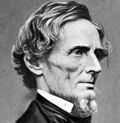
Confederate President Jefferson Davis
Changes in presidential voting in these counties over the past 40 years illustrate just how far the Black Republicans against which Lee and Davis fought are now transcendent—and the alarming (for Democrats) degree to which white Southerners have forsaken their traditional political roots.
Of course, the South’s march toward the GOP is not news. Today, the term “Solid South” has an entirely different connotation than it did during the days of FDR or Lyndon Johnson. However, these namesake counties do provide a window into how these shifts in party preference have occurred over time and the role that race played in them.

Confederate General Robert E. Lee
The 2016 presidential results also show that the Republicanization of the South is accelerating in these counties that bear the mark of Southern heritage, which bodes ill for future Democratic prospects.
In 1976, when Democrat Jimmy Carter became the first Southerner to win the White House since Zachary Taylor in 1848, he carried nine of the 12 Davis and Lee counties. By 1992, Bill Clinton and George H.W. Bush were splitting them six-to-six.
By 2000, Republican George W. Bush had flipped nine of the 12 namesake counties his way; his average share of the total votes cast for the two major party candidates in those counties that year was an impressive 64 percent. But in 2016, Trump trumped the younger Bush, carrying those same nine counties with an average of 70 percent of the two-party vote.
In 1976, Republican President Gerald Ford’s share of the two-party vote topped 50 percent in just three namesake counties (in Florida, Alabama, and Kentucky). But by 2016, Trump’s share of the two-party vote was more than 50 percent in nine counties and parishes; above 60 percent in eight; above 70 percent in four; and above a whopping 80 percent in two (Georgia and Kentucky).
The most dramatic changes were in Jeff Davis County, Georgia, where native Georgian Carter carried 79 percent of the vote in 1976 and Trump won 81 percent in 2016, and Jefferson Davis Parish, Louisiana, where Carter won 62 percent and Trump 75 percent. However, even in majority black Lee County, Arkansas, Trump’s 16-point loss in 2016 was less than half of Ford’s 38-point defeat.
In addition to Lee County, Arkansas, the only namesake counties Trump lost in 2016 were Jefferson Davis County, Mississippi, and Lee County, South Carolina, which are also majority black. However, even in these three counties, Trump carried a larger share of the two-party vote in 2016 than Mitt Romney did in 2012.
In fact, Trump improved on Romney’s result in 11 of the 12 namesake counties, save only Jeff Davis County, Texas, where Trump had to settle for merely matching Romney’s total.
The results in these namesake counties over time also illustrate the role race has played in the political realignment of the South.
In all seven of the overwhelmingly white namesake counties, the Republican share of the two-party vote was higher in 2016 than in 1976, by an average of 29 percent. Trump did better than Romney by an average of 4 percent.
By contrast, in majority-black Lee counties in Mississippi and South Carolina, the Republican two-party share fell by an average 2.5 percent from 1976 to 2016, but Trump outperformed Romney by the same 2.5 percent. These results indicate that the white Southern shift to the Republicans appears stronger than the corresponding black shift to the Democrats.
This is borne out by the results in Lee County, Arkansas, which has the smallest African-American population of any of the majority-black namesake counties (55 percent). There, the Republican share of the two-party vote actually climbed 11 percent between 1976 and 2016, and Trump beat Romney’s total by 5 percent.
Two of the namesake counties—Lee County, Florida, and Jeff Davis County, Texas—are outliers in that they have significant Latino populations. The Republican share of the two-party vote in both of those counties was higher in 2016 than it was in 1976, but Trump’s results were down from the numbers put up in 2000 and 2004 by George W. Bush, who, for a Republican, ran strongly with Latino voters.
The results in the namesake counties also illustrate the mountain which Democrats need to climb if they are to reduce Republican hegemony in the South.
The Democratic base once included small towns and rural areas across the Southern landscape, as well as urban areas. In 2016, Democrats still held the cities (with newfound and welcome signs of life in suburban Atlanta and Houston) and the mostly small rural counties with majority black populations, such as the namesake counties in Arkansas, Mississippi and South Carolina. Democrats also do well in college towns such as Athens, Georgia, and Gainesville, Florida.
But Democrats’ failure to compete for the votes of small town and rural white voters is what is killing them electorally, as the results in the Davis and Lee namesake counties without black majorities vividly illustrates.
Only one of these namesake counties is urban—Lee County, Florida, which includes Fort Myers—and Lee County, Alabama, contains Auburn University. The rest of these counties and parishes are all rural, white areas where Messrs. Davis and Lee are no doubt remembered fondly and Jimmy Carter ran reasonably well—and where Hillary Clinton couldn’t get elected dog catcher if she handed out $20 bills at the polling booth.
As a barometer of the past, these namesake counties illustrate how far Democrats have fallen in their former strongholds. But if Trump’s improved results over Romney’s are a barometer of the future, the bottom may not yet have been reached.
Former Georgia Governor Sonny Perdue picked as Trump’s agriculture chief
Perdue advised Trump on agricultural issues during presidential campaign
♦By Rich Shumate, Chickenfriedpolitics.com editor
WASHINGTON (CFP) — Former Georgia Governor Sonny Perdue, a veterinarian by training who grew up on a family farm, has been nominated by President-elect Donald Trump to be the nation’s next agriculture secretary.
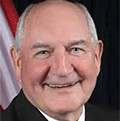
Former Georgia Governor Sonny Perdue
The selection of Perdue, announced a day before Trump’s inauguration on January 19, rounds out the new president’s cabinet.
“From growing up on a farm to being governor of a big agriculture state, (Perdue) has spent his whole life understanding and solving the challenges our farmers face,” Trump said in a statement announcing Perdue’s selection. “He is going to deliver big results for all Americans who earn their living off the land.”
In the same statement, Perdue said “making sure Americans who make their livelihood in the agriculture industry are thriving is near and dear to my heart.”
“I’m going to champion the concerns of American agriculture and work tirelessly to solve the issues facing our farm families in this new role,” he said.
If confirmed by the Senate, Purdue will oversee the sprawling U.S. Department of Agriculture, with more than 100,000 employees and a $140 billion budget. In addition to farm programs, the department also oversees food safety, national forests and the food stamp program that provides nutritional assistance to more than 40 million low-income Americans.
Perdue’s selection will present an unusual wrinkle in the Senate confirmation process, as one of the senators who will consider his nomination, U.S. Senator David Perdue, is Sonny Perdue’s first cousin.
Perdue, 70, served two terms as Georgia governor. His election in 2002 marked the first time a Republican had won the state’s chief executive post since Reconstruction, ending 130 years of Democratic dominance.
Perdue grew up on a farm in Houston County in central Georgia. During the presidential campaign, he had been a member of Trump’s agricultural advisory council.
13 Southern U.S. House Democrats bow out of Trump inaugural
All of the no-shows represent districts carried by Hillary Clinton
♦By Rich Shumate, Chickenfriedpolitics.com editor
WASHINGTON (CFP) — Thirteen of the 40 Southern Democrats in the U.S. House have announced that they will not take part in the January 20 inauguration of Donald Trump.
Lawmakers from Florida, Georgia, Florida, Kentucky, Mississippi, North Carolina, Tennessee, Texas and Virginia are among the no-shows. All of the boycotting members represent urban or black-majority districts that were carried by Democrat Hillary Clinton.
Trump’s tweets castigating U.S. Rep. John Lewis, D-Georgia, for announcing an inauguration boycott seemed to particularly rankle some of the members opting not to attend; Trump’s reaction was called “repugnant,” “ignorant,” and “insensitive and foolish.”
“We are sending a message to Mr. Trump. Respect, like Pennsylvania Avenue, is a two-way street,” said U.S. Rep. Lloyd Doggett, D-Texas, who will be among the no-shows.
However, none of the three other Democrats in Lewis’s own Georgia delegation have joined the boycott. Also not joining so far is U.S. Rep. Debbie Wasserman Schultz, who, as head of the Democratic National Committee during the presidential campaign, had been a sharp Trump critic.
As for the contention by Trump supporters that the inauguration is a celebration not of him but of the peaceful transfer of power, U.S. Rep. Julian Castro, D-Texas, said, “Every American should respect the office of the presidency and the fact that Donald Trump will be the 45th President of the United States. But winning an election does not mean a man can show contempt for millions of Americans and then expect those very people to celebrate him.”
U.S. Rep. Gerry Connolly, D-Virginia, said Trump’s “behavior and harmful words during and after the campaign have left the country I love with open, bleeding wounds. Instead of binding those wounds, he has poured salt on them. Instead of unifying us, he has reveled in driving wedges between us.”
Trump won 108 of the 154 congressional districts across the South in the November election; none of them are represented by Democrats.
Lawmakers boycotting the inaugural are unlikely to pay a political price, as all but two of them represent districts that Clinton carried with at least 60 percent of the vote. However, U.S. Reps. Darren Soto, D-Florida, and John Yarmuth, D-Kentucky, come from districts where Clinton’s share was just 55 percent.
The list of boycotting Democrats includes:
Georgia
- John Lewis, D-Atlanta
Florida
- Alcee Hastings, D-Fort Lauderdale
- Darren Soto, D-Orlando
- Frederica Wilson, D-Miami-Dade
Kentucky
- John Yarmuth, D-Louisville
Mississippi
- Bennie Thompson, D-Jackson
North Carolina
- Alma Adams, D-Greensboro
- G.K. Butterfield, D-Wilson
Tennessee
- Steve Cohen, D-Memphis
Texas
- Lloyd Doggett, D-Austin
- Al Green, D-Houston
- Joaquin Castro, D-San Antonio
Virginia
- Gerry Connolly, D-Fairfax County
Georgia U.S. Rep. Tom Price nominated to Cabinet post overseeing Obamacare
Price is Donald Trump’s pick to be secretary of the Department of Health and Human Services
♦By Rich Shumate, Chicken Fried Politics.com editor
WASHINGTON (CFP) — U.S. Rep. Tom Price of Georgia, who has led the charge in Congress to repeal Obamacare, has been nominated by President-elect Donald Trump to head the department that oversees the nation’s health care system.

U.S. Rep. Tom Price
Price, 62, an orthopedic surgeon from Roswell in the Atlanta suburbs, is Trump’s pick to run the Department of Health and Human Services, a post that took on vast new powers under the Affordable Care Act passed in 2009.
“I am humbled by the incredible challenges that lay ahead and enthusiastic for the opportunity to be a part of solving them on behalf of the American people,” Price said in a statement announcing the appointment.
“There is much work to be done to ensure we have a health care system that works for patients, families, and doctors; that leads the world in the cure and prevention of illness; and that is based on sensible rules to protect the well-being of the country while embracing its innovative spirit.”
In his own statement, Trump said Price “has earned a reputation for being a tireless problem solver and the go-to expert on healthcare policy, making him the ideal choice to serve in this capacity.”
“He is exceptionally qualified to shepherd our commitment to repeal and replace Obamacare and bring affordable and accessible healthcare to every American.”
Price, chairman of the House Budget Committee, was one of nine Republican chairman to jointly endorse Trump in early May, just before he had secured the party’s presidential nomination.
During the campaign, Trump vowed to repeal and replace Obamacare, something Republicans have tried to do repeatedly while President Obama was in office. Price has been among the leaders of that repeal effort in the House.
The HHS secretary is responsible for overseeing key parts of the Obamacare machinery, including the exchanges that offer subsidized insurance coverage to lower-income Americans and the Medicaid program that allows states to cover the medical costs of the poor.
Price was elected to the U.S. House in 2004, representing Georgia’s heavily Republican 6th District, which takes in upscale suburbs north of the city of Atlanta.
If he is confirmed to the HHS post, a special election will be held to pick his replacement in the House. Given the political leanings of the district, the seat is almost certain to remain in Republican hands.
 Chicken Fried Politics