
Home » Kentucky (Page 10)
Category Archives: Kentucky

Analysis: Results in Confederate namesake counties show role of race in Democratic decline
Trump accelerates Republican shift in counties named for Jefferson Davis and Robert E. Lee
♦By Rich Shumate, Chickenfriedpolitics.com editor
 (CFP) — Jefferson Davis and Robert E. Lee loom large as icons of the Southern Confederacy, so much so that 11 Southern counties and one Louisiana parish bear their names. But if these lions of the South are aware of what is happening in their namesake counties today, they may be rotating in their graves.
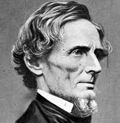
Confederate President Jefferson Davis
Changes in presidential voting in these counties over the past 40 years illustrate just how far the Black Republicans against which Lee and Davis fought are now transcendent—and the alarming (for Democrats) degree to which white Southerners have forsaken their traditional political roots.
Of course, the South’s march toward the GOP is not news. Today, the term “Solid South” has an entirely different connotation than it did during the days of FDR or Lyndon Johnson. However, these namesake counties do provide a window into how these shifts in party preference have occurred over time and the role that race played in them.

Confederate General Robert E. Lee
The 2016 presidential results also show that the Republicanization of the South is accelerating in these counties that bear the mark of Southern heritage, which bodes ill for future Democratic prospects.
In 1976, when Democrat Jimmy Carter became the first Southerner to win the White House since Zachary Taylor in 1848, he carried nine of the 12 Davis and Lee counties. By 1992, Bill Clinton and George H.W. Bush were splitting them six-to-six.
By 2000, Republican George W. Bush had flipped nine of the 12 namesake counties his way; his average share of the total votes cast for the two major party candidates in those counties that year was an impressive 64 percent. But in 2016, Trump trumped the younger Bush, carrying those same nine counties with an average of 70 percent of the two-party vote.
In 1976, Republican President Gerald Ford’s share of the two-party vote topped 50 percent in just three namesake counties (in Florida, Alabama, and Kentucky). But by 2016, Trump’s share of the two-party vote was more than 50 percent in nine counties and parishes; above 60 percent in eight; above 70 percent in four; and above a whopping 80 percent in two (Georgia and Kentucky).
The most dramatic changes were in Jeff Davis County, Georgia, where native Georgian Carter carried 79 percent of the vote in 1976 and Trump won 81 percent in 2016, and Jefferson Davis Parish, Louisiana, where Carter won 62 percent and Trump 75 percent. However, even in majority black Lee County, Arkansas, Trump’s 16-point loss in 2016 was less than half of Ford’s 38-point defeat.
In addition to Lee County, Arkansas, the only namesake counties Trump lost in 2016 were Jefferson Davis County, Mississippi, and Lee County, South Carolina, which are also majority black. However, even in these three counties, Trump carried a larger share of the two-party vote in 2016 than Mitt Romney did in 2012.
In fact, Trump improved on Romney’s result in 11 of the 12 namesake counties, save only Jeff Davis County, Texas, where Trump had to settle for merely matching Romney’s total.
The results in these namesake counties over time also illustrate the role race has played in the political realignment of the South.
In all seven of the overwhelmingly white namesake counties, the Republican share of the two-party vote was higher in 2016 than in 1976, by an average of 29 percent. Trump did better than Romney by an average of 4 percent.
By contrast, in majority-black Lee counties in Mississippi and South Carolina, the Republican two-party share fell by an average 2.5 percent from 1976 to 2016, but Trump outperformed Romney by the same 2.5 percent. These results indicate that the white Southern shift to the Republicans appears stronger than the corresponding black shift to the Democrats.
This is borne out by the results in Lee County, Arkansas, which has the smallest African-American population of any of the majority-black namesake counties (55 percent). There, the Republican share of the two-party vote actually climbed 11 percent between 1976 and 2016, and Trump beat Romney’s total by 5 percent.
Two of the namesake counties—Lee County, Florida, and Jeff Davis County, Texas—are outliers in that they have significant Latino populations. The Republican share of the two-party vote in both of those counties was higher in 2016 than it was in 1976, but Trump’s results were down from the numbers put up in 2000 and 2004 by George W. Bush, who, for a Republican, ran strongly with Latino voters.
The results in the namesake counties also illustrate the mountain which Democrats need to climb if they are to reduce Republican hegemony in the South.
The Democratic base once included small towns and rural areas across the Southern landscape, as well as urban areas. In 2016, Democrats still held the cities (with newfound and welcome signs of life in suburban Atlanta and Houston) and the mostly small rural counties with majority black populations, such as the namesake counties in Arkansas, Mississippi and South Carolina. Democrats also do well in college towns such as Athens, Georgia, and Gainesville, Florida.
But Democrats’ failure to compete for the votes of small town and rural white voters is what is killing them electorally, as the results in the Davis and Lee namesake counties without black majorities vividly illustrates.
Only one of these namesake counties is urban—Lee County, Florida, which includes Fort Myers—and Lee County, Alabama, contains Auburn University. The rest of these counties and parishes are all rural, white areas where Messrs. Davis and Lee are no doubt remembered fondly and Jimmy Carter ran reasonably well—and where Hillary Clinton couldn’t get elected dog catcher if she handed out $20 bills at the polling booth.
As a barometer of the past, these namesake counties illustrate how far Democrats have fallen in their former strongholds. But if Trump’s improved results over Romney’s are a barometer of the future, the bottom may not yet have been reached.
13 Southern U.S. House Democrats bow out of Trump inaugural
All of the no-shows represent districts carried by Hillary Clinton
♦By Rich Shumate, Chickenfriedpolitics.com editor
WASHINGTON (CFP) — Thirteen of the 40 Southern Democrats in the U.S. House have announced that they will not take part in the January 20 inauguration of Donald Trump.
Lawmakers from Florida, Georgia, Florida, Kentucky, Mississippi, North Carolina, Tennessee, Texas and Virginia are among the no-shows. All of the boycotting members represent urban or black-majority districts that were carried by Democrat Hillary Clinton.
Trump’s tweets castigating U.S. Rep. John Lewis, D-Georgia, for announcing an inauguration boycott seemed to particularly rankle some of the members opting not to attend; Trump’s reaction was called “repugnant,” “ignorant,” and “insensitive and foolish.”
“We are sending a message to Mr. Trump. Respect, like Pennsylvania Avenue, is a two-way street,” said U.S. Rep. Lloyd Doggett, D-Texas, who will be among the no-shows.
However, none of the three other Democrats in Lewis’s own Georgia delegation have joined the boycott. Also not joining so far is U.S. Rep. Debbie Wasserman Schultz, who, as head of the Democratic National Committee during the presidential campaign, had been a sharp Trump critic.
As for the contention by Trump supporters that the inauguration is a celebration not of him but of the peaceful transfer of power, U.S. Rep. Julian Castro, D-Texas, said, “Every American should respect the office of the presidency and the fact that Donald Trump will be the 45th President of the United States. But winning an election does not mean a man can show contempt for millions of Americans and then expect those very people to celebrate him.”
U.S. Rep. Gerry Connolly, D-Virginia, said Trump’s “behavior and harmful words during and after the campaign have left the country I love with open, bleeding wounds. Instead of binding those wounds, he has poured salt on them. Instead of unifying us, he has reveled in driving wedges between us.”
Trump won 108 of the 154 congressional districts across the South in the November election; none of them are represented by Democrats.
Lawmakers boycotting the inaugural are unlikely to pay a political price, as all but two of them represent districts that Clinton carried with at least 60 percent of the vote. However, U.S. Reps. Darren Soto, D-Florida, and John Yarmuth, D-Kentucky, come from districts where Clinton’s share was just 55 percent.
The list of boycotting Democrats includes:
Georgia
- John Lewis, D-Atlanta
Florida
- Alcee Hastings, D-Fort Lauderdale
- Darren Soto, D-Orlando
- Frederica Wilson, D-Miami-Dade
Kentucky
- John Yarmuth, D-Louisville
Mississippi
- Bennie Thompson, D-Jackson
North Carolina
- Alma Adams, D-Greensboro
- G.K. Butterfield, D-Wilson
Tennessee
- Steve Cohen, D-Memphis
Texas
- Lloyd Doggett, D-Austin
- Al Green, D-Houston
- Joaquin Castro, D-San Antonio
Virginia
- Gerry Connolly, D-Fairfax County
U.S. Senate: Republicans hold on to all 8 of their Southern seats
Rubio and Burr beat back challenges in Florida, North Carolina; Kennedy and Campbell will contest runoff in Louisiana
♦By Rich Shumate, Chickenfriedpolitics.com editor
 (CFP) — Republicans held on to all eight of their Southern U.S. Senate seats, with Marco Rubio in Florida and Richard Burr in North Carolina turning back strong Democratic challengers.
Meanwhile, in Louisiana’s all-party “jungle” primary, State Treasurer John Kennedy and Democratic Public Service Commissioner Foster Campbell will advance to a December 10 runoff for the open seat being vacated by Republican U.S. Senator David Vitter.
Kennedy led with 25 percent, with Campbell at 18 percent, edging out Republican U.S. Rep. Charles Boustany at 15 percent.
Because Republicans already secured their 51-seat Senate majority, the Louisiana runoff will not affect the balance of power.
In addition to Rubio and Burr, Republican incumbents also won re-election in Alabama, Arkansas, Georgia, Kentucky, Oklahoma and South Carolina.
With the wins on November 8, Republicans will hold 23 of the 28 Southern Senate seats, with Louisiana still to be decided.
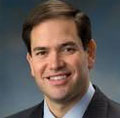
U.S. Senator Marco Rubio
In Florida, Rubio had initially decided to give up his Senate seat to pursue the Republican presidential nomination. But after losing the White House contest, he changed course and filed to run for a second term, improving the GOP ‘s prospects for keeping the seat.
Rubio took 52 percent, defeating Democratic U.S. Rep. Patrick Murphy, who took 44 percent.
Alluding to his withdrawal from the presidential race in March, he told election night supporters in Miami, “This is a lot better than the last time I did one of these.”
Rubio, who had been a critic of Trump before reluctantly endorsing him, did not mention his party’s victorious presidential standard-bearer in his speech, but he did make a plea for civility in politics.
“While we can disagree on issues, we cannot share a country where people hate each other because of their political affiliations,” Rubio said.

U.S. Senator Richard Burr
In North Carolina, Burr, seeking a third term, took 51 percent of the vote, defeating Deborah Ross, a former state legislator and Duke University law professor, who took 45 percent.
“I am truly humbled by the support I’ve received from people across this state,” Burr said at a victory celebration in Winston-Salem. “This is a victory for all of those who have believed in me.”
In a state notorious for exchanging Senate seats between parties, Burr becomes the first senator to win three consecutive terms since Jesse Helms in 1984.
Here are the other Southern Senate results:

Shelby
Alabama: Republican U.S. Senator Richard Shelby won a seventh term by defeating Democrat Ron Crumpton, a marijuana rights activist. by a margin of 64-36 percent. At the end of his new term, Shelby will be 88 and will have served in Congress for 44 years.

Boozman
Arkansas: Republican U.S. Senator John Boozman won a second term by taking 60-36 percent for Democrat Conner Eldridge, a former federal prosecutor from Fayetteville. Boozman suffered an aortic aneurysm in 2014 that kept him away from Washington for two months.

Isakson
Georgia: Republican U.S. Senator Johnny Isakson won a third term in the Senate by defeating Democrat Jim Barkdale, a wealthy Atlanta businessman, by a 55-41 percent margin. Isakson ran for re-election to a third term despite announcing in 2015 that he had been diagnosed with Parkinson’s disease.

Paul
Kentucky: Republican U.S. Senator Rand Paul defeated Lexington Mayor Jim Gray by a margin of 57-43 percent. Paul had pursued re-election simultaneously with a presidential campaign until he dropped out of the White House race in February.

Lankford
Oklahoma: Republican U.S. Senator James Lankford easily won his first full six-year term by defeating Democrat Mike Workman, a Tulsa political consultant, by a margin of 68-25 percent. In 2014, Lankford was elected to finish out the final two years of Tom Coburn’s term after he resigned.

Scott
South Carolina: Republican U.S. Senator Tim Scott, the only black Republican in the Senate, easily won a full six-year term by defeating Democrat Thomas Dixon, a Charleston pastor, by a margin of 61-36 percent. In 2014, Scott was elected to serve out the remaining two years of Jim DeMint’s term, after he resigned.
Republican U.S. Senate incumbents trying to fight off Democratic challengers
Florida and North Carolina are Senate battlegrounds; Louisiana holds all-party primary for Vitter’s seat
♦By Rich Shumate, Chickenfriedpolitics.com editor
(CFP) — Nine GOP-held Southern U.S. Senate seats are up for grabs in the November 8 election, with Republican incumbents heavily favored in six races.
The exceptions are Florida, where Republican U.S. Senator Marco Rubio is facing off against Democratic U.S. Rep. Patrick Murphy, and in North Carolina, where the GOP incumbent, U.S. Senator Richard Burr, is facing Deborah Ross, a former state legislator and Duke University law professor.
And in Louisiana, 24 candidates are running in an all-party “jungle” primary, with the top two vote-getters advancing to a December 10 runoff, which could potentially decide the balance of power in the Senate.
Pre-election polls have shown Republican State Treasurer John Kennedy in the lead, followed by Public Service Commissioner Foster Campbell, a Democrat; Republican U.S. Rep. Charles Boustany of Lafayette; and Democrat Caroline Fayard, a New Orleans lawyer.
If Kennedy and Boustany can both clear the runoff, the GOP would be guaranteed of keeping the seat, now held by U.S. Senator David Vitter. But if Campbell or Fayard can come through, the December 10 runoff will be the last word on Senate races this year — and, if the Senate is closely divided, decide which party controls the chamber.
In addition to Rubio and Burr, Republican incumbents are seeking re-election in Alabama, Arkansas, Georgia, Kentucky, Oklahoma and South Carolina.
All are heavily favored, although the race in Georgia between U.S. Senator Johnny Isakson and Democratic businessman Jim Barksdale is somewhat more competitive.
In Alabama, Richard Shelby faces Democrat Ron Crumpton, a marijuana rights activist; in Arkansas John Boozman is seeking a second term against Democrat Conner Eldridge, a former federal prosecutor from Fayetteville; and in Kentucky, Rand Paul is running against Lexington Mayor Jim Gray.
In Oklahoma, James Lankford faces Mike Workman, a Tulsa political consultant, and in South Carolina, Tim Scott, the only black Republican in the Senate, faces Democrat Thomas Dixon, a Charleston pastor.
Clinton ekes out win in Democratic presidential primary in Kentucky
Lexington Mayor Jim Gray wins Democratic nomination to face Republican Rand Paul in U.S. Senate race
♦By Rich Shumate, Chickenfriedpolitics.com
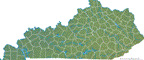 LOUISVILLE (CFP) — Hillary Clinton scored a narrow victory over U.S. Senator Bernie Sanders of Vermont in the Kentucky Democratic presidential primary, the last stop in the Southern primary season.
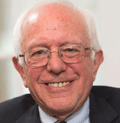
U.S. Senator Bernie Sanders
Clinton took 46.8 percent of the vote in the May 17 vote, compared to just 46.3 percent for Sanders. a margin of just 1,900 votes. That was a stark reversal from eight years ago, when Clinton walloped Barack Obama by more than 35 points in the Bluegrass State.
With the results in Kentucky, Clinton ends the Southern primary season by nearly running the table, taking 12 out of 14 contests. Sanders won only Oklahoma and West Virginia.

Lexington Mayor Jim Gray
Meanwhile, in Kentucky’s U.S. Senate primary, Lexington Mayor Jim Gray won the Democratic nomination over a crowded field, taking 58 percent of the vote. He will now face Republican U.S. Senator Rand Paul in November.
Given Kentucky’s Republican tendencies in federal elections, Paul, seeking his second term, is considered a prohibitive favorite, although Gray, as mayor of the commonwealth’s second-largest city and the wealthy owner of a family construction business, poses a credible challenge.
Gray is also trying to become the first openly gay man ever elected to the Senate.
 Chicken Fried Politics