
Home » North Carolina (Page 10)
Category Archives: North Carolina

7 new Southern U.S House Democrats who ousted Republicans support Nancy Pelosi for speaker
Cunningham of South Carolina and Spanberger of Virginia keep vow to oppose Pelosi; North Carolina’s 9th District remains vacant
♦By Rich Shumate, ChickenFriedPolitics.com
 WASHINGTON (CFP) — Seven Southern Democratic U.S. House freshmen who ousted GOP incumbents in November supported Nancy Pelosi’s bid to reclaim the gavel as speaker of the U.S. House — handing Republicans an issue to use against them in 2020.
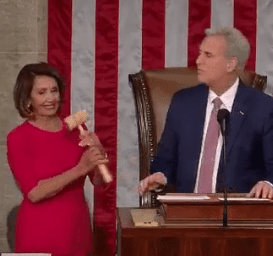
Incoming Speaker Nancy Pelosi accepts gavel from GOP Leader Kevin McCarthy (From Twitter)
Colin Allred and Lizzie Pannill Fletcher of Texas, Kendra Horn of Oklahoma, Lucy McBath of Georgia, Elaine Luria and Jennifer Wexton of Virginia, and Debbie Mucarsel-Powell of Florida all supported Pelosi in the January 3 vote.
Two other freshmen Democrats who had vowed during their campaign that they would not support Pelosi — Joe Cunningham of South Carolina and Abigail Spanberger of Virginia — kept that promise, voting instead for Cheri Bustos of Illinois.
And despite signing a letter in November calling for new leadership in the House, Filemon Vela of Texas switched course to vote for Pelosi.
Meanwhile, as the new Congress convened in Washington with 29 new Southern members, one seat sat empty — the representative from North Carolina’s 9th District, where state elections officials have refused to certify Republican Mark Harris’s narrow win over Democrat Dan McCready amid allegations of absentee ballot fraud.
In the vote for speaker, just three Southern Democratic members did not support Pelosi — Cunningham and Spanberger, who voted for Bustos, and Jim Cooper of Tennessee, who voted present.
Cooper, who has been in Congress since 1983, had been a long-time opponent of Pelosi’s speakership, having voted against her five times previously.
After the November election, a group of 16 Democratic members, including Cooper, Cunningham and Vela, signed a letter calling for “new leadership” in the Democratic caucus.
Vela changed course after Pelosi agreed to support term limits for the House Democratic leadership, which will limit her speakership to no more than four years.
Pelosi needed a majority of the 430 votes cast for speaker. In the end, she got 220 votes, four more than necessary.
Of the seven Southern Democrats who ousted Republicans and voted for Pelosi, McBath, Horn and Luria represent districts carried by President Donald Trump in 2016, while Allred and Fletcher represent districts he lost by less than 2 points.
Hillary Clinton carried Murcasel-Powell’s district in South Florida by 16 points and Wexton’s district in the Virginia suburbs of Washington, D.C. by 10 points.
Three other Southern Democratic newcomers who won open seats in November also supported Pelosi — Veronica Escobar and Sylvia Garcia of Texas, and Donna Shalala of Florida. All three represent districts Clinton carried handily.
Among Southern Republicans, only three did not support their candidate for speaker, House Minority Leader Kevin McCarthy of California.
Thomas Massie of Kentucky and Jody Hice of Georgia supported Jim Jordan of Ohio, one of the founders of the House Freedom Caucus, a grouping of the most conservative Republican members.
Walter Jones of North Carolina did not vote. He has been absent from Congress since September because of an undisclosed illness.
Of the 29 new Southern members of the House, 17 are Republicans and 12 are Democrats. Republicans hold 101 Southern seats, compared to 50 for Democrats, with North Carolina’s 9th District vacant.
The 9th District seat is likely to remain vacant until after the state elections board completes its investigation into the allegations of absentee ballot irregularities, which has been delayed until February because of a new law revamping the board.
Harris has filed a lawsuit seeking for force certification of the election.
We tweet @ChkFriPolitics Join us!

Change in party control of U.S. House diminishes Southern clout
Just five House committees in new Congress will have Southerners at the helm
♦By Rich Shumate, ChickenFriedPolitics.com
WASHINGTON (CFP) — When it comes to Southern clout in the U.S. House, what a difference an election makes.
In the recently departed Congress, with Republicans in control, 13 of the 22 committee chairs hailed from the 14 Southern states; in the newly installed Congress, with Democrats in charge, that number will fall to just five.
Five Southern Republican chairs retired, and one, Pete Sessions of Texas, went down to defeat in November. Those who stayed find themselves in the minority for the first time in eight years.
The switch in control has shifted power from the GOP, in which Southerners made up nearly half of the caucus, to the Democrats, where Southerners only make up a fifth. And that has led to reduced numbers of Southerners among committee chairs.
All five of the committees that will be chaired by Southern Democrats in the new Congress were chaired by Southern Republicans in the last Congress, so there will be no loss of influence on those panels.
Also, the outgoing majority whip, Republican Steve Scalise of Louisiana, will be replaced by the incoming majority whip, Democrat Jim Clyburn of South Carolina. Both men remain the only Southern members in their party’s top leadership.
But eight other committees that had GOP chairmen will now be headed by lawmakers from outside the region. And that list contains a number of the most powerful and high-profile chairmanships in Washington, including Judiciary, Rules, Ways and Means, and Oversight and Reform.
The five Southern Democratic committee chairmen are John Yarmuth of Kentucky, Budget; Ted Deutch of Florida, Ethics; Bobby Scott of Virginia, Education and Labor; Bennie Thompson of Mississippi, Homeland Security; and Eddie Bernice Johnson of Texas, Science, Space and Technology.
Unlike Republicans, who select committee chairs by voting within the caucus, Democrats use seniority. All five of the Southern Democrats ascending to chairmanships had been the ranking Democratic member when Democrats were in the minority.
Scott, Thompson and Johnson, all members of the Congressional Black Caucus, are among eight new chairs who are African American or Latino. In the departing Republican Congress, all of the chairs were white, and 20 were men.
Southerners will make up a slight majority within the Republican caucus in the new Congress, which is reflected in the GOP’s new committee leadership. On 14 of the 22 House committees, the ranking Republican in the new Congress will be from the South.
Among the notable newcomers to that group are Kay Granger of Texas, who will be ranking member on Appropriations, and Doug Collins of Georgia, on Judiciary–the committee that would handle any impeachment proceedings against President Donald Trump.
Michael McCaul of Texas, who had been chairman of Homeland Security, has shifted to become the new ranking member of Foreign Affairs.
Six Southern Republicans who had been chairs of their committees will continue as ranking members in the new Congress–Mike Conaway of Texas, Agriculture; Mac Thornberry of Texas, Armed Services; Steve Womack of Arkansas, Budget; Virginia Foxx of North Carolina, Education and Labor; Phil Roe of Tennessee, Veterans’ Affairs; and Kevin Brady of Texas, Ways and Means.
In addition to Granger and Collins, five other Southern Republicans were also newly named as ranking members–Patrick McHenry of North Carolina, Financial Services; Kenny Marchant of Texas, Ethics; Mike Rogers of Alabama, Homeland Security; Tom Cole of Oklahoma, Rules; and Frank Lucas of Oklahoma, Science, Space and Technology.
We tweet @ChkFriPolitics Join us!

North Carolina lawmakers give 9th District GOP voters option to dump Mark Harris
General Assembly overrides Governor Roy Cooper’s veto of bill requiring primaries in rerun elections
♦By Rich Shumate, ChickenFriedPolitics.com editor
 RALEIGH (CFP) — North Carolina Republicans will now be able to dump their embattled candidate in the nation’s last undecided U.S. House race, after the General Assembly overrode Governor Roy Cooper’s veto of bill changing state election law.
Under the new law, if state elections officials decide to rerun the 9th District race between Republican Mark Harris and Democrat Dan McCready, both parties will hold primaries, rather than simply redoing the general election.

Mark Harris
That would allow Republicans to replace Harris, whose campaign has become embroiled in an investigation into irregularities in absentee voting in Bladen County, a rural outpost at the edge of the district.
Had the law not been changed, Republicans would have been stuck with Harris as their nominee, raising concerns about losing the seat to McCready in the wake of the investigation.
The controversy over the 9th District race now turns to Washington, where the incoming Democratic majority is expected to refuse to seat Harris pending the outcome of the investigation.
The State Board of Elections. has scheduled a January 11 hearing on the results of the investigation and will then decide whether to order a new election in the 9th District race.
Republicans voted to override Cooper’s veto on December 27, just four days left before they were set to lose their legislative super-majority that has allowed them to override Cooper repeatedly over the last two years.
Cooper’s objection to the law was not over the new primary requirement but a different provision that shielded campaign finance complaints against elected officials from public disclosure.
Republicans hold a two-thirds majority in both houses of the General Assembly, and they have overridden more than 20 of Cooper’s vetoes since he took office in 2017. However, because of Democratic gains in November, the GOP super-majority will go away in January, although Republicans will still control both houses.
The state elections board refused to certify Harris’s unofficial 905-vote lead over McCready after reports surfaced that a political operative working for Harris’s campaign, McRae Dowless, had hired people to collect absentee ballots in Bladen County, a practice that is illegal in North Carolina.
Bladen County also had an unusually high number of absentee ballot requests, and Harris carried the absentee vote by 24 percentage points, a much higher percentage than elsewhere in the district, which stretches across eight counties from suburban Charlotte toward Fayetteville.
Harris has said that he personally made the decision to hire Dowless, but he said he did not know Dowless was doing anything illegal.
Dowless has not spoken publicly about the allegations but has denied any wrongdoing to local media.
McCready, who conceded to Harris on election night, has withdrawn his concession and is now raising money for a rematch.
Also possibly waiting in the wings for Harris in Republican primary is the man who now holds the seat, U.S. Rep. Robert Pittenger, whom Harris defeated by just 828 votes in the May primary after taking 96 percent of the absentee vote in Bladen — results that have come under renewed scrutiny since the state board’s refusal to certify the general election results.
Harris, 52, a Baptist pastor and prominent religious conservative activist, is making his third bid for political office, after losing a U.S. Senate race in 2014 and the 9th District race in 2016.
McCready, 34, a former Marine officer and Iraq War veteran, is making his political debut.
We tweet @ChkFriPolitics Join us!
North Carolina lawmakers allow GOP to ditch Mark Harris if disputed U.S. House race is rerun
Harris confirms he hired political operative at center of absentee ballot investigation but says he was unaware of illegal activity
♦By Rich Shumate, ChickenFriedPolitics.com editor
CHARLOTTE (CFP) — The Republican-controlled North Carolina legislature has voted to require party primaries if state elections officials order a rerun of the disputed 9th District U.S. House race — a move that would allow the GOP to ditch Mark Harris, their current nominee who is at the center of an absentee voting scandal.
Mark Harris
In another development, Harris — in his first interview since the scandal broke — told Charlotte TV station WTVB that he personally made the decision to hire McRae Dowless, the Bladen County political operative at the center of an investigation by the State Board of Elections. But he said he did not know Dowless was doing anything illegal.
The state board, which has refused to certify Harris’s unofficial 905-vote lead over Democrat Dan McCready, will hold an evidentiary hearing on the election dispute on January 11, which means that Harris is unlikely to be seated when the new Congress convenes on January 3.
Harris told WBTV that he decided to hire Dowless after narrowly losing a Republican primary for the 9th District seat in 2016, in which an opponent who hired Dowless had a strong performance among absentee voters in Bladen, a rural outpost at the eastern end of the district.
“I remember looking at that and going, ‘Wow, that’s unusual,'” Harris said.
Harris said the services Dowless offered included canvassing people to fill out absentee ballot requests and then helping them cast and mail in their ballots — not collecting and returning ballots for them, which is illegal in North Carolina.
“I remember (Dowless) saying specifically that they were not to take a ballot. They were not to touch a ballot,” Harris said, noting that Dowless had been “vouched for by a number of other leaders down there.”
“I had no reason to think that what he was doing was illegal,” Harris said.
The state board refused to certify the election after evidence surfaced that Dowless and workers that he hired had collected ballots during the November vote. Bladen County also had an unusually high number of absentee ballot requests, and Harris carried the absentee vote by 24 percentage points.
Dowless has not spoken publicly about the allegations but has denied any wrongdoing to local media.
Harris said the board’s refusal to certify the election was “frustrating” plans to set up his congressional offices and get committee assignments.
“It’s been very frustrating because I’ve been elected to serve the 9th District, and I don’t feel like the 9th District is getting served,” he said.
In his interview, Harris did not directly criticize GOP legislative leaders for moving to force a new primary. But he did say, “I certainly don’t feel the circling of the wagons around Harris the way I see the Democrats circling the wagons around McCready.”
The bill passed December 13 by the legislature would require Democratic and Republican primaries if a rerun of the 9th District election is ordered. Had the law not been changed, Republicans would have been stuck with Harris as their nominee, raising concerns about losing the seat to McCready in the wake of the investigation.
McCready, who conceded to Harris on election night, has withdrawn his concession and is now raising money for a rematch.
Also possibly waiting in the wings for Harris in Republican primary is the man who now holds the seat, U.S. Rep. Robert Pittenger, whom Harris defeated by just 828 votes in the May primary after taking 96 percent of the absentee vote in Bladen — results that have come under renewed scrutiny since the state board’s refusal to certify the general election results.
The bill mandating a primary — contained in a larger package of election reforms passed during a lame duck legislative session — is awaiting Democratic Governor Roy Cooper’s signature. If Cooper vetoes the bill, Republicans would have the votes to override him.
Because of Democratic gains in November, Republicans will only hold veto-proof majorities until January, when the new legislature takes office.
Harris, 52, a Baptist pastor and prominent religious conservative activist, is making his third bid for political office, after losing a U.S. Senate race in 2014 and the 9th District race in 2016.
McCready, 34, a former Marine officer and Iraq War veteran, is making his political debut.
The 9th District takes in eight counties stretching from the suburbs of Charlotte east toward Fayetteville.
We tweet @ChkFri Politics Join us!
Republican Mark Harris will support new vote in North Carolina’s 9th U.S. District if fraud affected outcome
Harris, who has a 905-vote lead in unofficial results, insists he was “absolutely unaware” of wrongdoing
♦By Rich Shumate, ChickenFriedPolitics.com editor
CHARLOTTE (CFP) — Mark Harris, the Republican candidate in North Carolina’s 9th U.S. House District, said he will support a new election if elections officials find proof that voter fraud affected the outcome of the November 6 vote.
Congressional candidate Mark Harris, R-North Carolina
In a video released December 7, Harris also said he was “absolutely unaware” of any wrongdoing by his campaign and pledged to cooperate with an investigation by the North Carolina State Board of Elections into allegations of fraud in absentee ballots linked to a subcontractor paid for work by his campaign.
“I’m hopeful that this process will ultimately result in the certification of my election to Congress,” Harris said. “However, if this investigation finds proof of illegal activities on either side to such a level that it could have changed the outcome of this election, then I would wholeheartedly support a new election to insure all voters have confidence in the results.”
Harris, 52, a Baptist pastor and prominent religious conservative activist, holds a 905-vote lead in unofficial results. But the state board refused to certify the results after allegations of fraud in the distribution and collection of absentee ballots in Bladen County, a rural outpost that Harris carried over his Democratic opponent, Dan McCready.
The 9th District includes parts of eight counties stretching from the suburbs of Charlotte east toward Fayettteville.

Congressional candidate Dan McCready, D-North Carolina
McCready, who had conceded to Harris on election night, took to Twitter to withdraw his concession and demand that Harris answer questions about the fraud allegations.
“I didn’t serve overseas in the Marine Corps just to come back home and watch politicians and career criminals attack our democracy,” McCredy said. “I call on Mark Harris to tell us exactly what he knew and when he knew it.”
McCready, 34, served four years as a Marine officer, including service in the Iraq war.
The fraud allegations swirl around Leslie McCrae Dowless Jr., who the state board has identified as “a person of interest” in its investigation. The board has subpoenaed documents from the Harris campaign and the Red Dome Group, a Charlotte-based political consultancy that helped run Harris’s campaign and has said it hired Dowless as a subcontractor.
Voters in Bladen County have signed affidavits saying that they were approached at their homes by people offering to collect their absentee ballots for them and return them to the county elections office. That practice, known as ballot harvesting, is illegal in North Carolina.
One of those ballot harvesters, Ginger Eason, told WSOC-TV that she was paid by Dowless to collect the ballots. Dowless has kept a low profile since the allegations surfaced but has denied any wrongdoing to the Charlotte Observer.
Dowless, who has a previous conviction for insurance fraud, was investigated by the state elections board over voting irregularities in 2016. The board referred its findings to federal and state prosecutors.
In addition to concerns about ballot harvesting, the absentee vote totals in Bladen have also raised questions. More than 1,340 voters in Bladen requested absentee ballots, but only 684 were actually cast. And while McCready beat Harris among absentee voters in the rest of the district, Harris won by a 24-point margin in the absentee vote in Bladen.
In the GOP primary, Harris ousted incumbent U.S. Rep. Robert Pittenger by just 828 votes, a race in which Harris took 437 absentee votes to just 17 for Pittenger in Bladen, a whopping margin of 96 percent.
If the state elections board finds that fraud affected the outcome of the vote, it could order an election rerun between Harris and McCready. Republicans could not replace Harris on the ballot unless he dies or moves out of state.
However, the new Democrat-controlled House in Washington could refused to seat Harris, which would trigger an entirely new election, in which both parties would pick nominees in primaries.
The Democratic leader, Nancy Pelosi, has indicated that refusing to seat Harris is a possibility if the state board decides not to act.
“This is bigger than that one seat. This is about undermining the integrity of our elections,” Pelosi said. “What was done there was so remarkable, in that that person, those entities, got away with that.”
The state elections board is made up of four Democrats, four Republicans and one member without a party affiliation.
The 9th District was one of four GOP-held seats in North Carolina targeted by Democrats in 2018. Republicans won the other three.
 Chicken Fried Politics