
Home » North Carolina (Page 12)
Category Archives: North Carolina

U.S. Supreme Court stays ruling striking down North Carolina U.S. House map
Decision means 2018 primaries can proceed in existing districts
♦By Rich Shumate, ChickenFriedPolitics.com editor
 WASHINGTON (CFP) – The U.S. Supreme Court has indefinitely stayed a ruling by a panel of three federal judges that invalidated North Carolina’s U.S. House map for unconstitutionally diluting the voting strength of Democrats.
The January 18 decision by the high court means state legislators will not have to redraw the map for the 2018 midterm election, a prospect that threatened to throw the election process into chaos.
The Supreme Court’s unsigned order stays the ruling “pending the timely filing and disposition of an appeal by this court.”
While the order did not indicate how many of the justices were in favor of granting a stay, it did note that two members of the court’s liberal bloc, Ruth Bader Ginsburg and Sonia Sotomayor, wanted to deny the application for a stay filed by Republican lawmakers.
Common Cause North Carolina and the League of Women Voters of North Carolina sued to invalidate the House map passed by the GOP-controlled legislature in 2016, arguing that the Republican majority improperly used political considerations in drawing the map.
No federal court had ever a stuck down a congressional map for being gerrymandered for political, rather than racial, reasons. But the majority opinion from three-judge panel who heard the case said partisan gerrymandering – a common political practice in many U.S. states – violates a “core principle of republican government” that “voters should choose their representatives, not the other way around.”
The January 9 ruling gave state lawmakers just 20 days to draw a new map, an order that is now on hold until the Supreme Court considers the appeal. Qualifying for the May 8 primary is scheduled to begin Feb. 28.
The high court is already considering similar cases involving state legislative districts in Wisconsin and Maryland that could set a precedent for the North Carolina case.
Should the ruling in North Carolina be upheld on appeal, it could have significant effects in other Southern states where Republican state legislative majorities have gerrymandered maps to their advantage, particularly Florida, Virginia and Texas.
Democrats cheered the ruling, which could help them make a dent in the GOP’s 10-to-3 advantage in North Carolina’s congressional delegation. But Republicans accused the judges of “waging a personal, partisan war” against the state GOP.
Ironically, what may have sunk the North Carolina map was the explicit admission by GOP lawmakers back in 2016 that they were drawing lines to maximize the number of Republican-friendly seats – an admission made to overcome objections to a previous map struck down for improperly using racial considerations.
After the map was redrawn in 2016, several incumbent lawmakers were forced to run in new territory and one, former U.S. Rep. Renee Ellmers, didn’t survive after she was forced to run against another incumbent in a Republican primary. However, the new map did not change the overall party composition in the state’s House delegation.
The 2016 map has allowed Republicans to hold on 77 percent of the state’s congressional seats, even though election results have been closely divided between the parties in recent statewide and presidential elections.
Donald Trump carried North Carolina by just 4 points in 2016, as Democrat Roy Cooper squeaked into the governorship by a margin of less than 1 percent.
The redistricting case was heard by James Wynn, a judge on the 4th U.S. Circuit Court of Appeals; W. Earl Britt, a senior U.S. District Court judge in Raleigh; and William Osteen Jr., a U.S. District Court judge in Greensboro.
Wynn and Britt were appointed by Democratic presidents; Osteen, who dissented from part of the ruling while concurring in striking down the map, is a Republican appointee.
Federal judges strike down North Carolina’s U.S. House map over gerrymandering
Ruling could have an impact on other Southern states with partisan maps
♦By Rich Shumate, ChickenFriedPolitics.com editor
RALEIGH (CFP) – In an unprecedented decision, a panel of three federal judges has struck down North Carolina’s U.S. House map, ruling that Republican lawmakers unconstitutionally diluted the voting strength of Democrats by gerrymandering the map for political reasons.
The panel’s majority opinion said partisan gerrymandering – a common political practice in many U.S. states – violates a “core principle of republican government” that “voters should choose their representatives, not the other way around.”
The January 9 ruling gives state lawmakers just 20 days to redraw the map; if they don’t, a new map will be redrawn by a special master appointed by the court. However, GOP legislative leaders are vowing to appeal the ruling to the U.S. Supreme Court, which could leave the current map in place until the appeal can be heard.
If the Supreme Court doesn’t issue a stay, significant chaos will be injected into the Tar Heel State’s 2018 election, with qualifying for candidates supposed to begin Feb. 28 for a May 8 primary.
The ruling marked the first time that a federal court has stuck down a congressional map for being gerrymandered for political, rather than racial, reasons. However, U.S. Supreme Court is currently considering similar cases involving state legislative districts in Wisconsin and Maryland that could set a precedent.
The judicial panel in the North Carolina case found unanimously that the map violated the equal protection clause of the Constitution and ruled 2-1 that it also violated the free speech rights of Democrats.
Should the ruling in North Carolina be upheld on appeal, it could have significant effects in other Southern states where Republican state legislative majorities have gerrymandered maps to their advantage, particularly Florida, Virginia and Texas.
Democrats cheered the ruling, which could help them make a dent in the GOP’s 10-to-3 advantage in North Carolina’s congressional delegation. But Republicans accused the judges of “waging a personal, partisan war” against the state GOP.
Ironically, what may have sunk the North Carolina map was the explicit admission by GOP lawmakers back in 2016 that they were drawing lines to maximize the number of Republican-friendly seats – an admission made to overcome objections to a previous map struck down for improperly using racial considerations.
After the map was redrawn in 2016, several incumbent lawmakers were forced to run in new territory and one, former U.S. Rep. Renee Ellmers, didn’t survive after she was forced to run against another incumbent in a Republican primary. However, the new map did not change the overall party composition in the state’s House delegation.
The 2016 map has allowed Republicans to hold on 77 percent of the state’s congressional seats, even though election results have been closely divided between the parties in recent statewide and presidential elections.
Donald Trump carried North Carolina by just 4 points in 2016, as Democrat Roy Cooper squeaked into the governorship by a margin of less than 1 percent.
The redistricting case was heard by James Wynn, a judge on the 4th U.S. Circuit Court of Appeals; W. Earl Britt, a senior U.S. District Court judge in Raleigh; and William Osteen Jr., a U.S. District Court judge in Greensboro.
Wynn and Britt were appointed by Democratic presidents; Osteen, who dissented from part of the ruling while concurring in striking down the map, is a Republican appointee.
U.S. Supreme Court upholds ruling invalidating North Carolina’s congressional map
Decision could affect current challenge in Texas and future GOP efforts to pack black voters into districts
By Rich Shumate, ChickenFriedPolitics.com editor
WASHINGTON (CFP) — The U.S. Supreme Court has upheld a lower court ruling striking down the congressional map approved by North Carolina lawmakers after the 2010 census because it relied too heavily on racial considerations in drawing the new lines.
The May 22 ruling will have little impact in North Carolina because lines were already redrawn after the state lost the case in the lower court. But in the long term, it could limit the ability of Republican majorities in Southern statehouses to pack black voters into a small number of districts, thereby maximizing the number of safe GOP seats.
It could also have an impact on pending litigation in Texas, where the U.S. House map is being challenged by Latino and Democratic groups over alleged racial gerrymandering.
After the high court’s ruling, a federal judge in San Antonio overseeing the case asked Texas’s lawyers to consider whether legislators might “voluntarily” meet in special session to consider changes to the state’s map. There was no immediate response from state leaders.
The case in North Carolina was the high court’s latest attempt to resolve the tension between the 14th Amendment, which forbids using race as the primary consideration in drawing political lines, and the Voting Rights Act, which requires legislators in most Southern states to maximize the potential of minority voters to elect candidates of their choice.
At issue were the 1st and 12th districts, which were changed substantially after the 2010 census as part of an effort to make the state’s districts equal in population, as required by earlier Supreme Court rulings.
Under the new lines, the black voting age population in the 1st District rose from 48.6 percent to 52.7 percent, largely by adding majority-black areas of Durham into the district. The black voting age population in the 12th District also rose from 43.8 percent to 50.7 percent, which was done by replacing existing white voters with black voters not previously in the district.
The state had defended the changes by arguing they were made to comply with the Voting Rights Act. But the Supreme Court’s majority opinion, authored by Justice Elena Kagan, rejected that argument, noting that both seats had already been represented by African-American Democrats without the addition of more black voters.
Kagan wrote that the Voting Rights Act “gave North Carolina no good reason to reshuffle voters because of their race.”
Kagan was joined in the opinion by her fellow liberal justices, Ruth Bader Ginsburg, Sonia Sotomayor and Stephen Breyer, along with conservative Clarence Thomas, the only African-American on the court.
Three other conservatives justices — Samuel Alito, John Roberts and Anthony Kennedy — agreed with the majority that the 1st District had been impermissibly drawn but disagreed about the validity of the 12th District. The court’s newest justice, Neil Gorsuch, did not take part in the case.
After losing the case at U.S. District court, North Carolina’s legislature redrew the state’s entire map, which was used in the 2016 elections. African-American incumbents in the 1st and 12th districts — G.K. Butterfield and Alma Adams — both won, although Adams was forced to move to Charlotte and run in new territory after her home in Greensboro was drawn out of her previous district.
The new map did not change the political balance in the state’s congressional delegation, which remained at nine Republicans and three Democrats. Its only significant effect was forcing two Republican incumbents — George Holding and Renee Ellmers — to run against each other. Holding won.
Over the last 30 years, as Republicans have taken control of state legislatures across the South, majority black districts created to comply with the Voting Rights Act have sent African-American representatives to Congress, in many cases for the first time since Reconstruction.
However, the packing of black voters into these districts have reduced black voting age populations in surrounding districts, making them more Republican. One result has been that white Democrats, who were once the mainstay of Southern congressional delegations, have all but disappeared.
Only six Southern states — Florida, Texas, Tennessee, North Carolina, Kentucky and Virginia — are currently represented by any white Democrats. And out of 40 Southern Democratic representatives in Congress, only 15 are non-Latino whites, compared with 20 African Americans and five Latinos.
Out of 109 Republicans representing the region, 105 are white, three are Latino and just one, U.S. Rep. Will Hurd of Texas, is African-American.
Texas, where the congressional map is currently being challenged, presents a particular wrinkle in application of the Voting Rights Act because it contains large concentrations of both African-American and Latino voters.
While black voters tend to be strong, partisan Democrats, Latino voters are somewhat less so, which makes it difficult to advance the argument that lines are being drawn for political reasons, which is legal, rather than for racial considerations, which is not.
5 Southern Republicans break ranks to oppose House Obamacare repeal
But 5 GOP lawmakers in other potential swing districts help pass new health care law
♦By Rich Shumate, Chickenfriedpolitics.com editor
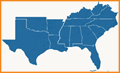 WASHINGTON (CFP) — Five Republican members of the U.S. House defied party leaders and President Donald Trump to oppose a bill to repeal Obamacare and replace it with a new blueprint for U.S. health care, but five other GOP lawmakers holding potentially vulnerable seats took a different tack and voted to go along with the American Health Care Act.
Two of the Southern GOP no votes on May 4 came from Will Hurd of Texas and Barbara Comstock of Virginia, who both represent districts that Hillary Clinton carried in 2016. A third lawmaker from a district Clinton carried, Ileana Ros-Lehtinen of Florida, also voted no but is retiring in 2018.

Hurd
Hurd, whose district stretches across a wide swath of West Texas, issued a statement after the vote saying the plan pushed by GOP leaders “does not address the concerns of many of my constituents, including adequate protections for those with pre-existing conditions and the challenges faced by rural healthcare providers.”

Comstock
Comstock, whose district is anchored in the Washington, D.C. suburbs, said in a statement that her “goals on healthcare reform are to provide patient-centered reforms that provide better access to high quality, affordable care and cover pre-existing conditions without lifetime limits. ”
“I did not support the AHCA today because (of) the many uncertainties in achieving those goals,” she said.
The other two Republicans who voted against the bill, Thomas Massie of Kentucky and Walter Jones of North Carolina, did so not out of any fear of Democratic competition but because they believe the repeal measure doesn’t go far enough.
“As recently as a year ago, Republicans argued that mandates were unconstitutional, bailouts were immoral and subsidies would bankrupt our country,” Massie said in a statement after the vote. “Today, however, the House voted for a healthcare bill that makes these objectionable measures permanent.”
Jones had earlier said the attempt by House Republican leaders to push an Obamacare bill repeal through the House on a rushed schedule was “shameful,” and he called for scrapping the bill in its entirety and starting over.
Of the 138 Southern Republicans in the House, 133 voted in favor of the AHCA. Five of those members represent districts where Democrats could conceivably use their votes for the new health care law to try to unseat them. In fact, if any one of them had voted no, the bill — which passed by just a single vote — would have failed, which will allow Democrats to make the argument that each of them bears responsibility for its passage.

Curbelo
This group of members who supported the bill includes two of the region’s most vulnerable House Republicans, Carlos Curbelo and Brian Mast, both from Florida. Curbelo represents a district in Miami-Dade and Monroe counties that Clinton carried; Mast’s district, which includes St. Lucie, Martin and northern Palm Beach counties, has changed parties in three of the last four election cycles.

Mast
In a statement, Mast said the GOP health care plan “returns control of health care from Washington back to you and restores access to quality, affordable options that are tailored to your individual needs.” He also pushed back against Democratic criticism that a provision in the new law allowing states to waive mandates for coverage of pre-existing conditions would imperil coverage for the sickest Americans.
“This bill mandates that people cannot be denied coverage because of pre-existing conditions and allocates almost $140 billion in additional funding that will subsidize coverage for people with pre-existing conditions to ensure they costs are low,” Mast said. “Those claiming otherwise are the same people who said ‘if you like your doctor, you can keep you doctor,” and they’re putting partisan politics ahead of the people in our community.”
Also voting yes were John Culberson of Texas, whose metro Houston House district was carried by Clinton; Mario Diaz-Balart, whose majority Latino district in metro Miami and southwest Florida went for Trump by less than 2 points; and Ted Budd of North Carolina, whose Greensboro-area district went for Trump by 9 points.
In a statement, Diaz-Balart conceded the AHCA was “far from perfect.” But he said the House needed to act because Obamacare “is collapsing,” leaving just one insurance provider in two of the three counties he represents.
“Knowing the people I represent could very well lose their coverage … is disturbing,” he said. “It would be irresponsible for Congress not to act in order to prevent this from happening.”
Budd also conceded in a statement that “the legislative process is a human process with all the flaws that entails. The results of that process are never perfect, and this bill isn’t either.”
“What I believe it will do is significantly reduce insurance premiums in our state, and help put the individual insurance marketplace on a more sound financial footing,” he said.
Also voting yes was Pete Sessions of Texas, whose metro Dallas district was also won by Clinton. However, Sessions, who has been in the House since 1997 and won re-election by more than 50 points in 2016, is not considered vulnerable to a Democratic challenge.
All 40 of the Democrats representing districts in the South voted against the AHCA.
North Carolina legislators pass compromise ending trangendered bathroom ban
But compromise measure prevents cities from passing protections for LGBTQ people
♦By Rich Shumate, Chickenfriedpolitics.com editor
RALEIGH (CFP) — After a year of turmoil and economic boycotts, North Carolina legislators have passed a compromise bill that rolls back HB2, a law which prohibited transgendered people from using restrooms in public facilities that didn’t conform with their their birth gender.
However, the bill hammered out by Democratic Governor Roy Cooper and leaders of the Republican-controlled legislature also forbids local jurisdictions in North Carolina from passing non-discrimination ordinances protecting LGBTQ people until at least 2020, a compromise that left LGBTQ advocates seething.
“Lawmakers and Governor Cooper have failed to resolve the problems with HB2 by doubling down on discrimination,” said Chris Sgro executive director of Equality NC. “Once again, the North Carolina General Assembly has enshrined discrimination into North Carolina law.”
“Lawmakers must reject this disgraceful backroom deal that uses the rights of LGBT people as a bargaining chip,” said Sarah Gillooly, policy director for the ACLU of North Carolina. “It is shameful that legislative leaders and North Carolina’s governor are once again rushing through a discriminatory anti-LGBT measure without proper vetting or an opportunity for public input.”
The bill to repeal HB 2 passed March 30, less than 12 hours after the compromise between Cooper and legislative leaders was unveiled. The House approved the repeal 70 to 48; the Senate, 32 to 16.
Cooper, who as attorney general refused to defend HB2 when it was challenged in court, campaigned for governor in 2016 on a pledge to repeal the law. Just a week before the compromise was reached, Equality NC was lauding Cooper for insisting on full repeal.
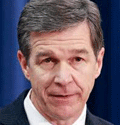
Attorney General Roy Cooper
In a statement issued after the repeal bill was unveiled, the governor conceded that it was a compromise from the outright repeal initially sought.
“It’s not a perfect deal, but it repeals House Bill 2 and begins to repair our reputation,” Cooper said.
The compromise bill was passed the same day that the NCAA was to decide whether to remove all of its events from North Carolina until 2022 in protest of the transgendered bathroom exclusion.
HB2 was pushed through the GOP-controlled legislature in March 2016 in reaction to the decision by the Charlotte City Council to pass a human rights ordinance protecting LGBTQ people, which included the right of transgendered people to use restrooms and locker rooms that comport with their gender identity, rather than their birth gender.
The new law set off a firestorm of controversy. The NBA, ACC and NCAA all pulled events from the state, and a number of businesses halted plans to relocate or expand there.
The governor at the time, Republican Pat McCrory, bore the brunt of the nationwide backlash to the law. Last November, he was the only Republican governor to lose his seat, in a campaign dominated by the HB2 controversy.
Under the repeal measure, local jurisdictions would no longer be able to regulate use of bathroom facilities in public buildings, as Charlotte tried to do. Only the legislature could enact such regulations, but, after repeal of HB 2, no regulations currently exist. In essence, while transgendered people would not specifically be barred from using facilities that comport with their gender identity, they would also not have a legal right to do so.
However, the second part of the repeal bill prevents Charlotte or any other jurisdiction in North Carolina from passing LGBTQ anti-discrimination measure for the next three years.
 Chicken Fried Politics