
Home » North Carolina (Page 13)
Category Archives: North Carolina

Analysis: Results in Confederate namesake counties show role of race in Democratic decline
Trump accelerates Republican shift in counties named for Jefferson Davis and Robert E. Lee
♦By Rich Shumate, Chickenfriedpolitics.com editor
 (CFP) — Jefferson Davis and Robert E. Lee loom large as icons of the Southern Confederacy, so much so that 11 Southern counties and one Louisiana parish bear their names. But if these lions of the South are aware of what is happening in their namesake counties today, they may be rotating in their graves.
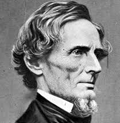
Confederate President Jefferson Davis
Changes in presidential voting in these counties over the past 40 years illustrate just how far the Black Republicans against which Lee and Davis fought are now transcendent—and the alarming (for Democrats) degree to which white Southerners have forsaken their traditional political roots.
Of course, the South’s march toward the GOP is not news. Today, the term “Solid South” has an entirely different connotation than it did during the days of FDR or Lyndon Johnson. However, these namesake counties do provide a window into how these shifts in party preference have occurred over time and the role that race played in them.

Confederate General Robert E. Lee
The 2016 presidential results also show that the Republicanization of the South is accelerating in these counties that bear the mark of Southern heritage, which bodes ill for future Democratic prospects.
In 1976, when Democrat Jimmy Carter became the first Southerner to win the White House since Zachary Taylor in 1848, he carried nine of the 12 Davis and Lee counties. By 1992, Bill Clinton and George H.W. Bush were splitting them six-to-six.
By 2000, Republican George W. Bush had flipped nine of the 12 namesake counties his way; his average share of the total votes cast for the two major party candidates in those counties that year was an impressive 64 percent. But in 2016, Trump trumped the younger Bush, carrying those same nine counties with an average of 70 percent of the two-party vote.
In 1976, Republican President Gerald Ford’s share of the two-party vote topped 50 percent in just three namesake counties (in Florida, Alabama, and Kentucky). But by 2016, Trump’s share of the two-party vote was more than 50 percent in nine counties and parishes; above 60 percent in eight; above 70 percent in four; and above a whopping 80 percent in two (Georgia and Kentucky).
The most dramatic changes were in Jeff Davis County, Georgia, where native Georgian Carter carried 79 percent of the vote in 1976 and Trump won 81 percent in 2016, and Jefferson Davis Parish, Louisiana, where Carter won 62 percent and Trump 75 percent. However, even in majority black Lee County, Arkansas, Trump’s 16-point loss in 2016 was less than half of Ford’s 38-point defeat.
In addition to Lee County, Arkansas, the only namesake counties Trump lost in 2016 were Jefferson Davis County, Mississippi, and Lee County, South Carolina, which are also majority black. However, even in these three counties, Trump carried a larger share of the two-party vote in 2016 than Mitt Romney did in 2012.
In fact, Trump improved on Romney’s result in 11 of the 12 namesake counties, save only Jeff Davis County, Texas, where Trump had to settle for merely matching Romney’s total.
The results in these namesake counties over time also illustrate the role race has played in the political realignment of the South.
In all seven of the overwhelmingly white namesake counties, the Republican share of the two-party vote was higher in 2016 than in 1976, by an average of 29 percent. Trump did better than Romney by an average of 4 percent.
By contrast, in majority-black Lee counties in Mississippi and South Carolina, the Republican two-party share fell by an average 2.5 percent from 1976 to 2016, but Trump outperformed Romney by the same 2.5 percent. These results indicate that the white Southern shift to the Republicans appears stronger than the corresponding black shift to the Democrats.
This is borne out by the results in Lee County, Arkansas, which has the smallest African-American population of any of the majority-black namesake counties (55 percent). There, the Republican share of the two-party vote actually climbed 11 percent between 1976 and 2016, and Trump beat Romney’s total by 5 percent.
Two of the namesake counties—Lee County, Florida, and Jeff Davis County, Texas—are outliers in that they have significant Latino populations. The Republican share of the two-party vote in both of those counties was higher in 2016 than it was in 1976, but Trump’s results were down from the numbers put up in 2000 and 2004 by George W. Bush, who, for a Republican, ran strongly with Latino voters.
The results in the namesake counties also illustrate the mountain which Democrats need to climb if they are to reduce Republican hegemony in the South.
The Democratic base once included small towns and rural areas across the Southern landscape, as well as urban areas. In 2016, Democrats still held the cities (with newfound and welcome signs of life in suburban Atlanta and Houston) and the mostly small rural counties with majority black populations, such as the namesake counties in Arkansas, Mississippi and South Carolina. Democrats also do well in college towns such as Athens, Georgia, and Gainesville, Florida.
But Democrats’ failure to compete for the votes of small town and rural white voters is what is killing them electorally, as the results in the Davis and Lee namesake counties without black majorities vividly illustrates.
Only one of these namesake counties is urban—Lee County, Florida, which includes Fort Myers—and Lee County, Alabama, contains Auburn University. The rest of these counties and parishes are all rural, white areas where Messrs. Davis and Lee are no doubt remembered fondly and Jimmy Carter ran reasonably well—and where Hillary Clinton couldn’t get elected dog catcher if she handed out $20 bills at the polling booth.
As a barometer of the past, these namesake counties illustrate how far Democrats have fallen in their former strongholds. But if Trump’s improved results over Romney’s are a barometer of the future, the bottom may not yet have been reached.
13 Southern U.S. House Democrats bow out of Trump inaugural
All of the no-shows represent districts carried by Hillary Clinton
♦By Rich Shumate, Chickenfriedpolitics.com editor
WASHINGTON (CFP) — Thirteen of the 40 Southern Democrats in the U.S. House have announced that they will not take part in the January 20 inauguration of Donald Trump.
Lawmakers from Florida, Georgia, Florida, Kentucky, Mississippi, North Carolina, Tennessee, Texas and Virginia are among the no-shows. All of the boycotting members represent urban or black-majority districts that were carried by Democrat Hillary Clinton.
Trump’s tweets castigating U.S. Rep. John Lewis, D-Georgia, for announcing an inauguration boycott seemed to particularly rankle some of the members opting not to attend; Trump’s reaction was called “repugnant,” “ignorant,” and “insensitive and foolish.”
“We are sending a message to Mr. Trump. Respect, like Pennsylvania Avenue, is a two-way street,” said U.S. Rep. Lloyd Doggett, D-Texas, who will be among the no-shows.
However, none of the three other Democrats in Lewis’s own Georgia delegation have joined the boycott. Also not joining so far is U.S. Rep. Debbie Wasserman Schultz, who, as head of the Democratic National Committee during the presidential campaign, had been a sharp Trump critic.
As for the contention by Trump supporters that the inauguration is a celebration not of him but of the peaceful transfer of power, U.S. Rep. Julian Castro, D-Texas, said, “Every American should respect the office of the presidency and the fact that Donald Trump will be the 45th President of the United States. But winning an election does not mean a man can show contempt for millions of Americans and then expect those very people to celebrate him.”
U.S. Rep. Gerry Connolly, D-Virginia, said Trump’s “behavior and harmful words during and after the campaign have left the country I love with open, bleeding wounds. Instead of binding those wounds, he has poured salt on them. Instead of unifying us, he has reveled in driving wedges between us.”
Trump won 108 of the 154 congressional districts across the South in the November election; none of them are represented by Democrats.
Lawmakers boycotting the inaugural are unlikely to pay a political price, as all but two of them represent districts that Clinton carried with at least 60 percent of the vote. However, U.S. Reps. Darren Soto, D-Florida, and John Yarmuth, D-Kentucky, come from districts where Clinton’s share was just 55 percent.
The list of boycotting Democrats includes:
Georgia
- John Lewis, D-Atlanta
Florida
- Alcee Hastings, D-Fort Lauderdale
- Darren Soto, D-Orlando
- Frederica Wilson, D-Miami-Dade
Kentucky
- John Yarmuth, D-Louisville
Mississippi
- Bennie Thompson, D-Jackson
North Carolina
- Alma Adams, D-Greensboro
- G.K. Butterfield, D-Wilson
Tennessee
- Steve Cohen, D-Memphis
Texas
- Lloyd Doggett, D-Austin
- Al Green, D-Houston
- Joaquin Castro, D-San Antonio
Virginia
- Gerry Connolly, D-Fairfax County
North Carolina Governor Roy Cooper enters office with call to end partisan friction
But new governor calls for repeal of law regulating transgendered bathroom use
♦By Rich Shumate, Chickenfriedpolitics.com editor
 RALEIGH (CFP) — In his inaugural address, incoming North Carolina Governor Roy Cooper issued a call to end the contentious politics that have bedeviled the start in recent years, but he also made it clear that he would push for repeal of a bill that limited use of public restroom facilities for transgendered people.
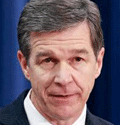
Attorney General Roy Cooper
“The people of this state are tired of yesterday’s politics. You expect and deserve public servants who reject cynicism, who don’t succumb to political paralysis, who negotiate differences in good faith,” Cooper said.
“I don’t think anyone believes that North Carolina families sit around the kitchen table every night thinking that their lives would change for the better if only the legislature would spend its time on the hot-button social issues of the day,” he said.
“People have bigger concerns, like why they haven’t gotten a raise in eight years or why the cost of health insurance is too much to bear or if they can afford to send their kids to college.”
Because of a snowstorm that paralyzed North Carolina, Cooper delivered his January 7 inaugural address on television, rather than to an outdoor crowd as initially planned.
Cooper, a Democrat, defeated incumbent Republican Governor Pat McCrory by just 10,277 votes out of nearly 4.8 million cast, which was the nation’s closest gubernatorial election this year and the only one that flipped from Republican to Democratic.
The most contentious issue in that election was House Bill 2 — passed by the GOP-controlled legislature and signed by McCrory — which required transgendered people to use bathrooms in public facilities consistent with their birth gender, rather than the gender with which they identify.
Cooper, who was attorney general at the time, opposed the measure and refused to defend it in court. In the wake of the bill’s passage, a number of major companies have dropped plans to move or expand in North Carolina, and the NBA, NCAA and ACC have all pulled sporting events out of the state.
After the election, the legislature met in special session to consider repealing the law, but Republican supporters of the law scuttled the effort. Cooper made in clear in his inaugural address that he would keep trying.
“This law has isolated and hurt a lot of people, damaged our state’s reputation and cost our economy hundreds of millions of dollars that could have paid our teachers and firefighters or built new highways,” he said.
“There are enough bipartisan votes in the legislature right now to fully repeal HB2 with no strings attached. This is not complicated. In fact, it’s very simple. Let them vote.”
Cooper will face a legislature dominated by Republicans. In the Senate, the GOP holds 35 seats to 15 for Democrats; in the House, Republicans have 74 seats and Democrats 46. Those margins are enough to override Cooper’s vetoes, which only requires a three-fifths majority in the Tar Heel State.
However, in late November, a federal judge struck down the state’s legislative districts on the grounds that they were improperly gerrymandered using racial considerations and ordered the legislature to draw new maps.
Unless the U.S. Supreme Court intervenes, new elections for the entire General Assembly will have to be held in 2017, which could allow Democrats to gain back some ground.
After the election, the legislature also passed measures to limit the number of political appointments Cooper can make and require that his cabinet picks to be approved by the legislature. Cooper has gone to court to challenge those new laws.
Cooper, 59, from Nash County in eastern North Carolina, served four terms as attorney general before seeking the governorship, the second longest tenure in that office in state history.
Pat McCrory concedes to Roy Cooper in North Carolina governor’s race
Concession comes after vote recount in Durham County
♦By Rich Shumate, Chicken Fried Politics.com editor
RALEIGH (CFP) — Nearly a month after election day, North Carolina’s hotly contested governor’s race has finally been settled and will flip into Democratic hands.
Attorney General Roy Cooper
Republican Governor Pat McCrory conceded the race to Democratic Attorney General Roy Cooper on December 5, after it became clear that an ongoing recount in Durham County would not overturn Cooper’s lead.
“Despite continued questions that should be answered regarding the voting process, I personally believe that the majority of our citizens have spoken,” McCrory said in a video posted on YouTube. “We now should do everything we can to support (Cooper).”
Cooper welcomed the concession in a Facebook post, bringing to an end a contentious race that became the most expensive governor’s race in state history.
“While this was a divisive election season, I know still that there is more that unites us than divides us,” Cooper said. “I’d like to thank all of the hardworking families in North Carolina, and I look forward to serving the greatest state in the country as your governor.”
Cooper’s lead over McCrory was 10,263 votes, out of more than 4.7 million votes cast, a difference of just .22 percent.
Cooper’s win is a rare moment of good news for Democrats in North Carolina, which went Republican in both the presidential and U.S. Senate races. The Cooper-McCrory contest was the only governor’s race in the country that shifted the office from Republican to Democrat.
Democrats will now hold four out 14 Southern governorships. The others are in Virginia, West Virginia and Louisiana. Republicans hold the remaining 10.
The contention over the results in Durham began on election night, when a batch of 90,000 votes came in all at once, propelling Cooper — who had trailed most of the night — into the lead statewide.
McCrory and his campaign found those results suspicious and demanded a recount. However, Durham election officials said the late reporting of results was caused by a technical problem that forced them to enter the results from voting machines by hand.
The Durham County elections board turned down McCrory’s request for a recount, but the State Board of Elections voted along party lines to order one.
In North Carolina, both state and county elections boards are appointed by the governor, and the governor’s party holds a majority.
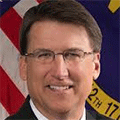
North Carolina Governor Pat McCrory
McCrory rode a GOP wave into office in 2012, but the Republican-controlled legislature’s passage of a controversial voter ID law and measures favored by religious conservatives made the governor a lightning rod.
The issue that dominated the race was McCrory’s decision to sign a law requiring transgendered students to use bathrooms that match their gender of birth, rather than their gender of identity, in public facilities.
McCrory continued to defend the law, even after a number of businesses scuttled expansion plans and the NCAA, NBA and ACC pulled events from the state.
Cooper not only opposed the measure, but he also refused to defend it in court when students and the federal government took legal action to overturn it.
Recount begins in North Carolina governor’s race
State board sets Monday deadline for recounting ballots in Durham County
♦By Rich Shumate, Chicken Fried Politics.com editor
RALEIGH (CFP) — The hotly contested North Carolina governor’s race has entered what is likely its final stage, with elections officials in Durham County now recounting ballots to meet a Monday deadline.
Republican Governor Pat McCrory has indicated that he will concede to Democratic Attorney General Roy Cooper if the recount doesn’t overturn Cooper’s slight lead.
With ballots certified in 98 of the state’s 100 counties, Cooper leads McCrory by 10,263 votes, out of more than 4.7 million votes cast.
If that margin holds after the Durham recount, McCrory won’t be entitled to a full statewide recount, which is only triggered if the margin is less than 10,000 votes.
The deadline for finishing the recount is 7 p.m. ET Monday.
Attorney General Roy Cooper
Cooper beat McCrory by a margin of 91,000 votes in Durham County, taking a whopping 79 percent of the vote, which was his best performance in any county.
The contention over the results in Durham began on election night, when a batch of 90,000 votes came in all at once, propelling Cooper — who had trailed most of the night — into the lead statewide.
McCrory and his campaign found those results suspicious and demanded a recount. However, Durham election officials said the late reporting of results was caused by a technical problem that forced them to enter the results from voting machines by hand.
The Durham County elections board turned down McCrory’s request for a recount, but the State Board of Elections voted along party lines to order one.
In North Carolina, both state and county elections boards are appointed by the governor, and the governor’s party holds a majority.
McCrory’s campaign has indicated that he will concede to Cooper if the Durham results don’t change the outcome. He has already filed the paperwork for a statewide recount, although that request would be moot if Cooper’s margin holds.
Cooper’s campaign has been calling on McCrory to concede and bring to an end the three-week drama over who will lead the Tar Heel State.
“It’s clear there is no path to victory for Governor McCrory,” said Cooper campaign manager Trey Nix in a statement posted on Facebook. “It’s time for Governor McCrory to accept the election results and respect the will of the voters.”
Should Cooper hang on, North Carolina would be the only state where Democrats flipped a governorship in 2016 and would give them a third Southern governorship, compared to 11 for Republicans.
North Carolina Governor Pat McCrory
McCrory rode a GOP wave into office in 2012, but the Republican-controlled legislature’s passage of a controversial voter ID law and measures favored by religious conservatives made the governor a lightning rod.
The issue that dominated the race was McCrory’s decision to sign a law requiring transgendered students to use bathrooms that match their gender of birth, rather than their gender of identity, in public facilities.
McCrory continued to defend the law, even after a number of businesses scuttled expansion plans and the NCAA, NBA and ACC pulled events from the state.
Cooper not only opposed the measure, but he also refused to defend it in court when students and the federal government took legal action to overturn it.
 Chicken Fried Politics