
Home » North Carolina (Page 4)
Category Archives: North Carolina


North Carolina environmental official Michael Regan picked to head EPA
Regan is the first Southern official named to President-elect Joe Biden’s Cabinet
♦By Rich Shumate, ChickenFriedPolitics.com editor
 WASHINGTON (CFP) — President-elect Joe Biden has nominated Michael Regan, North Carolina’s chief environmental regulator, to head the federal Environmental Protection Agency in his new administration.
Regan, 44, is currently the secretary of the North Carolina Department of Environmental Quality. He is the first Southern official to be named to the Biden Cabinet and, if confirmed, will be the first black man to run the EPA, overseeing nearly 14,000 employees and a $9 billion budget.
Prior to being appointed as head of the Tar Heel State’s environmental department in 2017 by Democratic Governor Roy Cooper, Regan had been an official with the Environmental Defense Fund, an environmental advocacy group, working on clean energy issues.

EPA nominee Michael Regan
He has previously worked as a regulator for the EPA from 1998 to 2008 during both the Clinton and George W. Bush administrations.
Earlier this year, Regan reached an agreement with Duke Energy to clean up coal ash contamination in North Carolina and ordered a subsidiary of chemical giant DuPont to clean up toxic chemicals from the Cape Fear River.
However, he was criticized by a number of environmental groups for approving permits for a natural gas pipeline across the state, a project that was later canceled.
The Biden transition rolled out Regan’s appointment as part of a slate of “climate nominees” expected to focus on climate change issues that will be emphasized in the new administration.
In a statement announcing their appointments, Biden said the nominees “share my belief that we have no time to waste to confront the climate crisis, protect our air and drinking water, and deliver justice to communities that have long shouldered the burdens of environmental harms.”
Regan is so far the only Southern public official named to the Biden Cabinet, although two — Lloyd Austin, the pick for defense secretary, and Linda Thomas-Greenfield, the pick for U.N. ambassador — have Southern roots. Austin was born in Alabama and is a graduate of Auburn University; Thomas-Greenfield is from Louisiana and graduated from Louisiana State University.
Louisiana U.S. Rep. Cedric Richmond will serve as a senior White House advisor, and Kate Bedingfield, the new White House communications director, grew up in the Atlanta suburbs.
We tweet @ChkFriPolitics Join us!

Outgoing GOP U.S. Rep. Mark Walker launches 2022 U.S. Senate run in North Carolina
Walker is first Republican candidate in race to replace retiring U.S. Senator Richard Burr
♦By Rich Shumate, ChickenFriedPolitics.com editor
 GREENSBORO, North Carolina (CFP) — With the dust still settling from November’s election, Republican U.S. Rep. Mark Walker has jumped into next campaign season by announcing he will run for North Carolina’s open U.S. Senate seat in 2022.
Walker opened his campaign December 1 with a video featuring endorsements from leaders around the state and Mike Huckabee, the former Arkansas governor and conservative talk show host. Walker said he was running “because serving others is my life, and I have the experience to fight and to win in Washington.”
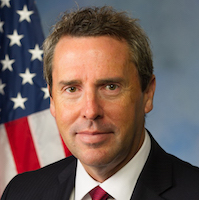
U.S. Rep. Mark Walker, R-North Carolina
“Washington has lost its mind. Job killing regulations, the Green New Deal, defund the police, end our military — seriously?” Walker said. “I’m proud of my record taking on the radicals as well as the establishment.”
Watch video of Walker’s announcement below
Walker, 51, from Greesboro, was a Southern Baptist pastor before his election to Congress. He has represented the 6th U.S. House District since 2015 but did not seek re-election in November after a court-ordered redraw of the state’s congressional districts made his district more Democratic.
Earlier this year, he considered a primary challenge against U.S. Senator Thom Tillis but eventually decided against it. Tillis was re-elected in November.
The seat Walker is seeking will be open in 2022 because incumbent Republican U.S. Senator Richard Burr has announced his retirement.
Given the Tar Heel State’s partisan competitiveness, the race will likely be one of the most hotly contested and expensive battles of the 2022 cycle and a top Democratic target. However, a Democrat has not won a Senate election in North Carolina since 2008.
Among the names being mentioned as possible Republican candidates are Lara Trump, the president’s daughter-in-law, who grew up in North Carolina; Lieutenant Governor Dan Forest, who lost in November’s governor’s race; and former Governor Pat McCrory.
Among Democrats, Governor Roy Cooper will likely face pressure from Senate Democratic leaders to make a run but has not indicated he is considering it. Erika Smith, who ran unsuccessfully for the Democratic Senate nomination this year, is the party’s only announced candidate so far.
Watch video of Walker’s announcement
We tweet @ChkFriPolitics Join us!

Decision 2020: Southern U.S. Senate races see cash avalanche, as Democrats set the pace
Democrats in competitive races raise eye-popping amounts, which Republican incumbents are struggling to match
By Rich Shumate, ChickenFriedPolitics.com editor
 (CFP) — How much money has Democrat Jaime Harrison raised for his race against Republican U.S. Senator Lindsey Graham in South Carolina?
Enough to give every woman, man and child in the Palmetto State $21. Graham could fork over $13 more. And if people in Kentucky could divvy up all the money raised by Senate Majority Leader Mitch McConnell and Democrat Amy McGrath for their contest, each one would pocket $33.
One of the biggest stories of the 2020 election has been the avalanche of campaign cash that candidates have been able to raise, much of it from small donors who contribute online. Campaign finance data from the Federal Elections Commission shows that in the South, as in the rest of the country, Democratic challengers have been the biggest recipients of this largesse.
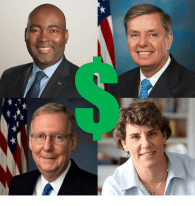 Indeed, only two Southern Republican incumbents facing competitive challenges — John Cornyn in Texas and Kellly Loeffler in Georgia — have raised more money than their Democratic rivals. But Loeffler only did so by pouring $23 million from her considerable personal fortune into the race.
Of course, the candidate who raises the most money doesn’t win; the candidate with the most votes does. Just ask Beto O’Rourke, who burned through $80 million on his way to not becoming a U.S. senator from Texas in 2018.
But the fundraising dominance of Democrats has put many challengers within shooting distance as the election approaches, and raising money can also be a reliable sign of energy and momentum behind a campaign.
Harrison, for instance, has never won political office before and is running against a man who has been in Congress for 26 years in a state that has been red for generations. But the $109 million he has raised, at last count, has helped turn this race into a dead heat — and reduced Graham to begging supporters to send him money on the Fox News Channel.
Graham has raised $68 million, which in a normal year would be exponentially more money than a Senate candidate in South Carolina would need. But this year, he is facing a $40 million gap, as Harrison blankets the airwaves of South Carolina in an advertising storm.
In Kentucky, McGrath has nearly matched Harrison’s per-person fundraising total, raising at least $90 million, or $20 per person. McConnell–who as majority leader has access to every Republican donor under the sun–has not been able to keep up, coming in at $57 million at last count.
In North Carolina, Democrat Cal Cunningham has raised $48 million, more than double the $22 million raised by Republican incumbent U.S. Senator Thom Tillis.
In Alabama, the only state where Republicans are trying to oust a Democratic incumbent, U.S. Senator Doug Jones has raised $27 million, dwarfing the $8.2 million collected by Republican challenger Tommy Tuberville.
Another state with a significant disparity between Republican incumbent and Democratic challenger is Mississippi, where Democrat Mike Espy has raised $9.3 million for his rematch against Republican U.S. Senator Cindy Hyde-Smith, more than three times as much as she has raised at $3 million.
The fundraising disparity has generated national attention on the possibility of an Espy upset — which shows how fundraising alone can change the conversation about a race.
In Georgia, which has two Senate races this year, five candidates have raised a combined $110 million, with Democrat Jon Ossoff leading the pack at $33 million. He is running against Republican U.S. Senator David Perdue, who has raised $21 million.
In the special election for the other seat, Loeffler has raised $28 million, $23 million from personal loans. Democrat Raphael Warnock has raised $22 million, while Republican U.S. Rep. Doug Colllins, who is trying to come at Loeffler from the right, trails badly at just $6 million.
Warnock, a political newcomer, surged to the front in polls of this race after he put his campaign money to use running ads. Though Collins has struggled badly in fundraising, polls show him still neck-and-neck with Loeffler for the second spot in the January runoff.
In Texas, Democrat MJ Hegar has raised $24 million compared to $31 million for Cornyn. However, she has been closing the gap with two strong fundraising quarters.
These are the figures reported with a week to go before the election. Given the prodigious pace of fundraising, the final numbers for many of these races are likely to be even larger by the time the votes are counted.
We tweet @ChkFriPolitics Join us!
Decision 2020: Can Joe Biden break through and make the South matter?
Texas and Georgia join North Carolina and Florida on list of 2020 presidential swing states
♦By Rich Shumate, ChickenFriedPolitics.com editor
 (CFP) — Twenty years ago, George W. Bush became the first Republican to sweep the entire South in a non-landslide election, and in the five presidential elections since, a Democrat has carried Virginia three times, Florida twice, and North Carolina once.
Every other state in the region went for the Republican, every time. If you add it up, that’s 64 state wins for the Republican, to just six for the Democrat.

The candidates for president
But if the pre-election polls are correct, the GOP’s lock on the South — which has been a bedrock of the party’s Electoral College fortunes — appears to be loosening, albeit slightly, in 2020. So election night may not be as much of an afterthought in the South as it has been for the past two decades.
Indeed, the results in three Southern states that report results early could point toward who is going to win the White House, even as the rest of the country finishes casting ballots.
Virginia seems almost certain to go Democratic for the fourth election in a row. North Carolina and Florida are, as expected, toss-ups, as they have been in the last three elections. But in 2020, the races in both Texas and Georgia are within the margin of error, which could complicate–if not end–Donald Trump’s hopes of winning re-election if Joe Biden wins either one.
Polls even show that in South Carolina, which hasn’t gone for a Democrat since Jimmy Carter in 1976, Trump’s lead may be in single digits. And while a win in the Palmetto State still seems like a stretch, a close race between Trump and Biden would be a sign that the president’s political fortunes have dipped even in a region he swept four years ago.
The 2020 race is also unusual in another respect — it is the first presidential race since 1972 where neither party has a Southerner on its ticket.
The list of four Southern swing states in 2020 echoes 2016, when Trump took them by single-digit margins while rolling up double-digit victories everywhere else. He won Florida by 1 point, North Carolina by 4, Georgia by 5, and Texas by 9.
In the 2018 midterm elections, Democrats made gains in the suburbs around major cities in Georgia and Texas, which is the template Democrats are using for 2020. However, they had less success in North Carolina, where Republican candidates held up better.
The Biden campaign has been up with ads in Georgia and has spent a token amount in Texas, although it has yet to commit any substantial resources to either state. Both Biden and Trump have campaigned in Georgia, although they have not yet barnstormed Texas.
These Southern states are much more important to Trump than they are to Biden, who can win the White House without them if he flips Pennsylvania, Wisconsin and Michigan back into the blue column. While Trump could survive losing either Georgia or North Carolina, if he can hold the line in the Upper Midwest, a loss in either Florida or Texas would be catastrophic.
Florida and Georgia have two of the earliest poll closing times in the country, at 7 p.m. Eastern (the Florida Panhandle stays open another hour), and North Carolina closes a half hour later. So those three states could be among the first places where winners can be declared, unless the races are extremely close.
If Trump wins these states, the result won’t tell us much about the eventual outcome. But a Biden win in any of them — particularly Florida — will point to a Democratic victory, and we will likely know the Florida result before the results in Pennsylvania, Michigan and Wisconsin.
No matter what happens in 2020, the results will almost certainly change how the presidential game is played in the South in 2024.
Four years from now, Texas and Georgia will be seriously contested by both sides, particularly if Biden wins or comes close this year. That will add two new large states where campaigns have to add significant resources, particularly in Texas, which has more than 20 TV markets.
For Republicans, who have not had to worry about the South at the presidential level for decades, more competition in the region complicates their path to the White House. For Democrats, the ability to win in the South gives them additional paths to 270 that reduce the number of must-win states elsewhere. So the long-term consequences of this election could be enormous.
That’s why, on Nov. 3, the South will matter as it hasn’t mattered in the last 20 years.
We tweet @ChkFriPolitics Join us!
Coronavirus, sexual texts upend North Carolina U.S. Senate race
Republican U.S. Senator Thom Tillis tests positive; Democratic challenger Cal Cunningham apologizes for racy text messages
♦By Rich Shumate, ChickenFriedPolitics.com editor
 RALEIGH (CFP) — A month before election day, the big money, high octane race for the U.S. Senate in North Carolina has been upended by a positive coronavirus test and a sexting scandal.
Republican U.S. Senator Thom Tillis announced Friday that he has been tested positive for the coronavirus, which will force him off the campaign trail for at least 10 days, although he remains asymptomatic.
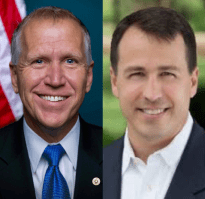
U.S. Senator Thom Tillis and Democratic challenger Cal Cunningham
Hours later, the campaign of his Democratic challenger, Cal Cunningham, a married father of two, confirmed that he was the author of suggestive text messages exchanged with a female public relations consultant from California that indicated he was engaged in an ongoing extramarital affair.
“I have hurt my family, disappointed my friends, and am deeply sorry,” Cunningham said in a statement. “The first step in repairing those relationships is taking complete responsibility, which I do.”
Cunningham indicated that he would stay in the race, saying he was “grateful and humbled by the ongoing support that North Carolinians have extended in this campaign, and in the remaining weeks before this election I will continue to work to earn the opportunity to fight for the people of our state.”
What may further complicate the situation for Cunningham is that he is a lieutenant colonel in the U.S. Army Reserves, and extramarital affairs violate the Uniform Code of Military Justice.
Prior to Friday, Cunningham had a consistent lead in the polls, and his campaign had just announced that it had raised a staggering $28.3 million in the third quarter, shattering a record for the largest fundraising quarter by a Senate candidate in state history.
Tillis’s positive coronavirus test will also force Cunningham to undergo testing because the two men met in a debate Thursday night, during which they were socially distanced but did not wear masks.
The North Carolina race is key to Democratic hopes of taking control of the Senate from Republicans. The Democratic Senatorial Campaign Committee issued a statement saying it was standing behind Cunningham.
The undated texts between Cunningham and Arlene Guzman Todd were first revealed on the conservative news website NationalFile.com. The site did not explain how the texts were obtained, attributing information to a friend of Todd’s who spoke with one of its sources.
In the texts, the two talk about arranging a meeting, with Todd saying at one point that “the only thing I want on my to do list is you” and Cunningham saying “I’ve had the most amazing dreams of our time together.”
Cunningham also texted Todd that he was “nervous about the next 100 days,” which, if a reference to the election, would put the date of the text in late July.
 Chicken Fried Politics