
Home » Oklahoma (Page 4)
Category Archives: Oklahoma


Texas U.S. Rep. Will Hurd is only Southern Republican to support condemning Trump
5 Southern Democrats from Trump districts voted to condemn his tweets about Democratic congresswomen
♦By Rich Shumate, ChickenFriedPolitics.com editor
 WASHINGTON (CFP) — After a day of high drama and contentious debate, the U.S. House approved a resolution condemning President Donald Trump for “racist” tweets directed at four left-wing congresswomen with only a single Southern Republican — U.S. Rep. Will Hurd of Texas — voting in favor.
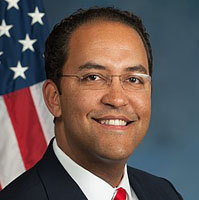
U.S. Rep. Will Hurd, R-Texas
Ninety-four other Southern House Republicans voted against the resolution, which was supported by all 50 Southern House Democrats in the July 16 vote, including five members who represent districts Trump carried in 2016.
Those five members are Lucy McBath from Georgia, Kendra Horn from Oklahoma, Joe Cunningham from South Carolina, and Abigail Spanberger and Elaine Luria from Virginia.
Five Republicans from Texas — Kay Granger, Louie Gohmert, Roger Williams, Kenny Marchant and Michael Burgess — did not vote on the resolution. They also did not participate in other roll call votes held the same day.
The floor fight over the resolution was led on the GOP side by U.S. Rep. Doug Collins of Georgia, who set off two hours of turmoil after objecting to House Speaker Nancy Pelosi calling Trump’s tweets “racist,” which he said violated House rules against offering personal criticism of the president.
After lengthy discussions between members and the chamber’s parliamentarians, the chair eventually ruled Pelosi’s comments out of order, but members, on a party-line vote, overturned that ruling.
Trump, who denied his criticism of the congresswomen was racist, had urged Republican members not to show “weakness” in supporting the resolution. In the end, only four Republicans broke ranks to support it.
The resolution said the House “strongly condemns” Trump’s “racist comments that have legitimized and increased fear and hatred of new Americans and people of color by saying that our fellow Americans who are immigrants, and those who may look to the President like immigrants, should ‘go back’ to other countries.”
Over the weekend, Trump tweeted that a group of Democratic congresswomen should “go back” to their home countries if they were dissatisfied with life in America.
While he did not single out anyone by name, the tweets appeared to be a reference to four female members from the party’s left wing who have been among his sharpest critics — Ilhan Omar of Minnesota, Alexandria Ocasio-Cortez of New York, Rashida Tlaib of Michigan and Ayanna Pressley of Massachusetts.
Of the four, only Omar, who came to the United States as a refugee from Somalia as a child, was not born in the United States. All four are U.S. citizens, which is a requirement to sit in Congress.
Critics attributed what they see as Trump’s racist intent to make-up of the group, dubbed The Squad. Omar and Pressley are black, Ocasio-Cortez is Latino, and Tlaib is of Palestinian descent.
Hurd represents a majority-Latino swing district in West Texas. He is the only Southern Republican in Congress who represents a district that Hillary Clinton carried in 2016 and is among the top targets for House Democrats next year.
In an interview with PBS, Hurd called the president’s tweets “racist and xenophobic” and “also inaccurate.”
“The four women he is referring to are actually citizens of the United States, three of the four were born here. It’s also a behavior that’s unbecoming of the leader of the free world,” Hurd said. “He should be talking about things that unite us, not divide us. And also, I think, politically, it doesn’t help.”
We tweet @ChkFriPolitics Join us!
Insight: Are the politics of Obamacare changing in the South?
Cracks are starting to show in the wall of Southern opposition to Medicaid expansion
♦By Rich Shumate, ChickenFriedPolitics.com editor
 After Obamacare made its way through Congress in 2009, triggering the Tea Party rebellion, Republican-controlled Southern statehouses became a redoubt of opposition to what critics saw as meddlesome socialist overreach.

ChickenFriedPolitics editor Rich Shumate
When, three years later, the U.S. Supreme Court ruled that the Obama administration couldn’t force states to enact a key Obamacare provision — expanding Medicaid to cover more low-income residents — most Southern states took advantage of the decision and didn’t.
Today, nine of the 14 states that haven’t expanded Medicaid are in the South, leaving more than 2.3 million low-income Southerners who would qualify for Medicaid without health care coverage, according to researchers at the Kaiser Family Foundation.
But there are some signs that the blanket opposition to expanding Medicaid in the South may be retreating, albeit slightly and slowly.
Louisiana and Virginia expanded Medicaid after electing Democratic governors in 2017. In Arkansas and Kentucky, where expansion passed under Democratic governors, it has endured despite their replacement by more skeptical Republicans.
In Florida and Oklahoma, petition drives are underway to put expansion on the ballot in 2020, doing an end-run around recalcitrant GOP leaders. And in Mississippi, a Democrat is trying to use expansion as a wedge issue to end a 16-year Republican lock on the governor’s office.
In states with expanded Medicaid, low-income people making up to 138 percent of the federal poverty level — about $17,000 for an individual — can get coverage. In states without expansion, the income limit for a family of three is just under $9,000; single people are excluded entirely.
Most of the singles and families who are not eligible for traditional Medicaid don’t make enough money to get the tax credits they need to buy insurance on the Obamacare insurance exchanges. According to estimates from Kaiser, 92 percent of all Americans who fall into this coverage gap live in Southern states that haven’t expanded Medicaid, including nearly 800,000 people in Texas, 450,000 in Florida, 275,000 in Georgia, and 225,000 in North Carolina.
The federal government pays 90 percent of the cost of Medicaid expansion; states must pick up the rest. Republican leaders who oppose the idea have balked at making a financial commitment to such an open-ended entitlement, which Congress could change at any time.
But that argument didn’t hold in Virginia after Democrats campaigning on expansion nearly took control of the legislature in 2017. When expansion came up for a vote, 18 House Republicans who survived that blue wave joined Democrats to pass it.
Louisiana Governor John Bel Edwards, who issued an executive order on his first day in office to expand Medicaid, is now running for re-election touting that decision; voters will give their verdict in October.
In Mississippi, Attorney General Jim Hood is also making expanded Medicaid the centerpiece of his gubernatorial campaign this year, arguing that his state, with the nation’s highest poverty rate, is cutting off its nose to spite its face by refusing to extend coverage to people who would benefit from it.
In Arkansas and Kentucky, where Democratic governors managed to push through expansion in 2014, the Republicans who replaced them have left the programs essentially intact, although they have fiddled at the edges by imposing premiums and work requirements on recipients. (Federal judges have blocked those changes.)
Die-hard Obamacare opponents have not been able to scuttle the program in either state — even in Arkansas, where the program has to be reauthorized annually by a three-fourths majority in both houses of the legislature.
In Florida and Oklahoma, supporters of expansion — including groups representing doctors, nurses and hospitals — are trying to put constitutional amendments expanding Medicaid coverage on the ballot in 2020.
Those ballot measures will be a key test of whether the public mood is more sympathetic to the idea of expansion than are the states’ conservative leaders, who have argued that the program is unaffordable and discourages people from seeking employment to secure health care.
However, the strategy of pursuing ballot initiatives is of limited use in the South because among states that haven’t expanded Medicaid, only Florida, Oklahoma and Mississippi allow the public to put measures on the ballot via petition. Texas, Georgia, Alabama, Tennessee, North Carolina, and South Carolina do not.
In Florida, the ballot measure will also need to get approval from 60 percent of the voters to pass.
The question to be answered this year and next is whether the fiscal and philosophical arguments against expansion will hold against the argument that low-income Southerners — rural and urban, black and white — deserve health care coverage and will benefit from it, in spite of its association with Obamacare.
We tweet @ChkFriPolitics Join us!
Southern House Democrats in targeted seats vote to turn up pressure on Trump
House Judiciary Committee can now sue to force compliance with requests for documents, testimony
♦By Rich Shumate, ChickenFriedPolitics.com editor
WASHINGTON (CFP) — In the first major test of how Southern Democrats in vulnerable seats will navigate through ongoing House investigations of President Donald Trump, all of them stuck to the party line in supporting new powers that could escalate those inquiries.
By a vote of 229-191 on June 11, the House authorized the Judiciary Committee to go into federal court and demand that the Justice Department comply with requests for documents and witness testimony.
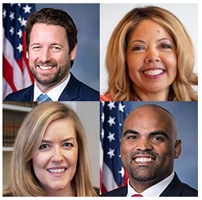
From top left clockwise: Cunningham, McBath, Allred, Weston
All 10 Southern House Democrats who flipped seats in 2018 and are at the top of the GOP hit list in 2020 agreed to give the committee the power to sue to force compliance, although none of them yet support moving toward impeaching the president.
That list includes Reps. Joe Cunningham of South Carolina; Lucy McBath of Georgia; Kendra Horn of Oklahoma; Elaine Luria, Jennifer Wexton and Abigail Spanberger of Virginia; Colin Allred and Lizzie Fletcher of Texas; and Debbie Mucarsel-Powell and Donna Shalala of Florida.
Not a single Southern Republican supported the resolution, including 11 GOP members who are on the Democrats’ target list for 2020.
The resolution is aimed squarely at Attorney General William Barr, who has refused to comply with some document requests, and former White House counsel Don McGahn, who has refused to testify at a committee hearing under instructions fro the White House.
The resolution ratchets up the pressure on the Trump administration, as an increasing number of House Democrats are calling for an impeachment inquiry.
While none of the Southern Democrats in competitive seats have so far come out in favor of an impeachment inquiry, 14 members in safe seats have done so.
That list includes Steve Cohen of Tennessee; Val Demings of Florida; Veronica Escobar, Sheila Jackson Lee, Joaquin Castro, Lloyd Doggett, Al Green, and Filemon Vela of Texas; Cedric Richmond of Louisiana; Alma Adams and G.K. Butterfield of North Carolina; Don Beyer of Virginia; Bennie Thompson of Mississippi; and John Yarmuth of Kentucky.
We tweet @ChkFriPolitics Join us!

Video: Newcomer Kevin Stitt takes helm in Oklahoma
Republican outlasted field of veteran politicos to claim governorship
Video from KJRN-TV via YouTube
7 new Southern U.S House Democrats who ousted Republicans support Nancy Pelosi for speaker
Cunningham of South Carolina and Spanberger of Virginia keep vow to oppose Pelosi; North Carolina’s 9th District remains vacant
♦By Rich Shumate, ChickenFriedPolitics.com
 WASHINGTON (CFP) — Seven Southern Democratic U.S. House freshmen who ousted GOP incumbents in November supported Nancy Pelosi’s bid to reclaim the gavel as speaker of the U.S. House — handing Republicans an issue to use against them in 2020.
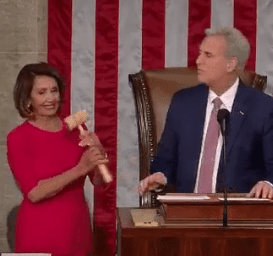
Incoming Speaker Nancy Pelosi accepts gavel from GOP Leader Kevin McCarthy (From Twitter)
Colin Allred and Lizzie Pannill Fletcher of Texas, Kendra Horn of Oklahoma, Lucy McBath of Georgia, Elaine Luria and Jennifer Wexton of Virginia, and Debbie Mucarsel-Powell of Florida all supported Pelosi in the January 3 vote.
Two other freshmen Democrats who had vowed during their campaign that they would not support Pelosi — Joe Cunningham of South Carolina and Abigail Spanberger of Virginia — kept that promise, voting instead for Cheri Bustos of Illinois.
And despite signing a letter in November calling for new leadership in the House, Filemon Vela of Texas switched course to vote for Pelosi.
Meanwhile, as the new Congress convened in Washington with 29 new Southern members, one seat sat empty — the representative from North Carolina’s 9th District, where state elections officials have refused to certify Republican Mark Harris’s narrow win over Democrat Dan McCready amid allegations of absentee ballot fraud.
In the vote for speaker, just three Southern Democratic members did not support Pelosi — Cunningham and Spanberger, who voted for Bustos, and Jim Cooper of Tennessee, who voted present.
Cooper, who has been in Congress since 1983, had been a long-time opponent of Pelosi’s speakership, having voted against her five times previously.
After the November election, a group of 16 Democratic members, including Cooper, Cunningham and Vela, signed a letter calling for “new leadership” in the Democratic caucus.
Vela changed course after Pelosi agreed to support term limits for the House Democratic leadership, which will limit her speakership to no more than four years.
Pelosi needed a majority of the 430 votes cast for speaker. In the end, she got 220 votes, four more than necessary.
Of the seven Southern Democrats who ousted Republicans and voted for Pelosi, McBath, Horn and Luria represent districts carried by President Donald Trump in 2016, while Allred and Fletcher represent districts he lost by less than 2 points.
Hillary Clinton carried Murcasel-Powell’s district in South Florida by 16 points and Wexton’s district in the Virginia suburbs of Washington, D.C. by 10 points.
Three other Southern Democratic newcomers who won open seats in November also supported Pelosi — Veronica Escobar and Sylvia Garcia of Texas, and Donna Shalala of Florida. All three represent districts Clinton carried handily.
Among Southern Republicans, only three did not support their candidate for speaker, House Minority Leader Kevin McCarthy of California.
Thomas Massie of Kentucky and Jody Hice of Georgia supported Jim Jordan of Ohio, one of the founders of the House Freedom Caucus, a grouping of the most conservative Republican members.
Walter Jones of North Carolina did not vote. He has been absent from Congress since September because of an undisclosed illness.
Of the 29 new Southern members of the House, 17 are Republicans and 12 are Democrats. Republicans hold 101 Southern seats, compared to 50 for Democrats, with North Carolina’s 9th District vacant.
The 9th District seat is likely to remain vacant until after the state elections board completes its investigation into the allegations of absentee ballot irregularities, which has been delayed until February because of a new law revamping the board.
Harris has filed a lawsuit seeking for force certification of the election.
 Chicken Fried Politics