
Home » South Carolina (Page 9)
Category Archives: South Carolina

South Carolina U.S. Rep. Trey Gowdy bowing out of Congress
Gowdy, chair of the House Oversight Committee, won’t seek re-election in 2018
 WASHINGTON (CNN) — U.S. Rep. Trey Gowdy of South Carolina, who drew national attention for leading a congressional investigation into the 2012 terror attacks in Benghazi, Libya, has announced he is retiring from Congress after four terms.

U.S. Rep. Trey Gowdy, R-South Carolina
In a January 31 statement announcing his departure, Gowdy, a former federal and state prosecutor, said he planned to return to work in the criminal justice system, although he gave no specifics.
“Whatever skills I may have are better utilized in a courtroom than in Congress, and I enjoy our justice system more than our political system,” the Republican lawmaker said in his statement. “As I look back on my career, it is the jobs that both seek and reward fairness that are most rewarding.”
“The book of Ecclesiastes teaches us there is a time and a season for all things. There is a time to start and a time to end. There is a time to come and a time to go. This is the right time, for me, to leave politics and return to the justice system.”
Gowdy, who was named chairman of the House Oversight Committee last summer, becomes the eighth Republican committee chair overall, and the sixth Southern chair, to forgo a re-election bid this year.
His election will open up a seat in South Carolina’s 4th District, in metro Greenville-Spartanburg. The district is solidly Republican, so Gowdy’s successor is likely to be picked in the June primary. Filing for office begins March 30.
Gowdy, 53, was elected in the Tea Party wave of 2010. He quickly rose to prominence after former House Speaker John Boehner appointed him to head a special investigative committee that looked into a terror attack on a U.S. diplomatic compound in Benghazi, Libya, that left four Americans dead.
The most lasting impact from that investigation was the disclosure that than-Secretary of State Hillary Clinton had used a private email server during her tenure at the State Department, an issue which dogged her throughout the 2016 presidential campaign.
Gowdy joins a growing list of Southern House committee chairs who are leaving Congress, which includes Jeb Hensarling of Texas, chair of the Financial Services Committee; Diane Black of Tennessee, chair of the House Budget Committee, who is running for governor; Bob Goodlatte of Virginia, chair of the House Judiciary Committee; Joe Barton of Texas, chair of the House Energy Commitee; and Gregg Harper of Mississippi, chair of the House Administration Committee.
So far, 15 Southern House Republicans have announced they won’t seek re-election in 2018, including six from Texas and two each from Tennessee and Florida. Only two Southern Democrats aren’t running, both in Texas.
GOP keeps South Carolina U.S. House seat with vastly decreased margin
Republican Ralph Norman defeats Democrat Archie Parnell by just 3 points
♦By Rich Shumate, ChickenFriedPolitics.com editor
COLUMBIA, South Carolina (CFP) — Republican Ralph Norman has won the special election for South Carolina’s 5th District U.S. House seat, but Democrat Archie Parnell managed to trim more than 17 points from the GOP’s 2016 margin despite getting little support from Democrats nationally.

U.S. Rep.-Elect Ralph Norman, R-South Carolina
With all of the precincts reporting in the June 20 vote, Norman, a former state representative, won 51.1 percent to 47.9 percent for Parnell, a former Goldman Sachs executive making his first run for political office.
That 3.2-point margin showed a marked deterioration in Republican support since the November election. President Trump won the district by 19 points in 2016, while Mick Mulvaney, who gave up the seat to become director of the Office of Management and Budget, won by nearly 21 points.
The 5th District takes in the north central part of the state, stretching along the I-77 corridor from the suburbs of Charlotte down to near Columbia.
Norman, 63, is a real estate developer from Rock Hill who served two stints in the state House, first from 2005 to 2007 and then from 2009 until he resigned to run for Mulvaney’s seat. He was favored to win after dispatching State Rep. Tommy Pope in May’s Republican primary runoff.

Archie Parnell, D-Congressional candidate
Parnell, 66, from Sumter, is a South Carolina native who is currently a senior adviser to Goldman Sachs after working there as a managing director for 20 years. He is also a former tax attorney for ExxonMobil and worked in Washington as senior counsel for a House committee from 1976 to 1980.
While Parnell’s long-shot campaign won enthusiasm from South Carolina Democrats, the national party and Democratic leaning outside groups largely avoided the 5th District race, concentrating their firepower instead on a House runoff in Georgia, held the same day, that was considered more winnable.
Parnell also had the endorsement of John Spratt, the Democrat who held the seat for 28 years before being ousted by Mulvaney in the Republican wave of 2010.
Norman’s win, along with a win by Republican Karen Handel in the Georgia 6th District runoff, means Republicans have successfully defended all four of the House seats that became vacant when their occupants were appointed to positions in the Trump administration. The other elections were in Kansas and Montana.
South Carolina U.S. Rep. Trey Gowdy picked to head powerful oversight panel
Gowdy will head House Oversight and Government Reform Committee
♦By Rich Shumate, ChickenFriedPolitics.com editor
WASHINGTON (CFP) — U.S. Rep. Trey Gowdy, who gained national prominence for his dogged investigation of the 2012 terrorist attack in Benghazi, Libya, has been selected to be the new chair of the House committee charged with investigating the executive branch.
U.S. Rep. Trey Gowdy, R-South Carolina
Gowdy was selected June 8 by the Republican Steering Committee to chair the Oversight and Government Reform Committee, replacing U.S. Rep. Jason Chaffetz of Utah, who is resigning from Congress.
“Oversight is constitutionally authorized and important to ensure branch integrity and equilibrium,” Gowdy said in a statement after his selection. “I look forward to working alongside the other committee members, as well as any member of Congress, as we discharge the jurisdiction assigned to us.”
Gowdy, 52, a former federal and state prosecutor in South Carolina, is in his fourth term representing the state’s 4th District, which includes the Greenville-Spartanburg metro area.
After four Americans died in a terrorist attack on a U.S. diplomatic compound in Benghazi in 2012, Gowdy was appointed by House GOP leaders to head a special committee to investigate the attack.
The primary target of that probe was Hillary Clinton, who was secretary of state at the time of the attack. Gowdy’s investigation eventually led to the disclosure that Clinton had used a private email server, which prompted an FBI investigation and dogged her throughout the 2016 presidential campaign.
After Donald Trump defeated Clinton, House Republicans shut down the Benghazi committee.
GOP primary in South Carolina U.S. House special election heads to a runoff
Winner of Republican contest will face Democrat Archie Parnell in June 20 election for Mick Mulvaney’s former House seat
♦By Rich Shumate, Chickenfriedpolitics.com editor
YORK, South Carolina (CFP) — State legislators Tommy Pope and Ralph Norman survived a crowded Republican field in the battle for South Carolina’s vacant 5th District U.S. House seat and will now face off in a May 16 runoff, with the winner facing Democrat Archie Parnell on June 20.

Pope

Norman
Pope narrowly edged out Norman in the first round of voting on May 2, with each taking about 30 percent of the vote against five other competitors. Parnell took 71 percent of the vote against two competitors in the Democratic primary, avoiding a runoff.
Given the district’s strong Republican lean, the winner of the GOP runoff will be considered a heavy favorite to capture the seat, which Mick Mulvaney gave up to become director of the Office of Management and Budget in the Trump administration.

Parnell
However, Parnell, who spend 20 years as a managing director at investment giant Goldman Sachs, brings a personal fortune to the race. He also has the endorsement of John Spratt, the Democrat who held this seat for 28 years before being ousted by Mulvaney in the Republican wave of 2010.
The 5th District takes in the north central part of the state, stretching along the I-77 corridor from the suburbs of Charlotte down to near Columbia.
Pope, 54, from York, is best known as the prosecutor in the trial of Susan Smith, who was convicted in 1995 of drowning her two young sons after first claiming they had been carjacked by a black man. He has served in the state House since 2010, rising to the position of speaker pro tempore in 2014.
Norman, 63, is a real estate developer from Rock Hill who served two stints in the state House, first from 2005 to 2007 and then from 2009 until he resigned to run for Mulvaney’s seat. He was the unsuccessful Republican nominee against Spratt in 2006.
Parnell, 66, from Sumter, is a South Carolina native who is currently a senior adviser to Goldman Sachs after working there as a managing director for 20 years. He is also a former tax attorney for ExxonMobil and worked in Washington as senior counsel for a House committee from 1976 to 1980.
Analysis: Results in Confederate namesake counties show role of race in Democratic decline
Trump accelerates Republican shift in counties named for Jefferson Davis and Robert E. Lee
♦By Rich Shumate, Chickenfriedpolitics.com editor
 (CFP) — Jefferson Davis and Robert E. Lee loom large as icons of the Southern Confederacy, so much so that 11 Southern counties and one Louisiana parish bear their names. But if these lions of the South are aware of what is happening in their namesake counties today, they may be rotating in their graves.
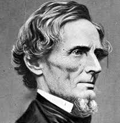
Confederate President Jefferson Davis
Changes in presidential voting in these counties over the past 40 years illustrate just how far the Black Republicans against which Lee and Davis fought are now transcendent—and the alarming (for Democrats) degree to which white Southerners have forsaken their traditional political roots.
Of course, the South’s march toward the GOP is not news. Today, the term “Solid South” has an entirely different connotation than it did during the days of FDR or Lyndon Johnson. However, these namesake counties do provide a window into how these shifts in party preference have occurred over time and the role that race played in them.

Confederate General Robert E. Lee
The 2016 presidential results also show that the Republicanization of the South is accelerating in these counties that bear the mark of Southern heritage, which bodes ill for future Democratic prospects.
In 1976, when Democrat Jimmy Carter became the first Southerner to win the White House since Zachary Taylor in 1848, he carried nine of the 12 Davis and Lee counties. By 1992, Bill Clinton and George H.W. Bush were splitting them six-to-six.
By 2000, Republican George W. Bush had flipped nine of the 12 namesake counties his way; his average share of the total votes cast for the two major party candidates in those counties that year was an impressive 64 percent. But in 2016, Trump trumped the younger Bush, carrying those same nine counties with an average of 70 percent of the two-party vote.
In 1976, Republican President Gerald Ford’s share of the two-party vote topped 50 percent in just three namesake counties (in Florida, Alabama, and Kentucky). But by 2016, Trump’s share of the two-party vote was more than 50 percent in nine counties and parishes; above 60 percent in eight; above 70 percent in four; and above a whopping 80 percent in two (Georgia and Kentucky).
The most dramatic changes were in Jeff Davis County, Georgia, where native Georgian Carter carried 79 percent of the vote in 1976 and Trump won 81 percent in 2016, and Jefferson Davis Parish, Louisiana, where Carter won 62 percent and Trump 75 percent. However, even in majority black Lee County, Arkansas, Trump’s 16-point loss in 2016 was less than half of Ford’s 38-point defeat.
In addition to Lee County, Arkansas, the only namesake counties Trump lost in 2016 were Jefferson Davis County, Mississippi, and Lee County, South Carolina, which are also majority black. However, even in these three counties, Trump carried a larger share of the two-party vote in 2016 than Mitt Romney did in 2012.
In fact, Trump improved on Romney’s result in 11 of the 12 namesake counties, save only Jeff Davis County, Texas, where Trump had to settle for merely matching Romney’s total.
The results in these namesake counties over time also illustrate the role race has played in the political realignment of the South.
In all seven of the overwhelmingly white namesake counties, the Republican share of the two-party vote was higher in 2016 than in 1976, by an average of 29 percent. Trump did better than Romney by an average of 4 percent.
By contrast, in majority-black Lee counties in Mississippi and South Carolina, the Republican two-party share fell by an average 2.5 percent from 1976 to 2016, but Trump outperformed Romney by the same 2.5 percent. These results indicate that the white Southern shift to the Republicans appears stronger than the corresponding black shift to the Democrats.
This is borne out by the results in Lee County, Arkansas, which has the smallest African-American population of any of the majority-black namesake counties (55 percent). There, the Republican share of the two-party vote actually climbed 11 percent between 1976 and 2016, and Trump beat Romney’s total by 5 percent.
Two of the namesake counties—Lee County, Florida, and Jeff Davis County, Texas—are outliers in that they have significant Latino populations. The Republican share of the two-party vote in both of those counties was higher in 2016 than it was in 1976, but Trump’s results were down from the numbers put up in 2000 and 2004 by George W. Bush, who, for a Republican, ran strongly with Latino voters.
The results in the namesake counties also illustrate the mountain which Democrats need to climb if they are to reduce Republican hegemony in the South.
The Democratic base once included small towns and rural areas across the Southern landscape, as well as urban areas. In 2016, Democrats still held the cities (with newfound and welcome signs of life in suburban Atlanta and Houston) and the mostly small rural counties with majority black populations, such as the namesake counties in Arkansas, Mississippi and South Carolina. Democrats also do well in college towns such as Athens, Georgia, and Gainesville, Florida.
But Democrats’ failure to compete for the votes of small town and rural white voters is what is killing them electorally, as the results in the Davis and Lee namesake counties without black majorities vividly illustrates.
Only one of these namesake counties is urban—Lee County, Florida, which includes Fort Myers—and Lee County, Alabama, contains Auburn University. The rest of these counties and parishes are all rural, white areas where Messrs. Davis and Lee are no doubt remembered fondly and Jimmy Carter ran reasonably well—and where Hillary Clinton couldn’t get elected dog catcher if she handed out $20 bills at the polling booth.
As a barometer of the past, these namesake counties illustrate how far Democrats have fallen in their former strongholds. But if Trump’s improved results over Romney’s are a barometer of the future, the bottom may not yet have been reached.
 Chicken Fried Politics