
Home » State Races (Page 15)
Category Archives: State Races

Texas primaries narrow crowded fields in U.S. House races
Valdez, White face off in Democratic governor’s primary; Cruz, O’Rourke in U.S. Senate race
♦By Rich Shumate, ChickenFriedPolitics.com editor
 AUSTIN — Texas primary voters have narrowed crowded fields vying for 11 open or potentially competitive U.S. House seats and the U.S. Senate, while the Democratic race for governor is heading to a May runoff to pick a nominee for an uphill climb against Republican Governor Greg Abbott.
And while Democrats have high hopes of riding a wave of enthusiasm to put a dent into the GOP’s 25-to-11 advantage in the Texas U.S. House delegation, more than 530,000 more voters chose the Republican over the Democratic ballot in the March 6 primaries, although that was a better showing by Democrats than in the last midterm primary in 2014.

O’Rourke

Cruz
In the U.S. Senate race, as expected, Republican incumbent Ted Cruz and Democratic U.S. Rep. Beto O’Rourke both easily won their primaries, setting up a November race likely to draw national attention. O’Rourke took 62 percent, and Cruz, 85 percent.
In the governor’s race, Abbott, seeking a second term, won outright with 90 percent of the vote. The Democratic runoff will be between former Dallas County Sheriff Lupe Valdez and Andrew White, a Houston investment banker and son of the late former Governor Mark White. Valdez had a strong lead in the race, 43 percent to 27 percent, over White.

George P. Bush
Republican incumbents also won in six other statewide races, including Land Commissioner George P. Bush, son of former Florida Governor Jeb Bush, who took 58 percent of the vote to beat back three challengers.
In the U.S. House races, Democrats’ top targets in November are three GOP incumbents who represent districts Hillary Clinton won in 2016: John Culberson in the 7th District in Houston; Pete Sessions in the 32nd District in Dallas; and William Hurd, who represents the 23rd District in West Texas stretching from the suburbs of San Antonio over to El Paso. All three easily won their primaries.
In the 7th District, the two Democrats who qualified for the runoff are Lizzie Pannill Fletcher, a Houston lawyer, and Laura Moser, a journalist who carried the endorsement of Our Revolution, a liberal group that sprang from Bernie Sanders’ failed presidential campaign.
This race heated up when Democratic Congressional Campaign Committee, the campaign arm of House Democrats, intervened by publishing opposition research critical of Moser because of fears she won’t be competitive against Culberson in November. However, she used the DCCC’s memo to raise money and made it past five other Democrats into the runoff with Fletcher.
In the 32nd District, Collin Allred, an attorney and former player for the NFL’s Tennessee Titans, topped the Democratic primary with 39 percent and will face Lillian Salerno, who served as a deputy undersecretary on the U.S. Department of Agriculture during the Obama administration, who got into the runoff with 18 percent.
In the 23rd District, Gina Oritz Jones, an Iraq war veteran from San Antonio who worked as a U.S. trade representative, led the race with 42 percent and will face Rick Trevino, a high school teacher from San Antonio who served as a Sanders delegate in 2016. The majority Latino 23rd District, where Hurd is seeking a third term, is a perennial swing seat that changed hands in 2010, 2012 and 2014.
In addition to the races that Democrats are targeting, there are also eight other open seats in Texas that drew crowded primaries:
- In the Houston-area 2nd District, being vacated by Republican Ted Poe, Republicans will have a runoff between State Rep. Kevin Roberts and David Crenshaw, a retired Navy officer.
- In the Dallas-area 3rd District, being vacated by Republican Sam Johnson, State Senator Van Taylor won the Republican nomination outright in the primary. He will face the winner of a Democratic runoff between attorneys Lorie Burch and Sam Johnson (no relation to the incumbent).
- In the 5th District, also near Dallas, which is being vacated by Republican Jeb Hensarling, Republican State Rep. Lance Gooden will be in a runoff against fundraising consultant Bunni Pounds for the right to take on Democrat Dan Wood, a former city councilman in Terrell. Hensarling has endorsed Pounds.
- In the 6th District south of Dallas, being vacated by Republican Joe Barton, both parties will have runoffs. The Republican runoff pits Jake Elizey, a former fighter pilot, against Tarrant County Tax Assessor Ron Wright. On the Democratic side, journalist Jana Sanchez will square off against Ruby Fay Woodridge, an Arlington pastor who ran for the seat in 2016.
- In the 16th District in El Paso, which O’Rourke is giving up to run for the Senate, former El Paso County Judge Veronica Escobar won the Democratic primary with 61 percent of the vote, making her a prohibitive favorite in this heavily Democratic, majority Latino district. Her Republican opponent will be Rick Seeberger, a strategic planner from Canutillo.
- In the 21st District in the Texas Hill Country, being vacated by Lamar Smith, a 18-candidate Republican field has been narrowed to businessman Matt McCall and Austin attorney Chip Roy. On the Democratic side, attorney and former military officer Joseph Kopser will face minister Mary Wilson.
- In the 27th District, which includes Corpus Christi and much of the Gulf Coast and is being vacated by Republican Blake Farenthold, the Republican primary will feature Bech Bruun, former chairman of the Texas Water Development Board, and Michael Cloud, the former GOP chair in Victoria County. The Democratic runoff will include Raul “Roy” Barrera, a federal court deputy in Corpus Christi, and Eric Holguin, a former congressional aide.
- In the 29th District in Houston, being vacated by Democrat Gene Green, State Senator Sylvia Garcia beat six other Democrats to win the Democratic nomination outright with 63 percent of the vote. She will face the winner of the Republican runoff between Phillip Aronoff, a physician, and Carmen Maria Montiel, a Houston TV journalist who once represented her native Venezuela in the Miss Universe Pageant.
Random drawing gives GOP control of Virginia House of Delegates
Republican Delegate David Yancey declared winner in race tied after disputed recount
♦By Rich Shumate, ChickenFriedPolitics.com editor
 RICHMOND (CFP) — Republicans have retained control of the Virginia House of Delegates after a random drawing to settle a race in Newport News that remained tied after a disputed recount.

Va. Del. David Yancey, R-Newport News
Republican Delegate David Yancey will get to keep his seat after his name was drawn from a bowl by James Alcorn, chairman of the State Board of Elections, as Yancey’s Democratic challenger, Shelly Simonds, looked on.
With Yancey’s win, Republicans will hold 51 seats in the House of Delegates, to 49 for Democrats, although Democrats have gone to federal court to overturn another race in which their candidate lost narrowly in a recount.
Speaking to reporters after the January 4 drawing, Simonds refused to concede and said “all options are on the table,” including possible legal action to contest the outcome in District 94.
Yancey, who didn’t attend the drawing, issued a statement saluting Simonds on running a “great campaign.”
“The election is behind us, the outcome is clear, and my responsibility now is to begin the work I was re-elected to do,” he said.
Despite falling short of control, Democrats made an astonishing breakthrough in the November vote in Virginia, nearly overturning a 66-34 Republican House majority by flipping 15 seats and taking out 12 GOP incumbents, including many veteran lawmakers in the Washington, D.C. suburbs.
Democrats also carried all three statewide races, including a win by Governor-elect Ralph Northam, and only trail Republicans by one vote in the Senate, where the GOP holds a 21-19 majority. Northam takes office January 13.
The drawing to settle the contest in District 94 was the latest bizarre twist in the seesaw battle between Yancey and Simonds that has roiled Virginia politics for more than eight weeks.

Shelly Simonds
After the initial results were reported, Yancey held a 10-vote lead. Then, a December 19 recount overturned Yancey’s margin and showed Simonds ahead by one vote. But when a panel of judges met to certify the results the next day, they decided to count a ballot for Yancey in which the bubbles for both candidates had been filled in but the bubble for Simonds was crossed off.
With that ballot counted, Simond’s single vote lead became a tie, which, under Virginia law, had to be settled by drawing lots.
Simonds asked the judges who counted the disputed ballot to reconsider, but they refused, saying they had complied with state law in determining the intention of the voter who filled out the ballot, who had voted for the Republican candidates in all of the other races.
The unusual circumstances of the drawing drew a large crowd to the Patrick Henry Building in Richmond, despite a snow storm. Slips of paper with the names of both candidates were put inside film canisters and then placed in a large bowl and mixed, with Alcorn selecting the winner.
Democrats, GOP will likely tie for control of Virginia House of Delegates
Democrat wins recount by a single vote to give party parity
RICHMOND (CFP) — By the margin of a single vote in a single race, Virginia Democrats are poised to do what was unthinkable before November’s House of Delegates election — gain enough seats to share control with Republicans come January.
Virginia Delegate-elect Shelly Simonds
A December 19 recount in District 94 in Newport News gave Democrat Shelly Simonds a one-vote victory over Republican Delegate David Yancey, out of nearly 24,000 votes cast. Before the recount, Yancy had a 10-vote lead.
Simonds’s win means Democrats and Republicans both have 49 seats in the 100-seat chamber, with recounts pending in two other races. The Democrat has a 336-vote lead in one of those races, while the Republican leads by 82 votes in the other, making a 50-50 tie the most likely scenario.
Heading into the November election, Republicans held a commanding 66-34 lead in the House of Delegates. But Democrats, riding a surge of suburban support, flipped 16 seats and took out 13 Republican incumbents to end 18 years of GOP control.
While the recount result in District 94 still has to be certified by a judicial panel, GOP House leaders issued a statement conceding both Simonds’s victory and their loss of control.
“As we have said for the last six weeks, we are committed to leading and governing alongside our colleagues,” the GOP leaders said. “We stand ready to establish a bipartisan framework under which the House can operate efficiently and effectively over the next two years.”
Governor-elect Ralph Northam took to Twitter to congratulate Simonds, observing that her one-vote win proves “(e)very vote matters.”
Democrats have filed a federal lawsuit seeking a new election in District 28 in Fredericksburg, where the GOP candidate has an 82-vote lead pending a recount. If successful, Democrats would have a shot at winning an outright majority in the election rerun.
Republicans hold a narrow 21-19 lead in the Virginia Senate. Democrats carried all three statewide posts in November, led by Northam’s 9-point win in the governor’s race.
Earthquake in Virginia: Democrats overturn huge GOP majority in House of Delegates
Results show U.S. Rep. Barbara Comstock faces tough sledding to keep her seat in 2018
♦By Rich Shumate, ChickenFriedPolitics.com editor
RICHMOND (CFP) — Heading into the November 7 election, Republicans enjoyed a comfortable majority in the Virginia House of Delegates, just one seat short of the two-thirds majority necessary to override the vetoes of a Democratic governor.

U.S. Rep. Barbara Comstock, R-Virginia
But after a catastrophic showing in the Washington, D.C. suburbs, they may now end up sharing power in the legislature’s lower house with Democrats. And those results spell trouble ahead for Republican U.S. Rep. Barbara Comstock, who will have to defend her seat in 2018 in the same suburban areas where Democrats rolled.
With three races still too close to call, Democrats are assured of winning at least 49 seats in the House, to 48 for Republicans. Republican candidates lead in all of the three outstanding races, but the margin in all three is small enough to trigger a recount; in one district, the GOP margin is a mere 13 votes.
If all of the races fall to the GOP, Republicans would keep control of the chamber, 51-49. But if just one flips back to the Democrats, the split will be 50-50, and neither party will have control.
State Senate races were not on the ballot; Republicans control that chamber 21 to 19.

Virginia Delegate-Elect Danica Roem
History was also made when Danica Roem, a transgender woman, won a seat in Prince William County by defeating GOP Delegate Bob Marshall, a 14-term social conservative who had described himself as Virginia’s “chief homophobe” and insisted on referring to Roem with male pronouns during the campaign.
When Roem takes office, she will be the the first transgender person in the United States to be elected and serve in a state legislature while openly acknowledging her transgender identification.
Democrats made a concerted push to cut into the 66-34 majority that Republicans held before the election, contesting 88 of the 100 seats and raising copious amounts of money, including more than $800,000 in four races. But the swing of at least 15 seats was beyond their wildest expectations.
Democratic challengers took down 12 Republican incumbents, with two more in danger in the races still too close to call. Democrats also picked up three open seats that Republicans had held, with one more open GOP seat still to be called.

Virginia Delegate-Elect Chris Hurst
Most of the carnage was in the D.C. suburbs, where seven incumbents fell, including four in Prince William County. But incumbents also lost in suburban Richmond, the Hampton Roads area, and even in a rural district near Blacksburg won by Democrat Chris Hurst, whose girlfriend, Roanoke TV reporter Alison Parker, was gunned down on live TV in 2015.
Hurst raised more than $1.1 million, a staggering summing in a constituency with just 80,000 people. And despite running in a rural Southern district, he also advocated for treating gun violence as a “public health crisis.”
Democratic Delegate candidates were helped by the top of the ticket: Lieutenant Governor Ralph Northam rolled up margins of 20 to 30 points in the northern Virginia suburbs on his way to winning the governorship over Republican Ed Gillespie, and Democratic candidates also took statewide races for lieutenant governor and attorney general.
The results in Virginia were being widely interpreted as a sign that Democrats are reaping the rewards of anger toward President Trump and congressional Republicans, particularly in suburban areas filled with upscale, college-educated voters.
Even before the November 7 election, Comstock was considered to among the most vulnerable Republicans in the U.S. House because Hillary Clinton won her 10th District in 2016 by 10 points, en route to carrying the Old Dominion, the lone Southern state in Clinton’s column.
The district stretches from Fairfax and Manassas west to the West Virginia border. However, its major population centers are in Loudon, Prince William and Fairfax counties — all areas where Northam ran up big numbers and GOP delegates fell by the wayside.
Comstock has already drawn 11 Democratic challengers. The biggest name in the pack is State Senator Jennifer Wexton from Leesburg.
Democrats roll in state elections in Virginia
Northam elected governor; Democrats sweep statewide races and make big gains in legislature
♦By Rich Shumate, ChickenFriedPolitics.com
RICHMOND (CFP) — In a huge night for Democrats, Lieutenant Governor Ralph Northam easily defeated Republican Ed Gillespie to claim Virginia’s governorship.
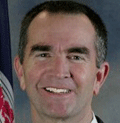
Lieutenant Governor Ralph Northam
Democrats also won two other statewide offices, and the GOP lost its once-comfortable majority in the lower house of the state legislature, a stunning feat that included election of the nation’s first-ever transgender legislator.
Northam’s 54-45 percent victory over Gillespie in the November 7 vote was nearly twice as large as Hillary Clinton’s margin of victory over Donald Trump in 2016 and was built on 20-point victories in the suburbs of Washington, D.C. and Richmond.
Holding the governorship in Virginia is a boon for Democrats frustrated by a string of heartbreaking defeats in special and off-year elections since Trump took the White House. The result, however, was a hold, not a takeaway, and it came in the lone Southern state Clinton carried.
Speaking to jubilant supporters in Fairfax, Northam offered a thinly veiled rebuke to the president’s take-no-prisoners style of politics.
“It was said that the eyes of the nation are on the commonwealth,” Northam said. “Today, Virginians have answered and have spoken. Virginia has told us to end the divisiveness, that we will not condone hatred and bigotry and to end the politics that have torn this country apart.”
After Northam was declared the winner, Trump, visiting South Korea, sent a tweet taking issue with Gillespie’s decision to distance himself from the president: “Ed Gillespie worked hard but did not embrace me or what I stand for.”
The specter of Trump hovered over the governor’s race. Gillespie did not invite the president to cross the Potomac to campaign for him, angering some in his party’s pro-Trump base, but Northam still tried to hang Trump around Gillespie’s neck, accusing the GOP nominee of figuratively “standing right next” to the president, even if literally he had not.

Ed Gillespie
In his concession speech, Gillespie thanked his campaign workers and supporters but did not mention the president.
“I felt called to serve. I hope I’ll discern what (God’s) calling is for me next,” Gillespie said.
Gillespie’s loss is his second statewide defeat in four years. In 2014, he challenged Democratic U.S. Senator Mark Warner, coming to within 18,000 votes of beating him.
In the race for lieutenant governor, Democrat Justin Fairfax, an attorney and former federal prosecutor from the D.C. suburbs, defeated Republican State Senator Jill Vogel. Democratic Attorney General Mark Herring also won his re-election race over Republican John Adams.
Perhaps the most shocking result of the night came in the races for the House of Delegates, the lower house of Virginia’s legislature. Republicans entered election day holding a 66-34 majority; Democrats ousted at least 11 incumbents and picked up three open seats that the GOP had held.
With five races still too close to call, Democrats had 48 seats and Republicans 47. Of the five races left outstanding, Republicans were ahead in three and Democrats in two. If those results hold, the chamber would be evenly divided, 50-50.
In four of the five House races still to be decided, the leads are less than 125 votes, making recounts likely.
Virginia Delegate-Elect Danica Roem
Among the winners was Danica Roem, a transgender woman who won a seat in Prince William County by defeating veteran GOP Delegate Bob Marshall, a 14-term social conservative who had described himself as Virginia’s “chief homophobe” and insisted on referring to Roem with male pronouns.
When Roem takes office, she will be the the first transgender person in the United States to be elected and serve in a state legislature while openly acknowledging her gender identity.
Northam’s win in the South’s lone off-year governor’s election gives Democrats three of the region’s 14 governorships, with Northam joining Louisiana Governor Jon Bell Edwards and North Carolina Governor Roy Cooper. The incumbent Democrat in Virginia, Governor Terry McAuliffe, was barred by state law from seeking re-election.
Northam, 58, comes to the governorship after 10 years in elected office, first as a state senator and then lieutenant governor. A former U.S. Army doctor, he has practiced pediatric neurology at a children’s hospital in Norfolk since 1992.
With his win, Democrats have now won three of the last four governor’s races in Virginia, a once solidly Republican state that has trended Democratic in recent years, primarily due to an influx of new voters into the Washington, D.C. suburbs.
 Chicken Fried Politics