
Home » Texas (Page 16)
Category Archives: Texas

Analysis: Results in Confederate namesake counties show role of race in Democratic decline
Trump accelerates Republican shift in counties named for Jefferson Davis and Robert E. Lee
♦By Rich Shumate, Chickenfriedpolitics.com editor
 (CFP) — Jefferson Davis and Robert E. Lee loom large as icons of the Southern Confederacy, so much so that 11 Southern counties and one Louisiana parish bear their names. But if these lions of the South are aware of what is happening in their namesake counties today, they may be rotating in their graves.
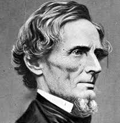
Confederate President Jefferson Davis
Changes in presidential voting in these counties over the past 40 years illustrate just how far the Black Republicans against which Lee and Davis fought are now transcendent—and the alarming (for Democrats) degree to which white Southerners have forsaken their traditional political roots.
Of course, the South’s march toward the GOP is not news. Today, the term “Solid South” has an entirely different connotation than it did during the days of FDR or Lyndon Johnson. However, these namesake counties do provide a window into how these shifts in party preference have occurred over time and the role that race played in them.

Confederate General Robert E. Lee
The 2016 presidential results also show that the Republicanization of the South is accelerating in these counties that bear the mark of Southern heritage, which bodes ill for future Democratic prospects.
In 1976, when Democrat Jimmy Carter became the first Southerner to win the White House since Zachary Taylor in 1848, he carried nine of the 12 Davis and Lee counties. By 1992, Bill Clinton and George H.W. Bush were splitting them six-to-six.
By 2000, Republican George W. Bush had flipped nine of the 12 namesake counties his way; his average share of the total votes cast for the two major party candidates in those counties that year was an impressive 64 percent. But in 2016, Trump trumped the younger Bush, carrying those same nine counties with an average of 70 percent of the two-party vote.
In 1976, Republican President Gerald Ford’s share of the two-party vote topped 50 percent in just three namesake counties (in Florida, Alabama, and Kentucky). But by 2016, Trump’s share of the two-party vote was more than 50 percent in nine counties and parishes; above 60 percent in eight; above 70 percent in four; and above a whopping 80 percent in two (Georgia and Kentucky).
The most dramatic changes were in Jeff Davis County, Georgia, where native Georgian Carter carried 79 percent of the vote in 1976 and Trump won 81 percent in 2016, and Jefferson Davis Parish, Louisiana, where Carter won 62 percent and Trump 75 percent. However, even in majority black Lee County, Arkansas, Trump’s 16-point loss in 2016 was less than half of Ford’s 38-point defeat.
In addition to Lee County, Arkansas, the only namesake counties Trump lost in 2016 were Jefferson Davis County, Mississippi, and Lee County, South Carolina, which are also majority black. However, even in these three counties, Trump carried a larger share of the two-party vote in 2016 than Mitt Romney did in 2012.
In fact, Trump improved on Romney’s result in 11 of the 12 namesake counties, save only Jeff Davis County, Texas, where Trump had to settle for merely matching Romney’s total.
The results in these namesake counties over time also illustrate the role race has played in the political realignment of the South.
In all seven of the overwhelmingly white namesake counties, the Republican share of the two-party vote was higher in 2016 than in 1976, by an average of 29 percent. Trump did better than Romney by an average of 4 percent.
By contrast, in majority-black Lee counties in Mississippi and South Carolina, the Republican two-party share fell by an average 2.5 percent from 1976 to 2016, but Trump outperformed Romney by the same 2.5 percent. These results indicate that the white Southern shift to the Republicans appears stronger than the corresponding black shift to the Democrats.
This is borne out by the results in Lee County, Arkansas, which has the smallest African-American population of any of the majority-black namesake counties (55 percent). There, the Republican share of the two-party vote actually climbed 11 percent between 1976 and 2016, and Trump beat Romney’s total by 5 percent.
Two of the namesake counties—Lee County, Florida, and Jeff Davis County, Texas—are outliers in that they have significant Latino populations. The Republican share of the two-party vote in both of those counties was higher in 2016 than it was in 1976, but Trump’s results were down from the numbers put up in 2000 and 2004 by George W. Bush, who, for a Republican, ran strongly with Latino voters.
The results in the namesake counties also illustrate the mountain which Democrats need to climb if they are to reduce Republican hegemony in the South.
The Democratic base once included small towns and rural areas across the Southern landscape, as well as urban areas. In 2016, Democrats still held the cities (with newfound and welcome signs of life in suburban Atlanta and Houston) and the mostly small rural counties with majority black populations, such as the namesake counties in Arkansas, Mississippi and South Carolina. Democrats also do well in college towns such as Athens, Georgia, and Gainesville, Florida.
But Democrats’ failure to compete for the votes of small town and rural white voters is what is killing them electorally, as the results in the Davis and Lee namesake counties without black majorities vividly illustrates.
Only one of these namesake counties is urban—Lee County, Florida, which includes Fort Myers—and Lee County, Alabama, contains Auburn University. The rest of these counties and parishes are all rural, white areas where Messrs. Davis and Lee are no doubt remembered fondly and Jimmy Carter ran reasonably well—and where Hillary Clinton couldn’t get elected dog catcher if she handed out $20 bills at the polling booth.
As a barometer of the past, these namesake counties illustrate how far Democrats have fallen in their former strongholds. But if Trump’s improved results over Romney’s are a barometer of the future, the bottom may not yet have been reached.
13 Southern U.S. House Democrats bow out of Trump inaugural
All of the no-shows represent districts carried by Hillary Clinton
♦By Rich Shumate, Chickenfriedpolitics.com editor
WASHINGTON (CFP) — Thirteen of the 40 Southern Democrats in the U.S. House have announced that they will not take part in the January 20 inauguration of Donald Trump.
Lawmakers from Florida, Georgia, Florida, Kentucky, Mississippi, North Carolina, Tennessee, Texas and Virginia are among the no-shows. All of the boycotting members represent urban or black-majority districts that were carried by Democrat Hillary Clinton.
Trump’s tweets castigating U.S. Rep. John Lewis, D-Georgia, for announcing an inauguration boycott seemed to particularly rankle some of the members opting not to attend; Trump’s reaction was called “repugnant,” “ignorant,” and “insensitive and foolish.”
“We are sending a message to Mr. Trump. Respect, like Pennsylvania Avenue, is a two-way street,” said U.S. Rep. Lloyd Doggett, D-Texas, who will be among the no-shows.
However, none of the three other Democrats in Lewis’s own Georgia delegation have joined the boycott. Also not joining so far is U.S. Rep. Debbie Wasserman Schultz, who, as head of the Democratic National Committee during the presidential campaign, had been a sharp Trump critic.
As for the contention by Trump supporters that the inauguration is a celebration not of him but of the peaceful transfer of power, U.S. Rep. Julian Castro, D-Texas, said, “Every American should respect the office of the presidency and the fact that Donald Trump will be the 45th President of the United States. But winning an election does not mean a man can show contempt for millions of Americans and then expect those very people to celebrate him.”
U.S. Rep. Gerry Connolly, D-Virginia, said Trump’s “behavior and harmful words during and after the campaign have left the country I love with open, bleeding wounds. Instead of binding those wounds, he has poured salt on them. Instead of unifying us, he has reveled in driving wedges between us.”
Trump won 108 of the 154 congressional districts across the South in the November election; none of them are represented by Democrats.
Lawmakers boycotting the inaugural are unlikely to pay a political price, as all but two of them represent districts that Clinton carried with at least 60 percent of the vote. However, U.S. Reps. Darren Soto, D-Florida, and John Yarmuth, D-Kentucky, come from districts where Clinton’s share was just 55 percent.
The list of boycotting Democrats includes:
Georgia
- John Lewis, D-Atlanta
Florida
- Alcee Hastings, D-Fort Lauderdale
- Darren Soto, D-Orlando
- Frederica Wilson, D-Miami-Dade
Kentucky
- John Yarmuth, D-Louisville
Mississippi
- Bennie Thompson, D-Jackson
North Carolina
- Alma Adams, D-Greensboro
- G.K. Butterfield, D-Wilson
Tennessee
- Steve Cohen, D-Memphis
Texas
- Lloyd Doggett, D-Austin
- Al Green, D-Houston
- Joaquin Castro, D-San Antonio
Virginia
- Gerry Connolly, D-Fairfax County
Electoral College: Despite protests, Southern electors stick with Trump
Trump carried 165 of the region’s 180 votes; two ‘faithless’ electors in Texas vote for Kasich, Ron Paul
♦By Rich Shumate, Chicken Fried Politics.com editor
(CFP) — Members of the Electoral College have met at 14 Southern statehouses and, as expected, gave the overwhelming majority of the region’s electoral votes to President-elect Donald Trump, ignoring calls by anti-Trump protestors to stop his elevation to the nation’s highest office.
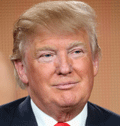
Donald Trump
Trump carried 165 of the South’s 180 electoral votes in the December 19 vote. Hillary Clinton won the 13 electoral votes from Virginia, which was the only Southern state she carried.
The only place where Republican electors broke ranks was in Texas, where the defections of two Republican electors did not stop Trump from securing the 270 votes he needed to win the White House.
Chris Suprun, a Dallas paramedic who had previously announced he would not vote for Trump, cast his ballot for Ohio Governor John Kasich. Elector Bill Greene, who represented the 34th District, which takes in the Gulf Coast between Brownsville and Corpus Christi, voted for former Texas U.S. Rep. Ron Paul.
Afterward, Texas Governor Greg Abbott tweeted his support for a bill that would preclude so-called “faithless” electors by requiring them to vote for the candidate who carried the state on election day, in this case, Trump.
“This charade is over.,” Abbot said. “A bill is already filed to make these commitments binding. I look forward to signing it & ending this circus.
Twenty-nine states have laws binding electors to the popular vote winner in their states, including the Southern states of Oklahoma, Mississippi, Alabama, Florida, South Carolina, North Carolina and Virginia. Currently in Texas, state law doesn’t bind electors, although the Texas GOP required them to take an oath pledging to vote for the popular vote winner.
The Electoral College vote is usually a formality to which scant public attention is paid. However, Trump’s surprise win on November 8, coupled with his loss to Clinton by more than 2.8 million votes in the popular vote, galvanized anti-Trump protests at state capitols around the country.
Small groups of protestors gathered in Tallahassee, Atlanta, Nashville, Raleigh, Austin, Oklahoma City and Montgomery.
In Austin, shouts from protestors were audible inside the State House chamber where electors met, according to local media reports.
In Little Rock, anti-Trump activists took many of the seats in the old Supreme Court chamber in the State Capitol, where the vote took place. According to local media reports, one protestor was removed, although the electors also chatted amiably with the demonstrators before the vote took place.
Former Texas Governor Rick Perry picked to head Energy Department
Perry will lead agency he pledged to abolish during his presidential campaigns
♦By Rich Shumate, Chicken Fried Politics.com editor
 WASHINGTON (CFP) — Former Texas Governor Rick Perry has been nominated to head the U.S. Department of Energy, despite his scathing criticism of President-elect Donald Trump when the two men battled for the Republican presidential nomination.

Former Texas Governor Rick Perry
Perry had also pledged to eliminate the department during his two presidential campaigns, most notably in his infamous “ooops” moment during a 2011 debate when he was unable to remember Energy as one of the three departments he had pledged to abolish.
In a December 14 statement announcing Perry’s nomination, Trump said that Perry “created a business climate that produced millions of new jobs and lower energy prices in his state, and he will bring that same approach to our entire country.”
“My administration is going to make sure we take advantage of our huge natural resource deposits to make America energy independent and create vast new wealth for our nation, and Rick Perry is going to do an amazing job as the leader of that process,” Trump said.
In the same statement, Perry said he was “deeply humbled” to be nominated for the energy post.
“As the former governor of the nation’s largest energy producing state, I know American energy is critical to our economy and our security,” he said. “I look forward to engaging in a conversation about the development, stewardship and regulation of our energy resources, safeguarding our nuclear arsenal, and promoting an American energy policy that creates jobs and puts America first.”
Perry, 66, served 14 years as governor of Texas from 2000 to 2014, the longest tenure of any governor in state history. But he was unable to parlay that experience into a successful run for the White House in either 2012 or 2016.
During his campaign against Trump for the 2016 nomination, Perry called him a “cancer on conservatism” and said his campaign would lead the GOP to “perdition.” But last May, as Trump was poised to capture the nomination, Perry endorsed him, and he later campaigned for Trump.
As energy secretary, Perry would oversee a vast bureaucracy that runs the nation’s nuclear programs, markets power from federal hydroelectric projects and regulates the nation’s electric grid and natural gas pipelines.
The agency also has a research arm that, among other things, has conducted studies regarding climate change. Perry has said he does not think the science used by proponents of climate change to make their case that human activity is warming the planet is “settled,” and he has rejected the idea that carbon dioxide — a naturally occurring compound fundamental to human life — should be considered a pollutant.
Perry is also a supporter of the Keystone XL pipeline, a project that proponents of climate change have been fighting. President Obama stopped the final phase of that project in 2015; Trump has vowed to reverse that decision and let construction proceed.
Second Texas GOP elector bolts from Donald Trump
Elector Chris Suprun says Trump is not qualified to be president
♦By Rich Shumate, Chicken Fried Politics.com editor
DALLAS (CFP) — A Texas Republican presidential elector has announced he won’t vote for Donald Trump, making his case in a New York Times op-ed in which he argues the president-elect “shows daily he is not qualified for the office.”

Chris Suprin (Photo: Twitter)
“The election of the next president is not yet a done deal,” said Chris Suprun, a paramedic from Dallas. “Electors of conscience can still do the right thing for the good of the county. Presidential electors have the legal right and a constitutional duty to vote their conscience.”
Suprun said that while he has “poured countless hours into serving the party of Lincoln and electing its candidates,” Trump is an divisive demagogue who lacks foreign policy experience and has overseas business interests that would conflict with his role as president.
“I owe no debt to a party,” he said. “I owe a debt to my children to leave them a nation they can trust.”
Suprun did not say who would get his vote when Texas’s 38 electors meet to cast their ballots in Austin on December 19. However, he called on electors to “unify behind a Republican alternative, an honorable and qualified man or woman such as Gov. John Kasich of Ohio.”
Under Texas law, electors are not bound to vote for the candidate who carried the state in the November 8 election. However, the Texas Republican Party required all electors to take an oath pledging to vote for the winner.
Suprun was selected as the elector representing the 30th U.S. House District, a majority-minority area that includes much of the city of Dallas and southern Dallas County. While Trump carried the state, Hillary Clinton won Suprun’s district.
Suprun is the second Texas elector to refuse to vote for Trump, following Art Sisneros, who resigned as an elector rather than cast a ballot for the president-elect, which he said “would bring dishonor to God.
Sisneros will be replaced by the remaining electors when they meet on December 19.
 Chicken Fried Politics