
Home » U.S. House Races (Page 11)
Category Archives: U.S. House Races

Cliffhanger in the Bluegrass: Charles Booker poised for upset in U.S. Senate Democratic primary
As absentee ballot count continues, Booker takes the lead over establishment favorite Amy McGrath
♦By Rich Shumate, ChickenFriedPolitics.com editor
 (CFP) — State Rep. Charles Booker has taken the lead in the Democratic race for U.S. Senate in Kentucky, setting the stage for one of the year’s biggest political upsets that will upend the best-laid plans by the party establishment to take out Senate Majority Leader Mitch McConnell.
With the absentee ballot count continuing, Booker took a 2,500 vote lead over former Marine fighter pilot Amy McGrath as the first batch of votes began trickling in from Jefferson County, which includes Louisville.
While absentee ballots are still being counted across the commonwealth, the bulk of the outstanding vote was from Jefferson and Fayette County, which includes Lexington. In Jefferson, where Booker lives, he was carrying 80% of the vote; he was carrying 72% in Fayette.
A loss by McGrath — who has raised $40 million and has the backing of Senate Minority Leader Chuck Schumer and the Democratic Senatorial Campaign Committee — would be a embarrassing upset at the hands of Booker, a 35-year-old first-term lawmaker whose scrappy campaign surged from behind in the closing weeks of the race with the support of grassroots groups on the Democratic left.
It would also jumble the fall race in which establishment Democrats saw McGrath as their best chance to unseat McConnell, who carried 87% in his primary Tuesday against seven challengers.
In the only other contested federal race in Kentucky, Republican U.S. Rep. Thomas Massie easily turned back a challenge from Covington attorney Todd McMurtry in the 4th District in the Cincinnati suburbs, despite his sometimes rocky relationship with President Donald Trump.
Due to coronavirus concerns, absentee balloting was expanded statewide, with more than 800,000 ballots mailed out. Election officials in Jefferson and Fayette counties have said it could take until June 30 for final results to be released.
Booker went to court to extend the poll closing time in Jefferson County, where all voters countywide voted at a single polling place at the Kentucky Exposition Center. In Fayette County, everyone voted at the University of Kentucky’s football stadium.
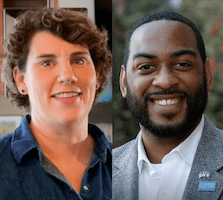
Amy McGrath and Charles Booker
In 2018, McGrath, 45, rode a wave from a viral announcement video to become a national fundraising sensation in a U.S. House race in central Kentucky, which she narrowly lost.
She spent $20 million in the Senate primary, almost all of it on ads that focused on McConnell, rather than her primary opponents.
Booker criticized McGrath as a “pro-Trump Democrat” unable to motivate the Democratic grassroots. He had the backing of U.S. Senators Bernie Sanders, Elizabeth Warren, Kamala Harris and Cory Booker; two members of “The Squad” in the U.S. House, Alexandria Ocasio-Cortez of New York and Ayanna Pressley of Massachusetts; and a number of self-described “progressive” activist groups.
However, Booker also got the backing of the state’s two largest newspapers, the Louisville Courier-Journal, which called him a “change agent”, and the Lexington Herald-Leader, which urged voters to choose “passion over pragmatism.”And he received the endorsements of former Secretary State Allison Lundergan Grimes, who lost to McConnell in 2018, and former Attorney General Greg Stumbo.
The state’s two most prominent elected Democrats — Governor Andy Beshear and U.S. Rep. John Yarmuth — did not endorse either candidate.
One factor in the race was the effect of protests over police violence that have roiled Louisville, home to the state’s largest pool of Democratic voters, in the wake of the death of Breonna Taylor, an African-American woman who was mistakenly shot in her home by police executing a no-knock warrant.
In the race’s closing days, Booker went up with ads criticizing McGrath for not participating in the protests, which included a awkward clip from a recent debate in which McGrath said she wasn’t involved because she “had some family things going on.” By contrast, Booker is shown addressing the protest crowd will a bullhorn.
The McGrath campaign has responded with ads that, while not attacking Booker directly, touted her as the only Democrat who can possibly beat McConnell, a formidable campaigner who has been in the Senate since 1985 and is seeking his seventh term.
Kentucky does not have primary runoff, which means that the candidate with the most votes when the smoke finally clears will be the nominee.
We tweet @ChkFriPolitics Join us!

Virginia GOP U.S. Rep. Denver Riggleman ousted at party convention amid gay wedding controversy
Challenger Bob Good defeats Riggleman in drive-thru convention; Riggleman hints at challenge to results over “irregularities”
 LYNCHBURG, Virginia (CFP) — Last summer, freshman Republican U.S. Rep. Denver Riggleman of Virginia agreed to preside at the wedding of two men who had supported him during his 2018 campaign for Congress.
That gesture of friendship and inclusivity has now cost Riggleman his seat, even with Donald Trump’s support and a solid conservative voting record.

Riggleman, center, presides at gay wedding (From Facebook/Christine Riggleman)
In a party convention Saturday, Riggleman, who represents the state’s 5th District, was defeated by Campbell County Supervisor Bob Good, a former athletics official at Liberty University who was recruited to run for the position by conservative activists unhappy with the congressman’s participation in a same-sex wedding.
Good took 58 percent of the convention delegates to 42 percent for Riggleman. Because of the coronavirus, more than 2,400 convention delegates cast their ballots from their cars in the parking lot of Tree of Life Ministries in Lynchburg.
However, Riggleman indicated Saturday night that he might challenge the results over what he termed “voting irregularities and ballot stuffing.”
“Voter fraud has been a hallmark of this nomination process, and I will not stand for it,” Riggleman tweeted shortly before the results were announced. “We are evaluating all our options at this time.”
Speaking to supporters after results were announced in the early hours of Sunday morning, Good said delegates had “embraced true and conservative principles that we have presented for this campaign and the true contrast that we showed.”
“We believed from the beginning that the 5th District was a bright red district that would embrace us,” he said. “The voters have embraced our values, they have embraced our principles, and they have embraced our platform.”
Party officials in the 5th District had opted for a convention, rather than a primary, which Virginia law allows. Riggleman had derided the drive-thru convention format as a “Dairy Queen convention,” although he was selected as the nominee in a convention two years ago.
The voting process took more than 10 hours, and it took six hours to tabulate the votes.
The district stretches through central Virginia from the Washington D.C. suburbs to the North Carolina border, including Charlottesville and suburban areas near Roanoke and Lynchburg. Riggleman carried it by 7 points in 2018.
Democrats running in the June 23 primary in the 5th District immediately pounced on the news of Good’s win, which will set up a fall race with a nominee who describes himself as “biblical conservative,” rather than embracing Riggleman’s more libertarian positions.
“Denver Riggleman voted with Trump 94% of the time and got his endorsement. Virginia Republicans did not think that was enough,” said Rappahannock County Supervisor John Lesinski in a statement posted on Twitter. “Just imagine what Bob Good will do to our district. It is revolting. We need this seat.”
“I don’t fall on the same side of a lot of issues as Denver Riggleman, but the fact that there is there is no longer space in the Republican Party for someone not pushing an agenda as extreme and radical as Bob Good should send a chill down every Americans spine,” said Claire Russo, a former Marine intelligence officer and fellow at the Council on Foreign Relations, in a Twitter video.
“Republicans just doubled-down on partisan bickering and chaos in Washington,” said RD Huffstetler, a Marine veteran and technology executive in a statement posted on Twitter. “Bob Good’s divisive and partisan ideology is plainly out of step with what the people of our district want or need.”
Also running in the Democratic primary is Cameron Webb, a Charlottesville physician and former Obama White House aide, who told journalist Amy Friedenberger of the Roanoke Times that Good’s nomination “is a reflection of how misguided and off-base the Republican Party in VA-05 is when comes to understanding the needs and concerns of the folks who live here.”
Good told his supporters that he was looking forward to running against the Democratic nominee, “who will undoubtedly embrace the radical socialist agenda of the Democrat Party.”
In July 2019, Anthony LeCounte and Alex Pisciarino asked Rigglemen to preside at their wedding, held at a winery in the Blue Ridge foothills. The men have said they got involved in Riggleman’s 2018 campaign because of his record on LBGTQ issues, including his support for same-sex marriage.
But after the Washington Post and other media outlets picked up the story of a conservative congressman marrying two men, the backlash was immediate. Several GOP county committees in the district voted to censure him, although the larger 5th District committee rejected censure.
However, Trump endorsed Riggleman in a tweet, and he also had the support of Liberty University President Jerry Falwell Jr., Good’s former boss. However, Falwell’s brother, Jonathan, senior pastor of Thomas Road Baptist Church in Lynchburg, supported Good, as did the two most recent occupants of the 5th District seat, former U.S. Reps. Tom Garrett and Virgil Good.
Good, 54, was senior associate athletic director at Liberty, his alma mater, from 2005 until earlier this year. In 2015, was elected as a supervisor in Campbell County, just south of Lynchburg. There he helped pass a measure declaring the county a “2nd Amendment sanctuary” to oppose efforts by Democratic legislators in Richmond to advance gun control measures.
Riggleman, 50, is a former Air Force intelligence officer who operates a distillery in Afton.
We tweet @ChkFriPolitics Join us!
South Carolina Primary: State Rep. Nancy Mace gets easy win in GOP primary for Lowcountry U.S. House seat
Republican U.S. Senator Lindsey Graham easily dispatches 3 primary opponents, will face Democrat Jaime Harrison in the fall
♦By Rich Shumate, ChickenFriedPolitics.com editor
 CHARLESTON (CFP) — State Rep. Nancy Mace cruised to an easy victory Tuesday in the Republican primary in South Carolina’s 1st U.S. House District, setting up a Lowcountry slugfest this fall against Democratic U.S. Rep. Joe Cunningham, one of the GOP’s top 2020 targets.
Mace, from Daniel Island, took 57 percent of the vote, easily eclipsing Mount Pleasant Councilwoman Kathy Landing, at 26 percent. Chris Cox, a founder of the Bikers for Trump organization, came in third with 10 percent.

Nancy Mace speaks to supporters after her primary victory (From SCETV via YouTube)
Speaking to supporters after her win, Mace said her campaign would “take back the Lowcountry and put it back into the hands of someone who’s going to be a truly independent voice.”
“Joe Cunningham votes with Nancy Pelosi of California and [Alexandria Ocasio-Cortez] of New York 85 percent of the time,” she said. “The Lowcountry doesn’t want that, and they don’t deserve it.”
Mace, 42, a real estate agent and businesswoman elected to the legislature in 2017, was the first female graduate of The Citadel, the state’s formerly all-male military college, in 1999. If elected in November, she would be the first woman to ever represent South Carolina in the House.
In her primary battle with Landing, she had the backing of House Majority Leader Kevin McCarthy and the conservative business groups Americans for Prosperity and Club for Growth.
Cunningham, 38, a Charleston lawyer, narrowly won the 1st District seat in the Democratic wave of 2018, after the incumbent Republican, Mark Sanford, was upset in his primary. He is the first Democrat in nearly four decades to hold the seat.
President Donald Trump carried the district by 13 points in 2016, making it one of the prime targets for Republicans running in 2020 with Trump on the ballot. Cunningham’s vote in favor of impeaching Trump will no doubt feature prominently in GOP ads this fall.
Also Tuesday Republican U.S. Senator Lindsey Graham, as expected, easily dispatched three little-known challengers in his primary, getting 68 percent of the vote. He will now face Democrat Jaime Harrison in November.
When Graham last ran for re-election in 2014, he faced a hotly contested primary against candidates running at him from the right who charged that he was inauthentically conservative. But his strong embrace of Trump over the last three years helped quiet his Republican critics.
Harrison, a Columbia lawyer and former state party chair, is trying to become the first Democrat to win a Senate race in South Carolina since 1998 or any statewide race since 2006. His campaign has caught on with Democratic donors, collecting $19 million so far for his challenge to Graham, according to the latest FEC filings.
Graham has raised $26 million.
We tweet @ChkFriPolitics Join us!
Georgia Primary: Jon Ossoff avoids runoff, wins Democratic U.S. Senate race
Republican Karen Handel gets her rematch in 6th U.S. House district; Democratic U.S. Rep David Scott barely escapes getting forced into a runoff
♦By Rich Shumate, ChickenFriedPolitics.com editor
 ATLANTA (CFP) — Three years after coming up on the short end in the most expensive House race in U.S. history, Democrat Jon Ossoff revived his political fortunes by winning Georgia’s U.S. Senate primary and earning the right to challenge Republican to U.S. Senator David Perdue in the fall.
Offoss took 51 percent over the vote, defeating Teresa Tomlinson, the former mayor of Columbus, who came in second with 15.2 percent, and Sarah Riggs Amico, a Marietta businesswoman who was the party’s unsuccessful nominee for lieutenant governor in 2018, at 12.6 percent.

Jon Ossoff
On election night, Ossoff had been under the 50 percent threshold he needed to avoid a runoff but moved into a majority as tens of thousands of absentee ballots were counted.
Due to the coronavirus crisis, the state had mailed absentee ballot applications to every voter in the state to increase mail-in voting. Tuesday’s vote in the Peach State was still marred by long lines and technical issues with the state’s new touch screen voting machines, which forced poll times to be extended up to three hours in parts of metro Atlanta.
Ossoff, a documentary filmmaker, rose to national prominence in 2017 in a special election for the 6th District seat in Atlanta’s northwest suburbs, in which he turned Democratic anger at President Donald Trump’s election into a $30 million fundraising haul but was edged out for the seat by Karen Handel.
Handel, who subsequently lost the seat in 2018 to Democratic U.S. Rep. Lucy McBath, will get a rematch after she easily cleared the Republican primary Tuesday. McBath was unopposed in the Democratic primary
The 6th District race is at the top of the Republican target list, with McBath’s support of Trump’s impeachment likely to be front and center in the fall. Trump carried the district by just 1.5 points in 2016.
The breakout performance in Georgia Tuesday came from political newcomer Rich McCormick, an emergency room doctor and former Marine Corps helicopter pilot won the GOP nomination in the 7th U.S. House District in Atlanta’s northeast suburbs without a runoff.
He won 55 percent and defeated six other candidates, including State Senator Renee Unterman, a former mayor who has spent two decades in the legislature, who finished in second with 17 percent.
Democrats in the 7th District nominated Carolyn Bourdeaux, who came within 400 votes of winning the seat in 2018 against Republican Rob Woodall, who decided not to run again. She carried 53 percent of the vote, ahead of State Rep. Brenda Lopez Romero and Nabilah Islam, a political consultant, both at 12 percent.
Veteran Democratic U.S. Rep. David Scott, running for his 10th term, survived a scare after he was nearly forced into a runoff against former State Rep. Keisha Waites for his seat in Atlanta’s southern and western suburbs. On election night, Scott only stood at 48 percent, but he went over the 50 percent threshold on Thursday, after the remaining absentee ballots were counted.
Republicans also filled runoff slots for two of their safest Georgia U.S. House seats — the 9th District in the north Georgia mountains, which U.S. Rep. Doug Collins is giving up to run for the state’s other Senate seat, and the 14th District in northwest Georgia, where Tom Graves is retiring.
In the 9th District, the GOP runoff will pit State Rep. Matt Gurtler of Tiger, who came in on top with 22 percent, against Andrew Clyde, a retired Navy officer and firearms instructor from Jackson County, who finished in second at 19 percent. Former U.S. Rep. Paul Broun, who represented a neighboring district from 2007 until 2015, came in fourth.
In the 14th District, Marjorie Taylor Greene, a Milton businesswoman, will face John Cowan, a neurosurgeon from Rome, in the Republican runoff. Greene, who had originally filed to run in the 6th District but switched to the 14th when Graves retired, took 41 percent to 20 percent for Cowan.
Georgia’s other Senate seat, held by Republican Kelly Loeffler, is also up for election in 2020; however, because that contest is to fill the remainder of a term, a special election will be held until November in which Loeffler will run against candidates from all parties, including Collins, who has launched an intra-party fight to push Loeffler out of the seat.
We tweet @ChkFriPolitics Join us!

Voters in Georgia, West Virginia and South Carolina vote Tuesday in rescheduled primaries
Democrats will pick a U.S. Senate nominee in Georgia and a gubernatorial candidate in West Virginia
♦By Rich Shumate, ChickenFriedPolitics.com editor
(CFP) — Voters in three Southern states — Georgia, West Virginia and South Carolina — will vote Tuesday in primaries that were rescheduled from earlier in the year due to the coronavirus crisis.
In Georgia, Democrats will be picking a nominee to oppose Republican U.S. Senator David Perdue in November, while Republicans will begin sorting out their nominees for two open U.S. House seats in safely Republican districts that have both drawn a gaggle of candidates.
In West Virginia, Democrats will pick an opponent to face Republican Governor Jim Justice — who won four years ago as a Democrat before switching parties and embracing President Donald Trump — and will also decide on a nominee to face U.S. Senator Shelly Moore Capito.
In South Carolina, Republican U.S. Senator Lindsey Graham faces three little-known challengers in his primary, while his expected Democratic opponent in the fall, Jaime Harrison, is running unopposed.
Republicans in the Lowcountry will also pick a candidate to run against Democratic U.S. Rep. Joe Cunningham, who is one of the GOP’s top 2020 targets.
Due to the coronavirus crisis, mail and early voting has been expanded for the primaries, with a smaller portion expected to vote in person on primary day with reduced numbers of polling stations.
Polls are open from 7 a.m. to 7 p.m. in Georgia and South Carolina and from 6:30 a.m. to 7:30 p.m. in West Virginia.
In Georgia, the marquee race is the Democratic contest for U.S. Senate. The polling leader in the race has been Jon Ossoff, who benefits from the statewide name recognition he built in 2017 by spending $30 million in a special election for the 6th District House seat, a race he narrowly lost.
Ossoff’s primary challengers include Teresa Tomlinson, the former mayor of Columbus, and Sarah Riggs Amico, a Marietta businesswoman who was the party’s unsuccessful nominee for lieutenant governor in 2018.
Polls have given Ossoff a large lead but short of the majority he would need to win the nomination outright and earn a spot against Perdue in November. If he does not clear that threshold, he’ll face an August runoff against Tomlinson or Amico.
Georgia’s other Senate seat, held by Republican Kelly Loeffler, is also up for election in 2020; however, because that contest is to fill the remainder of a term, a special election won’t be held until November, in which Loeffler will run against candidates from all parties, including Republican U.S. Rep. Doug Collins, who has launched an intra-party fight to push Loeffler out of the seat.
Peach State Republicans will also start the process for picking nominees for two of their safest U.S. House seats — the 9th District in the north Georgia mountains, which Collins is giving up to run for the Senate, and the 14th District in northwest Georgia, where Tom Graves is retiring. Nine Republicans have entered the primary for both of those seats, making runoffs a near certainty.
In the 7th District in Atlanta’s northeast suburbs, seven Republicans and six Democrats are running in their respective primaries for the seat Republican Rob Woodall kept by a scant 413 votes in 2018. He decided to retire rather than to contest the seat again.
Carolyn Bourdeaux, the Democrat whom Woodall barely beat two years ago, is back, but she faces a primary battle against five challengers including State Senator Zahra Karinshak, a lawyer and former Air Force officer; State Rep. Brenda Lopez Romero, the first Latina to serve in the Georgia legislature; and John Eaves, the former chairman of the Fulton County Commission and former Atlantan who decamped for the suburbs in a bid to get to Congress.
On the Republican side, State Senator Renee Unterman, a former mayor who has served 22 years in the legislature, is facing off against six competitors, including Lynne Homrich, a former Home Depot executive, and Rich McCormick, an emergency room doctor and former Marine Corps helicopter pilot.
The only House incumbent in either party facing a significant primary challenge in Georgia is Democratic U.S. Rep. David Scott, who is being challenged in the 13th District in the southern and western Atlanta suburbs by Jannquelle Peters, the former mayor of East Point; former State Rep. Keisha Waites; and Michael Owens, the former chair of the Cobb County Democratic Party who challenged Scott unsuccessfully in 2014.
Scott, 74, is seeking his 10th term in the House and has held elected office continuously for 46 years. The majority black 13th District is strongly Democratic, which means whoever emerges from the primary will likely win the seat in November.
In West Virginia, Democrats are itching for a grudge match against Justice, who infuriated them by jumping to the GOP just seven months after taking office — and adding insult to injury by announcing the switch on stage with the president at a Trump rally.
Five Democrats are running for the nomination to oppose the governor, led by Kanawha County Commissioner Ben Salango, who has the backing of a slew of labor and teachers unions. He was also endorsed by Democratic U.S. Senator Joe Manchin, who had flirted with running against Justice himself before deciding to take a pass.
Also running are State Senator Ron Stollings from Madison; Jody Parker, a former journalist from Madison; and Stephen Smith, a community organizer and former executive director of the West Virginia Healthy Kids and Families Coalition, who is running what he describes as a grassroots, progressive campaign.
A fifth candidate who filed to run, Doug Hughes, later announced on Facebook that he was pulling out and endorsing Smith.
In the Senate race, former State Senator Richard Ojeda — an outspoken retired Army officer who lost a race for Congress in 2018 and then launched a quixotic bid for the Democratic presidential nomination that failed to gain traction — is the best-known of the three candidates vying to take on Capito, whose seat is not currently considered to be jeopardy.
West Virginia does not have primary runoffs, which means that the leading vote-getter in both the governor’s and Senate races will be the nominee.
In South Carolina, the marquee race is the U.S. House contest in the 1st District, where Republicans have their sights set on Cunningham, who flipped the seat in 2018.
The race for the GOP nomination includes State Rep. Nancy Mace from Daniel Island, a real estate agent and businesswoman who was the first female graduate of The Citadel; Kathy Landing, a businesswoman who serves on the town council in Mount Pleasant; Chris Cox, a chainsaw artist who was one of the founders of the Bikers for Trump group; and Brad Mole, a housing administrator from Bluffton.
Mace and Landing have led the race in fundraising and advertising, with Mace raking in more than $1.3 million for the race to $630,000 for Landing, according to the most recent filings with the Federal Election Commission. The question will be whether either woman will be able to clear the majority needed to avoid a runoff with Cox and Mole also in the race.
Mace has gotten the backing of House Majority Leader Kevin McCarthy and the conservative business groups Americans for Prosperity and Club for Growth. But Landing has her own conservative backers, including the House Freedom Fund, a campaign group associated with House Freedom Caucus, as well as conservative stalwart and former U.S. Senator Jim DeMint.
In the U.S. Senate race, Republican primary voters will decide whether to reward Graham for his enthusiastic embrace of Trump.
Six years ago, he faced a slew of candidates who ran at him from the right and criticized him as inauthentically conservative. But this time around, Graham faces only token opposition from three little-known candidates, none of whom has raised enough money to compete with his $26 million war chest.
Harrison, who hopes to be the first Democrat to win a Senate race in South Carolina since 1998, faces no opposition on the Democratic side of the ballot. He has so far raised $19 million, according to the latest FEC filings.
 Chicken Fried Politics