
Home » U.S. House Races (Page 26)
Category Archives: U.S. House Races

U.S. Supreme Court stays ruling striking down North Carolina U.S. House map
Decision means 2018 primaries can proceed in existing districts
♦By Rich Shumate, ChickenFriedPolitics.com editor
 WASHINGTON (CFP) – The U.S. Supreme Court has indefinitely stayed a ruling by a panel of three federal judges that invalidated North Carolina’s U.S. House map for unconstitutionally diluting the voting strength of Democrats.
The January 18 decision by the high court means state legislators will not have to redraw the map for the 2018 midterm election, a prospect that threatened to throw the election process into chaos.
The Supreme Court’s unsigned order stays the ruling “pending the timely filing and disposition of an appeal by this court.”
While the order did not indicate how many of the justices were in favor of granting a stay, it did note that two members of the court’s liberal bloc, Ruth Bader Ginsburg and Sonia Sotomayor, wanted to deny the application for a stay filed by Republican lawmakers.
Common Cause North Carolina and the League of Women Voters of North Carolina sued to invalidate the House map passed by the GOP-controlled legislature in 2016, arguing that the Republican majority improperly used political considerations in drawing the map.
No federal court had ever a stuck down a congressional map for being gerrymandered for political, rather than racial, reasons. But the majority opinion from three-judge panel who heard the case said partisan gerrymandering – a common political practice in many U.S. states – violates a “core principle of republican government” that “voters should choose their representatives, not the other way around.”
The January 9 ruling gave state lawmakers just 20 days to draw a new map, an order that is now on hold until the Supreme Court considers the appeal. Qualifying for the May 8 primary is scheduled to begin Feb. 28.
The high court is already considering similar cases involving state legislative districts in Wisconsin and Maryland that could set a precedent for the North Carolina case.
Should the ruling in North Carolina be upheld on appeal, it could have significant effects in other Southern states where Republican state legislative majorities have gerrymandered maps to their advantage, particularly Florida, Virginia and Texas.
Democrats cheered the ruling, which could help them make a dent in the GOP’s 10-to-3 advantage in North Carolina’s congressional delegation. But Republicans accused the judges of “waging a personal, partisan war” against the state GOP.
Ironically, what may have sunk the North Carolina map was the explicit admission by GOP lawmakers back in 2016 that they were drawing lines to maximize the number of Republican-friendly seats – an admission made to overcome objections to a previous map struck down for improperly using racial considerations.
After the map was redrawn in 2016, several incumbent lawmakers were forced to run in new territory and one, former U.S. Rep. Renee Ellmers, didn’t survive after she was forced to run against another incumbent in a Republican primary. However, the new map did not change the overall party composition in the state’s House delegation.
The 2016 map has allowed Republicans to hold on 77 percent of the state’s congressional seats, even though election results have been closely divided between the parties in recent statewide and presidential elections.
Donald Trump carried North Carolina by just 4 points in 2016, as Democrat Roy Cooper squeaked into the governorship by a margin of less than 1 percent.
The redistricting case was heard by James Wynn, a judge on the 4th U.S. Circuit Court of Appeals; W. Earl Britt, a senior U.S. District Court judge in Raleigh; and William Osteen Jr., a U.S. District Court judge in Greensboro.
Wynn and Britt were appointed by Democratic presidents; Osteen, who dissented from part of the ruling while concurring in striking down the map, is a Republican appointee.
Federal judges strike down North Carolina’s U.S. House map over gerrymandering
Ruling could have an impact on other Southern states with partisan maps
♦By Rich Shumate, ChickenFriedPolitics.com editor
RALEIGH (CFP) – In an unprecedented decision, a panel of three federal judges has struck down North Carolina’s U.S. House map, ruling that Republican lawmakers unconstitutionally diluted the voting strength of Democrats by gerrymandering the map for political reasons.
The panel’s majority opinion said partisan gerrymandering – a common political practice in many U.S. states – violates a “core principle of republican government” that “voters should choose their representatives, not the other way around.”
The January 9 ruling gives state lawmakers just 20 days to redraw the map; if they don’t, a new map will be redrawn by a special master appointed by the court. However, GOP legislative leaders are vowing to appeal the ruling to the U.S. Supreme Court, which could leave the current map in place until the appeal can be heard.
If the Supreme Court doesn’t issue a stay, significant chaos will be injected into the Tar Heel State’s 2018 election, with qualifying for candidates supposed to begin Feb. 28 for a May 8 primary.
The ruling marked the first time that a federal court has stuck down a congressional map for being gerrymandered for political, rather than racial, reasons. However, U.S. Supreme Court is currently considering similar cases involving state legislative districts in Wisconsin and Maryland that could set a precedent.
The judicial panel in the North Carolina case found unanimously that the map violated the equal protection clause of the Constitution and ruled 2-1 that it also violated the free speech rights of Democrats.
Should the ruling in North Carolina be upheld on appeal, it could have significant effects in other Southern states where Republican state legislative majorities have gerrymandered maps to their advantage, particularly Florida, Virginia and Texas.
Democrats cheered the ruling, which could help them make a dent in the GOP’s 10-to-3 advantage in North Carolina’s congressional delegation. But Republicans accused the judges of “waging a personal, partisan war” against the state GOP.
Ironically, what may have sunk the North Carolina map was the explicit admission by GOP lawmakers back in 2016 that they were drawing lines to maximize the number of Republican-friendly seats – an admission made to overcome objections to a previous map struck down for improperly using racial considerations.
After the map was redrawn in 2016, several incumbent lawmakers were forced to run in new territory and one, former U.S. Rep. Renee Ellmers, didn’t survive after she was forced to run against another incumbent in a Republican primary. However, the new map did not change the overall party composition in the state’s House delegation.
The 2016 map has allowed Republicans to hold on 77 percent of the state’s congressional seats, even though election results have been closely divided between the parties in recent statewide and presidential elections.
Donald Trump carried North Carolina by just 4 points in 2016, as Democrat Roy Cooper squeaked into the governorship by a margin of less than 1 percent.
The redistricting case was heard by James Wynn, a judge on the 4th U.S. Circuit Court of Appeals; W. Earl Britt, a senior U.S. District Court judge in Raleigh; and William Osteen Jr., a U.S. District Court judge in Greensboro.
Wynn and Britt were appointed by Democratic presidents; Osteen, who dissented from part of the ruling while concurring in striking down the map, is a Republican appointee.
Texas U.S. Rep. Joe Barton announces retirement from Congress amid flap over nude photos
Barton’s departure sets up competitive race for GOP-held seat in metro Dallas
♦By Rich Shumate, ChickenFriedPolitics.com editor
 DALLAS (CFP) — Republican U.S. Rep. Joe Barton, the dean of the Texas House delegation, has announced he will not seek re-election in 2018, a week after acknowledging that he exchanged a nude photograph of himself with a woman with whom he was having a consensual extramarital relationship — a photo which wound up on social media.

U.S. Rep. Joe Barton, R-Texas
Barton, 68, who has served in Congress since 1985, told the Dallas Morning News that “there are enough people who lost faith in me that it’s time to step aside.” He said that while he still thinks he could win re-election in the 6th District, “it would be a nasty campaign, a difficult campaign for my family.”
Barton also stressed to the News that unlike a number of other politicians recently ensnared in sex scandals, his conduct was entirely consensual: “I am not guilty of sexual harassment.”
The controversy now ending Barton’s career began when a nude photo purportedly of him began circulating on Twitter, and a woman who said she had a sexual relationship with him told the Washington Post that he had threatened to contact the U.S. Capitol Police if she disseminated the photo.
The woman told the Post that she did not send the photo out on Twitter, and it remains unclear who is responsible.
After the Post story, Barton issued a statement in which he admitting having consensual sexual relationships with other women while separated from his second wife, prior to their divorce in 2015.
“Those relationships have ended. I am sorry I did not use better judgment during those days. I am sorry that I let my constituents down,” he said in the statement. Barton has also said that police are investigating the circumstances surrounding the release of the photo.
Barton’s departure creates a sudden, unexpected opening that will likely draw a crowd of aspiring congressmen, particularly on the Republican side. The 6th District takes a swath of suburbs between Dallas and Ft. Worth, plus Ellis and Navarro counties to the South.
While the district leans Republican, the tilt is not overwhelmingly so — Barton carried it with 58 percent of the vote in 2016, and Donald Trump took just 54 percent. Five Democrats are already running for the seat.
Barton, who is currently the longest-serving member of the Texas delegation, becomes the seventh Texas U.S. House member to forego re-election in 2018, joining Republicans Ted Poe, Sam Johnson, Jeb Hensarling and Lamar Smith and Democrats Beto O’Rourke and Gene Green.
All except O’Rourke are leaving Congress; he is running for the U.S. Senate against incumbent Republican Ted Cruz.
Texas U.S. Rep. Jeb Hensarling won’t seek re-election in 2018
Hensarling’s retirement announcement comes just two weeks before filing begins for 2018 primaries
♦By Rich Shumate, ChickenFriedPolitics.com editor
DALLAS (CFP) — U.S. Rep. Jeb Hensarling, the Texas Republican who chairs the powerful House Financial Services Committee, has announced he won’t seek re-election in 2018, creating a third open House race in Texas less than two weeks before filing begins for the 2018 primaries.

U.S. Rep. Jeb Hensarling, R-Texas
“Although service in Congress remains the greatest privilege of my life, I never intended to make it a lifetime commitment, and I have already stayed far longer than I had originally planned,” said Hensarling, who was first elected to Congress in 2002 to represent Texas’s 5th District. “Although I will not be running for reelection, there are 14 months left in my congressional term to continue the fight for individual liberty, free enterprise, and limited constitutional government — the causes for which I remain passionate.”
Because of GOP term limits for committee chairman, Hensarling would have lost his chairmanship in 2019 had he remained in Congress, even if Republicans held control of the chamber. He said that with the end of his chairmanship, “the time seems right for my departure.”
Hensarling’s 5th District takes in eastern Dallas County and stretches into rural areas to the east and south. Although the district has a majority-minority population, it is solidly Republican, having gone for President Trump with 63 percent of the vote in 2016; Hensarling carried 80 percent.
However, Hensarling’s retirement is likely to set off a mad scramble for his seat, thanks to Texas’s early primary schedule. Filing opens November 11 and closes December 11, and the primary will be held on March 6. The only candidate in the race at the time of Hensarling’s October 31 retirement was Democrat Dan Wood, an attorney and city councilman from Terrell.
Before being electing to Congress, Hensarling, 60, was an aide to former U.S. Senator Phil Gramm, and, like Gramm, cultivated an image as a fiscal hawk and opponent of increased government spending. In 2010, he was elected as chairman of the House Republican Conference, the fourth-ranking position in the House, a post he gave up to take the Financial Services chairmanship.
Hensarling is the third member of the Texas House delegation to forgo a re-election bid in 2016. Democratic U.S. Rep. Beto O’Rourke from El Paso is giving up his seat to challenge U.S. Senator Ted Cruz. GOP U.S. Rep. Sam Johnson from Dallas is retiring after 28 years in Congress.
While all three of these seats are unlikely to change hands, three Democrats are making a play for Johnson’s 3rd District seat, which Trump only carried with 55 percent of the vote.
Analysis: South is the GOP’s ace in the hole in stopping Democratic takeover of U.S. House
Democrats will need to flip 11 Southern seats or make make up the difference elsewhere
♦By Rich Shumate, ChickenFriedPolitics.com editor
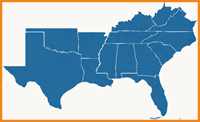 (CFP) — With President Trump’s approval ratings at historically low levels, Democrats have high hopes of taking back the U.S. House in 2018. But those hopes are tempered by a giant geographic obstacle standing in their way — namely, the South.
 To reclaim the House, Democrats need to flip 24 seats, shifting about 10 percent of the seats that Republicans now hold. And nearly half of the GOP caucus — 114 seats — is from the South, where Republican House members outnumber Democrats by 3-to-1.
So a 10 percent shift in the South would require winning 11 seats, in a region where Democrats won just two seats in 2016 (both in Florida and neither yet safe.) If Democrats fall short of that total, they will need to shift an even higher percentage of seats throughout the rest of the country — as much as 19 percent if they come up empty in the South.
And as Democrats plot and plan to add to their meager total of 40 Southern House seats, two recent special elections for open seats offer decidedly mixed omens on their chances for overturning the GOP’s hegemony.
In South Carolina’s 5th District, the swing away from Trump’s 2016 numbers in the special election was nearly 20 percent — not enough for Democrat Archie Parnell to win but a much bigger scare than Republicans had expected. Indeed, if that 20-point swing could be replicated across the South in 2018, 42 GOP-held seats could potentially be in play, more than Democrats would need to return Nancy Pelosi to the speaker’s chair.

Handel
But the results in the other race, in Georgia’s 6th District, pour substantial caution on such irrational exuberance. Republican Karen Handel kept the seat by running slightly ahead of Trump, in a race where Democrats spent a whopping $30 million and still came up short.
And this district in the northern Atlanta suburbs is exactly the kind of place where Democrats will need to compete to claw away at Republican dominance in the South next year — increasingly diverse, maturing suburbs whose upscale, educated voters, though conservative by inclination, are somewhat wary of Trump’s stewardship of the GOP brand.
If Democrats couldn’t win this race for an open seat in a low-turnout special election with a highly energized base and a president with historically low approval ratings, flipping these seats in 2018 will be a tall order indeed, particularly given Trump’s solid base of support in the South.
So where can Democrats start? Their first targets will be three majority Latino districts in metro Miami, all of which have large numbers of Cuban-American voters. Trump lost two of these districts and only narrowly won the third.
Veteran GOP U.S. Rep. Ileana Ros-Lehtinen is retiring, and Republicans will be hard pressed to keep her seat in a district Trump lost by 20 points. But in the other two districts, Democrats will have to unseat incumbents Carlos Curbelo, who has gone out of this way to distance himself from Trump, and Mario Diaz-Balart, who has been winning congressional elections with relative ease since 2002.
Democrats are also likely to target four other Southern districts where Hillary Clinton defeated Trump last year, which include three seats in Texas and one in Virginia. The GOP, however, has held three of these districts, in varying configurations, for decades.

Comstock
The Virginia seat, in the Washington D.C. suburbs, is held by Barbara Comstock, who first won it in 2014 and was narrowly re-elected in 2016. Even at this early date, she has already drawn six Democratic challengers in a district that, like the rest of Virginia, has become more hospitable to Democrats over the last decade.
In Texas, the climb for Democrats will be steeper. Clinton won the 32nd District in suburban Dallas, but that seat is held by Pete Sessions, a GOP titan who won by 52 points in 2016. She also won the 7th District in suburban Houston, where John Culberson ran well ahead of Trump to win by 12 points.
While Democrats appear eager to try to unseat both (Culberson already has seven challengers and Sessions nine), these districts have long Republican pedigrees reminiscent of Georgia’s 6th District, which was once represented by Newt Gingrich. Former President George H.W. Bush began his political career in the 7th District in 1967; former President George W. Bush’s Dallas home is in the 32nd.

Hurd
Democrats may have more luck in Texas’s 23rd District, which stretches from the suburbs of San Antonio across rural West Texas. This district is part of an ongoing legal fight over the state’s 2013 redistricting map, and a panel of federal judges is considering changes that could make it more difficult for Republican Will Hurd to hang on for a third term.
After those Clinton-won districts, the next set of seats Democrats might logically target are those where Trump’s winning margin was less than 10 points and where it would take less than a 10-point swing from the 2016 congressional results to put the seat in Democratic hands. But that list contains a scant eight seats — four in Texas, two in North Carolina and one each in Florida and Virginia. None of them are open at this point.
After that, the pickings get even slimmer — places like Arkansas’s 2nd District, where a Democrat can carry Little Rock only to get swamped by the Republican vote in the suburbs, and Florida’s 3rd District, where liberal-leaning Gainesville is subsumed in a sea of more traditional, conservative Southern voters. To be competitive in these districts, Democrats would have to commit to putting resources into races where chances of victory would appear, at the moment, to be rather remote.
So if Democrats can’t move the playing field into these second and third tiers, they have a reasonable shot at just seven Republican-held Southern seats, five of which have been in GOP hands for decades and all but one of which is likely to have an incumbent. And any anti-Trump tide that helps them in other parts of the country will likely not crest as high in the South.
With a lot of angry voters and a lot of luck, Democrats may indeed swing enough seats in 2018 to win control of the House. But as Republicans try to stop them, their ace in the hole is their dominance across the South, which should give them plenty of reason for confidence.
 Chicken Fried Politics