
Home » U.S. Senate Races (Page 2)
Category Archives: U.S. Senate Races


Open Louisville U.S. House race, U.S. Senate contest up Tuesday in Kentucky primary
Charles Booker seeking Democratic nomination to try to take out Republican U.S. Senator Rand Paul
♦By Rich Shumate, ChickenFriedPolitics.com editor
 LOUISVILLE (CFP) — Democratic voters in Louisville will pick their likely next Congress member in Tuesday’s primary, while Kentucky voters statewide are expected to set up a fall showdown between Republican U.S. Senator Rand Paul and Democratic challenger Charles Booker.
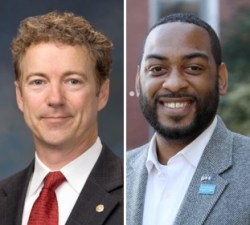
Rand Paul and Charles Booker expected to face off in fall U.S. Senate race
Legislative and local offices are also on the ballot Tuesday; contests for statewide offices aren’t held until 2023.
Polls for in-person voting open at 6 a.m. and close at 6 p.m. in both the Central and Eastern time zones.
In the 3rd U.S. House District in metro Louisville, where Democratic U.S. Rep. John Yarmuth is retiring, State Senator Morgan McGarvey and State Rep. Attica Scott are competing for the Democratic nomination in the state’s only Democratic-leaning district.
Seven Republicans are also competing in the 3rd District, including businessman Stuart Ray and Mike Craven, a former union official who ran unsuccessfully for the seat in 2018 and 2020.
None of Kentucky’s other five House seats – all held by Republicans – are expected to be competitive.
In the Senate race, Paul, from Bowling Green, is facing five little-known Republican challengers in his bid for a third term, while Booker is the biggest name in a four-candidate Democratic race.
Booker, a former state representative from Louisville, broke onto the political scene in 2020 when he nearly upset Amy McGrath, the anointed candidate of the Democratic establishment, in the state’s U.S. Senate primary. She was later crushed by Senate Republican leader Mitch McConnell.
Booker launched his uphill run against Paul in July 2021 and opted to stay in the race rather than switching to the metro Louisville U.S. House seat when Yarmuth retired.
We tweet @ChkFriPolitics Join us!

Bromance Bye: Donald Trump pulls Mo Brooks endorsement in Alabama U.S. Senate race
Trump says Brooks became “woke” in suggesting Republicans stop dwelling on 2020
♦By Rich Shumate, ChickenFriedPolitics.com editor
 MONTGOMERY (CFP) — Donald Trump has rescinded his endorsement of Alabama U.S Senate candidate U.S. Rep. Mo Brooks, accusing him of becoming “woke” for urging Republicans to put the results of the 2020 election behind them and focus on the future.
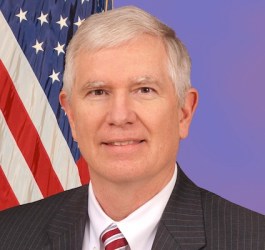
Alabama U.S. Senate candidate Mo Brooks
Trump’s decision is a blow to Brooks’s struggling campaign – but it could also save Trump from what increasingly looked to be an embarrassing defeat by his anointed candidate in the state’s May 24 primary.
It is also likely to set up a spirited chase to get Trump’s seal of approval between Brooks’s Republican rivals, Katie Britt and Mike Durant.
After the announcement, Brooks issued a statement calling Trump’s decision “disappointing” but insisting that he could not do what Trump wanted — try to overturn Joe Biden’s election win after Congress finalized it on January 6, 2021, when rioters stormed the U.S. Capitol.
“I’ve told President Trump the truth knowing full well that it might cause President Trump to rescind his endorsement,” Brooks said. “But I took a sworn oath to defend and protect the U.S. Constitution. I honor my oath. That is the way I am. I break my sworn oath for no man.”
Even after Trump voted him off the island, Brooks reiterated his allegiance to the former president, saying he was the “only proven America First candidate in this Senate race” and “the only candidate who fought voter fraud and election theft when it counted, between November 3 and January 6.”
He also accused Senate Republican leader Mitch McConnell of manipulating Trump into pulling the endorsement, although he didn’t explain how.
The denouement between Trump and Brooks is the end of what was once a fervent political romance, capped by Brooks’s fiery speech before the January 6th Capitol riot in which he told the crowd that “today is the day American patriots start taking down names and kicking ass.”
But things started to turn during a Trump rally last August in Cullman, when Brooks was booed by the crowd after saying that Trump partisans upset by the 2020 results should “put that behind you.”
In his statement withdrawing his endorsement, Trump said that when he heard that statement, “I said, ‘Mo, you just blew the Election, and there’s nothing you can do about it,” even though he continued supporting Brooks for seven more months.
Brooks had also refused for months to say he would oppose Trump nemesis McConnell as Senate party leader, before finally blasting him as “a weak-kneed, debt junkie, open-border RINO Republican” amid rumors that Trump was about to pull his support.
Brooks, 67, has represented North Alabama in the House since 2011. In 2017, he ran for Senate in a special election, coming in third in the Republican primary.
This time around, Brooks has lagged in polling and fundraising behind Britt, a former aide to retiring U.S. Senator Richard Shelby, and Durant, a businessman and former Army officer whose helicopter was shot down in Somalia in 1993, an episode immortalized in the film “Black Hawk Down.”
They are running to replace Shelby, an Alabama political legend retiring after six Senate terms. He has endorsed Britt.
In his statement pulling his Brooks endorsement, Trump said he expected to endorse a candidate in the race “in the near future.” Reuters reported that both Britt and Durant had met with Trump in recent days.
We tweet @ChkFriPolitics Join us!

Hot or not, in or out: Our forecast of 2022’s most interesting Southern political races
Trump’s sway will be key metric in outcome of midterm elections across region
♦By Rich Shumate, ChickenFriedPolitics.com editor
 (CFP) — 2022 has dawned, and with it a mid-term election year in which most Southern states will decide who gets to be their governor and congressional races across the region will play a key role in deciding which party controls Congress.
Of the eight Southern states with open races for governor this year, seven will feature incumbents seeking re-election, with the only open race in Arkansas, where former Donald Trump spokesperson Sarah Huckabee Sanders appears on her way to victory.
Nine U.S. Senate seats will be up, with open races in Alabama and North Carolina and Georgia Democratic U.S. Senator Raphael Warnock battling for a full term after winning a special election runoff in 2020.
Here is a look at some of the hottest races, and likely biggest political stories, of the upcoming year.
Reapportionment Primary-Palooza
The redrawing of new U.S. House maps after reapportionment has set up two Southern primary contests, one in each party, where incumbents will need to defeat a current colleague to stay in Congress.
In Georgia, Republican mapmakers have pitted Democratic U.S. Reps. Lucy McBath and Carolyn Bourdeaux against each other in Atlanta’s suburbs. McBath’s existing district in the northwest suburbs became too Republican for her to survive; Bourdeaux’s in the northeast suburbs actually became more Democratic with the addition of areas that had been in McBath’s orbit.
The two women — who campaigned with each other in 2018 and 2020 and differ little politically — will face off in what is likely to be an expensive primary. McBath has a stronger national profile and fundraising operation, but the district now centers on Gwinnett County, which Bourdeaux currently represents.
One caveat is that voting rights groups are suing the block the new map, which, if successful, could provide a wrinkle ahead of the March filing deadline.
In West Virginia, the loss of one of the state’s three U.S. House seats sets up a primary contest between Republican U.S. Reps. David McKinley and Alex Mooney for a new district that includes the northern half of the state.
However, this race will have more of an ideological flavor than the primary in Georgia. Mooney, a former Washington lobbyist who moved to the state in 2014 from Maryland to run for Congress, is a member of the ultra-conservative, anti-establishment Freedom Caucus. McKinley, a seventh-generation West Virginian and former state party chair, is more aligned with the Republican Party’s establishment wing.
Expect to hear a great deal in this race about McKinley’s vote in favor of establishing a bipartisan commission to investigation the January 6th attack on the U.S. Capitol, which Mooney opposed.
The Power of Trump
The former president has already been active in offering endorsements and pursuing revenge, particularly against Georgia Governor Brian Kemp and Secretary of State Brad Raffensperger for refusing to indulge his claims of widespread fraud in the state’s 2020 vote.
Trump recruited former U.S. Senator David Perdue to run against Kemp, setting off what is likely to be a bare-knuckled brawl in the Republican primary ahead of a stiff challenge from Democrat Stacey Abrams. He also endorsed U.S. Rep. Jody Hice’s bid to unseat Raffensperger.
And in one of the strangest early developments of the 2020 campaign, Trump also reportedly encouraged his former ambassador to Slovenia, Lindy Blanchard, to drop out of the U.S. Senate race to run instead against the very popular Alabama Governor Kay Ivey, in a fit of pique over cancellation of a July 4th Trump rally (a decision Ivey did not actually make.)
Trump has also waded into the attorney general’s race in Texas with an endorsement of incumbent Ken Paxton, who has drawn a gaggle of primary challengers (including Bush family scion George P. Bush and stalwart pro-Trump U.S. Rep. Louie Gohmert) after a criminal indictment and FBI bribery investigation.
Taking down Ivey would seem a long shot at this point; Kemp is holding his own against Perdue in early polls; and Paxton race seems likely to be headed to an unpredictable runoff in March. So it remains to be seen whether the Trump endorsement machine will produce results in 2022.
Trump has also endorsed in three U.S. Senate races. In Georgia, his nod put Herschel Walker on a glide path to the Republican nomination, but his chosen candidates in Alabama (U.S. Rep. Mo Brooks) and North Carolina (U.S. Rep. Ted Budd) are facing tough primary battles against more establishment candidates.
Adding to the MAGA Squad
Trump’s election has led to the rise of a core group of MAGA-philes in the House – social media savvy, outspoken, and willing to pounce on fellow Republicans who display the slightest scrap of bipartisanship. Among this group are Georgia’s Marjorie Taylor Greene, Florida’s Matt Gaetz, the aforementioned Gohmert and Brooks, and North Carolina’s Madison Cawthorn.
In 2022, they are hoping to add to their numbers by offering endorsements and fundraising help to like-minded candidates across the South and around the country, which will put them in position to be power brokers if Republicans take control of the House (a prospect likely to give House Republican leader Kevin McCarthy heartburn.)
Some of these candidates are little known and will face tough climbs against incumbent Republicans. But it is worth noting that both Greene and Cawthorn followed this same playbook successfully in 2020, going from unknowns to the halls of Congress with lightning speed.
Southern Black Woman in the U.S. Senate?
No black woman has ever been elected to represent a Southern state in the Senate. This year, Democrats are poised to pick two black women as their Senate nominees – U.S. Rep. Val Demings in Florida and Cheri Beasley in North Carolina.
Demings, the former police chief of Orlando who served on the first House impeachment committee that investigated Trump, faces an uphill climb against Republican U.S. Senator Marco Rubio, particularly with his strong core of support among Hispanic voters in South Florida. But with her national profile, she has been posting strong fundraising numbers that could make the race competitive.
Beasley, the former chief justice of the North Carolina Supreme Court, may have better prospects in running for an open seat in a race where Republicans are slogging through a multi-candidate race in which Trump has intervened in favor of Budd.
A victory by either in November will make history.
Palmetto State “RINOs”
The most serious insult that can be hurled in Republican politics these days is to call someone a RINO – a Republican in Name Only.
Two incumbent U.S. House members in South Carolina have been branded with the RINO label by their critics – Nancy Mace in the Lowcountry and Tom Rice in the Pee Dee – and are each facing multiple challengers in their respective Republican primaries.
Mace was among the few Republican House members to offer criticism of Trump after the January 6th Capitol attack, although she did not vote to impeach him. Rice did, which got him censured by the state’s Republican Party, and he compounded his sin among the MAGA fervency by supporting the bipartisan commission to investigate the attacks.
As a result, Mace has four GOP challengers; Rice has 12. Trump has encouraged their challengers but has yet to announce a favorite. His blessing may be good enough to earn a runoff slot against the incumbent.
Thinking Outside The Box
After Warnock won a January special U.S. Senate election runoff in Georgia, he immediately become the Republicans’ primary 2022 target. Yet, no sitting U.S. House member ventured to take him on, nor did the three Republicans who ran against him in 2020.
Enter Herschel Walker, University of Georgia football hero and NFL standout. Though he carries significant personal baggage and has not a whiff of political experience, he does have the one accessory every Republican candidate wants in 2022 – Trump’s blessing.
Trump’s endorsement didn’t clear the primary field, but it did get Republican Senate leaders in Washgington behind Walker’s candidacy – taking a significant leap of faith in a race against a charismatic Democrat with Obama-level political skills.
Is this a gamble that will pay off or blow up? The answer may decide control of the Senate.
Beto O’Crist for Governor
The good people of Texas told Beto O’Rourke that they didn’t want him to be their senator in 2018, even after he spent $80 million trying to persuade them otherwise. The good people of Iowa and New Hampshire told him they didn’t want him to be their president in 2020, without nearly as much money going down the drain.
But not willing to take no and no for an answer, O’Rourke is back again, running this time for governor against incumbent Republican Greg Abbott. Only this time, he’s running in the gun-loving Lone Star State after telling a Democratic presidential debate audience that he was in favor of confiscating their assault weapons.
But lest you think Beto is the region’s most resolute embracer of questionable causes, he pales in comparison to Florida’s well-tanned political chameleon Charlie Crist, who is running for governor again this year after losing two statewide races in the past eight years and metamorphosing from a conservative Republican into an independent and then into a liberal Democrat.
Which begs the question: What part of “no” don’t you understand?
We tweet @ChkFriPolitics Join us!
Black U.S. Senate candidates in the South piling up impressive amounts of campaign cash
U.S. Senators Raphael Warnock and Tim Scott have raised more money than any other Senate candidates nationwide
♦By Rich Shumate, ChickenFriedPolitics.com editor
 (CFP) — African American candidates have historically faced a structural barrier in gaining election to high office — difficulty raising the money needed to run a competitive race. But in 2022, black candidates appear to be kicking down that barrier in Southern U.S. Senate races.
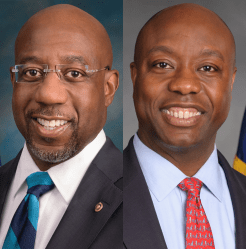
U.S. Senators Raphael Warnock and Tim Scott lead national fundraising totals
Six Southern African American candidates have each raised more than $1 million; three have raised more than $10 million. And more than a year before election day, Democratic U.S Senator Raphael Warnock of Georgia has raised more money than any other Senate candidate in the country, $44 million.
Behind Warnock is Republican U.S. Senator Tim Scott of South Carolina, at $31 million.
In the 150 years since Reconstruction, just two African Americans have been elected to represent a Southern state in the U.S. Senate — Scott and Warnock, who are both up for re-election in 2022 and amassing mountains of cash.
But the four other Southern African American candidates trying to join Scott and Warnock in the Senate are also pulling in impressive amounts of campaign money, the possession of which doesn’t ensure victory but the absence of which would certainly spell defeat.
In Georgia, Warnock is likely to face another black candidate, Republican Herschel Walker, the NFL and Georgia Bulldog great whom Donald Trump inveighed to get into the race.
In the third quarter of 2021, Warnock and Walker combined raised $13.3 million for what is likely to be among the most competitive races of the 2022 cycle; Warnock pulled in $9.5 million to $3.8 million for Walker.
Trump’s endorsement has not cleared the Republican primary field for Walker, who faces a multi-candidate primary before he can get to Warnock,. However, in his first five weeks in the race, Walker has already raised more money than any of his primary rivals.
Unlike Warnock, Scott is not facing a competitive race in the Palmetto State in 2022. But his haul during the third quarter — $8.4 million — is stoking speculation that Scott may be filling his cash cupboard for a possible 2024 run for the Republican presidential nomination.
In Florida, Democratic U.S. Rep. Val Demings — who raised her a national political profile as an House manager in the first Trump impeachment trial — raised $8.5 million in the third quarter, eclipsing the $6 million raised by her likely Republican opponent, U.S. Senator Marco Rubio. But he’s raised $19 million overall so far, compared to her $13.5 million.
Neither Demings nor Rubio appear likely at this point to face a serious primary challenge that would deplete their coffers before turning their fire on each other.
In North Carolina, former Supreme Court Chief Justice Cheri Beasley raised $1.5 million in the third quarter. While that total was not as impressive as some of the black candidates in other races, it was more than any other candidate in her race in either party, although she remains slightly behind her strongest white rival for the Democratic nomination, State Senator Jeff Jackson, in overall fundraising.
In heavily Republican Kentucky, former State Rep. Charles Booker from Louisville is considered the longest of long shots to unseat U.S. Senator Rand Paul, running as a self-styled “progressive.” But he, too, has taken in $1.7 million, tapping into national Democratic anger at some of Paul’s statements during the COVID-19 pandemic.
At this point in the cycle, five of the six Southern African American candidates — Warnock, Scott, Demings, Walker, and Booker — are likely to be their party’s nominee, while Beasley’s fundraising will make her competitive in North Carolina’s Democratic primary. That number of major party Southern African-American nominees will shatter historical precedent.
The races in Georgia, Florida, and North Carolina are also likely to be among the most hard-fought, and expensive, in the country, with African American candidates in the mix for victory, while Scott could use 2022 as a springboard to bigger and better things.
We tweet @ChkFriPolitics Join us!
Genius or gimmick? Georgia GOP puts its Senate hopes on Herschel Walker
With Donald Trump’s blessing, untested Walker poised to claim U.S. Senate nomination. But is he too much of a risk?
♦By Rich Shumate, ChickenFriedPolitics.com editor
 ATLANTA (CFP) — Are Georgia Republicans ready to hand their U.S. Senate nomination to a man who has never run for political office, hasn’t lived in the Peach State for decades, and has a personal history that includes mental health struggles and an ex-wife with a restraining order?
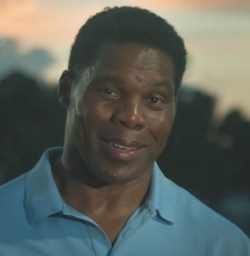
U.S. Senate candidate Herschel Walker, R-Georgia
With Donald Trump’s enthusiastic endorsement, Hall of Fame football hero Herschel Walker enters the race as the clear front-runner for the Republican nomination to take on Democratic U.S. Senator Raphael Warnock next year. But with control of the Senate on the line, nominating Walker is certainly not the safest path, given the questions he will face about his politics and his past.
Will a Walker candidacy end in strategic triumph or bitter regret? Trump clearly believes the former; Senate Republican leader Mitch McConnell is reportedly nervous about the latter.
“I’m a kid from a small town in Georgia who’s lived the American dream, and I’m ready to fight to keep that dream alive for you,” said Walker in a campaign kickoff video posted August 25, which contained footage of his Heisman-winning exploits at the University of Georgia, spliced with workouts in the gym.
“I’m a conservative not because someone told me to be. I’m a conservative because I believe in smaller government, a strong military, personal responsibility and making sure all people have the opportunity to pursue their dreams.”
Watch Walker’s announcement video at bottom of page
The video did not mention Trump, who has been encouraging Walker to make a Senate run for months. But his campaign website features a famous photo of Walker doing an elbow bump with the former president during the 2020 presidential campaign.
The campaign rollout was unusual in that Walker entered the race quietly, with a statement and website, rather that with a public event in front of reporters, who might have asked uncomfortable questions.
Walker, 59, was born and raised in Wrightsville, a small town in Middle Georgia. He led UGA’s football team to its only consensus national title in 1980 and, in 1982, won the Heisman Trophy as the nation’s top college football player.
He went on to play professional football, first in the USFL (where he played for a team Trump owned) and then in the NFL, where he retired from the Dallas Cowboys in 1997.
Since his retirement, Walker had been living in Texas, where he established a poultry business. He registered to vote in Georgia just days before entering the Senate race.
In a 2008 book, Walker disclosed that he has suffered from dissociative identity disorder, which used to be called multiple personality disorder. He credited therapy and his Christian faith for his recovery.
In July, the Associated Press published an extensive investigative profile of Walker, based on business and court records. According to the report, Walker’s ex-wife got a protective order in 2005, alleging violent and threatening behavior. Walker was also involved in several contentious disputes with his business partners and may have made exaggerated claims about his record as a businessman.
Walker did not respond to the AP’s requests for comment for the story. Refusing to address the allegations will be much harder to do in the heat of a political campaign.
Walker’s current wife, Julie Blanchard, is also under investigation by Georgia election officials for casting an absentee ballot in the 2020 election, despite residing in Texas. As one of Walker’s rivals for the GOP Senate nomination, Agriculture Commissioner Gary Black, noted, “it makes it very difficult to talk about voter fraud after that.”
Black, who has won statewide office three times, will certainly be no pushover for Walker. But Trump’s full-throated support for Walker will make his task that much harder, as evidenced by Black’s tepid fundraising in what will become one of the most expensive races of the 2022 cycle. (He’s raised $703,000, compared to $34 million for Warnock.)
The Republican field had been frozen for months as potential Senate candidates waited for Walker’s decision, with several members of Georgia’s U.S. House delegation looking at bids. But there will be very little appetite to take on the Trump-Walker duo.
In a sense, Georgia Republicans find themselves in this situation because of Republican Governor Brian Kemp’s decision to think outside the box and pick uber-wealthy businesswoman Kelly Loeffler for a Senate seat in 2020. She quickly proved to be out of her element against Warnock — with debate performances that were painful to watch — and could not hold the seat.
So is it wise for Georgia Republicans to think outside the box again with Walker, having no idea what kind of political candidate he will make? Particularly against Warnock, equipped as he is with the power of incumbency, a mountain of money, and Barack Obama-level political skills?
Georgia Bulldog fans view Walker fondly, even reverently. But it has been 40 years since he led them to glory — years in which the state has changed almost beyond recognition.
Trump, of course, is the ultimate example of using celebrity to gain political power, which is no doubt why he thinks Walker is a slam-dunk Senate choice.
But time will tell whether nominating Walker is strategic genius or an ill-fated gimmick. Control of the Senate may very well hang on the answer.
 Chicken Fried Politics