
Home » U.S. Senate Races (Page 32)
Category Archives: U.S. Senate Races

Poll: Kentuckians don’t want Rand Paul to run for both Senate and White House
Two-thirds of Bluegrass State voters, and a majority of Republicans, opposing changing state law to allow Paul to run for both offices
♦By Rich Shumate, Chickenfriendpolitics.com editor
 LOUISVILLE (CFP) — A new poll finds that Kentucky voters are less than enamored with the prospect of U.S. Senator Rand Paul seeking re-election in 2016 while also running for the Republican presidential nomination.

Rand Paul
In a Bluegrass/Survey USA poll released September 1, 66 percent of state voters said they’re against changing Kentucky law to let Paul pursue both offices, something that is currently not allowed.
A majority of Republicans, 54 percent, were opposed, while only 36 percent supported the idea. Opposition rose to 57 percent among independent voters and 78 percent among Democrats.
Paul, who is considering a 2010 White House bid, maintains the Kentucky restriction is unconstitutional because of a 1995 Supreme Court ruling that a state can’t impose its own restrictions in races for federal offices.
GOP legislative leaders have been considering trying to change the law. However, that task is complicated by the fact that Democrats hold a four-seat majority Kentucky House, although that could change during legislative elections in November.
The law would only be necessary if Paul was successful in getting the Republican nomination. If he ran in the presidential primaries and didn’t win, he would be free to run for re-election to the Senate, as his father, Ron Paul, did in his U.S. House seat in Texas after he sought the White House in 2008.
The Senate seat of 2016 GOP presidential contender, U.S. Senator Marco Rubio of Florida, is also up in 2016. But Rubio has said he will give up his Senate seat if he decides to run for president.
There is recent precedent for seeking national office and a Senate seat at the same time. In 2008, Joe Biden ran for both vice president and a Senate seat in Delaware, and, in 1960, Lyndon Johnson won re-election to the Senate from Texas at the same time he was winning the vice presidency.
In 2012, U.S. Rep. Paul Ryan ran for both the House and the vice presidency at the same time. He kept his House seat after the Romney-Ryan ticket was defeated.
Poll: Kay Hagan and Thom Tillis in dead heat in North Carolina U.S. Senate race
Poll has Democrat Hagan and Republican Tillis within the margin of error
♦By Rich Shumate, Chickenfriedpolitics.com
 RALEIGH (CFP) — Democratic U.S. Senator Kay Hagan and her GOP challenger, State House Speaker Thom Tillis, are in a statistical dead heat in Senate race in North Carolina, a new poll shows.

U.S. Senator Kay Hagan
The Suffolk University/USA Today poll showed Hagan’s support at 45 percent to 43 percent for Tillis, which was within the poll’s margin of error of plus or minus 4.4 percent.
The poll found a significant gender gap in the race. Hagan held an 18-point lead among women, while Tillis had a 14-point lead among men.
Hagan, 61, who is seeking a second term, is one of the top Republican targets in this election cycle. Tillis, 53, won a hotly contested GOP primary to win the right to take her on.
Outside groups supporting both candidates have already poured more than $10 million into the race.
Former U.S. Senator Zell Miller endorses Democrat Michelle Nunn in Georgia Senate race
Miller, a popular two-term Democratic governor known for endorsing Republicans, cuts TV ad for Nunn
♦By Rich Shumate, Chickenfriedpolitics.com editor
 ATLANTA (CFP) — Former U.S. Senator Zell Miller has made a high-profile endorsement of fellow Democrat Michelle Nunn in Georgia’s hotly contested U.S. Senate race, a major boost to Nunn’s efforts to position herself as a moderate distant from national Democrats.
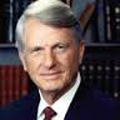
Former U.S. Senator Zell Miller
Miller, a Democrat who angered many in his party with his 2004 endorsement of President George W. Bush, has cut a television ad for Nunn that touts her as “a bridge builder, not a bridge burner.”
“I’m so angry about what’s going on in Washington — partisanship over patriotism. They can’t stop themselves, but we can stop them. Let’s send Michelle Nunn to the Senate,” Miller says in the ad. “Michelle Nunn gives this old Georgian hope.”
Nunn, the daughter of former Democratic U.S. Senator Sam Nunn, is running against Republican David Perdue, the cousin of former Republican Governor Sonny Perdue. Neither candidate has run for office before.
The Perdue camp has not directly responded to Miller’s endorsement.
Miller, 82, is a venerable — if unpredictable — figure in Georgia politics, serving four terms as lieutenant governor and two terms as governor before being appointed to the Senate in 2000 to replace the late Republican Paul
Coverdell.
In 2004, while still sitting as a Democrat in the Senate, he not only endorsed Bush but gave the keynote address at the Republican National Convention, where he offered a withering critique of the Democratic nominee, John Kerry. Miler did not seek re-election that year, but he rejected suggestions that he switch parties, opting to remain a Democrat.
In addition to Bush, Miller endorsed the Republican replaced him in the Senate, Johnny Isakson, and the state’s other Republican senator, Saxby Chambliss, whose retirement is opening up the seat Nunn is seeking. He was also co-chair of Newt Gingrich’s unsuccessful campaign for the GOP presidential nomination in 2012.
Recent polls have shown a close race, with Perdue slightly in the lead.
Perdue and outside conservative groups have been trying to tie Nunn to President Obama. The National Republican Senatorial Committee is in the middle of a $2.5 million ad buy calling Nunn “Obama’s senator.”
Unlike Democratic incumbents in the South who voted for Obamacare, Nunn does not have that vote to defend. But she has come under fire for evading a clear answer when asked whether she supports the president’s health care law.
View Zell Miller’s ad endorsing Michelle Nunn:
Analysis: Southern Senate races expose fault line that GOP must correct
Incumbents’ weak victories show bitter primaries have become the new normal
♦By Rich Shumate, Chickenfriedpolitics.com editor
 Tea Party-backed insurgents struck out in their quest to unseat sitting Southern Republican U.S. senators this year, with a final tally of 0-for-5.
 But while those results are arguably a significant victory for the powers that be in the GOP, a closer look at the results shows a deep and potentially problematic fault line running right through the party. And the rancor and contention generated by the establishment’s aggressive push back against the Tea Party has made that fault line wider.
Historically, sitting senators rarely face much of a battle for renomination. If they have any opposition at all, it is usually dispatched with an easy majority of 70 or 80 percent. While that is still largely true for Democrats, for Republicans — in the South and elsewhere — bitter primary contests seem to have become the new normal. True, all the incumbents survived this year. But they didn’t exactly set the world on fire.
In Tennessee, Lamar Alexander — a well-respected former Cabinet secretary and university president who has won statewide office four times — could only manage a meager 50 percent, while in Mississippi, Thad Cochran was dragged into a runoff that he only survived with the help of Democrats.
John Cornyn in Texas and Lindsey Graham in South Carolina did a bit better (59 percent and 56 percent, respectively), but they should be thankful that their opposition was as weak as it was. If bigger names had gotten into either of these races, the outcome might have been very different.
The Southern GOP senator who performed the best was Senate Minority Leader Mitch McConnell, who took 60 percent in his race, despite an avalanche of outside help given to his opponent, Matt Bevin. But that brutish primary did nothing to help McConnell’s prospects in a tough race this fall with Democratic Secretary of State Alison Ludergan Grimes.
What these races, collectively, show is that 40 percent or more of the Republican primary electorate is unhappy enough with their own elected leaders that they are prepared to vote them out — even if that means nominating little known candidates who, in many cases, seem less than fit to sit in the Senate.
For the time being, the GOP might be able to ignore this fault line because there is little indication, except perhaps in Kentucky, that Democrats will be able to take advantage of the Republican schism to flip seats in November.
But if Republicans can’t figure out a way to avoid this internal warfare, Democrats are eventually going to figure out a way to use it to their advantage. And that presents a real and present danger to the political hegemony that the GOP has built in the South.
Yes, 2014 was a victory for the establishment. But it was also a danger-Will-Robinson moment. And the bitterness left over from these primary fights has probably made the divisions within the party even worse, particularly in Mississippi.
Few of those Tea Party Republicans who feel scorned by their party are going to vote Democratic in November, but more than a few may stay home. Is this hemorrhage from the base likely to imperil these sitting Southern senators? No, except maybe for McConnell. But if the establishment can’t find a way to bridge this divide, there is certainly potential for trouble ahead.
Tennessee primary: Lamar Alexander wins, Scott DesJarlais in cliffhanger
Alexander beats back Tea Party U.S. Senate challenger; DesJarlais battles to keep U.S. House seat amid messy personal scandal
♦By Rich Shumate, Chickenfriedpolitics.com editor
NASHVILLE (CFP) — U.S. Senator Lamar Alexander has taken a major step towards securing a third term by easily beating back a Tea Party-inspired GOP primary challenge from State Rep. Joe Carr.
U.S. Senator Lamar Alexander
Alexander took 50 percent of the vote in the August 7 primary, where he faced Carr and five other challengers. Carr, who had the support of Tea Party and outside conservative groups that had targeted Alexander for defeat, took 41 percent.
Alexander was one of five sitting Southern Republican senators targeted in primaries this year. All five survived.
In a closely-fought Democratic primary, Gordon Ball, a former federal prosecutor, narrowly defeated Terry Adams, a Knoxville attorney, by less than 2,000 votes. Ball will face Alexander in November.
After a fractious primary in which half of the voters from his own party voted for someone else, Alexander, 74, sounded a note of conciliation in his victory speech at a Nashville pizza parlor, reaching out not only to his GOP opponents but also to Democrats and independents.
“After we make our speeches, we’re going to have to roll up our sleeves, get together, work with each other and get something done,” he said. “That’s the Tennessee way. That’s the American way.”
Meanwhile, in Tennessee’s 4th District, with some absentee and provisional ballots still to be counted, incumbent Republican U.S. Rep. Scott DesJarlais held a lead of just 35 votes over his primary challenger, State Senator Jim Tracy, amid a messy personal scandal that took a toll on DesJarlais’s popularity.
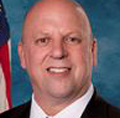
U.S. Rep. Scott DesJarlais
Given the district’s strong GOP tendencies, the GOP nominee will be favored for re-election in November over Democrat Lenda Sherrell, a retired accountant from Monteagle.
DesJarlais, 49, was facing voters for the first time since lurid details emerged from the case file of his bitter 2001 divorce from his first wife. In it, the congressman admitted having a string of extra-martial affairs and — perhaps even more damaging for an avowed right-to-life lawmaker — encouraging his then-wife to have two abortions.
DesJarlais (pronounced Dez-yar-lay), a medical doctor, also admitted having relationships with two female patients, which prompted the Tennessee State Board of Medical Examiners to reprimand him for unprofessional conduct and fine him $500.
Details about DesJarlais’s divorce became an issue in his contentious 2012 re-election campaign, which he won with just 56 percent of the vote. However, he successfully fought to prevent release of the full transcript of the case file until after the election.
 Chicken Fried Politics