
Home » U.S. Senate Races (Page 9)
Category Archives: U.S. Senate Races

Georgia Primary: Jon Ossoff avoids runoff, wins Democratic U.S. Senate race
Republican Karen Handel gets her rematch in 6th U.S. House district; Democratic U.S. Rep David Scott barely escapes getting forced into a runoff
♦By Rich Shumate, ChickenFriedPolitics.com editor
 ATLANTA (CFP) — Three years after coming up on the short end in the most expensive House race in U.S. history, Democrat Jon Ossoff revived his political fortunes by winning Georgia’s U.S. Senate primary and earning the right to challenge Republican to U.S. Senator David Perdue in the fall.
Offoss took 51 percent over the vote, defeating Teresa Tomlinson, the former mayor of Columbus, who came in second with 15.2 percent, and Sarah Riggs Amico, a Marietta businesswoman who was the party’s unsuccessful nominee for lieutenant governor in 2018, at 12.6 percent.

Jon Ossoff
On election night, Ossoff had been under the 50 percent threshold he needed to avoid a runoff but moved into a majority as tens of thousands of absentee ballots were counted.
Due to the coronavirus crisis, the state had mailed absentee ballot applications to every voter in the state to increase mail-in voting. Tuesday’s vote in the Peach State was still marred by long lines and technical issues with the state’s new touch screen voting machines, which forced poll times to be extended up to three hours in parts of metro Atlanta.
Ossoff, a documentary filmmaker, rose to national prominence in 2017 in a special election for the 6th District seat in Atlanta’s northwest suburbs, in which he turned Democratic anger at President Donald Trump’s election into a $30 million fundraising haul but was edged out for the seat by Karen Handel.
Handel, who subsequently lost the seat in 2018 to Democratic U.S. Rep. Lucy McBath, will get a rematch after she easily cleared the Republican primary Tuesday. McBath was unopposed in the Democratic primary
The 6th District race is at the top of the Republican target list, with McBath’s support of Trump’s impeachment likely to be front and center in the fall. Trump carried the district by just 1.5 points in 2016.
The breakout performance in Georgia Tuesday came from political newcomer Rich McCormick, an emergency room doctor and former Marine Corps helicopter pilot won the GOP nomination in the 7th U.S. House District in Atlanta’s northeast suburbs without a runoff.
He won 55 percent and defeated six other candidates, including State Senator Renee Unterman, a former mayor who has spent two decades in the legislature, who finished in second with 17 percent.
Democrats in the 7th District nominated Carolyn Bourdeaux, who came within 400 votes of winning the seat in 2018 against Republican Rob Woodall, who decided not to run again. She carried 53 percent of the vote, ahead of State Rep. Brenda Lopez Romero and Nabilah Islam, a political consultant, both at 12 percent.
Veteran Democratic U.S. Rep. David Scott, running for his 10th term, survived a scare after he was nearly forced into a runoff against former State Rep. Keisha Waites for his seat in Atlanta’s southern and western suburbs. On election night, Scott only stood at 48 percent, but he went over the 50 percent threshold on Thursday, after the remaining absentee ballots were counted.
Republicans also filled runoff slots for two of their safest Georgia U.S. House seats — the 9th District in the north Georgia mountains, which U.S. Rep. Doug Collins is giving up to run for the state’s other Senate seat, and the 14th District in northwest Georgia, where Tom Graves is retiring.
In the 9th District, the GOP runoff will pit State Rep. Matt Gurtler of Tiger, who came in on top with 22 percent, against Andrew Clyde, a retired Navy officer and firearms instructor from Jackson County, who finished in second at 19 percent. Former U.S. Rep. Paul Broun, who represented a neighboring district from 2007 until 2015, came in fourth.
In the 14th District, Marjorie Taylor Greene, a Milton businesswoman, will face John Cowan, a neurosurgeon from Rome, in the Republican runoff. Greene, who had originally filed to run in the 6th District but switched to the 14th when Graves retired, took 41 percent to 20 percent for Cowan.
Georgia’s other Senate seat, held by Republican Kelly Loeffler, is also up for election in 2020; however, because that contest is to fill the remainder of a term, a special election will be held until November in which Loeffler will run against candidates from all parties, including Collins, who has launched an intra-party fight to push Loeffler out of the seat.
We tweet @ChkFriPolitics Join us!

Voters in Georgia, West Virginia and South Carolina vote Tuesday in rescheduled primaries
Democrats will pick a U.S. Senate nominee in Georgia and a gubernatorial candidate in West Virginia
♦By Rich Shumate, ChickenFriedPolitics.com editor
 (CFP) — Voters in three Southern states — Georgia, West Virginia and South Carolina — will vote Tuesday in primaries that were rescheduled from earlier in the year due to the coronavirus crisis.
In Georgia, Democrats will be picking a nominee to oppose Republican U.S. Senator David Perdue in November, while Republicans will begin sorting out their nominees for two open U.S. House seats in safely Republican districts that have both drawn a gaggle of candidates.
In West Virginia, Democrats will pick an opponent to face Republican Governor Jim Justice — who won four years ago as a Democrat before switching parties and embracing President Donald Trump — and will also decide on a nominee to face U.S. Senator Shelly Moore Capito.
In South Carolina, Republican U.S. Senator Lindsey Graham faces three little-known challengers in his primary, while his expected Democratic opponent in the fall, Jaime Harrison, is running unopposed.
Republicans in the Lowcountry will also pick a candidate to run against Democratic U.S. Rep. Joe Cunningham, who is one of the GOP’s top 2020 targets.
Due to the coronavirus crisis, mail and early voting has been expanded for the primaries, with a smaller portion expected to vote in person on primary day with reduced numbers of polling stations.
Polls are open from 7 a.m. to 7 p.m. in Georgia and South Carolina and from 6:30 a.m. to 7:30 p.m. in West Virginia.
In Georgia, the marquee race is the Democratic contest for U.S. Senate. The polling leader in the race has been Jon Ossoff, who benefits from the statewide name recognition he built in 2017 by spending $30 million in a special election for the 6th District House seat, a race he narrowly lost.
Ossoff’s primary challengers include Teresa Tomlinson, the former mayor of Columbus, and Sarah Riggs Amico, a Marietta businesswoman who was the party’s unsuccessful nominee for lieutenant governor in 2018.
Polls have given Ossoff a large lead but short of the majority he would need to win the nomination outright and earn a spot against Perdue in November. If he does not clear that threshold, he’ll face an August runoff against Tomlinson or Amico.
Georgia’s other Senate seat, held by Republican Kelly Loeffler, is also up for election in 2020; however, because that contest is to fill the remainder of a term, a special election won’t be held until November, in which Loeffler will run against candidates from all parties, including Republican U.S. Rep. Doug Collins, who has launched an intra-party fight to push Loeffler out of the seat.
Peach State Republicans will also start the process for picking nominees for two of their safest U.S. House seats — the 9th District in the north Georgia mountains, which Collins is giving up to run for the Senate, and the 14th District in northwest Georgia, where Tom Graves is retiring. Nine Republicans have entered the primary for both of those seats, making runoffs a near certainty.
In the 7th District in Atlanta’s northeast suburbs, seven Republicans and six Democrats are running in their respective primaries for the seat Republican Rob Woodall kept by a scant 413 votes in 2018. He decided to retire rather than to contest the seat again.
Carolyn Bourdeaux, the Democrat whom Woodall barely beat two years ago, is back, but she faces a primary battle against five challengers including State Senator Zahra Karinshak, a lawyer and former Air Force officer; State Rep. Brenda Lopez Romero, the first Latina to serve in the Georgia legislature; and John Eaves, the former chairman of the Fulton County Commission and former Atlantan who decamped for the suburbs in a bid to get to Congress.
On the Republican side, State Senator Renee Unterman, a former mayor who has served 22 years in the legislature, is facing off against six competitors, including Lynne Homrich, a former Home Depot executive, and Rich McCormick, an emergency room doctor and former Marine Corps helicopter pilot.
The only House incumbent in either party facing a significant primary challenge in Georgia is Democratic U.S. Rep. David Scott, who is being challenged in the 13th District in the southern and western Atlanta suburbs by Jannquelle Peters, the former mayor of East Point; former State Rep. Keisha Waites; and Michael Owens, the former chair of the Cobb County Democratic Party who challenged Scott unsuccessfully in 2014.
Scott, 74, is seeking his 10th term in the House and has held elected office continuously for 46 years. The majority black 13th District is strongly Democratic, which means whoever emerges from the primary will likely win the seat in November.
In West Virginia, Democrats are itching for a grudge match against Justice, who infuriated them by jumping to the GOP just seven months after taking office — and adding insult to injury by announcing the switch on stage with the president at a Trump rally.
Five Democrats are running for the nomination to oppose the governor, led by Kanawha County Commissioner Ben Salango, who has the backing of a slew of labor and teachers unions. He was also endorsed by Democratic U.S. Senator Joe Manchin, who had flirted with running against Justice himself before deciding to take a pass.
Also running are State Senator Ron Stollings from Madison; Jody Parker, a former journalist from Madison; and Stephen Smith, a community organizer and former executive director of the West Virginia Healthy Kids and Families Coalition, who is running what he describes as a grassroots, progressive campaign.
A fifth candidate who filed to run, Doug Hughes, later announced on Facebook that he was pulling out and endorsing Smith.
In the Senate race, former State Senator Richard Ojeda — an outspoken retired Army officer who lost a race for Congress in 2018 and then launched a quixotic bid for the Democratic presidential nomination that failed to gain traction — is the best-known of the three candidates vying to take on Capito, whose seat is not currently considered to be jeopardy.
West Virginia does not have primary runoffs, which means that the leading vote-getter in both the governor’s and Senate races will be the nominee.
In South Carolina, the marquee race is the U.S. House contest in the 1st District, where Republicans have their sights set on Cunningham, who flipped the seat in 2018.
The race for the GOP nomination includes State Rep. Nancy Mace from Daniel Island, a real estate agent and businesswoman who was the first female graduate of The Citadel; Kathy Landing, a businesswoman who serves on the town council in Mount Pleasant; Chris Cox, a chainsaw artist who was one of the founders of the Bikers for Trump group; and Brad Mole, a housing administrator from Bluffton.
Mace and Landing have led the race in fundraising and advertising, with Mace raking in more than $1.3 million for the race to $630,000 for Landing, according to the most recent filings with the Federal Election Commission. The question will be whether either woman will be able to clear the majority needed to avoid a runoff with Cox and Mole also in the race.
Mace has gotten the backing of House Majority Leader Kevin McCarthy and the conservative business groups Americans for Prosperity and Club for Growth. But Landing has her own conservative backers, including the House Freedom Fund, a campaign group associated with House Freedom Caucus, as well as conservative stalwart and former U.S. Senator Jim DeMint.
In the U.S. Senate race, Republican primary voters will decide whether to reward Graham for his enthusiastic embrace of Trump.
Six years ago, he faced a slew of candidates who ran at him from the right and criticized him as inauthentically conservative. But this time around, Graham faces only token opposition from three little-known candidates, none of whom has raised enough money to compete with his $26 million war chest.
Harrison, who hopes to be the first Democrat to win a Senate race in South Carolina since 1998, faces no opposition on the Democratic side of the ballot. He has so far raised $19 million, according to the latest FEC filings.
We tweet @ChkFriPolitics Join us!
Jeff Sessions’s plea to Alabama: I really, really love Donald Trump. Really.
Sessions pens open letter touting his pro-Trump bona fides as he battles for his political life in GOP U.S. Senate primary runoff
♦By Rich Shumate, ChickenFriedPolitics.com editor
MONTGOMERY (CFP) — Facing political headwinds blowing from President Donald Trump’s Twitter feed, U.S. Senate candidate Jeff Sessions has taken the extraordinary step of sending open letter to his fellow Alabamians in which he expresses undying fealty to the man who has repeatedly, publicly belittled him.

Former Attorney General Jeff Sessions
“I have remained faithful to the President and his agenda. I have always stood up for him, and I never backed down, not even for one moment. My convictions are immovable, built on rock, not sand,” Sessions said in the letter released May 12.
“I believe President Trump is a great President who is steadily making progress for America, despite relentless opposition. My support for his agenda is not about me, or even about him. It’s about doing the right thing for the country I so love.”
Insisting that there is no daylight between him and Trump, Sessions said “the people of Alabama do not have to choose between voting for the President and voting for me, they can do both.”
Read full text of Session’s open letter.
However, Sessions also defended the decision he made that has drawn Trump’s unending ire — recusing himself as U.S. attorney general from the investigation into allegations of Russian interference in the 2016 presidential election after his own meeting with Russia’s ambassador in Washington became public.
“I did what the law required me to do,” Sessions said. “I was a central figure in the campaign and was also a subject of and witness in the investigation and could obviously not legally be involved in investigating myself.”
“If I had ignored and broken the law, the Democrats would have used that to severely damage the President.”
But as he tries to reclaim the goodwill of Trump’s most fervent partisans, Sessions also dismissed the investigation as “a disruptive and prolonged fiasco for America and especially for President Trump, and a massive waste of money chasing the deep state myth of Russian collusion.”
He also said that from the beginning of the administration, he had urged Trump to fire the man who launched the Russia investigation, former FBI Director James Comey.
“I concluded that Comey was driven by ego, lacked self-discipline, and lacked the judgement necessary to lead an agency as critical as the FBI,” he said.
Sessions’s letter is the latest chapter in his quest to regain the Senate seat he gave up in 2017 to become attorney general — a seat he had held for 20 years and likely could have kept for life had he not agreed to join the Trump administration.
Trump was publicly critical of Sessions during his time attorney general and has continued to needle him since firing Sessions in 2018, including in an interview just days before Session’s open letter in which he said Sessions had “begged” to be attorney general and was “a very average guy” and a “total disaster.”
The president has endorsed Session’s opponent in the July 14 GOP primary runoff, former Auburn football coach Tommy Tuberville — an endorsement that has left Sessions fighting for his political life in a state where the president remains popular.
In his letter, Sessions noted that in 2016, he the first member of Congress to endorse Trump, at a time when “many thought I was nuts to do so.”
“I helped Trump win and traveled the country with him, embedded in his campaign. I am one of the architects of his agenda, and I was pushing his agenda even before he ran for office,” he said.
Sessions also noted that after Trump fired him, “I did not say a cross word about him, as I thought that would be dishonorable.”
He also said that while Alabamians “enthusiastically” support Trump, “we also make our own decisions on who to send to the U.S. Senate.”
“Alabamians have long resisted pressure from people in Washington telling them how to vote,” Sessions said.
We tweet @ChkFriPolitics Join us!
U.S. Senators Richard Burr, Kelly Loeffler under fire for selling stock before coronavirus slide
Burr and Loeffler insist they did nothing wrong in unloading stocks before markets tanked
♦By Rich Shumate, ChickenFriedPolitics.com editor
 WASHINGTON (CFP) — Republican U.S. Senators Richard Burr of North Carolina and Kelly Loeffler of Georgia are facing a torrent of criticism after revelations that they and family members unloaded millions of dollars worth of stock before U.S. markets tanked over concerns about the coronavirus — and while both senators were still making upbeat assessments about its threat.
Prior to his stock sales, Burr, as chair of the Senate Intelligence Committee, was receiving daily briefings from Trump administration officials about coronavirus; Loeffler and her husband, Jeffrey Sprecher, whose company owns the New York Stock Exchange, sold stock after she attended a private briefing for senators on the topic in late January.
Another Southern senator, James Inhofe of Oklahoma, also sold stock after that briefing but says he did not attend.
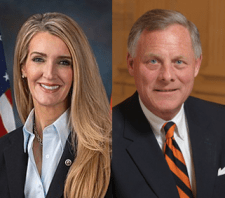
U.S. Senators Kelly Loeffler (R-Georgia) and Richard Burr (R-North Carolina)
All three senators insist they did nothing wrong, although Burr has asked the Senate Ethics Committee to review his sales.
“I relied solely on public news reports to guide my decision regarding the sale of stocks,” Burr said in a statement posted on Twitter. “Specifically, I closely followed CNBC’s daily health and science reporting out it its Asia bureaus.”
Loeffler — a multimillionaire business executive appointed to the Senate in January by Governor Brian Kemp — called the reports about the stock trades “completely false,” saying they were made by her financial advisers.
“I’m not involved in the decision-making of these trades, nor have I been in communication with my third-party financial advisors about them,” she said in a statement posted on Twitter. “I have no knowledge of these trades until well after they are made.”
However, Democrats and even some Republicans are calling for investigations into the trades — and even for the senators to resign.
Among those calling for Burr’s head is Fox News host Tucker Carlson, who told his viewers that “there is no greater moral crime than betraying your country in a time of crisis.”
While Burr is retiring in 2018, Loeffler is facing a tough special election battle for the remainder of her term in November, a race that includes an intra-party challenge from Republican U.S. Rep. Doug Collins.
Collins — still in self-quarantine after being exposed to the virus — said he was “sickened” by Loeffler’s actions.
“People are losing their jobs, their businesses, their retirements, and even their lives and Kelly Loeffler is profiting off their pain?” he said in a tweet.
The leading Democrat in the race, Raphael Warnock, called Loeffler’s conduct “unconscionable.”
“As the coronavirus pandemic is busy taking lives and livelihoods, Kelly Loeffler has been busy looking out for herself,” Warnock said on Twitter.
An analysis of disclosure reports by the Center for Responsive Politics, a non-partisan research group, showed that on February 13, Burr sold 33 stocks worth between $628,000 and $1.7 million dollars, including stocks in hotel companies hard hit by the coronavirus. The stock market began to plunge about a week later.
Senators only have to report financial transactions within ranges on disclosure reports, so the exact amount of Burr’s stock sales is unknown.
Loeffler and Sprecher sold up between $1.3 million and $3.2 million worth of stock in the weeks after she attended a private January 24 briefing for senators in which administration officials discussed the spread of coronavirus, according to a financial disclosure report she posted on Twitter.
In that report, Koeffler said she wasn’t notified of those transactions until Feb. 16, which she said was “proof” that the stock sales weren’t improper.
At the time of the briefing, Loeffler had been in office just three weeks.
Two other senators — Inhofe and Dianne Feinstein of California — also sold stock after the January 24 briefing.
In a statement, Inhofe, who is seeking re-election in November, said he did not attend the briefing and that the sales were part of an ongoing effort to shift his stock portfolio into mutual funds after he became chair of the Senate Armed Services Committee. His sales were on a smaller scale than those of Burr and Loeffler, between $180,000 and $400,000.
A Feinstein spokesman said her holdings were in a blind trust run by her husband and she was not involved in the sale.
Members of Congress are permitted to own and trade stocks. However, trades have to be disclosed, and it is illegal for them to buy and sell stock based on insider information that isn’t available to the general public.
In addition to the stock sales themselves, statements made by Burr and Loeffler about coronavirus as their stocks were being sold have also come under scrutiny, as have Burr’s remarks at a private gathering in late February where he likened the coronavirus to the 1918 flu epidemic that killed millions of people worldwide.
On February 28, Loeffler took to Twitter to allege that “Democrats have dangerously and intentionally misled the American people on #Coronavirus readiness. Here’s the truth: @realDonald Trump & his administration are doing a great job working to keep Americans healthy & safe.”
On March 10, following a meeting with the president, she said on Twitter: “Concerned about #coronavirus? Remember this: The consumer is strong, the economy is strong, & jobs are growing, which puts us in the best economic position to tackle #COVID19 & keep Americans safe.”
By the time of those tweets, at least $355,000 worth of her stock had been sold and possibly as much as $950,000; her husband’s total was between $926,000 and $2.2 million, according to her disclosure report.
On February 7, Burr co-wrote an opinion article for Fox News in which he said that the United States “is better prepared than ever before to face emerging public health threats, like the coronavirus” and said public health officials were moving “swiftly and decisively” to deal with the threat.
A week later, he began selling stock, and on February 27, he told a private meeting of North Carolina business leaders that coronavirus “is much more aggressive in its transmission than anything that we have seen in recent history,” according to audio of the speech obtained by National Public Radio.
Burr also likened coronavirus to the 1918 Spanish flu pandemic that is believed to have killed at least 17 million people worldwide, NPR reported.
We tweet @ChkFriPolitics Join us!
U.S. Senate: Sessions, Tuberville advance to Alabama runoff, with Trump front and center
Texas Democrat MJ Hegar makes runoff; Cal Cunningham wins Democratic nod in North Carolina
♦By Rich Shumate, ChickenFriedPolitics.com editor
BIRMINGHAM (CFP) — Former Auburn University football coach Tommy Tuberville topped the field in Alabama’s Republican U.S. Senate primary, setting up an March 31 runoff with the man who gave up the seat in 2017 to serve as President Donald Trump’s attorney general, Jeff Sessions.
And Trump, who opted not to endorse anyone in the first round of voting, was quick to demonstrate that he still carries a grudge against Sessions with a post-primary tweet attributing his second-place showing to a lack of loyalty: “This is what happens to someone who loyally gets appointed Attorney General of the United States & then doesn’t have the wisdom or courage to stare down & end the phony Russia Witch Hunt.
Meanwhile in Texas, Democrats will decide a May 26 U.S. Senate runoff between the pick of the Democratic Senate establishment, MJ Hegar, and State Senator Royce West from Dallas. The winner of the runoff will take on Republican U.S. Senator John Cornyn in November.
And in North Carolina, Cal Cunningham, a Raleigh attorney and former state senator, easily won the Democratic nomination to take on Republican U.S. Senator Thom Tillis, turning back a challenger who had been aided with more than $2 million in ads from a Republican-affiliated PAC.

Sessions and Tuberville declare victory (From WSFA, Fox 10)
In Alabama, where Republicans have high hopes of defeating Democratic U.S. Senator Doug Jones in November, Tuberville — making his first run for political office — won 33 percent to 31 percent for Sessions. U.S. Rep. Bradley Byrne, who gave up his House seat to make the Senate race, finished third at 26 percent.
Roy Moore, the former chief justice of the Alabama Supreme Court who lost to Jones in a special election in 2017 amid allegations of inappropriate sexual contact with underage girls, won just 7 percent. Moore has denied the allegations.
In their election night speeches, both Sessions and Tuberville made it clear that fealty to Trump will be front and center in the runoff race.
Referring to Tuberville as a “tourist from Florida,” Sessions noted that he was the first member of Congress to endorse Trump in 2016 and accused Tuberville of being a johnny-come-lately to the Trump cause.
“Where was [Tuberville] when President Trump needed him? What did he do for Trump? Never said a kind word about him that I can find. Never gave a single penny of his millions to the Trump campaign,” Sessions said.
But Tuberville pointed to Sessions’s abrupt departure from the Trump administration after the president repeatedly criticized him for recusing himself during the investigation into Russian meddling in the 2016 presidential campaign.
“We’re going to finish what President Trump started when he looked at Jeff Sessions from across the table and said, ‘You’re fired,'” Tuberville said. “Only one candidate in this race will support Donald Trump down the line. Doug won’t, Jeff didn’t, but Tommy will.”
In Texas, where the Democratic primary drew 12 candidates, Hegar, 43, a retired Air Force combat pilot who had the backing of the Democratic Senatorial Campaign Committee, took 23 percent to lead the field, with Royce at 15 percent.
West has been a fixture in Austin for nearly three decades and is one of the state’s most prominent African American political leaders. He edged out Cristina Tzintzún Ramirez, who ran as a “progressive,” garnering endorsements from a host of groups and figures on the left of the party, including New York U.S. Rep. Alexandria Ocasio Cortez.
In North Carolina, Cunningham took 56 percent of the vote to 36 percent for State Senator Erika Smith from Gaston.
A group called the Faith and Power PAC poured spent more than $2 million airing ads promoting Smith as the “progressive” in the race. Federal financial disclosure records show that the group was largely financed by the Senate Leadership Fund, a PAC closely aligned with Senate Majority Leader Mitch McConnell that appeared to be trying to complicate Cunningham’s bid to unseat Tillis.
The Senate races in North Carolina and Texas are at the top of the Democrats’ target list for 2020, while Jones is considered to be the country’s most vulnerable Democratic incumbent in dark red Alabama.
 Chicken Fried Politics