
Home » Uncategorized (Page 5)
Category Archives: Uncategorized

Alabama governor orders special election to fill U.S. Senate seat handed to Luther Strange
Decision truncates two-year temporary term Strange received from disgraced ex-Governor Robert Bentley
♦By Rich Shumate, Chickenfriedpolitics.com editor
 MONTGOMERY (CFP) — Alabama Governor Kay Ivey has reversed a decision by her disgraced predecessor and ordered a special election this year to permanently fill the state’s open U.S. Senate seat, forcing Republican Luther Strange to defend the seat nearly a year before he expected to face voters.

U.S. Senator Luther Strange
Strange was appointed to the seat in February by ex-Governor Robert Bentley, who delayed a special election for the vacancy until November 2018, despite a state law mandating that vacancies be filled “forthwith.” But Ivey, who took office April 10 after Bentley resigned, said the “the rule of law” required an election this year.
“I promised to steady our ship of state. This means following the law, which clearly states the people should vote for a replacement U.S. senator as soon as possible,” Ivey said in a statement. She set party primaries for September, with the general election to follow in December.
Ivey’s decision means Strange will have to defend his seat, as questions continue to swirl about his push as state attorney general first to delay Bentley’s impeachment and then downplay an investigation into his conduct after Bentley sent him to Washington.
However, the senator was publicly nonplussed about the prospect of an earlier vote.
“I’m a candidate, and I’m ready to run whether the election is next month or next year,” he said in a statement. “As the only announced candidate for this office, I will spend the next several months being the best senator I can be, upholding Alabama values and working with President Donald Trump to drain the swamp.”
Strange, 64, served as attorney general from 2011 until his appointment to the Senate. He was selected to fill the vacancy created when Jeff Sessions was confirmed as U.S. attorney general.
Bentley said he decided to hold the special election at the same time as the 2018 midterm elections to save money. But as a result, Strange would have received a temporary appointment that lasted nearly two years without facing voters.
Alabama is one of 15 states that require a special election to fill Senate vacancies. In the other 35 states, governors appoint replacements to serve until the next scheduled election.
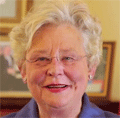
Alabama Governor Kay Ivey
Ivey conceded that an election this year is likely to be costly, but she said “following the law trumps the expense of a special election.”
So far, no candidate in either party has stepped forward to challenge Strange, although the Bentley imbroglio could provide a political opening.
Bentley resigned as state lawmakers were considering impeaching him over efforts to cover up a relationship with a former female aide. He pleaded guilty to two misdemeanors and agreed never to seek political office again.
In November 2016, just before the presidential election, Strange asked leaders of the House Judiciary Committee to suspend their work on possible impeachment charges against Bentley because it might impact “related work” by the attorney general’s office.
But after being appointed by Bentley to the Senate, Strange tried to tamp down speculation that the governor was under investigation, telling reporters, “We have never said in our office that we are investigating the governor. I think it’s actually somewhat unfair to him and unfair to the process.”
Then, just days later, Strange’s successor as attorney general, Steve Marshall, confirmed that Bentley was indeed under investigation. And because he, too, had been appointed by Bentley, he recused himself and named a special prosecutor, who negotiated the plea deal that pried the former governor from office.
Strange has insisted that his actions as attorney general regarding the Bentley investigation were above board. However, Bessemer attorney Sam McClure has filed a complaint with the Alabama State Bar Association, asking for Strange to be disbarred for accepting the Senate appointment after delaying the impeachment proceedings, which he said violated legal ethics.
McClure has indicated he will file a similar complaint with the Alabama Ethics Commission, which could also investigate Strange.
However, a strong argument against any quid quo pro between Bentley and Strange is the fact that at the time he asked the Judiciary Committee to suspend its process, Donald Trump had not been elected. So Strange had no way of knowing that Sessions would be appointed as attorney general and a Senate vacancy would open.
In another twist, a legislator who pushed for Bentley’s impeachment, State Rep. Ed Henry, R-Hartselle, now says he met with Bentley shortly after Strange’s appointment, and the then-governor told Henry that he sent Strange to the Senate not to impede the investigation into his own conduct but because Bentley thought Strange was corrupt and wanted to get him out of the state.
Henry has now told this story in both national and state media outlets, prompting strong denials from Bentley’s attorney. Two other state legislators have now gone on the record saying that Henry told them the details of what Bentley said in that meeting, although they were not privy to the conversation.
18 candidates qualify in race for Tom Price’s former U.S. House seat in Georgia
Democrats have hopes for a breakthrough in a district Trump barely carried
♦By Rich Shumate, Chickenfriedpolitics.com
 ROSWELL, Georgia (CFP) — A gaggle of 18 candidates qualified for the April 18 special election for Georgia’s 6th District U.S. House seat, kicking off a wide-open race to succeed Health and Human Services Secretary Tom Price in the suburban Atlanta district.

HHS Secretary Tom Price
A Republican field of 11 includes former Secretary of State Karen Handel and two former state senators, Judson Hill and Dan Moody, as well as two candidates, Bob Gray and Bruce LeVell, who are aligning themselves with President Donald Trump
The Trump factor could prove interesting in this race. While the 6th District trends Republican (Price was re-elected with 62 percent in November), Trump carried it by a scant 1.5 percent in November, on his way to losing all three of the counties that make up parts of the district.
Trump’s weak showing in the district has drawn five Democrats into the race to succeed Price, including former State Senator Ron Slotin from Sandy Springs and Jon Ossoff, a filmmaker and former congressional aide who has snagged high-profile endorsements from U.S. Reps. John Lewis and Hank Johnson.
A crowd-funding effort launched through Daily Kos has raised more than $760,000 for Ossoff, whose campaign website features a banner headline reading “Georgia: Stand Up To Trump.”
The district includes East Cobb, North Fulton and northern DeKalb Counties and has been held in the past by former House Speaker Newt Gingrich and U.S. Senator Johnny Isakson. The April election will be the first U.S. House contest since Trump was elected in November.
In addition to the 11 Republicans and five Democrats running, two independents also qualified. All candidates will run together in the same race; if no one clears a majority, the top two candidates regardless of party will meet in a June 20 runoff, a process likely to help Democrats with a smaller number of top-flight candidates.
Handel, who chaired the Fulton County Commission before becoming secretary of state, is perhaps the best known of the Republican candidates, having narrowly lost races for governor in 2010 and U.S. Senate in 2014. In 2012, she made national headlines after resigning from the Susan G. Komen for the Cure Foundation after it reversed a decision to cut off funds to the abortion provider Planned Parenthood.
However, she will be competing for the North Fulton share of the 6th District vote with Moody, who represented the area in the Georgia Senate; Gray, a former city councilman in Johns Creek; and Kurt Wilson, a Roswell businessman who is making imposition of term limits a centerpiece of his campaign.
Hill will have the advantage of being the only major GOP candidate from East Cobb. He has been raising money for the race since Price was nominated for HHS secretary and resigned from the Senate after qualifying for the 6th District race.
LeVell, a businessman from Sandy Springs and former chairman of the Gwinnett County GOP, was executive director of the National Diversity Coalition for Trump during the presidential campaign. His campaign website features a photo of him standing next to the president.
Also in the running is Mohammad Ali Bhuiyan, an economist from Cobb County who is trying to become the first Muslim Republican in the House.
The election is April 18, with the top two candidates regardless of party meeting in a June 20 runoff if no one clears a majority.
Catch up on all the latest Southern election news at Chicken Fried Politics.com
 News and reaction in races for president, U.S. Senate, U.S. House and governor
♦From Rich Shumate, Chickenfriedpolitics.com editor
Click here: chickenfriedpolitics.com
With David Duke in the hall, turmoil erupts at Louisiana U.S. Senate debate
Protestors spar with police as Duke screams at the moderator, calls for Hillary Clinton to get the electric chair
 NEW ORLEANS (CFP) — David Duke’s appearance at a November 2 U.S. Senate debate in Louisiana descended into turmoil, with the white racist screaming at the moderator and calling for Hillary Clinton’s execution, while police used pepper spray on angry protestors trying to get into the hall.
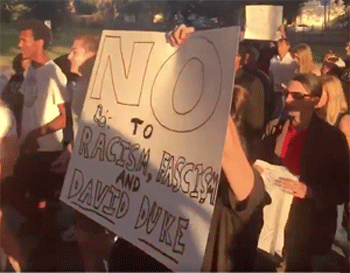
Protestors march against David Duke at Dillard University. (Courtesy: Twitter)
The sponsor of the debate, Raycom Media, which operates television states in four Louisiana cities, decided not to allow the public into the debate, leaving the six candidates on the stage talking to a television camera and a largely empty auditorium at Dillard University in New Orleans.
That didn’t sit well with protestors outside, who were angered by Duke’s presence at the historically black university and tried to force their way through a police cordon at the doorway. Six people were arrested, only one of which was a Dillard student, according to the university.
The specter of Duke was inescapable inside as well as outside the hall, with the moderator, John Snell, struggling mightily at times to prevent his presence from overwhelming the discussion.
Answering a question about Obamacare, Democrat Caroline Fayard pivoted to a direct attack on Duke.
“This snake has slithered out of the swamp, probably because the career politicians on this stage haven’t done their job effectively enough,” Fayard said. “But I’m here to tell … everybody who cares about the future of Louisiana that on November 8, the voters of Louisiana are going to join with me and cut the head off his hatred, once and for all.”
At another point, State Treasurer John Kennedy, a Republican who is leading the polls in the race, called Duke “a convicted liar,” a reference to his 2002 conviction for tax and mail fraud.
“He spent time in prison for lying to his supporters. He swindled them out of their money and took that money and used it for his gambling addiction,” Kennedy said.
Snell gave Duke 15 seconds to respond, and, when he tried to go over his allotted time, the fireworks began.
“You’re not a moderator. You’re a typical media hack,” Duke shouted, as Snell tried to go on to the next speaker. “You’re gonna silence me now? You’re going to silence me?”
Later in the debate, Snell asked Duke what he meant by repeated references to “CNN Jews” in his earlier complaints about the media’s coverage of Donald Trump’s Access Hollywood tape.
“There is a problem in America with a very strong, powerful, tribal group that dominates our media and dominates out international banking,” Duke said. “I’m not opposed to all Jews … I’m against Jews or anybody else that puts the interest of some other place, or another country, over our own country.”
He then pivoted to a criticism of American foreign policy in general — and Clinton’s role in it in particular.
“The lady should be getting the electric chair, being charged with treason,” he said.
Duke has been an outspoken supporter of Trump. During the debate, he said, “I will be Donald Trump’s most loyal advocate to make sure his nominees go to the Supreme Court.”
Duke was also the subject of a testy change between the two Democrats on the stage, Fayard and Public Service Commissioner Foster Campbell, over an ad her campaign has run insinuating that Campbell has been friendly with Duke on the campaign trail.
“There’s no context in which it is acceptable to have a conversation, whether public or private, with someone like David Duke,” said Fayard, who insisted her ad was accurate.
But Campbell said the insinuation that he has been cozy with Duke not was “not just a lie, it’s a damn lie.”
“I have nothing in common with David Duke other that that we’re probably breathing,” Campbell said.
After the debate, Dillard issued a statement saying police used pepper spray as a “last resort” after protestors tried to enter the building. However, peaceful protests outside the hall were not impeded.
“At no time did Dillard discourage protests; either by students or members of the community. We shared a dual responsibility of providing a safe space for those protesters and for the orderly management of the event,” the statement said.
Raycom contracted with Dillard to host the debate before it knew Duke would qualify for the event. The university decided to go ahead and honor the contract, despite criticism from students and alumni unhappy about the prospect of Duke appearing at Dillard.
Of the 24 candidates running for the Pelican State’s open U.S. Senate seat, six qualified for the debate based on their support in a poll commissioned by Raycom — Kennedy, Campbell, Fayard, Duke, and U.S. Reps. Charles Boustany of Layfayette and John Fleming of Minden.
In Louisiana, all candidates regardless of party run in a “jungle” primary on November 8, with the top two vote-getters advancing to a December 10 runoff.
Polls show Kennedy and Campbell leading the race, which was apparent in the debate, with Boustany and Fleming taking aim at Kennedy and Fayard primarily targeting Campbell.
Here is the video of the debate:
Poll: Georgia is in play in presidential race
Clinton and Trump in statistical tie in a state Democrats haven’t carried since 1992
♦By Rich Shumate, Chickenfriedpolitics.com editor
ATLANTA (CFP) — A new poll shows that Georgia is in play in the race for the White House for the first time in 24 years, the latest evidence of a shift in the Southern electoral map.
 The Atlanta Journal-Constitution poll released August 6 put Democrat Hillary Clinton at 41 percent to 38 percent for Republican Donald Trump, 11 percent for Libertarian Gary Johnson and 2 percent for Green Party candidate Jill Stein.
The poll’s margin of error was plus or minus 4 percentage points, which means that Clinton and Trump were in a statistical tie.
Both Clinton and Trump are widely, and equally, unpopular in the Peach State. The poll found that 58 percent of voters had an unfavorable view of both candidates.
Johnson’s double-digit support is evidence of that satisfaction. Four years ago, when he was also the libertarian standard-bearer, he polled just 1 percent in Georgia.
The last Democrat to carry Georgia was Clinton’s husband, Bill, in 1992, when he squeaked by President George W. Bush in a three-way race with independent Ross Perot.
Since then, Republicans have owned the state at the presidential level. In 2012, Mitt Romney beat President Obama by 8 points.
Despite the indications of a close race in Georgia, the Clinton campaign has not yet diverted its resources to the state and has not gone up with TV ads. Trump, who won the state’s Republican primary, has also not aired TV ads.
Georgia’s shift into swing-state status is the latest evidence of a shift in the Electoral College map in the South. In 2008 and 2012, Florida, Virginia and North Carolina were all toss-ups; now, Clinton has opened up leads in Florida and in Virginia, where the her campaign is confident enough of victory that it stopped advertising.
There has been little public polling across the rest of the South to indicate whether Clinton has made headway anywhere else. However, a poll back in April showed she and Trump in a statistical tied in Mississippi, a state Democrats have not carried since 1980.
 Chicken Fried Politics