
Home » Virginia (Page 13)
Category Archives: Virginia

President: Trump rolls across the South, shuts out Clinton in Florida, North Carolina
Clinton takes just one Southern state, Virginia
♦By Rich Shumate, Chickenfriedpolitics.com editor
 (CFP) — Republican Donald Trump blazed through the South on his way to the White House, defeating Hillary Clinton in the battleground states of Florida and North Carolina.
Trump won 13 of 14 Southern states, with a combined 167 electoral votes, a better performance than Mitt Romney had in 2012, when he took 12.
Trump’s haul of Southern electoral votes made up 58 percent of his national total.
Clinton’s only Southern victory came in Virginia, where she defeated Trump by a margin of 50-46 percent, thanks to a late vote surge from the Washington, D.C. suburbs.
Trump defeated Clinton by a margin of 49-48 percent in Florida and 51-47 percent in North Carolina.
Across the rest of the South, Trump rolled up double-digit margins, including winning by a whopping 43 points in West Virginia. 36 points in Oklahoma and 30 points in Kentucky.
Trump outperformed Romney’s totals in every Southern state except Georgia and Texas. In Georgia, the GOP result was down 3 points; in Texas, 6 points.
Fewer than a dozen U.S. House seats in play in the South this election
Democrats looking for pickups in Florida, Texas and Virginia
♦By Rich Shumate, Chickenfriedpolitics.com editor
(CFP) — Heading into the November 8 election, fewer than a dozen U.S. House seats across the South are in play, and most of those are the result of court-ordered redraws of congressional maps in Florida and Virginia.
If the night goes well, Democrats could pick up a net total of seven GOP-held seats — three each in Florida and Virginia and one in Texas. But if Republican incumbents manage to pull out close races, the shift could be just one seat, the 4th District in Virginia that seems certain to change hands because of the new map.
Either way, the Republican advantage over Democrats in U.S. House seats, now 116 to 38, should not budge much.
In Florida, the redraw of the map (click here to see map) should allow Republicans to pick up the 2nd District, based in the Panhandle and now held by U.S. Rep. Gwen Graham, who opted not to run after the district became substantially more Republican.
But Democrats are almost certain to counter that GOP gain by taking the Orlando-based 10th District, which under the new map is more Democratic.
Republican fortunes in Florida will come down to three incumbents facing tough fights for re-election — John Mica in the 7th District, which includes parts of Orlando and its northern suburbs; David Jolly in the 13th District in and around St. Petersburg; and Carlos Curbelo, in the 26th District, which includes part of Miami-Dade County and the Florida Keys.
Democrats are defending a seat in the 18th District, along the Treasure Coast, which U.S. Rep. Patrick Murphy gave up to run for the U.S. Senate.
In Virginia, the new map affected two Republican-held districts, the 4th and the 5th. The 4th is expected to go Democratic, but Republicans are hoping to keep the 5th.
In addition to those seats, Republican U.S. Rep. Barbara Comstock , whose 10th District seat meanders from the Washington, D.C. suburbs toward West Virginia, has become a top Democratic target.
In Texas, Republican U.S. Rep. Will Hurd is also in a tough fight in the 23rd District, which includes a vast expanse of West Texas from the San Antonio suburbs to near El Paso. In a district with a 55 percent Latino population, Hurd is facing significant headwinds with Donald Trump at the top of his party’s ticket.
Here is a rundown of the key U.S. House races around the South:

Dunn
Florida 2: With Graham stepping aside, Panama City urologist Neal Dunn should pick up this seat for Republicans over Democrat Walt Dartland, a lawyer and consumer advocate from Tallahassee.

Lawson
Florida 5: This seat opened up after the incumbent, Democratic U.S. Rep. Corrine Brown, was defeated in the primary by Al Lawson, a former state lawmaker from Tallahassee. This district was radically redrawn and now starts in Jacksonville and heads due west to Tallahassee, making it less black and more Republican. Still, Lawson is a heavy favorite over Republican Glo Smith.

Murphy

Mica
Florida 7: Mica is running again in this district in suburban Orlando. But he now has some of the Democratic voters who used to be in Brown’s 5th District, making this district much less safe that it was. He faces political newcomer Stephanie Murphy, a college professor and former national security professional who has benefited from more than $3 million in outside funding poured into the race by Democrat-aligned groups.

Demings
Florida 10: This Orlando-area district, now held by Republican U.S. Rep. Daniel Webster, was made substantially more Democratic in the redraw–so much so that Webster opted to run for re-election in the adjacent 11th District, where U.S. Rep. Rich Nugent is retiring. Democrats nominated former Orlando Police Chief Val Demings, who should carry this seat over Republican Thuy Lowe.

Crist

Jolly
Florida 13: This swing district in the Tampa Bay area features a high voltage smackdown between David Jolly and former Florida Governor Charlie Crist, the Republican-turned-independent-turned-Democrat who is trying to make a political comeback after losing the governor’s race in 2014. The redraw of Florida’s map added a portion of St. Petersburg with a large minority population to this district, making it more Democratic. Facing long odds, Jolly first opted to run for the U.S. Senate before deciding to try to keep his seat.

Perkins

Mast
Florida 18: This seat, which includes part of Palm Beach County and the Treasure Coast, is a classic swing district. With Murphy out, Democrats selected Randy Perkins, a multimillionaire businessman from Delray Beach, while Republicans went with Brian Mast, an Army veteran who lost both his legs while serving as a bomb disposal specialist in Afghanistan. Both are political newcomers.

Garcia

Curbelo
Florida 26: Like the 18th District, this seat, which includes southwest Miami-Dade County and the Florida Keys, has gone back and forth between the parties in recent cycles. The incumbent, Curbelo, faces a rematch against the man he beat by less than 5,800 votes in 2014, former Democratic U.S. Rep. Joe Garcia.

Gallego

Hurd
Texas 23: This massive district, which stretches across a vast expanse of West Texas from the San Antonio suburbs to near El Paso, has changed hands in the last three elections. The incumbent, Hurd, is that rarest of creatures, a black Republican representing a majority Latino district. His Democratic challenger is the man Hurd beat in 2014, former U.S. Rep. Pete Gallego. Hurd’s winning margin last time was just 2,400 votes, indicating just how equally divided this district is.

McEachin

Wade
Virginia 4: A new map drawn by a federal court added Richmond and Petersburg to this southeast Virginia district, making it substantially more Democratic. The incumbent, Republican U.S. Rep. Randy Forbes, left this seat to run unsuccessfully in the redrawn 2nd District, leaving an open seat that’s ripe for a Democratic pick-up. Republican Henrico County Sheriff Mike Wade will face off against Democratic State Senator Donald McEachin, also of Henrico County. A win by McEachin would add a second African-American congressman to the state’s delegation.

Dittmar

Garrett
Virginia 5: Democrats have hopes of taking this seat, which is open because of the retirement of Republican U.S. Rep. Robert Hurt. But this district, which stretches through central Virginia from the North Carolina border to the Washington, D.C. suburbs, has a Republican lean. GOP State Senator Tom Garrett from Buckingham County is facing Democrat Jane Dittmar, the former chair of the Albermarle County Board of Supervisors.

Comstock

Bennett
Virginia 10: This district starts in the western D.C. suburbs and stretches out to West Virginia. Although Comstock won handily in 2014, this is a district full of suburban swing voters who Democrats are hoping will be turned off by a Trump-led GOP ticket. She faces Democrat LuAnn Bennett, a real estate developer who is the ex-wife of former U.S. Rep. Jim Moran.
Trump’s Southern firewall shows cracks but no wholesale erosion
Three Alabama politicos flee from Trump; Rubio, Burr and McCrory are non-committal
♦By Rich Shumate, Chickenfriedpolitics.com editor
 (CFP) — Donald Trump’s support among Southern elected officials has begun to crack after the release of an audiotape in which he made offensive comments about women, but, so far, there has been no wholesale deterioration of his Southern support heading into the second presidential debate.
U.S. Senator Shelley Moore Capito of West Virginia is the only Southern senator to distance herself from Trump, calling on him to “reexamine his candidacy” in light of remarks that surfaced on October 9 in which he bragged about being able to sexually assault women because of his celebrity.
“As a woman, a mother and a grandmother to three young girls, I am deeply offended by Mr. Trump’s remarks, and there is no excuse for the disgusting and demeaning language,” Capito said in a statement.

Comstock
Two U.S. House incumbents in tough re-election battles, Reps. Barbara Comstock in Virginia and William Hurd in Texas, both announced they would not vote for Trump and want him to step aside as the Republican nominee.
But three other incumbent Republican politicians locked in tight re-election fights – U.S. Senators Marco Rubio of Florida and Richard Burr of North Carolina and North Carolina Governor Pat McCrory – did not retract their support for Trump, although all three condemned his remarks.
Rubio, who offered Trump a tepid endorsement after losing to him in the GOP presidential primaries, went on Twitter to call Trump’s remarks “vulgar, egregious & impossible to justify.” But his opponent in the Senate race, U.S. Rep. Patrick Murphy, said Rubio’s refusal to unendorse Trump amounted to “political cowardice.”

Murphy
“Donald Trump is a threat to every value this country holds dear,” Murphy said in an op-ed in The Hill newspaper. “If Marco Rubio cannot withdraw his endorsement after this latest sickening news, then he should withdraw from the race.”
The most significant erosion of Trump’s support has come in conservative Alabama, where Republican Governor Robert Bentley has announced he won’t vote for Trump, and two GOP members of the U.S. House delegation, Reps. Martha Roby and Bradley Byrne, have called on him to step aside as their party’s presidential nominee.
“As disappointed as I’ve been with his antics throughout the campaign, I thought supporting the nominee was the best thing for our country and our party,” Roby said in a statement “Now, it is abundantly clear that the best thing for our country and our party is for Trump to step aside and allow a responsible, respectable Republican to lead the ticket.”
Byrne called Trump’s comments “disgraceful and appalling.”
“It is now clear Donald Trump is not fit to be President of the United States and cannot defeat Hillary Clinton,” he said in a statement. “I believe he should step aside and allow Governor Pence to lead the Republican ticket.”
Roby represents parts of metro Montgomery and southeast Alabama. Byrne represents metro Mobile and southwestern parts of the state. Both are seeking re-election, and neither race is expected to be competitive in November.

Bentley
Bentley, who has been mired in his own scandal over a purported affair with a former aide, issued a short statement in which he said, “I certainly won’t vote for Hillary Clinton, but I cannot and will not vote for Donald Trump.”
Notably absent from the list of Alabama politicos distancing themselves from Trump is U.S. Senator Jeff Sessions, one of his staunchest supporters in Congress. Trump announced Sessions would be in New York to help him prepare for his October 9 debate with Hillary Clinton, although Sessions’s office has not confirmed that information.
In Virginia, Comstock, who had not previously endorsed Trump, is in a tough re-election battle in the 10th District, based in the Washington, D.C. suburbs, against Democrat Democrat LuAnn Bennett, a real estate developer who is the ex-wife of former U.S. Rep. Jim Moran.
Comstock called Trump’s comments “disgusting, vile and disqualifying.”
“No woman should ever be subjected to this type of obscene behavior, and it is unbecoming of anybody seeking high office,” she said in a statement. “Donald Trump should step aside and allow our party to replace him with Mike Pence or another appropriate nominee from the Republican Party. I cannot in good conscience vote for Donald Trump, and I would never vote for Hillary Clinton.”
In Texas, Hurd, who had also not endorsed Trump, is battling to keep his 23rd District seat, which stretches from the suburbs of San Antonio across a wide swath of West Texas to the edge of El Paso.
As a black Republican running in a majority Latino district, Trump’s incendiary comments about Latinos had already put Hurd on the defensive in the race against the man he beat in 2014, former U.S. Rep. Pete Gallego.
Hurd issued a statement saying he could not vote for a candidate who degrades women and insults minorities. He said Trump should step aside in favor of “a true conservative to beat Hillary Clinton.”

Burr
Burr, who polls show is neck-and-neck with Democrat Deborah Ross in his re-election race in North Carolina, told Politico that he was “going to watch (Trump’s) level of contrition over the next few days to determine my level of support.”
McCrory, who trails Democratic Attorney General Roy Cooper in recent polls, issued a statement in which he said, “I condemn in the strongest possible terms the comments made by Donald Trump regarding women. I find them disgusting,” But he stopped short of retracting his support for Trump or announcing that he would not vote for him.
Kaine, Pence spar in vice presidential debate in Virginia
Kaine challenges Pence to defend Trump; Pence criticizes Clinton’s foreign policy tenure
♦By Rich Shumate, Chickenfriedpolitics.com editor
 FARMVILLE, Virginia (CFP) – Vice presidential candidates Tim Kaine and Mike Pence have squared off in their first and only debate, with Kaine challenging Pence to defend Donald Trump’s behavior and Pence criticizing Hillary Clinton as a tax-and-spend liberal whose tenure as secretary of state has led to chaos around the world.
The October 4 debate, at Longwood University in central Virginia, is the only one of this year’s four national debates to take place in the South, and Kaine, a Democratic U.S. senator from Virginia, is the only Southerner on a major party ticket this year.
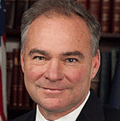
U.S. Senator Tim Kaine
Kaine was clearly the aggressor, repeatedly interrupting Pence, the Republican governor of Indiana, and challenging him to defend controversial statements that Trump, the GOP standard-bearer, has made in the past.
“He’s called women slobs, pigs, dogs, disgusting,” Kaine said. “He attacked an Indiana-born federal judge and said he was unqualified to hear a federal lawsuit because his parents were Mexican … And he perpetrated this outrageous and bigoted lie that President Obama is not a U.S. citizen.”
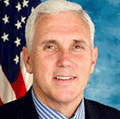
Indiana Governor Mike Pence
Pence, in turn, derided what he termed Kaine’s “avalanche of insults” and tried to turn the tables on the Democratic vice presidential nominee.
“If Donald Trump had said all of the things that you’ve said he said in the way you said he said them, he still wouldn’t have a fraction of the insults that Hillary Clinton leveled when she said that half of our supporters were a basket of deplorables,” Pence said.
However, Pence was willing to defend Trump on one line of Democratic attack—namely, that the Republican nominee may have used nearly $1 billion in business losses to avoid paying federal income taxes for decades.
“Donald Trump is a businessman, not a career politician. He actually built a business,” Pence said. “His tax returns showed he went through a very difficult time, but he used the tax code just the way it’s supposed to be used. And he did it brilliantly.”
Kaine responded by taking issue with Trump’s assertion in the first presidential debate that avoiding taxes made him “smart.”
“So it’s smart not to pay for our military?” Kaine said. “It’s smart not to pay for veterans? It’s smart not to pay for teachers? And I guess all of us who do pay for those things, I guess we’re stupid.”
Pence retorted with a question: “Senator, do you take all the deductions you’re entitled to? I do.”
Pence and Trump also sparred over their respective economic plans, with Pence criticizing the Democratic ticket over a proposal to raise income taxes on the wealthiest taxpayers.
“In the wake of a season where American families are struggling in this economy under the weight of higher taxes and Obamacare and the war on coal and the stifling avalanche of regulation coming out of this administration, Hillary Clinton and Tim Kaine want more of the same,” he said. “It really is remarkable that they actually are advocating a trillion dollars in tax increases.”
But Kaine criticized the Republicans for proposing new corporate tax breaks that would benefit “people just like Donald Trump,” which he said would repeat the same mistakes made during the Bush administration that led to the 2008-2009 economic downturn.
“Independent analysts say the Clinton plan would grow the economy by 10.5 billion jobs. The Trump plan would cost 3.5 million jobs,” he said. “Why would (Trump) do this? Because his tax plan basically helps him. And if he ever met his promise and he gave his tax returns to the American public like he said he would, we would see just how much his economic plan is really a Trump-first plan.”
Pence, however, insisted that Trump had not broken his promise and would release his tax returns once an ongoing IRS audit was concluded.
IRS officials have repeatedly said that an audit does not preclude a taxpayer from releasing his tax returns. Because of federal privacy laws, the IRS cannot confirm whether Trump is actually being audited.
Pence also offered sharp criticism of Clinton’s tenure as America’s top diplomat, charging that “America is less safe today than it was the day that Barack Obama became president of the United States.”
“It’s absolutely inarguable. We’ve weakened America’s place in the world. It’s been a combination of factors, but mostly, it’s been a lack of leadership,” he said. “Our primary threat today is ISIS, and because Hillary Clinton failed to renegotiation a status-of-forces agreement that would have allowed some American combat troops to remain in Iraq and secure the hard-fought gains the American soldier had won by 2009, ISIS was able to be literally conjured up out of the desert.”
But Kaine noted that at the time the Obama administration came into office, Al Queda leader Osama bin Laden was still alive, the United States had more than 175,000 troops in Iraq and Afghanistan and Iran was pursuing a nuclear weapons program that it has now agreed to give up.
“Under Secretary Clinton’s leadership, she was part of the public safety team that went after and revived the dormant hunt against bin Laden and wiped him off the face of the earth,” Kaine said. “She worked a tough negotiation with nations around the world to eliminate the Iranian nuclear weapons program without firing a shot.”
Pence also criticized Clinton for using a private e-mail server while she was secretary of state, which he said may have allowed foreign hackers to gain access to sensitive information.
“If your son or my son handled classified information the way Hillary Clinton did, they’d be court martialed,” Pence said, referring to the candidates’ sons who are both serving in the Marine Corps.
Kaine shot back: “That is absolutely false, and you know that,” noting an FBI investigation that resulted in no criminal charges against Clinton or any of her aides over use of the email server.
On other issues:
Immigraton: Kaine said he and Clinton both support comprehensive immigration reform leading to an eventual path to citizenship while Trump “believes in deportation nation.”
“Donald Trump proposes to deport 16 million people, 11 million who are here without documents. And both Donald Trump and Mike Pence want to get rid of birthright citizenship, so if you’re born here, but your parents don’t have documents, they want to eliminate that,” he said. “They want to go house to house, school to school, business to business, and kick out 16 million people.”
Pence insisted that claim was “nonsense,” saying Trump first wants to strengthen border defenses and deport illegal immigrants who have committed crimes “and once we’ve done all of those things, … we’re going to reform the immigration system that we have.”
He accused Clinton and Kaine of wanting “to continue the policies of open borders, amnesty, catch and release, sanctuary cities, all the things that are driving wages down in this country.”
Abortion: Pence, who was raised a Roman Catholic and considers himself a born-again Christian, said his opposition to abortion flows from a passage in the Bible where “God says, before you were formed in the womb, I knew you.” He criticized Clinton’s support for repealing a provision in federal law that forbids use of taxpayer funds for abortions—a provision Kaine has supported in the past.
But Kaine, a Roman Catholic who has said he is personally opposed to abortion, said he and Clinton support the right of women to make their own decisions on the issue.
“I think you should live your moral values. But the last thing, the very last thing government should do is have laws that would punish women who make reproductive choices,” he said.
In an interview earlier in the campaign, Trump indicated he might support criminal penalties for women who have abortions. But he quickly walked back from that position, and Pence told the debate audience that he and Trump “would never support legislation that punished women who made the heartbreaking choice to end a pregnancy.”
Former Virginia U.S. Senator John Warner crosses party lines to endorse Hillary Clinton
Former Armed Services Committee chairman “distressed” by Donald Trump’s criticisms of the military
♦By Rich Shumate, Chickenfriedpolitics.com editor
ALEXANDRIA, Virginia (CFP) — Former Republican U.S. Senator John Warner of Virginia has endorsed Democrat Hillary Clinton for president, questioning Republican nominee Donald Trump’s ability to lead on national security issues and military affairs.

Former U.S. Senator John Warner
“You don’t pull up a quick text, like National Security for Dummies,” Warner said at a September 28 rally in Alexandria where he announced he would vote for Clinton in November. “You have to build on a foundation of experience how you will go forward in the leadership of this country.”
Warner, without mentioning Trump by name, took particular issue with Trump over his critical comments on the state of the U.S. military.
“It is not in shambles. It is not the admirals and the generals … in the rubble in the hallways of the Pentagon,” Warner said. “No one should have the audacity to stand up and degrade the Purple Heart, degrade military families or talk about the military being in a state of disaster.”
Warner’s remark about the Purple Heart, which is awarded to members of the military wounded in battle, stemmed from an August rally in Virginia during which a veteran gave Trump his medal. Trump then told the audience that he had always wanted a Purple Heart but “this was much easier.”
Warner, 89, is the longest serving senator in Virginia history, in office from 1979 until 2009, and was also Navy secretary during the Nixon administration. He spent more than six years as chairman of the Senate Armed Services Committee, on which Clinton also served when she was a senator.
Warner lauded Clinton’s work on the committee, saying she was always well prepared and had one of the best attendance records among senators on the panel. He also said that the September 26 debate between Clinton and Trump showed that she was composed while he was not, despite Trump’s insistence afterward that he won the debate.
“The film speaks for itself. You can’t rewrite it. There it is,” Warner said.
The former senator also had kind words for Clinton’s running mate and fellow Virginian, U.S. Senator Tim Kaine, who he said “exemplified what this country needs foremost — a man of unquestioned integrity.”
Warner was flanked at the rally by Kaine and the commonwealth’s other senator, Democratic Mark Warner, who is no relation to the former senator.
The endorsement of the popular Warner, who won 83 percent of the vote in his last re-election campaign in 2002, may help strengthen the prospects of the Clinton-Kaine ticket in Virginia, where polls show them with a lead.
Virginia has gone Democratic in the last two presidential elections, after going for the GOP candidate in 10 straight elections dating back to 1968.
Outside of his political career, Warner may be best known as the sixth husband of actress Elizabeth Taylor, whom he wed in 1976. They divorced in 1982.
 Chicken Fried Politics