
Home » White House 2016 (Page 11)
Category Archives: White House 2016

Rick Perry bows out of 2016 White House race with veiled shot at Trump
Former Texas governor says “no room” for “nativist appeals” in GOP race
♦By Rich Shumate, Chickenfriedpolitics.com editor
 ST. LOUIS (CFP) — Four months before the first vote is cast, former Texas Governor Rick Perry has suspended his campaign for the 2016 GOP presidential nomination — but not before taking a veiled blast at front-runner Donald Trump over his negative comments about Latino immigrants.

Former Texas Governor Rick Perry
“We cannot indulge nativist appeals that divide the nation further,” Perry said, without mentioning Trump by name. “There is no room for debate that denigrates certain people based on their heritage or their origin.”
“We can secure the border of this country and reform our immigration system without inflammatory rhetoric … Demeaning people of Hispanic heritage is not just ignorant, it betrays the example of Christ.”
Perry, who has languished near the bottom of the polls in the crowded GOP field, announced the end of his campaign September 11 in an appearance before the Eagle Forum, a conservative women’s group. The decision to drop out came after news reports that his campaign no longer had enough money to pay staff.
Saying “some things have become clear to me,” Perry went on to laud what he termed “a tremendous field of candidates.”
“I step aside knowing our party’s in good hands as long as we listen to the grassroots, listen to the cause of conservatism,” he said.
Perry, 65, a former Air Force officer who was a cotton farmer in West Texas before getting into politics, left office in January after serving 14 years as governor, the longest tenure in the state’s history.
This was his second try for the White House. He ran in 2012, entering the campaign as one of the favorites only to see his stock plummet after a series of of gaffes, including a moment in a debate when he could not remember the name of a federal agency he had previously pledged to abolish. He later blamed his faltering performance on lack of preparation and the aftereffects of back surgery.
Perry had hoped for political redemption in the 2016 race, but his candidacy never caught fire in the polls. He was one of the most outspoken critics of Trump, particularly over his assertions that many illegal migrants from Mexico were criminals.
Perry was one of nine Southern Republicans seeking the nomination. The other candidates are U.S. Senators Ted Cruz of Texas, Marco Rubio of Florida, Rand Paul of Kentucky and Lindsey Graham of South Carolina; former governors Jeb Bush of Florida, Mike Huckabee of Arkansas and Jim Gilmore of Virginia; and Governor Bobby Jindal of Louisiana.
The lone Southern seeking the Democratic nomination is former U.S. Senator Jim Webb of Virginia.
Watch video of Perry’s withdrawal announcement:
Kentucky GOP switches from presidential primary to caucus to help Rand Paul
Decision means Paul will be able to pursue the White House and re-election to the Senate simultaneously
♦By Rich Shumate, Chickenfriedpolitics.com editor
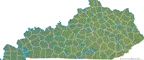 FRANKFORT, Kentucky (CFP) — With U.S. Senator Rand Paul looking on, Kentucky’s Republican central committee voted to switch the presidential contest in the Bluegrass State from a May primary to a March caucus, clearing the way for Paul to run for the Senate and the White House at the same time.
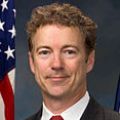
U.S. Senator Rand Paul
However, the central committee made the switch contingent on Paul contributing at least $250,000 to defray expenses associated with the caucus, something Paul has promised to do. The committee set a deadline of Sept. 18 for the payment to be made.
The vote, held by secret ballot, was 111-36, more than the two-thirds majority necessary to make the change. After the vote was announced, Paul’s supporters stood and cheered.
Paul release a statement saying “holding a caucus will ensure that Kentucky is relevant and participates early in the process.”
“I am also grateful for the Republican Party’s trust in me, allowing me to run for re-election to the U.S. Senate and seek the nomination for the presidency of the United States,” he said.
The change was necessary because Kentucky law does not allow the same candidate to appear on the ballot twice in the same election. If the Kentucky GOP held a primary, Paul would have faced a choice of whether to seek a second term in the Senate or opt out of a presidential primary contest he is likely to win. The caucus is also earlier in the presidential nominating calendar, which could boost his White House prospects.
Kentucky Democrats, who control the state House and the governorship, have blocked efforts by Paul’s allies to change the state law against political double-dipping. While the change fixes Paul’s problem for the primary, he could still face the same issue in November 2016 if he wins the GOP presidential nomination.
Paul maintains the law is unconstitutional because of a 1995 Supreme Court ruling that a state can’t impose its own restrictions in races for federal offices. He had hinted that he would a federal lawsuit if any attempt is made to keep him from seeking both offices at the same time.
The switch to a caucus was criticized by the Bluegrass State’s top elections official, Democratic Secretary of State Alison Lundergan Grimes, who issued a statement saying “it is unfortunate that today a few insiders were able to disenfranchise over 1.2 million Republican voters.”
“One candidate should not be able to buy an election. Democracy demands that all eligible Kentuckians be a part of the election process. That didn’t happen today and won’t happen with a caucus.
There is historical precedent for running for both the presidency or vice presidency and Congress at the same time, most recently in 2012 when U.S. Rep. Paul Ryan, the GOP’s vice presidential nominee, was re-elected to his House seat in Wisconsin.
Vice President Joe Biden also won Senate re-election in 2008 on the same day he was elected vice president, as did Lyndon Johnson in 1960.
The only other senator up for re-election in 2016 running for president, U.S. Senator Marco Rubio of Florida, is giving up his Senate seat.
Poll: Bush, Rubio open up lead over Hillary Clinton in Florida
Clinton’s unfavorable rating in Florida climbs to 55 percent
♦By Rich Shumate, Chickenfriedpolitics.com
 GAINESVILLE, Florida (CFP) — U.S. Senator Marco Rubio of Florida and former Florida Governor Jeb Bush have opened up big leads over Democratic frontrunner Hillary Clinton in the presidential race in the key swing state of Florida, a new poll shows.
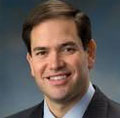
U.S. Senator Marco Rubio
The Quinnipiac Poll released August 20 also shows New York businessman Donald Trump and Bush leading among Florida Republicans; however, nearly 30 percent of state GOP voters say they would definitely not support the controversial Trump if he became the nominee.
In a hypothetical general election race, Bush bests Clinton 49 percent to 38 percent, well outside the poll’s margin of error of plus or minus 3 percent. Rubio does even better, 51 percent to 39 percent.
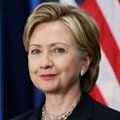
Former Secretary of State Hillary Clinton
The results are a marked change from the same poll in June, when Clinton held a slight lead over both Bush and Rubio. And in the latest poll, 55 percent of Florida voters had an unfavorable view of Clinton — up 10 points from June.
Nearly two-thirds of Florida voters — 64 percent — say Clinton is not honest or trustworthy.
Clinton even narrowly trails Trump, 43 percent to 41 percent, although that gap was within the margin of error.
In nine of the last 10 presidential elections, the winner of the presidential race in Florida also won nationally, making a victory in the Sunshine State vital for anyone who wants to capture the White House.
In the GOP primary race, Trump was the choice of 21 percent of Florida Republicans, with Bush at 17 percent, which was within the poll’s margin of error of plus or minus 4.5 percent. Rubio and retired neurosurgeon Ben Carson tied for third at 11 percent each.
However, 29 percent of Republican voters polled say they will definitely not support Trump if he is the nominee, a larger group than those now supporting him. And just 55 percent of the GOP voters polled view Trump positively, compared to 87 percent for Rubio and 81 percent for Bush.
Trump’s demeanor is also seen as a problem, with 64 percent saying he lacks the temperament and personality to handle an international crisis.
In the Democratic primary race, Clinton still maintains a wide lead in Florida, with support from 48 percent of Democrats polled. Senator Bernie Sanders of Vermont trails at 15 percent, and Vice President Joe Biden, who had yet to announce a 2016 White House bid, comes in at 11 percent.
In head-to-head matchups against Republicans, Biden runs slightly better against Rubio and Trump than does Clinton but slightly worse against Bush. The poll shows Sanders is weaker than Clinton against all three Republicans.
In the poll, 1093 Florida voters were interviewed, including 477 Republicans and 345 Democrats.
In 2016, the Florida primary will be held early in the primary calendar, on March 15, which is likely to give the state added prominence in the presidential nominating process.
The Florida GOP has also made its contest a winner-take-all affair, which means the winner gets a treasure trove of 99 delegates.
Louisiana Governor Bobby Jindal opens White House bid pledging “never to lead from behind”
Jindal touts his record, says Republicans “must stop being afraid to lose”
♦By Rich Shumate, Chickenfriedpolitics.com editor
 KENNER, Louisiana (CFP) — Taking a swipe at both Democratic “socialism” and a Republican Party that he says has been “beaten into submission,” Louisiana Governor Bobby Jindal launched his campaign for the 2016 GOP presidential nomination by calling himself a “doer,” not a “talker.”
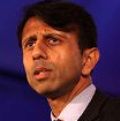
Louisiana Governor Bobby Jindal
“There are a lot of great talkers running for president. But none of them — not one — can match our record of actually shrinking the size of government,” Jindal said in his June 24 kickoff rally in Kenner, a New Orleans suburb. “I’m not running for president to be somebody. I’m running for president to do something.”
“If you want somebody who’s just going to pretend that everything is fine, just make some small tweaks, then you want somebody else. I’ll make this promise to you. I will never lead from behind.”
Jindal, 44, is in the last year of his second term as the Pelican State’s chief executive. He touted his record as governor in his opening address, noting that he took office just two years after Hurricane Katrina devastated New Orleans.
“Our economy was locked in a downward spiral. Our biggest city was reeling. For 25 straight years, more people had left this state than had moved into it,” he said. “Louisiana was in big trouble, so we had to make big changes.”
Among the achievements Jindal cited were education reform, particularly in New Orleans where the entire school system was converted into charter schools, and a 26 percent reduction in the state’s budget.
“It wasn’t easy. The big government crowd fought us every step of the way,” he said. “But in the end, we won.”
However, Jindal had to delay his widely anticipated presidential campaign while Louisiana’s legislature struggled to close a massive budget deficit that the governor’s critics blame on his refusal to consider tax increases to offset sharp declines in revenues from oil production.
Those budget problems have taken a toll on Jindal’s popularity, with a poll in March putting his approval rating at just 27 percent.
Jindal, a Rhodes scholar, was something of a wunderkind in Louisiana politics, becoming head of the state health department at the tender age of 24 and president of the University of Louisiana System at just 28. He was appointed assistant secretary of the U.S. Department of Health and Human Services during the administration of President George W. Bush.
Jindal left the Bush administration to run unsuccessfully for governor in 2003. In 2004, he was elected to the U.S. House, representing a suburban New Orleans district until his election as governor in 2007.
In the opening speech of his presidential campaigns, Jindal signaled that he plans to run as an unvarnished conservative who would cut the size of government and defend religious liberty.
“Republicans must stop being afraid to lose,” he said. “If we try to hide who we are again, we will lose again.”
Jindal took a direct shot at one of his chief GOP rivals, former Florida Governor Jeb Bush, by lampooning Bush’s assertion that GOP candidates “need to be willing to lose the primary in order to win the general election.”
“We’re going to help him do that,” Jindal said. “What Jeb Bush is saying is we need to hide our conservative ideals … Let’s do something new. Let’s endorse our own principles for a change. Let’s boldly speak the truth without fear.”
In recent months, Jindal, the son of Indian immigrants who converted to Roman Catholicism as a teenager, has been courting religious conservatives, particularly with his outspoken opposition to same-sex marriage. In his campaign kickoff, he charged that Christianity “is under assault today in America.”
“I want to say this slowly so that even Hillary Clinton can understand this — America did not create religious liberty. Religious liberty created the United States of America,” he said.
Jindal — whose given name is Piyush and who, if elected, would be the nation’s first Indian-American president — also lashed out at “all this talk about hyphenated Americans.”
“We are not Indian-Americans, African-Americans, Irish-Americans, rich Americans or poor Americans. We are all Americans.”
Jindal also leveled a broadside against President Obama, saying “this president and his apprentice-in-waiting, Hillary Clinton, are leading America down the path to destruction economically, culturally and internationally.”
“The simple fact is they are trying to turn the American dream into socialism.”
Jindal said his four main objectives as president would be to secure the border, replace Obamacare with a market-based health care system, cut the size of government and improve “America’s defenses.”
Jindal is one of eight Southern Republicans seeking the presidency in 2016. In addition to Bush and Jindal, the other Southern candidates are former governors Mike Huckabee of Arkansas and Rick Perry of Texas and U.S. Senators Ted Cruz of Texas, Marco Rubio of Florida, Rand Paul of Kentucky and Lindsey Graham of South Carolina.
The Southern GOP field is divided equally between senators and governors. Two of the last three Republicans elected president — George W. Bush and Ronald Reagan — served as governor, while the last GOP senator elected to the presidency was Warren Harding in 1920.
On the Democratic side, former U.S. Senator Jim Webb of Virginia has launched an exploratory committee for the 2016 Democratic nomination — a race that’s expected to be dominated by former Secretary of State Clinton, a former first lady of Arkansas who went on to be elected to the Senate from New York.
Poll: Rubio, Bush lead GOP field in Florida, narrowly trail Clinton
But a Quinnipiac University poll finds a majority of Sunshine State voters think Clinton isn’t trustworthy
♦By Rich Shumate, Chickenfriedpolitics.com editor
GAINESVILLE, Fla. (CFP) — Former Florida Governor Jeb Bush and the state’s U.S. senator, Marco Rubio, are in a dead heat in the GOP presidential sweepstakes in their home state, and both men are far ahead of the rest of the field, a new poll finds.
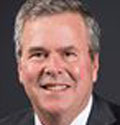
Former Florida Governor Jeb Bush
The Quinniapiac University poll of Florida voters also found that while both Bush and Rubio narrowly trailed former Secretary of State Hillary Clinton in hypothetical general election match-ups, a majority of Florida voters say they think Clinton isn’t trustworthy.
In the Republican primary race, Bush was the choice of 20 percent of registered Republicans in the poll, with Rubio at 18 percent, which was within the poll’s margin of error of plus or minus 4.6 percent. No other candidate was in double digits.
When voters were asked to name both their first and second choices in the crowded GOP field, Rubio was either the first or second choice of 36 percent of respondents; Bush, 33 percent.
U.S. Senator Marco Rubio
Florida is likely to loom large in the 2016 Republican presidential contest. The state legislature moved the primary to March 15, which will make Florida first among the four largest states to hold a primary, and the Florida Republican Party decided to make it a winner-take-all affair, putting a treasure trove of 99 delegates up for grabs.
In Quinniapiac’s hypothetical general election match-ups, Clinton led Rubio 47 percent to 44 percent, just outside the poll’s margin of error of plus or minus 2.9 percent. Her lead over Bush was 46 percent to 42 percent.
When asked whether they had a favorable or unfavorable opinion of Clinton, respondents were nearly evenly split, with 47 percent saying they viewed her favorably and 45 percent unfavorably.
However, when they were asked if they found Clinton trustworthy, only 43 percent said yes, while 51 percent said no.
Bush was viewed favorably by 52 percent and unfavorably by 36 percent. Rubio was viewed favorably by 50 percent and unfavorably by 34 percent.
Florida has become a key bellweather state in presidential politics. The last person to win the White House without carrying the state was Bill Clinton in 1992, and in the last 16 presidential elections, the winner carried Florida 14 times.
 Chicken Fried Politics