
Home » White House 2020 (Page 4)
Category Archives: White House 2020


Insight: What do 2019’s election results in the South tell us about 2020?
Wins in Kentucky and Louisiana aren’t nirvana for Democrats, but they do show limits to GOP strategy of socialist pigeonholing
♦By Rich Shumate, ChickenFriedPolitics.com editor
 Now that the dust has cleared from elections in four Southern states earlier this month, what are the lessons, if any, for 2020 elections in which both the presidency and control of Congress will be on the line?
Some pundits in the chattering class and Democratic politicians have looked at victories by Democrats in governor’s races in deep red Kentucky and Louisiana and gleefully found evil portends for their GOP rivals next year.
That would be overreach.

Editor Rich Shumate
In Kentucky, Democrat Andy Beshear won because the Republican incumbent, Matt Bevin, was as popular as a skin rash after four years of gratuitous insults and irritation. In Louisiana, Democratic incumbent John Bel Edwards — that rarest of creatures, a pro-life Democrat — had strong job approval numbers and ran as far away as he could from the Elizabeth Warrens and Alexandria Ocasio-Cortezes in his party.
Trump couldn’t push Republicans over the finish line in either race, but Republicans carried all of the other statewide contests in both states and had a clean sweep in of state offices in Mississippi. So it would be a mistake to see these Democratic wins as a referendum on Trump, and Democrats shouldn’t find much solace in what was otherwise a rather dismal showing.
Still, the wins by Beshear and Edwards showed that the Republican strategy of calling Democrats socialists and ginning up the faithful with Trump rallies has its limits, even in states that the president carried by more than 20 points. In states with more even strength between the parties — Florida, Georgia, Texas, and North Carolina — that strategy could be even less effective next year, particularly at the presidential level and in U.S. Senate races in the latter three states.
What should be of more concern to Republicans is the fact that the Democratic vote in cities and suburban areas was unusually strong and decidedly Democratic in 2019, mirroring a trend seen in 2018 when Democrats took control of the U.S. House.
Beshear won in Kentucky by carrying Louisville and Lexington and their suburbs by a margin of 135,000 votes, swamping Republican margins in the rest of the state. In Louisiana, Edwards won by carrying Baton Rouge, Shreveport and New Orleans by almost 165,000 votes, including winning almost 90 percent of the vote in Orleans Parish and carrying suburban Jefferson Parish — home of House GOP Whip Steve Scalise — by 14 points.
The news for Republicans was even worse in Virginia, where Democrats took control of both houses of the legislature — in elections that used maps drawn by Republicans to protect Republicans — by gaining more ground in the suburbs around Washington, Richmond, and Norfolk. Among the casualties was the last Republican House member representing a district in the inner Washington suburbs, which 20 years ago was undisputed GOP territory.
In 2018, newfound Democratic strength in the suburbs allowed the party to take competitive U.S. House seats in Atlanta, Richmond, Miami, Dallas and Houston — and get surprise wins in Oklahoma City and Charleston. If that trend, also seen in 2019, continues into 2020, it could potentially put more seats into play in Little Rock, Tampa, Lexington, San Antonio and across North Carolina, where a court recently forced Republican legislators to redraw gerrymandered maps.
Over in the Senate, Republicans are defending two seats in Georgia and seats in Texas and North Carolina where Democrats now have a plausible path to victory, if they can push the urban/suburban vote past the pro-Trump margin in small towns and rural areas as they did in 2019. And the eyes of the nation will be on Kentucky, where Senate Majority Leader Mitch McConnell will be defending his seat in the wake of Beshear’s breakthrough.
McConnell’s job approval numbers are 13 points underwater in Kentucky, according to the latest Morning Consult survey, making him one of the nation’s least popular senators. However, McConnell has substantially more political acumen than Bevin and a much better political machine, and he could benefit if he faces a Democrat whom he can pigeonhole as a leftist.
McConnell’s campaign is already taking aim at his only announced Democratic rival, Amy McGrath, who raised $8.6 million in an unsuccessful congressional race in 2018 but started the campaign with an embarrassing flip-flop on whether she would have voted to confirm Brett Kavanaugh to the Supreme Court. (First she said yes, then she said no.)
Rocky Adkins, a folksy, pro-life state legislator from Eastern Kentucky who ran second to Beshear in this year’s gubernatorial primary, is also considering entering the race and could prove a much more slippery target for McConnell’s ad makers.
Democrats need a net gain of four seats to take control of the Senate; three seats will be enough if a Democrat also carries the White House. That task will be very uphill if they don’t make breakthroughs in the South.
In the presidential race, the question will be if any the Democrats in the 2020 field can survive in the South in a binary match-up against Trump and his faithful followers.
Virginia is probably a lock for the Democrats, and Florida and North Carolina are always in play. The wild cards will be Georgia and Texas, where the heavy urban-suburban Democratic vote seen in 2018 and 2019 could make things interesting if it materializes again in 2020. (Trump carried Georgia by just 5 points in 2016; the margin was 9 points in Texas.)
However, it should be noted that if either Beshear or Edwards were in the presidential race, they would be far and away the most conservative candidate in the Democratic field. So could a presidential candidate who is highly likely to be substantially to their left duplicate the success they had locally in 2019, particularly in states where the president remains more popular than he does nationally?
Mmmm … don’t bet the rent.
We tweet @ChkFriPolitics Join us!
Beto O’Rourke ends quest for 2020 Democratic nomination
O’Rourke tells supporters in Iowa that “we do not have the means to pursue this campaign successfully”
♦By Rich Shumate, ChickenFriedPolitics.com editor
 DES MOINES, Iowa (CFP) — Seven months after beginning his quest for the presidency with high hopes and lavish media attention born of political star power, former Texas U.S. Rep. Beto O’Rourke has brought his campaign to an abrupt and quiet end.
O’Rourke’s exit from the race, amid anemic polling results and fundraising numbers, was made official November 1 in front of a crowd of supporters in Des Moines, Iowa, where he had been scheduled to speak at a Democratic event with the rest of the 2020 field.
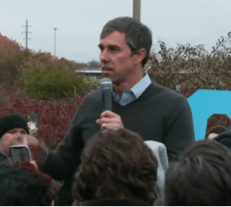
Beto O’Rourke withdraws from Democratic race in Iowa (NBC News via YouTube)
“This is a campaign that has prided itself on seeing things clearly and speaking honestly,” O’Rourke told a small crowd of subdued supporters. “We have clearly seen at this point that we do not have the means to pursue this campaign successfully and that my service will not be as a candidate, nor as the nominee of this party for president.”
An aide to O’Rourke later told reporters that he would not enter the U.S. Senate race in Texas, as some Democratic leaders have been urging him to do. The filing deadline in Texas is December 9.
Watch video of Beto O’Rourke’s speech leaving the 2020 race
O’Rourke’s short-lived campaign will perhaps be best remembered for a moment in a September debate where, in a call for mandatory buybacks of assault weapons, he said, “Hell, yes, we’re going to take your AR-15, your AK-47.”
While the audience cheered, even some of his fellow Democrats winced at a soundbite likely to be weaponized by Republicans — and which may have extinguished any hope of a statewide political future for O’Rourke in Texas.
But O’Rourke offered no apologies during his withdrawal speech, saluting his campaign for being “unafraid to confront the conventional wisdom of what it was possible to say in the public sphere.”
O’Rourke, 47 — whose given first name is Robert but who uses his childhood nickname, Beto, a Spanish diminutive — served three terms in Congress representing El Paso before deciding to challenge Republican U.S. Senator Ted Cruz in 2018.
Given little chance at the beginning, O’Rourke and his campaign fired the imagination of Democratic activists around the country, raising more than $80 million and coming within 3 points of ousting Cruz, the runner up to President Donald Trump in the 2016 GOP presidential contest.
O’Rourke hoped to ride that momentum to the Democratic nomination when he entered the race in late March. While his initial fundraising and polling numbers were strong amid an avalanche of media attention, both began to fade after uneven performances in early presidential debates.
O’Rourke pivoted to the gun control issue in August after a gunman killed 22 people at a Wal-Mart in his hometown of El Paso, but it did not resonate enough to propel him to the front of the Democratic pack.
O’Rourke was polling at 2 percent or less nationally and didn’t even register in one recent poll in Iowa, the first caucus state where he was drawing large crowds back in April.
His fundraising had also dried up, leaving his campaign with just $3.2 million at the end of September with early contests in Iowa and New Hampshire looming.
O’Rourke’s departure from the race leaves just one Southerner in the presidential race, former San Antonio Mayor Julián Castro.
We tweet @ChkFriPolitics Join us!

Former South Carolina Governor Mark Sanford will challenge Donald Trump for GOP nomination
Sanford says Trump has strayed from Republican orthodoxy and damaged political institutions
♦By Rich Shumate, ChickenFriedPolitics.com editor
Note: Video of Sanford’s announcement is at end of post.
 WASHINGTON (CFP) — Former South Carolina governor and congressman Mark Sanford has announced he will challenge President Donald Trump for the 2020 Republican presidential nomination, faulting the president for straying from GOP orthodoxy on spending and trade and damaging the nation’s political culture.
“I think we need to have a conversation on what it means to be a Republican. I think that as a Republican Party, we have lost our way,” Sanford said on Fox News Sunday, where he announced his challenge on September 8. “Americans deserve and need a choice.”

Sanford announces on Fox News Sunday
Despite his long pedigree in politics, which includes two terms as governor and 12 years in the U.S. House, Sanford faces the steepest of uphill climbs in trying to unseat Trump, whose approval ratings among Republicans top 80 percent.
The Republican National Committee has shut down the possibility of primary debates, and state parties have begun scrapping primary contests against Trump — including Sanford’s home state of South Carolina.
The president, who announced his 2020 re-election bid shortly after his inauguration in 2017, has already raised $125 million for the coming campaign.
Asked about the long odds he faces, Sanford noted that Trump was also considered a long shot when he ran in 2016 and insisted rank-and-file Republicans are more interested in a primary contest than their party leaders.
“This is the beginning of a long walk, but it begins with that first step,” he said.
Sanford said he would emphasize the ballooning level of spending and debt on Trump’s watch and the president’s tariffs policy, both of which he said are a departure from conventional Republican positions of spending restraint and free trade.
He said his campaign would also provide the opportunity to discuss “the degree to which institutions and political culture are being damaged by this president.”
“Those institutions and that political culture is really the glue that holds together our balance of power,” Sanford said.
He also took a slap at Trump’s use of his favorite medium of communication, Twitter.
“At the end of the day, a tweet is interesting, maybe newsworthy, but it’s not leadership,” he said. “And we’re not going to solve some of the profound problems that we have as Americans by tweet.”
After winning his second term as the Palmetto State’s governor in 2006, Sanford was being mentioned as a possible presidential candidate for 2012 — until he disappeared after telling his staff that he was off hiking the Appalachian Trail, when he was actually in Argentina canoodling with his mistress.
Ignoring calls to resign, Sanford completed his term in 2011. Two years later, he came back from the political graveyard by reclaiming his Low Country House seat in a special election.
After Trump was elected, Sanford became one of the few Republicans in the House willing to criticize him publicly. The president got his revenge by endorsing Sanford’s opponent on the day of the 2018 primary election — and taking great public glee when Sanford lost. (Democrat Joe Cunningham won the seat in November.)
Sanford told Fox News that his run against Trump is not personal but based on principle, noting that he voted with the president 90 percent of the time. But he said Trump’s active opposition to his re-election “is indicative of the way he makes too many things personal.”
“The world of Trump is personal loyalty,” he said.
In addition to Sanford, former Massachusetts Governor Bill Weld and former U.S. Rep. Joe Walsh from Illinois are running against Trump. Weld comes from the GOP’s moderate wing; Walsh, like Sanford, is a conservative.
In addition to South Carolina, Republicans in Nevada and Kansas have also canceled their 2020 primary contests.
Video of Sanford’s announcement
We tweet @ChkFriPolitics Join us!

Will South Carolina’s Mark Sanford pull the trigger on a 2020 primary challenge to President Trump?
Former governor and congressman tells Charleston newspaper he’s considering a run
♦By Rich Shumate, ChickenFriedPolitics.com editor
 CHARLESTON, South Carolina (CFP) — Last summer, President Donald Trump reacted with some glee after helping take out then-U.S. Rep. Mark Sanford, who went down to defeat in his Lowcountry district to a GOP primary challenger whom Trump endorsed.
Mark Sanford
Now, Sanford is considering trying to once again resurrect his political career — with a long-shot challenge to Trump himself for the Republican presidential nomination in 2020.
“Sometimes in life you’ve got to say what you’ve got to say, whether there’s an audience or not for that message,” Sanford said in an interview with the Post and Courier newspaper, where he teased his intentions. “I feel convicted.”
Sanford said the GOP “has lost its way on debt, spending and financial matters,” issues that he said would be central to his campaign. He told the newspaper that he expects to decide within the next month whether to join the race against Trump.
 But even the possibility of a Sanford challenge to Trump set off the state’s Republican Party chairman, Drew McKissick, who released a statement saying “the last time Mark Sanford had an idea this dumb, it killed his Governorship. This makes about as much sense as that trip up the Appalachian Trail.”
The state Democratic Party took a more light-hearted tone, tweeting: “We look forward to seeing mark [sic] on the trail! Always nice to see a candidate with fewer extra marital affairs than the president.”
In 2009, Sanford, then the Palmetto State’s governor, touched off a messy personal scandal when he disappeared from public view after telling reporters that he was hiking the Appalachian Trail, when he was actually off canoodling with his Argentinian mistress.
He refused calls to resign and served out the rest of his term, then, in 2013, resurrected his political career by winning a special election in the 1st U.S. House District.
After Trump was elected in 2016, Sanford became one of a very small number of congressional Republicans willing to criticize the president, calling his behavior in office “weird,” criticizing his disparagement of Haiti and countries in Africa and calling his policy of imposing tariffs on steel and aluminum “an experiment with stupidity.”
Trump got his revenge in 2018 when State Rep. Katie Arrington defeated Sanford in the Republican primary, after getting a well-timed Twitter endorsement from the president on election day. However, the victory proved somewhat pyrrhic when Arrrington lost the seat to Democrat Joe Cunningham in November.
Sanford, 59, served a total of 13 years during his two stints in Congress and eight years as governor. He told the Post and Courier that if he doesn’t run against Trump, he won’t try to reclaim his former seat in Congress against Cunningham but might try to start a think tank focused on deficit issues.
The only Republican challenging Trump in 2020 so far is former Massachusetts Governor William Weld, who comes from the party’s moderate wing, unlike Sanford, who carved out a conservative record in Congress and as governor.
We tweet @ChkFriPolitics Join us!

10 takeaways from the second 2020 Democratic debate
Kamala Harris draws blood on Joe Biden on race issue; Sanders stands pat as grumpy socialist
♦By Rich Shumate, ChickenFriedPolitics.com
MIAMI (CFP) — The second flight of 10 Democrats took the stage in Miami Thursday night for the second of two nights of debate among the more than two dozen candidates running for their party’s 2020 presidential nomination. Here’s a recap of some of the key takeaways from the proceedings:
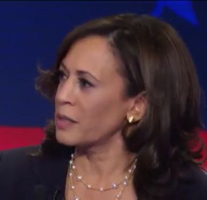
Kamala Harris challenges Joe Biden on race during Democratic debate (From MSNBC)
1. Race and Fireworks: The tussle of the night — and the clip every network will play for days — was between former Vice President Joe Biden and U.S. Senator Kamala Harris of California. It began when an emotional Harris took aim at Biden for his recent comments that he was able to work with segregationist senators in the past, which she called “hurtful.” “I will tell you on this subject, it cannot be an intellectual debate among Democrats,” she said, explaining how she benefited from school busing in the 1970s, which Biden opposed at the time. Biden, his anger rising, was having none of it: “I did not praise racists. This is not true,” he said, before launching into a somewhat disjointed defense of his record on civil rights, which ended awkwardly when he noted that his time was up. The former vice president seemed a bit rattled after the exchange, although he recovered his equilibrium later in the debate.
2. Bernie Being Bernie: The most consistent performer on the stage was U.S. Senator Bernie Sanders of Vermont, who, in his own indomitable style, stuck to his battle-tested positions on the need for a political revolution to take America back from the greedy, unscrupulous capitalist class. Asked how he, as a older white man, could represent the party’s diversity, he stuck to his economic line: “How come today the worker in the middle of our economy is making no more money than he or she was making 45 years ago … We need a party that is diverse, but we need a party that has guts.” Love him or hate him, this is one grumpy socialist who knows his own mind and never wavers — and does it all at the top of his lungs.
3. South Bend Shooting: Mayor Pete Buttegieg had to handle a hot potato question about a shooting of a black man by a white police officer in the city he leads, South Bend, Indiana. “It’s a mess, and we’re hurting … I have to face the fact that nothing I can say will bring (the victim) back,” he said. And while conceding that he has not been able as mayor to bring more diversity to the city’s mostly white police force, he also said that the investigation into the shooting needs to run its course — and ignored a shouted demand from U.S. Rep. Eric Swalwell of California that he fire the officer involved.
4. Generational Dust-Up: Swalwell got in a pointed dig at Biden by quoting a speech that the septuagenarian former vice president made calling for passing the torch to a new generation of leadership — 32 years ago, when Swalwell was 6. That set off a cacophony of cross-talk that only ended when Harris managed to get off the line of the night: “Hey guys, you know what, America does not want to witness a food fight. They want to know how we’re going to put food on the table.”
5. Private Insurance Fault Line: When asked by the moderator if they supported abolishing private health insurance as part of a Medicare-for-all plan, only two candidates — Sanders and Harris — raised their hands. Sanders offered a robust defense of the idea, saying that if other major countries such as Britain and Canada can operate a health care system for their citizens, the United States should be able to do the same. The biggest pushback on eliminating private insurance came from U.S. Senator Michael Bennet of Colorado, who noted that Canada has just a tenth of the population of the United States, and Biden, who touted his role in passing Obamacare and said he had no intention of scrapping it. Buttigieg proposed a mixture of public and private plans that he called “Medicare-for-all-who-want-it.”
6. At Back of the Pack: Unlike in the first debate, when former San Antonio Mayor Julián Castro had a breakout performance, none of the candidates lagging at the back of the pack turned in a performance that is likely to move the needle. Bennet did manage to grab a bit of air time; Swalwell tried to create moments on gun control and his calls for generational change; and U.S. Senator Kirsten Gillibrand of New York tried to do the same with her support for legal abortion. But neither they nor former Colorado Governor John Hickenlooper are likely to play much of a role in the post-debate conversation.
7. Stepping Up The Trump Attacks: The candidates in the second debate had clearly paid attention to pundits’ commentary after the first debate that President Donald Trump had not been sufficiently targeted. They stepped up the rhetoric against the president, particularly on his immigration policies. As Sanders put it, with his characteristic subtlety: “Trump is a phony. Trump is a pathological liar and a racist.”
8. Making News: Very little of what the candidates said during the debate was unexpected or made much news, with one exception — Gillibrand said that if elected, “my first act will be to engage Iran to stabilize the Middle East,” which would change 40 years of official hostility to the imams in Tehran.
9. Um, Why Were These People on the Stage? Democrats did nothing to burnish their reputation for seriousness by including new age guru Marianne Williamson and tech bro Andrew Yang as part of the debate, both of whom seemed hopelessly out of place and, frankly, in the way. It was perhaps not as silly as hosting Kim Kardashian, but it was close. Yang, to his credit, was mostly mute and later complained that his microphone had been turned off (if only); Williamson, alas, opted to interject herself with any number of peculiar observations, including that her first phone call as president would be to the president of New Zealand (which, by the way, doesn’t have a president) and that she was going to “harness love” to beat Trump. Good luck with that.
10. Winners and Losers: The winner of the night was clearly Harris, who managed to make herself look presidential and take a bite out of Biden. The biggest loser of the evening was Biden, who, as the front-runner, needed to stay above the fray, but, by letting Harris get under his skin, may have punctured his aura of invincibility. Sanders and Buttigieg did no harm to their prospects, but Gillibrand clearly suffered in comparison to Harris, the only other woman on the stage.
 Chicken Fried Politics