
Latest Posts
Latest Coverage
-
Symbolic solution in search of an actual problem
Support of 9 Southern Republicans for Respect for Marriage Act shows why Supreme Court isn’t about to ban same-sex marriage ♦By Rich Shumate, ChickenFriedPolitics.com editor…
-

West Virginia stubborn, or playing hard to get
U.S. Senator Joe Manchin pisses off his party yet again … to what end? ♦By Rich Shumate, ChickenFriedPolitics.com editor Also in this report: Atlanta DA…
-

2 Mississippi Republican U.S. House members forced into runoffs after weak primary showings
Michael Guest narrowly trails challenger in 3rd District; Steven Palazzo clears just 32% in 4th District ♦By Rich Shumate, ChickenFriedPolitics.com editor JACKSON, Mississippi (CFP) –…
-
Mississippi Republican U.S. Rep. Steven Palazzo facing Tuesday primary fight amid ethics investigation
6 opponents hitting “No-Show Palazzo” over inattention to district, ethics problems ♦By Rich Shumate, ChickenFriedPolitics.com editor GULFPORT (CFP) — Mississippi U.S. Rep. Steven Palazzo —…
-

Primary Wrap: Kemp, Raffensperger survive Trump’s ire; Brooks makes Alabama U.S. Senate runoff
Texas Democratic U.S. Rep. Henry Cuellar survives challenge from the left; George P. Bush gets blown out by Attorney General Ken Paxton ♦By Rich Shumate,…
-

U.S. House’s last pro-life Democrat, Texas’s Henry Cuellar, fighting to keep seat in Tuesday primary runoff
Challenger Jessica Cisneros wanted House Democratic leaders to rescind Cuellar endorsement; they refused ♦By Rich Shumate, ChickenFriedPolitics.com editor LAREDO, Texas (CFP) — Amid the newly…

5 Southern U.S. House Democrats from pro-Trump districts support impeachment bill
Vote on bill outlining procedures for impeachment process breaks down along party lines
♦By Rich Shumate, ChickenFriedPolitics.com
 WASHINGTON (CFP) — Five Southern U.S. House Democrats who hold seats from districts President Donald Trump carried in 2016 voted with their party Thursday to approve procedures for his possible impeachment, a vote they’ll have to defend as they fight to keep their seats next year.
The Democrats from Trump districts who voted yes included Abigail Spanberger and Elaine Luria of Virginia, Lucy McBath of Georgia, Kendra Horn of Oklahoma, and Joe Cunningham of South Carolina.
Cunningham, Horn and McBath had not previously expressed support for the impeachment inquiry; Spanberger and Luria had.
Five other Democrats who also flipped GOP-held seats in 2018 — Colin Alled and Lizzie Fletcher of Texas, Jennifer Wexton of Virginia, and Debbie Mucarsel-Powell and Donna Shalala of Florida — also voted for the resolution. Those districts were carried by Hillary Clinton in 2016.
These 10 seats are at the top of the GOP target list for 2020, with the impeachment vote certain to be an issue in those races.
Two other GOP 2020 targets — Democrats Stephanie Murphy and Charlie Crist from Florida — also voted in favor of the impeachment measure.
The lone Republican in a Southern seat Clinton carried, Will Hurd of Texas, voted no, as did eight other Southern Republicans who have announced they won’t seek another term in 2020.
The overall vote among Southern House members on the bill broke down entirely along party lines. Across the whole House, no Republicans supported the measure, while two Democrats — Collin Peterson from Minnesota and Jeff Van Drew of New Jersey — voted no.
Thursday’s vote was the first formal move by House Democrats to advance the impeachment of Trump over his overture to the president of Ukraine to investigate corruption allegations against his Democratic rival, Joe Biden.
Cunningham told the Post and Courier newspaper of Charleston that he was voting for the bill in order to make the investigation into Trump more transparent, as Republicans have been demanding.
“Overall it’s a good measure to shine some light on these hearings and make sure that we respect due process,” Cunningham told the Post and Courier.
Horn, announcing her support for the bill on Twitter, stressed that she was only supporting an investigation, not Trump’s actual impeachment.
“It is a vote to create clear rules for effective public hearings and ensure transparency for the American people,” she said. “As I’ve said all along, I always look at the facts in front of me and vote in the best interests of Oklahomans.”
Even before the vote, McBath had felt the potential sting of the impeachment fight when unhappy Trump supporters picketed her district office in suburban Atlanta earlier this month. In response, McBath took to Twitter to say she refused “to be intimidated, I will do what is right,” and included a fundraising solicitation in her post.
Three Southern House members did not vote on the impeachment bill — Jody Hice of Georgia, John Rose of Tennessee, Don McEachin of Virginia.
We tweet @ChkFriPolitics Join us!

Polls point to razor-close governor’s races in Kentucky, Mississippi heading into last week
Kentucky Governor Matt Bevin appears to have closed gap on Democratic challenger, poll finds
♦By Rich Shumate, ChickenFriedPolitics.com editor
 Heading into the final week of campaigning in governor’s races in Kentucky and Mississippi, polling shows Democrats within striking distance of winning in states that President Donald Trump won by a mile just three years ago.
In Kentucky, a Mason-Dixon poll released October 16 showed Republican Governor Matt Bevin and Democratic Attorney General Andy Beshear both at 46 percent, with a margin of error of plus-or-minus 4 percentage points.
While neither candidate has a lead in the race, the results of the poll were actually good news for Bevin, who trailed Beshear by 8 points in a poll by the same organization back in January.
In Mississippi, where Republican Lieutenant Governor Tate Reeves and Democratic Attorney General Jim Hood are competing for an open governor’s seat, Reeves led Hood 46 percent to 43 percent in an October 23 Mason-Dixon poll, within the poll’s margin of error of plus-or-minus 4 percent.
Because the result is within the margin of error, the poll cannot definitely say either candidate is ahead, although the result does point to a close race.
Very little public polling has been done in either of these races, which also makes it difficult to confirm Mason-Dixon’s findings.

Beshear

Bevin
The poll in Kentucky found that Bevin has closed the gap with Beshear due to a 10-point increase in his support among Republicans, who appear to be returning to the governor’s camp as the election nears.
Bevin is also drawing support from 22 percent of Democrats in the poll, while Beshear is only getting 15 percent crossover support from Republicans.
The poll also showed that Bevin — who has consistently ranked among the nation’s least popular governors — has improved his job performance rating since January, although it still remains about 3 points underwater.
The poll also found Bevin leading Beshear in Eastern Kentucky, a region he lost to a little-known challenger in the Republican primary, which will be key to winning re-election.
The governor has also tied himself firmly to Trump, who carried Kentucky by 30 points in 2016. The poll showed Trump’s approval rating in Kentucky at 57 percent, with almost two-thirds of state voters opposing his impeachment.
Like Bevin, Reeves is also benefiting from Trump’s popularity in Mississippi, where the poll found his job approval rating at 54 percent and 56 percent opposing impeachment. The president carried the Magnolia State by 28 points in 2016.
Trump will come to Tupleo to campaign for Reeves on the Sunday before the November 5 election and will be at Rupp Arena in Lexington on the Monday before the election to campaign for Bevin.
The governor’s race in Mississippi is a collision between two men who, between them, have won eight statewide races.

Hood

Reeves
For Reeves, 45, the governorship will be a culmination of a climb through state politics that began when he won election as state treasurer in 2003 at the tender age of 29. He has served two terms as treasurer and two as lieutenant governor.
Hood, 57, the only Democrat holding statewide office in Mississippi, has been attorney general since 2004. He has parted ways with national Democrats by taking more conservative positions on criminal justice and legal abortion, which he opposes.
He has also made expanding Medicaid in Mississippi — opposed by Reeves and long blocked by Republicans in Jackson — a centerpiece of his campaign.
Mississippi has not elected a Democrat as governor since 1999.
In Kentucky, the governor’s race is an extension of a bitter feud between Bevin and Beshear that began in 2016, when Beshear assumed the attorney generalship and the governor took over as chief executive from Beshear’s father, former Governor Steve Beshear.
Beshear has sued the governor at least eight times, including a successful effort to scuttle a GOP pension reform plan passed in 2018.
Bevin’s approval ratings have sagged as he has sparred with his lieutenant governor and fellow Republicans in the legislature and criticized public school teachers, who have descended on Frankfort during the past two legislative sessions to protest proposed changes in state pensions.
Beshear highlighted that issue by picking a public school teacher, Jacqueline Coleman, as his running mate for lieutenant governor and featuring aggrieved educators in his campaign ads.
We tweet @ChkFriPolitics Join us!
Casting call: Georgia Governor Brian Kemp holding public auditions for U.S. Senate
Applicants include one of Donald Trump’s biggest defenders in the U.S. House, Newt Gingrich’s daughter and a man who kills hogs for a living
♦By Rich Shumate, ChickenFriedPolitics.com
Married white governor seeks senatorial companion who is interested but not too eager. Must enjoy gridlock and prickly egos. Prudes OK, but no Democrats. One-year commitment, may go longer if things work out.
OK, so Georgia’s Republican Governor Brian Kemp didn’t really place a personal ad to fill U.S. Senator Johnny Isakson’s soon-to-be vacant seat. But he did launch a process that perhaps unprecedented in Senate history — inviting any Georgian who is at least 30 years old (the constitutionally required age to be a senator) to apply for the job.

Clockwise from top left: Doug Colllins, Jan Jones, Tom Price, Martha Zoller
And apply they have — nearly 500 people have gone online and submitted their resumes, which have been posted on the governor’s website.
Kemp has not said when the application process will close, nor when he will name a replacement for Isakson, who is leaving at the end of the year due to ill health. The governor has also not committed himself to picking one of applicants.
It’s a good bet that the governor won’t bestow the prize on some of the more obscure candidates, including the front man for a band called Big Mike and the Booty Papas or the owner of a hog-killing business, who presumably knows a thing or two about pork-barrel politics.
A number of Democrats have also applied, bless their hearts, almost certainly to no avail.
Whoever is appointed will also have to hold the seat in a special election next year, which argues for a candidate who has the political and fundraising chops to win a statewide election on short notice. The winner in 2020 will also face election again in 2022, when Isakson’s term will be up.
Perhaps the most high-profile applicant is U.S. Rep. Doug Collins from Gainesville, who, as the ranking Republican on the House Judiciary Committee, has become one of the most zealous House defenders of President Donald Trump. None of the state’s other eight Republican House members has so far applied.
Another applicant with a Trump connection is Tom Price from Roswell, who left Congress in 2017 to become Trump’s health secretary, only to resign after less than seven months in office amid criticism of his high-flying travel practices.
Trump’s ambassador to Luxembourg, Randy Evans, a well-connected lawyer who has represented both former House Speaker Newt Gingrich and former Governor Sonny Perdue, has also applied, as has Jackie Gingrich Cushman, Gingrich’s daughter who is (perhaps not coincidentally) also promoting a new book arguing for more civility in politics.
Also among the applicants are Jack Kingston and Paul Broun, two former House members who were defeated in the GOP primary the last time a Senate seat opened in Georgia in 2014. Kingston finished second in that race behind the eventual winner, U.S. Senator David Purdue; Broun finished fifth.
Another name to keep an eye on: Jack Markwalter, a politically connected Atlanta business executive who applied late in the process. While Markwalter has no political experience, his resume is very similar to that of Perdue, who came out of the business world to claim a Senate seat in 2014.
However, one salient demographic fact may shape the process — every previous U.S. Senator who has represented the Peach State in its long and illustrious history, save one, has been a white man, giving Kemp the opportunity to make history with his appointment. (The lone exception was Rebecca Latimer Felton, who was picked in 1922, at the age of 87, to serve just one day by a governor using the appointment to pique a political rival.)
Topping the list of female applicants is State Rep. Jan Jones from Milton, who as speaker pro tem, is the legislature’s highest-ranking Republican woman.
Another possibility is former U.S. Rep. Karen Handel, a former secretary of state and chair of the Fulton County Commission who narrowly lost statewide races for governor in 2010 and U.S. Senate in 2014. However, Handel has not applied, as she’s running to reclaim the House seat she lost in 2018.
While Handel has valuable statewide name recognition, her won-loss record in statewide races (one win, two losses) and her 2018 defeat would likely give Kemp pause if he’s trying to pick someone who can hold the seat.
Another notable woman among the applicants is Martha Zoller, a former conservative talk show host from Gainesville who has worked as an adviser to both Perdue and Kemp. She lost a primary runoff to Collins in 2012.
Democrats have so far mostly held their fire on this race, waiting for Kemp’s appointment to be made before committing to running in the special election. The only Democrat who has jumped in so far is Mark Lieberman, the son of former Connecticut U.S. Senator Joe Lieberman.
Perdue’s term is also up in 2020, which means both of Georgia’s Senate seats will be on the ballot next year as Republicans try to preserve their three-seat majority.
We tweet @ChkFriPolitics Join us!

Louisiana governor’s race heads to a November runoff
Democratic Governor John Bel Edwards falls short of majority, will face Republican Eddie Rispone in 2nd round
♦By Rich Shumate, ChickenFriedPolitics.com
 BATON ROUGE (CFP) — The Louisiana governor’s race will be decided in a November runoff after Democratic Governor John Bel Edwards fell short of the majority he needed to knock out his two Republican challengers.
Edwards will face Baton Rouge businessman Eddie Rispone, who came in second place in the first round of voting Saturday. The runoff is Nov. 16.

Democratic Governor John Bel Edwards will face Republican Eddie Rispone in Nov. 12 runoff
Edwards took 47 percent of the vote to 27 percent for Rispone and 24 percent for the third place finisher, U.S. Rep. Ralph Abraham from Alto.
Under Louisiana’s “jungle” primary system, candidates from all parties run together in the same contest, with the top two vote-getters advancing to the runoff if no one gets an outright majority.
Six other statewide offices were also on the ballot Saturday. Five Republican incumbents won without a runoff, but Republican Secretary of State Kyle Ardoin fell short of a majority and will face Democrat Gwen Collins-Greenup in November.
With pre-election polls showing Edwards within striking distance of winning the primary outright, President Donald Trump held a rally Friday night in Lake Charles to rally Republican voters, calling both Abraham and Rispone to the stage.
The president and most of the state’s Republican congressional delegation did not take sides in the battle between Abraham and Rispone, focusing their fire instead on Edwards.
“Louisiana cannot take four more years of a liberal Democrat governor,” said Trump, who accused the governor of “taking money from open borders extremists.”
Edwards, 53, is one of just three Democratic governors in the South, along with North Carolina’s Roy Cooper and Virginia’s Ralph Northam. But unlike Northam and Cooper, Edwards has positioned himself as a conservative Democrat who opposes legal abortion and gun control, both of which have played well in Louisiana.
As a result, national Democrats, including the large crop of 2020 White House contenders, have conspicuously avoided campaigning on his behalf, although former President Barack Obama did make a robocall for the governor.
In 2015, Edwards claimed the governorship by defeating Republican U.S. Senator David Vitter, who was bogged down by personal scandals and the unpopularity of the outgoing GOP governor, Bobby Jindal.
Edwards signature achievements in office have been expanding Medicaid, over Republican objections, and dealing with a budget shortfall he inherited from Jindal.
However, the tax increases imposed to deal with the budget have become fodder for his Republican opponents, who say the new taxes have driven business out of the state.
A Morning Consult poll in June put Edwards’s job approval rating at 47 percent, compared to 33 percent who disapproved.
Rispone, 70, owns an industrial contracting company that has made him one of Louisiana’s richest men. While he has long been a major GOP donor, this is his first race for political office, and he has poured in more than $10 million of his own money.
In addition to Louisiana, two other Southern states will hold governor’s races this year, Kentucky and Mississippi.
We tweet @ChkFriPolitics Join us!

Louisiana Democratic Governor John Bel Edwards aiming for knockout in Saturday’s jungle primary
Trump making election-eve visit to Lake Charles to rally Republicans and force Edwards into a runoff
♦By Rich Shumate, ChickenFriedPolitics.com
BATON ROUGE (CFP) — Unless pre-election polls are seriously off the mark, Louisiana’s Democratic Governor John Bel Edwards will come out on top when the votes are counted in Saturday’s primary election.
So the two questions to be answered Saturday are whether Edwards can knock out both of his Republican challengers by clearing 50 percent of the vote and, if he doesn’t, which of the two leading Republicans he will face in a November runoff.
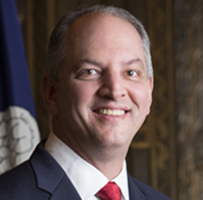
Governor John Bel Edwards
In Louisiana’s “jungle” primary, candidates from all parties run together in the same contest, with the top two vote-getters advancing to the runoff if no one gets an outright majority. Polls have put Edwards within striking distance of that mark, which would be a significant embarrassment for the GOP in the very conservative Pelican State.
In the clearest sign of Republicans’ concern about the outcome, President Donald Trump is holding a rally in Lake Charles on Friday night, even though he has not taken sides in the battle for second place between U.S. Rep. Ralph Abraham from Alto and Baton Rouge businessman Eddie Rispone.
Both Abraham and Rispone, who have sparred with each other and with Edwards during the campaign, have welcomed the president’s visit for what Trump termed “a big Republican rally” designed to leverage his popularity into forcing Edwards into a runoff against a single GOP challenger.
Edwards is one of just three Democratic governors in the South, along with North Carolina’s Roy Cooper and Virginia’s Ralph Northam. But unlike Northam and Cooper, Edwards has positioned himself as a conservative Democrat who opposes legal abortion and gun control, both of which have played well in Louisiana.
As a result, national Democrats, including the large crop of 2020 White House contenders, have conspicuously avoided campaigning on his behalf.
In 2015, Edwards claimed the governorship by defeating Republican U.S. Senator David Vitter, who was bogged down by personal scandals and the unpopularity of the outgoing GOP governor, Bobby Jindal.
Edwards signature achievements in office have been expanding Medicaid, over Republican objections, and dealing with a budget shortfall he inherited from Jindal. However, the tax increases imposed to deal with the budget have become fodder for his Republican opponents, who say the new taxes have driven business out of the state.
A Morning Consult poll in June put Edwards’s job approval rating at 47 percent, compared to 33 percent who disapproved.
Abraham, 65, who is both a veterinarian and medical doctor, is in his third term in Congress representing the 5th District, which covers the northeastern corner of the state.
Rispone, 70, owns a building company that has made him one of Louisiana’s richest men. While he has long been a major GOP donor, this is his first race for political office, and he has poured in more than $10 million of his own money.
Other elected Republicans, including both U.S. senators and most of the House delegation, have stayed on the sidelines in the race between Abraham and Rispone. Both Vice President Mike Pence and Donald Trump Jr. have held rallies in Louisiana that both candidates attended.
In addition to Louisiana, two other Southern states will hold governor’s races this year, Kentucky and Mississippi.

 Chicken Fried Politics