
Latest Posts
Latest Coverage
-
Symbolic solution in search of an actual problem
Support of 9 Southern Republicans for Respect for Marriage Act shows why Supreme Court isn’t about to ban same-sex marriage ♦By Rich Shumate, ChickenFriedPolitics.com editor…
-

West Virginia stubborn, or playing hard to get
U.S. Senator Joe Manchin pisses off his party yet again … to what end? ♦By Rich Shumate, ChickenFriedPolitics.com editor Also in this report: Atlanta DA…
-

2 Mississippi Republican U.S. House members forced into runoffs after weak primary showings
Michael Guest narrowly trails challenger in 3rd District; Steven Palazzo clears just 32% in 4th District ♦By Rich Shumate, ChickenFriedPolitics.com editor JACKSON, Mississippi (CFP) –…
-

Mississippi Republican U.S. Rep. Steven Palazzo facing Tuesday primary fight amid ethics investigation
6 opponents hitting “No-Show Palazzo” over inattention to district, ethics problems ♦By Rich Shumate, ChickenFriedPolitics.com editor GULFPORT (CFP) — Mississippi U.S. Rep. Steven Palazzo —…
-

Primary Wrap: Kemp, Raffensperger survive Trump’s ire; Brooks makes Alabama U.S. Senate runoff
Texas Democratic U.S. Rep. Henry Cuellar survives challenge from the left; George P. Bush gets blown out by Attorney General Ken Paxton ♦By Rich Shumate,…
-

U.S. House’s last pro-life Democrat, Texas’s Henry Cuellar, fighting to keep seat in Tuesday primary runoff
Challenger Jessica Cisneros wanted House Democratic leaders to rescind Cuellar endorsement; they refused ♦By Rich Shumate, ChickenFriedPolitics.com editor LAREDO, Texas (CFP) — Amid the newly…
Bluegrass feud: Kentucky lieutenant governor cries foul over dismissal of staff
Jenean Hampton’s power struggle with Matt Bevin’s administration accelerates since she was dumped from his re-election ticket
♦By Rich Shumate, ChickenFriedPolitics.com editor
 FRANKFORT, Kentucky (CFP) — Kentucky Lieutenant Governor Jenean Hampton has fired off an angry letter demanding that Governor Matt Bevin‘s administration stop firing members of her staff, as the relationship between the state’s two top political leaders continues to deteriorate.

Lieutenant Governor Jenean Hampton
“In the future, you are not to execute any personnel action involving my staff unless you have my express, written permission,” Hampton said in a letter to Troy Robinson, the head of the governor’s Office of Administrative Services, which was obtained by the Lexington Herald-Leader.
On May 30, Robinson’s office, which oversees human resources for state executive officers, terminated Hampton’s deputy chief of staff, leaving her with just one staff member.
The lieutenant governor then took to Twitter to ask for prayers “as I battle dark forces.”
The firing marks that second time Hampton has seen one of her staff members fired without her assent.
In January, her chief of staff, Steve Knipper, was fired when he filed to run for secretary of state. She tried without success to rehire him by issuing her own executive order.
The reasons for the latest firing remain unclear; Bevin told reporters he was not aware of the staffer’s termination and did not know the reason for the firing.
The personnel dispute is the latest sign of a deteriorating relationship between Bevin and Hampton, who was vaulted to the No. 2 position in Kentucky politics after he selected her as his running mate in 2015.
Earlier this year, Bevin announced he was dumping Hampton — the first African American to serve in a statewide constitutional office — from his ticket in favor of State Senator Ralph Alvarado..
He offered no explanation for the switch other than to say he chose not to run with Hampton “because I chose to run with Ralph Alvarado.”
Hampton, 61, a former Air Force captain from Bowling Green, was a favorite of Tea Party groups, who had lobbied Bevin to keep her on his ticket.
Kentucky is one of 13 states where candidates for governor select a running mate, rather than electing lieutenant governors separately.
The duties of the lieutenant governor are limited to participation on several state boards and taking over in the event a governor cannot continue in office. The lieutenant governor does not preside of the State Senate, as is the case in 26 other states.
In her letter to Robinson, Hampton said she “did not advise or authorize you to terminate employment” of Adrienne Southworth, her deputy chief of staff.
“I was not consulted in this action, and I fail to understand how my staff can be terminated without discussing matters with me, their immediate supervisor,” she said. “Neither you nor anyone other than myself is positioned to determine if the services of my staffers are needed or not.”
Hampton demanded that Southworth be reinstated and that she be provided with the reasons behind her termination.
We tweet @ChkFriPolitics Join us!
Former Mississippi U.S. Senator Thad Cochran dies at 81
Cochran, the state’s first Republican senator since Reconstruction, served 45 years in Congress
♦By Rich Shumate, ChickenFriedPolitics.com editor
 OXFORD, Mississippi (CFP) — Former U.S. Senator Thad Cochran, who became one of Mississippi’s most revered statesmen in a political career that spanned nine presidents, has died. He was 81.
Cochran died May 30 at a nursing home in Oxford. His death was announced by the office of his successor, U.S. Senator Cindy Hyde-Smith. His daughter, Kate, told the Washington Post that the cause of death was renal failure.
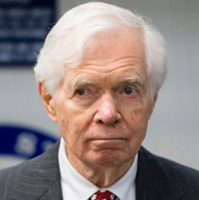
Former U.S. Senator Thad Cochran
Cochran retired in April 2018 because of ongoing health issues that had kept him away from the Senate for several months.
A funeral service will be held Monday at 11 a.m. at the State Capitol in Jackson. A second service will follow Tuesday at the Northminster Baptist Church in Jackson at 11 a.m.
Tributes for the late senator began pouring upon news of his death.
U.S. Senator Roger Wicker, who sat alongside Cochran representing Mississippi for a decade, said he “was a giant in the United States Senate and one of the greatest champions Mississippi has ever known.”
“When Thad Cochran left the Senate, I was reminded of Henry Wadsworth Longfellow, who wrote, ‘Lives of great men all remind us we can make our lives sublime, and departing leave behind us footprints on the sands of time,'” Wicker said. “Thad Cochran’s footprints are all around us
“Mississippi and our nation have lost a true statesman in Thad Cochran,” said Governor Phil Bryant. “He was a legend in the United States Senate where he worked tirelessly to move his state and country forward.”
President Donald Trump expressed condolences on Twitter: “Very sad to hear the news on the passing of my friend, Senator Thad Cochran. He was a real Senator with incredible values – even flew back to Senate from Mississippi for important Healthcare Vote when he was desperately ill. Thad never let our Country (or me) down!”
Cochran was born in 1937 in Pontotoc, a small town in the state’s northeast corner. After graduating from Ole Miss in 1959, he served two years in the Navy before returning home to finish law school and begin practicing law in Jackson.
His first foray into politics came in the 1968 presidential race, when he became state chairman for Richard Nixon’s campaign. At the time, the Republican Party was virtually non-existent in Mississippi, and segregationist George Wallace would bury Nixon. But four years later, Cochran would be elected to Congress on Nixon’s coattails as a Republican.
Cochran served three terms in the House before being elected to the Senate in 1978, becoming the first Republican since Reconstruction to represent the Magnolia State in the Senate.
During his time in the Senate, Cochran chaired both the agriculture and appropriations committees, positions that allowed him to funnel billions of dollars in federal money to projects back home, earning him the nickname “King of Pork.”
Cochran routinely won re-election without breaking a sweat until 2014, when he was challenged in the Republican primary by State Senator Chris McDaniel, who tried to rally Tea Party support to dislodge Cochran.
McDaniel forced Cochran into a primary runoff, which is when the good will and political capital the senator had banked during his long career paid off — he narrowly beat McDaniel after encouraging Democratic voters, including African Americans and farmers, to cross over and vote for him in the runoff.
That campaign became extremely contentious, particularly after a McDaniel supporter sneaked into a nursing home to shoot video of Cochran’s late wife, Rose, who was suffering from dementia, which was part of a gambit to accuse the senator of having an improper relationship with an aide.
The hard feelings remained in 2018, when McDaniel ran to succeed Cochran and the Republican establishment pulled out all the stops for Hyde-Smith, who beat McDaniel easily.
Rose Cochran died in 2014. In 2015, the senator married Kay Webber, a longtime aide.
Cochran is survived by his wife, two children and three grandchildren.
We tweet @ChkFriPolitics Join us!
Insight: Outcome of Kentucky governor’s race could be early indicator for Trump 2020
Can Governor Matt Bevin overcome his unpopularity by casting fall contest as conservative vs. liberal?
 ♦By Rich Shumate, ChickenFriedPolitics.com editor

Consider if you will a leader who is unapologetic, unconventional and unleashed. Who is in office not because of, but in spite of, the political class and cares little for its opinions.
A man whose opponents are reduced to sputtering fits of rage at the mere mention of his name. Who plays happily to his base, unperturbed by tepid approval ratings.
That, of course, describes Donald Trump, but it also describes the central player in the South’s hottest governor’s race in 2019 — which could very well be the first canary in the coal mine telling us how Trump himself might fare in 2020.

Kentucky Governor Matt Bevin
Kentucky Governor Matt Bevin is running for re-election after four turbulent years in Frankfort, in which he sparred with his fellow Republicans in the legislature, accused teachers of endangering students by leaving their classrooms to protest changes in their pensions, and lamented that Americans had become “soft” after school districts canceled classes during a subfreezing cold snap.
He has even endured the worst indignity that can befall a Kentucky politician — being booed lustily by the crowd on Derby Day.
In November, Bevin will face Democratic Attorney General Andy Beshear, the son of his predecessor, who over the past four years has made it his personal mission to sue Bevin — over pension reform, over higher education cuts and, most recently, over subpoenas issued to teachers who called in sick to protest at the Capitol.
The blood here is bad. Bevin went after Beshear’s mother, Kentucky’s former first lady, removing her from a commission that oversees a state horse park and taking her name off of a state-run visitor’s center.
Beshear likes to tell voters that the bombastic Bevin, who grew up in New Hampshire, just wasn’t raised right, a rather serious insult down South.
A preview of both camps’ general election strategies was full display on the night of May’s primary. Beshear called Bevin a bully and said the election would be about “right versus wrong.” Bevin called Beshear a liberal and said the election would be about right versus left.
The governor is betting that a binary choice between himself and a “liberal” candidate will work to his advantage in Kentucky, just as Trump is painting his re-election as a binary choice between him and the “socialists” he says are running amok in the Democratic Party.
The question will be whether, when it comes time for voters to render a verdict, the pull of that binary choice will be stronger than the incumbents’ personal unpopularity (which is, arguably, how Trump became president in the first place).
In a sense, Bevin was Trump before Trump was Trump. His came on the political scene in 2014 with a kamikaze mission to unseat U.S. Senator Mitch McConnell in a Republican primary with Tea Party support. In 2015, he won the GOP primary for governor by less than 100 votes after his two better-known rivals savaged each other. He won the general election by opposing same-sex marriage and tying his Democratic opponent to Barack Obama.
But as controversies have mounted, his fortunes have fallen. When Morning Consult looked at gubernatorial approval ratings in April, Bevin came in dead last, at just 33 percent and nearly 20 points under water.
Being tagged as America’s most unpopular governor is certainly no badge of honor when running for re-election, although Bevin, characteristically, insists he pays no attention to such things.
The governor’s job approval is about 10 points lower than Trump’s, and, while the president retains strong support among Republicans, Bevin could only manage to win 52 percent in May’s GOP primary, against three little-known opponents.
However, if the strategy of presenting a binary choice against a liberal is going to work anywhere, it should work in Kentucky, home to many rural, white, religious voters who propelled Trump to a whopping 40-point win in 2016.
Abortion is likely to be the key fault line in Bevin’s quest to paint Beshear as too liberal. Bevin opposes legal abortion; Beshear supports it and has refused to defend abortion restrictions passed by the legislature in court.
Bevin has also, not surprisingly, wrapped himself firmly in Trump’s aura. The president is featured prominently in his campaign ads and is expected to travel to the Bluegrass this fall to campaign for him.
A Bevin victory, despite weak poll numbers and ceaseless controversy, would be a boon for the binary choice strategy and a testament to Trump’s enduring popularity among his supporters.
A Bevin defeat could show the limits of trying to overcome marked unpopularity through ideological contrast. While that won’t have implications for 2020 in places such as Kentucky where Trump is popular, it could illustrate the limits of a contrast strategy in battleground states he needs to win.
No matter how Bevin vs. Beshear 2019 turns out, it will be loud, expensive and mean — just the thing to get us ready for Trump vs. Democrats 2020.
We tweet @ChkFriPolitics Join us!

Democrat Jaime Harrison launches campaign to unseat Republican U.S. Senator Lindsey Graham
Former state Democratic Party chair hits Graham for his about-face on Donald Trump
♦By Rich Shumate, ChickenFriedPolitics.com
 COLUMBIA, South Carolina (CFP) — Former South Carolina Democratic chair Jaime Harrison has entered the state’s 2020 U.S. Senate race with a pledge to bring “the spirit of helping” back to politics — and withering criticism of incumbent Lindsey Graham for his about-face embrace of Donald Trump.
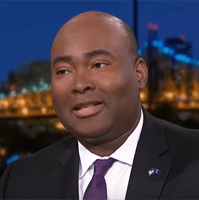
Jaime Harrison (From MSNBC)
Harrison, 43, a Columbia lawyer who serves as associate chair of the Democratic National Committee, unveiled his bid May 28 on MSNBC’s “The Rachel Maddow Show,” where he called Graham “a political windsock” who over the last two years has gone from Trump critic to Trump booster.
“I used to think that this was a guy who was a statesman, a guy who could stand above the fray and help solve the issues,” Harrison said. “He’s a chameleon who has changed his colors.”
Although South Carolina hasn’t elected a Democrat to the Senate since 1998, Harrison said he believes the party “is on the verge of a renaissance in the South,” pointing to recent gubernatorial races in Georgia and Florida, in which African American Democrats narrowly lost, and the party’s pickup of a U.S. House seat in the Palmetto State in 2018.
Harrison, a former aide to House Minority Whip Jim Clyburn, was the first African American elected to chair the state party in 2013. After four years in that role, he ran unsuccessfully for national DNC chair and was appointed as an associate chairman after Tom Perez won the position.
In an announcement video posted to his campaign website, Harrison contrasts Graham’s assessment of Trump during the 2016 campaign as a “kook,” “crazy” and a “race baiting, xenophobic religious bigot” with later comments that Graham is “all in” with Trump and the president “deserves the Nobel Peace Prize and then some.”
In the video, Harrison calls Graham “a guy who will say anything to stay in office.”
“Lindsey Graham can’t lead us in any direction because he has traded his moral compass for petty political gain,” Harrison said.
The Graham campaign didn’t immediately fire back. But the state GOP chair, Drew McKissick accused Democrats in a statement of “attacking Senator Graham for standing up for conservative values and refusing to give in to the liberal smear campaign against Justice Brett Kavanaugh.”
He said Harrison and the other Democrat in the race, Gloria Tinubu, “hope to extract revenge by rallying liberals across America to their cause, but they are going to learn the hard way that South Carolinians appreciate the leadership that Lindsey Graham has brought to the issues they care about.”
Tinubu, an economics professor and former state legislator in Georgia, announced her candidacy in April.
Graham, 63, is seeking a fourth term in 2020. He has posted double-digit wins in all three of his previous campaigns.
We tweet @ChkFriPolitics Join us!
Kentucky Attorney General Andy Beshear wins Democratic nomination to face Governor Matt Bevin
Bevin barely clears a majority in GOP gubernatorial primary
♦By Rich Shumate, ChickenFriedPolitics.com
LOUISVILLE (CFP) — Attorney General Andy Beshear narrowly won the Democratic primary for Kentucky governor, setting up a November showdown with Republican Governor Matt Bevin, who turned in a mediocre primary result against weak competition.
Attorney General Andy Beshear
Beshear turned back a challenge in the May 21 primary from State Rep. Rocky Adkins, who led for most of election night after running up huge margins of victory in Eastern Kentucky, where he lives. His lead faded once more returns from Louisville, Lexington and Western Kentucky rolled in.
Former State Auditor Adam Edelen, who led the race in fundraising and touted himself as a fresh face in Kentucky politics, finished third, unable to beat Beshear in the state’s urban centers and winning just two counties.
Beshear took 38 percent to 32 percent for Adkins and 27 percent for Edelen.
The results from the May 21 primary contained potentially ill portents for Bevin as he fights to hang on to his job.
Despite a significant money advantage and the powers of the governorship at his disposal, he took just 52 percent in the GOP primary against three little-known opponents and received 13,000 fewer votes in his primary than did Beshear, who faced much stouter competition — leading to some gloating by Beshear in his victory speech.
“Tonight we not only won this primary, we did something we’re going to do in November — we got more raw votes than Matt Bevin,” Beshear told supporters in Louisville.
State Rep. Robert Goforth, who has crisscrossed the commonwealth trying to convince his fellow Republicans that Bevin is a sure loser in November, took 39 percent of the vote and beat the governor in 27 of Kentucky’s 120 counties.
In the end, more than 120,000 Republicans voted for someone other than Bevin, who wrapped himself in the mantle of President Donald Trump in his television ads.
Speaking to reporters outside the Governor’s Mansion in Frankfort after the results came in, Bevin said he was not surprised by the result, noting that Goforth had run a substantive campaign.
The governor also said “I think it’s a little concerning for [Beshear] that he couldn’t even hit 40 percent.”
Bevin’s approval ratings have sagged as he sparred with his fellow Republicans in the legislature and criticized public school teachers, who have descended on Frankfort during the past two legislative sessions to protest proposed changes in state pensions.
His November battle with Beshear will be nothing new. The two have clashed repeatedly in court over the last four years, including the attorney general’s successful lawsuit to scuttle a GOP pension reform plan passed in 2018.
In his victory speech, Beshear — whose father, Steve, was Bevin’s predecessor as governor — went directly after Bevin, saying the general election is not about left versus right but “right versus wrong” and hitting the governor for contention in state politics during his term.
“We were raised better than this. We were raised better than the bullying we see in Frankfort,” he said. “Matt Bevin is going to try to make this election about anything other than his record because it is one of total failure.”
But Bevin told reporters at his news conference that the fall election will come down to a “binary” choice between conservative and liberal candidates.
“What you’re going to have … is a very clear contrast on issues that matter significantly to people in Kentucky,” Bevin said, noting in particular Beshear’s support for legal abortion, which he opposes “You have somebody in Andy Beshear who proudly supported Hillary Clinton. That doesn’t play well in Kentucky.”
The governor said he expects Trump to travel to Kentucky to campaign for him during the general election contest.
In other primary races, Miss America 2000 Heather French Henry, the only Kentucky woman to ever win the title, easily won the Democratic nomination for secretary of state to replaced the term-limited Alison Lundergan Grimes.
Henry polled more than 260,000 votes statewide, more than any other candidate on the primary ballot in either party.
Henry will face Republican Michael Adams, a former general counsel for the Republican Governor’s Association whom Bevin appointed to the State Board of Elections.
In the Republican race for attorney general, Daniel Cameron, an attorney and former University of Louisville football player who served as legal counsel to Senate Majority Leader Mitch McConnell, defeated State Senator Wil Schroder, a former prosecutor from suburban Cincinnati.
He will now face Democrat Greg Stumbo, who held the attorney general’s job from 2004 to 2008.
Hanging on to the attorney generalship, which Beshear used with great effect to stymie Bevin, is an important aim for Democrats, who have held the office continuously since 1948.

 Chicken Fried Politics