
Latest Posts
Latest Coverage
-
Symbolic solution in search of an actual problem
Support of 9 Southern Republicans for Respect for Marriage Act shows why Supreme Court isn’t about to ban same-sex marriage ♦By Rich Shumate, ChickenFriedPolitics.com editor…
-

West Virginia stubborn, or playing hard to get
U.S. Senator Joe Manchin pisses off his party yet again … to what end? ♦By Rich Shumate, ChickenFriedPolitics.com editor Also in this report: Atlanta DA…
-
2 Mississippi Republican U.S. House members forced into runoffs after weak primary showings
Michael Guest narrowly trails challenger in 3rd District; Steven Palazzo clears just 32% in 4th District ♦By Rich Shumate, ChickenFriedPolitics.com editor JACKSON, Mississippi (CFP) –…
-
Mississippi Republican U.S. Rep. Steven Palazzo facing Tuesday primary fight amid ethics investigation
6 opponents hitting “No-Show Palazzo” over inattention to district, ethics problems ♦By Rich Shumate, ChickenFriedPolitics.com editor GULFPORT (CFP) — Mississippi U.S. Rep. Steven Palazzo —…
-

Primary Wrap: Kemp, Raffensperger survive Trump’s ire; Brooks makes Alabama U.S. Senate runoff
Texas Democratic U.S. Rep. Henry Cuellar survives challenge from the left; George P. Bush gets blown out by Attorney General Ken Paxton ♦By Rich Shumate,…
-
U.S. House’s last pro-life Democrat, Texas’s Henry Cuellar, fighting to keep seat in Tuesday primary runoff
Challenger Jessica Cisneros wanted House Democratic leaders to rescind Cuellar endorsement; they refused ♦By Rich Shumate, ChickenFriedPolitics.com editor LAREDO, Texas (CFP) — Amid the newly…
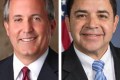
Texas kicks off 2022 midterms with primaries featuring battles for attorney general, U.S. House
Republican Attorney General Ken Paxton and Democratic U.S. Rep. Henry Cuellar trying to hang on amid FBI investigations
♦By Rich Shumate, ChickenFriedPolitics.com editor
 AUSTIN (CFP) — Voters in Texas kick off the 2022 midterm elections with the nation’s first party primary Tuesday, featuring a pitched battle among Republicans for attorney general, the last pro-life Democratic in the U.S. House trying to hang on to his South Texas seat, and two House Republicans facing primary challenges for not being sufficiently pro-Trump.
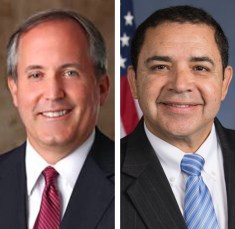
Republican Attorney General Ken Paxton and Democratic U.S. Rep. Henry Cuellar facing primary challenges
Voters will pick party nominees for statewide offices, including governor and lieutenant governor, as well as races for 38 U.S. House seats and the state legislature, which are being fought under newly drawn maps.
No U.S. Senate seat is up this year in the Lone Star State.
Polls for in-person voting open at 7 a.m. and close at 7 p.m., in both the Central and Mountain time zones.
Republican Governor Greg Abbott is expected to easily dispatch seven primary challengers, on his way to a November match-up with Democratic former U.S. Rep. Beto O’Rourke, a prohibitive favorite in the Democratic primary.
Seven Republicans holding statewide executive offices are running for re-election, with two facing fierce primary challenges to keep their posts.
Attorney General Ken Paxton – who is being investigated by the FBI and sued by former staffers in his office while facing a criminal trial for securities fraud – is facing three primary challengers, including Land Commissioner George P. Bush, the third generation of his famous family involved in Texas politics; U.S. Rep. Louie Gohmert, who gave up his House seat to take a last-minute plunge into the race; and Eva Guzman, who left the state Supreme Court to run against Paxton.
Pre-election polls indicated that Paxton, who has been endorsed by Donald Trump, will likely face a runoff against Bush, setting up a MAGA-vs.-Establishment free-for-all in the May 24 contest.
Five Democrats are waiting in the wings for the Republican primary winner, with hopes of winning the party’s first statewide race in 28 years, particularly if Paxton prevails.
Agriculture Commissioner Sid Miller is also facing a tight battle with two Republican challengers, amid ongoing battles with state legislators and the indictment of a campaign consultant on bribery charges related to hemp licenses overseen by his office.
State Rep. James White from Hillister, the only black Republican in the Texas House, has scooped up endorsements from 20 fellow lawmakers in his bid to unseat Miller. Also in the race is Carey Counsil, a rancher and real estate developer from Brenham.
In U.S. House District 28 in South Texas, moderate Democratic U.S. Rep. Henry Cuellar from Laredo – the last pro-life Democrat left in the House – is facing Jessica Cisneros, a Laredo immigration lawyer who has the backing of key figures in the Democratic left, including Vermont U.S. Senator Bernie Sanders and New York U.S. Rep. Alexandria Ocasio-Cortez.
Cisneros came within 3,000 votes of unseating Cuellar in 2020. The district has since been redrawn, and Cuellar is also running under the shadow of a January FBI raid on his home and office, related to an investigation of donations connected to Azerbaijan. He has denied any wrongdoing.
Republicans in the Texas legislature made the majority-Hispanic district more Republican, and it will be a top GOP target in the fall. Joe Biden would have carried it by just four points.
In U.S. House District 3 in suburban Dallas, U.S. Rep. Van Taylor is facing four Republican challengers who are hitting him for voting to certify President Joe Biden’s Electoral College win and supporting a congressional investigation into the January 6th riot at the U.S. Capitol.
In U.S. House District 2 in suburban Houston, U.S. Rep. Dan Crenshaw, a former Navy SEAL who has been seen as a rising Republican star since his election in 2018, is also facing three primary challengers after criticizing Trump for his actions on January 6th and opposing efforts to thwart Biden’s victory.
Two other open U.S. House seats have triggered primary battles, one in each party, for seats where the primary will likely decide the November winner.
In heavily Republican District 8 in suburban Houston, where U.S. Rep. Kevin Brady is retiring, the primary race has turned into a proxy battle between the Republican establishment and hard-right MAGA luminaries in the House Freedom Caucus.
Morgan Luttrell, a Navy veteran and former adviser in the U.S. Department of Energy, is running with the backing of Lieutenant Governor Dan Patrick, former governor Rick Perry, and U.S. Rep. Adam Kinzinger of Illinois, one of Trump’s most vocal critics.
Luttrell served with Kinzinger in the military and has said he considers him a friend and “not a traitor to his country.” But pressed by his opponents over their relationship, Luttrell said he returned a campaign donation from Kinzinger and doesn’t “agree with anything Adam says politically anymore.”
On the other side, conservative political consultant and podcaster Christian Collins is backed by U.S. Senator Ted Cruz, U.S. Reps. Marjorie Taylor Greene and Madison Cawthorn and My Pillow CEO Mike Lindell.
In District 30 in Dallas, where veteran Democratic U.S. Rep. Eddie Bernice Johnson is retiring, nine Democrats are competing for the nomination to represent the majority-minority district. Johnson endorsed State Rep. Jasmine Crockett as her successor.
In District 15, a seat that Democratic U.S. Rep. Vicente Gonzalez gave up to seek re-election in a neighboring district, six Democrats and eight Republicans are vying for their party’s nomination.
The newly configured district, which stretches from San Antonio to the Rio Grande Valley, is expected to be a battleground between the two parties in the fall. Biden would have carried it by less than two points in 2020.
We tweet @ChkFriPolitics Join us!

Decision in Arkansas case could limit lawsuits under Voting Rights Act
Federal judge rules that only U.S. attorney general, not private groups or individuals, can bring suits under the 1965 law
♦By Rich Shumate, ChickenFriedPolitics.com editor
 LITTLE ROCK (CFP) — Can private groups and individuals who believe their electoral prospects are harmed by new political maps bring suit in federal court under the Voting Rights Act?
For more than 50 years, the answer to that question has been yes. But a federal judge in Arkansas has come down on the other side, saying that only the U.S. attorney general, not private parties, can bring lawsuits under the act.
The decision drew strong rebukes from voting rights advocates, who say that line of reasoning would drastically undercut the ability of minority voters to seek redress in federal court.
“It is farcical to think the [Voting Rights Act] could be consistently enforced without citizens having the right to bring suit to protect their voting rights,” said the Arkansas Public Policy Panel, one of the plaintiffs in the case, in a statement.
“The Court ruling would create a reality where state or local governments can violate voting rights … but citizens must wait and hope the federal government has the capacity and desire to intervene to enforce those rights.”
While the Biden administration has pledged to be active in pursuing voting rights cases, the record of the Trump Justice Department illustrates how lack of such desire might affect plaintiffs — in four years, it brought just one such suit, over selection of a school board in a South Dakota district with a large native population.
The decision by U.S. District Judge Lee Rudofsky – a member of the conservative Federalist Society appointed to the federal bench by Donald Trump – tees up a case that conservatives on the U.S. Supreme Court could use to drastically limit lawsuits under the Voting Rights Act.
At least two Supreme Court justices, Neil Gorsuch and Clarence Thomas, have already signaled in another case that they are sympathetic to Rudofsky’s interpretation of who can bring lawsuits under the Voting Rights Act, which overturns the rationale in a 1969 Supreme Court decision that has governed voting rights cases for more than 50 years.
The Justice Department declined Rudofsky’s invitation to step into the case, prompting the plaintiffs to appeal to the Eighth U.S. Circuit Court of Appeals, which could set the case on a path to the Supreme Court.
The Arkansas lawsuit centers around a new map for state House seats crafted by Republicans in the legislature, which has 11 majority black districts out of 100, in a state where the black population is 16%.
The plaintiffs – the Arkansas NAACP and the Arkansas Public Policy Panel – contend that the map violates Section 2 of the Voting Rights Act because legislators could have drawn 16 geographically compact, majority black districts.
Plaintiffs in Section 2 lawsuits don’t have to prove discrimination was intentional, just that the map creates a discriminatory effect.
In his decision, Rudofsky said “there is a strong merits case that at least some of the challenged districts … are unlawful.” But he said he could not make that determination because the language of Section 2, as drafted by Congress, gives only the U.S. attorney general the right to litigate violations.
“The question is not whether the Court believes the Voting Rights Act has been and continues to be a force for good and progress in our society. (I do.) The question is not whether the Court believes that in the last 57 years Congress should have included a private right of action in the Voting Rights Act. (I do.) The question is not whether the Court believes cases like this one are important to pursue. (I do.)
“The narrow question before the Court is whether, under current Supreme Court precedent, a court should imply a private right of action to enforce [Section 2] of the Voting Rights Act where Congress has not expressly provided one. The answer to this narrow question is no. Only the Attorney General of the United States can bring a case like this one.”
But Rudofsky also said he would welcome an appeal by the plaintiffs because the “private-right-of-action question is an important one” and “this Court will not be the last word on it.”
“Judges should not be allergic to acknowledging that any one of our legal conclusions might be wrong,” he said. “If the strength of plaintiff’s private-right-of-action arguments is really as overwhelming as they suggest it is, then the Eighth Circuit or the Supreme Court will overrule [this] decision.”
In 1969, the U.S. Supreme Court, in the case of Allen vs. State Board of Elections, ruled that a private right of action was implied in Voting Rights Act cases brought under another section of the law.
But Rudofsky said later Supreme Court decisions have changed the standard used to determine private-right-of-action cases, rendering the Allen case inapplicable.
Rudofsky also noted that private groups and individuals can still bring suits in federal courts challenging maps on 14th and 15th Amendment grounds, without turning to the Voting Rights Act.
We tweet @ChkFriPolitics Join us!
North Carolina Supreme Court strikes down Republican-drawn U.S. House, legislative maps
Court says politically gerrymandered maps violate state constitution, orders legislators to try again
♦By Rich Shumate, ChickenFriedPolitics.com editor
 RALEIGH (CFP) – North Carolina’s Supreme Court has struck down political maps drawn by Republican legislators to maximize their political advantage over the next decade, a victory for Democrats in one of the country’s most evenly divided swing states.
In a February 4 decision, the high court, which has a 4-to-3 Democratic majority, said maps drawn for U.S. House seats and state legislative districts were gerrymandered for political reasons in violation of the state constitution.
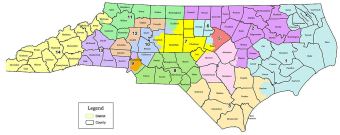 The court gave legislators just two weeks, until February 18, to redraw the maps, or a lower court will take over the process. It did not delay the scheduled May 17 primary but said that election must use the new maps.
“Achieving partisan advantage incommensurate with a political party’s level of statewide voter support is neither a compelling nor a legitimate governmental interest,” said the majority ruling, penned by Associate Justice Robin Hudson, a Democrat.
The court also ordered legislators to avoid chopping up counties into multiple districts whenever possible – a direct shot at the Republican map, which divided Mecklenberg and Guilford counties into three districts each to dilute the Democratic vote in Charlotte and Greensboro.
In a sharply worded dissent, Chief Justice Paul Newby, a Republican, accused the court’s Democratic majority of usurping the legislature’s power to decide redistricting, suggesting that amounted to “judicial despotism”
“A majority of this court … tosses judicial restraint aside, seizing the opportunity to advance its agenda,” Newby wrote.
North Carolina is one of just six states where judges are elected on a partisan basis.
Although North Carolina is closely competitive between Democrats and Republicans, the U.S. House map drawn by Republican legislators would have likely given the GOP 10 of the state’s 14 seats, compared to the current line-up of eight Republicans and five Democrats. (The state gained a new seat during reapportionment after the 2020 census.)
The legislative maps would also have cemented Republican control of both houses of the legislature over the next decade.
Democratic Governor Roy Cooper did not have the power to veto the maps, drawn by Republicans who control both houses of the legislature, forcing Democrats to go to court to try to reverse them.
The biggest beneficiary of the court’s decision may be freshman Democratic U.S. Rep. Kathy Manning, whose district in Greensboro and Winston-Salem was dismembered in the invalidated map. She had not announced her re-election plans, pending resolution of the legal challenge.
Another Democrat, U.S. Rep. G.K. Butterfield –- a former chair of the Congressional Black Caucus who sat on the state Supreme Court before his election to Congress — retired after legislators made his district in rural Eastern North Carolina more competitive by reducing its population of black voters.
Democratic U.S. Rep. David Price from Chapel Hill also announced his retirement, even though his district was left largely intact.
After Republican legislators passed their map, U.S. Rep. Madison Cawthorn announced that he would leave his current district in far Western North Carolina and run instead in a more Republican district just to the east that included suburban Charlotte. Those plans may be upended once the map is redrawn.
Another candidate who may be affected is Clay Aiken, the “American Idol” finalist who announced he would run as a Democrat for Price’s seat. Although the new map is not likely to change that district, had it stood, Aiken may have faced a primary contest against Manning, rather than a easier run for an open seat.
Cooper hailed the court’s decision in a statement, saying “a healthy democracy requires free elections and the NC Supreme Court is right to order a redraw of unconstitutionally gerrymandered districts.”
“More work remains and any legislative redraw must reflect the full intent of this decision,” he said.
But Republican State Senator Ralph Hise, chair of the Senate’s redistricting committee, called the decision a “perverse precedent” that will be “nearly impossible to unwind.”
“Democratic judges, lawyers, and activists have worked in concert to transform the Supreme Court into a policymaking body to impose their political ideas,” Hise said.
We tweet @ChkFriPolitics Join us!
Preemptive Strike: North Carolina U.S. Rep. Madison Cawthorn sues to block ballot challenge
Cawthorn says attempt to toss him off 2022 ballot for role in January 6th is unconstitutional
♦By Rich Shumate, ChickenFriedPolitics.com editor
 ASHEVILLE (CFP) — Tucked inside the 14th Amendment to the U.S. Constitution, in lesser known Section 3, is a provision that says “no person shall be a Senator or Representative in Congress” if, having taken an oath to support the Constitution “shall have engaged in insurrection or rebellion against the same, or given aid or comfort to the enemies thereof.”

U.S. Rep. Madison Cawthorn, R-North Carolina
A North Carolina federal judge is now being called upon to decide whether that prohibition — meant to keep unreconstructed Confederates out of Congress after the Civil War — is applicable to supporters of Donald Trump involved in events surrounding the January 6, 2020 riot at the U.S. Capitol.
North Carolina Republican U.S. Rep. Madison Cawthorn, a fiercely pro-Trump partisan who spoke at a rally on the Ellipse before the riot, has gone to federal court to block the North Carolina State Elections Board from hearing a complaint filed by voters in his district, asking that he be barred from the 2022 ballot over his actions that day.
If successful, his preemptive strike would prevent the board’s Democratic majority from possibly agreeing that his actions amounted to “insurrection” and barring him from seeking re-election.
His case has been assigned to U.S. District Judge Richard Myers in Wilmington, whom Trump appointed to the federal bench in 2019.
The group that organized the effort to disqualify Cawthorn, Free Speech for People, is planning similar challenges against other conservative pro-Trump lawmakers who have raised false claims of voter fraud and riled up the crowd on January 6th.
Section 3 does not outline a mechanism to disqualify lawmakers for “insurrection,” or even define the term. So the ad-hoc effort to use it as a cudgel against lawmakers who have promoted Trump’s unproven allegations of voter fraud plows untested legal ground that Cawthorn’s suit might help define.
Another aspect of the legal fight could be the conditions attached to North Carolina’s readmission to the Union in 1868, which required the state to enforce the 14th Amendment.
The North Carolina elections board has not acted on the voters’ challenge. However, state law requires that the board automatically hold a hearing if challengers establish a “reasonable suspicion” that there is a valid reason for disqualification, a provision that Cawthorn says violates his First Amendment right to run for office.
Cawthorn also contends that the challenge statute would require him to prove he didn’t engage in insurrection or rebellion, rather than the challengers proving that he did, which violates his rights under the 14th Amendment’s Due Process Clause.
And finally, he argues that under the Constitution, only Congress has the authority to decide who is or is not eligible to be a member, not a state board.
He wants the judge to prevent the state elections board from even hearing the challenge, contending the entire effort is a constitutional affront.
In a statement, Cawthorn said the challenge statute is “being used as a weapon by liberal Democrats to attempt to defeat our democracy by having state bureaucrats, rather than the people, choose who will represent North Carolina in Congress.”
But Ron Fein, Free Speech for People’s legal director, said in a statement that “Cawthorn’s attempt to bypass the state’s well-developed procedures for resolving candidacy challenges is based on misunderstandings of federal and state law,” particularly the state’s agreement to enforce the 14th Amendment.
“It is unfortunate that Madison Cawthorn has decided to run to federal court instead of complying with the process before the State Board of Elections,” Fein said. “We intend to move to intervene in this federal court case to oppose Cawthorn’s attempted end-run around the laws that the people of North Carolina enacted for addressing candidacy challenges.”
Under state law, the five-member election board has three members from the same party as the governor – currently Democrat Roy Cooper – and two members of the opposing party.
After Cooper was elected in 2016, Republicans who control the legislature passed legislation to reconfigure the board to keep it out of Democratic hands, but Cooper successfully went to court to overturn that effort.
Cawthorn, 26, from Hendersonville, is the youngest member of Congress. He was elected in 2020 and took his oath of office, vowing to uphold the Constitution, just days before the January 6th riot.
He has announced that he plans for re-election in the state’s newly configured 13th District, rather than the 11th District in Western North Carolina that he currently represents. However, the state’s new map is being challenged in both state and federal courts and could be redrawn.
We tweet @ChkFriPolitics Join us!
U.S. Supreme Court overrules panel of judges who blocked U.S House map over 2nd majority-black district
High court’s decision will leave map in place for 2022 election but allows challenge to map to continue
♦By Rich Shumate, ChickenFriedPolitics.com editor
 WASHINGTON (CFP) — The U.S. Supreme Court has overruled a panel of Alabama federal judges who ordered state legislators to redraw the state’s U.S. House map to create a second majority-black district.
The decision is a victory for Republican members of Alabama’s U.S. House delegation, who can now proceed with their re-election plans without the daunting prospect of running in unfamiliar territory.
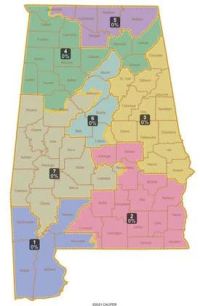
Alabama U.S. House map blocked by federal court
In a 5-to-4 decision issued February 8, the high court did not rule on the underlying legal dispute over whether Alabama’s map violated the Voting Rights Act. But the majority said forcing legislators to redraw it before May’s primary, with candidate qualifying underway, would be too disruptive to the process.
“When an election is close at hand, the rules of the road must be clear and settled,” Justice Brett Kavanaugh wrote explaining the majority’s reasoning. “Late judicial tinkering with election laws can lead to disruption and to unanticipated and unfair consequences for candidates, political parties, and voters.”
However, Chief Justice John Roberts — who voted with the court’s four liberal members against giving the state a stay of the lower court ruling — said the lower court had “properly applied” the standard for evaluating voting rights challenges “with no apparent errors for our correction.”
The Supreme Court’s order did not invalidate the determination of the lower court that the map was illegally drawn but stayed the order striking down the map until the case can be fully adjudicated — likely with another trip up to the Supreme Court.
On January 24, a panel of three federal judges — which included two judges appointed by Donald Trump — tossed out the map drawn by state legislators that contained six heavily Republican districts and one majority black district, following the general contours of the map in place since 2011.
The judges noted that the black voting age population in Alabama is 27%, while having one black Congress member out of seven results in 14% representation. With two black members, participation and the voting age population would match, and the judges told legislators that “any remedial plan will need to include two districts in which Black voters either comprise a voting-age majority or something quite close to it.”
The decision would almost certainly have meant another Democrat joining the state’s seven-member House delegation, forcing one of the five sitting Republicans seeking re-election to either run in unfamiliar territory in North Alabama or launch a primary challenge to one of their GOP colleagues to stay in office.
Attorney General Steve Merrill immediately appealed the ruling to the Supreme Court, saying he “strongly disagreed” with the judges’ conclusion that the map ran afoul of the federal Voting Rights Act.
The ruling also had implications in neighboring Louisiana, which has an even higher black voting age population but just one black member of Congress in a six-member delegation. (Adding a second black-majority district in Louisiana would slightly overrepresent the state’s black voting age population because of its lower number of seats.)
With the ruling in the Alabama case, it would appear that the high court would be unlikely to sustain a similar challenge in Louisiana.
If the courts eventually order creation of second majority-black district, the change would likely have the biggest effect in South Alabama. The current majority-black 7th District, represented by Democrat Terri Sewell, includes black voters in Birmingham and Montgomery but not in Mobile, which has a black majority that could be the core of a new district.
Another possibility would be creating a seat similar to a district in southwest Georgia, which includes enough of the area’s rural black population to elect black Democrat Sanford Bishop, who has held the seat since it was created in 1992.
Prior to 2013, the Biden Justice Department would have needed to clear Alabama’s U.S. House map before it could have gone into effect. But a U.S. Supreme Court ruling struck down the pre-clearance provisions of the Voting Rights Act, which pushed map challenges into federal courts.
The judges who struck down Alabama’s map were Trump-appointed U.S. District Judges Terry Moorer, from the Southern District of Alabama, and Anna Manasco, from the Northern District, and 11th U.S. Circuit Court of Appeals Judge Stanley Marcus, who was appointed to the Atlanta-based appeals court by President Bill Clinton.

 Chicken Fried Politics