
Latest Posts
Latest Coverage
-
Symbolic solution in search of an actual problem
Support of 9 Southern Republicans for Respect for Marriage Act shows why Supreme Court isn’t about to ban same-sex marriage ♦By Rich Shumate, ChickenFriedPolitics.com editor…
-

West Virginia stubborn, or playing hard to get
U.S. Senator Joe Manchin pisses off his party yet again … to what end? ♦By Rich Shumate, ChickenFriedPolitics.com editor Also in this report: Atlanta DA…
-

2 Mississippi Republican U.S. House members forced into runoffs after weak primary showings
Michael Guest narrowly trails challenger in 3rd District; Steven Palazzo clears just 32% in 4th District ♦By Rich Shumate, ChickenFriedPolitics.com editor JACKSON, Mississippi (CFP) –…
-

Mississippi Republican U.S. Rep. Steven Palazzo facing Tuesday primary fight amid ethics investigation
6 opponents hitting “No-Show Palazzo” over inattention to district, ethics problems ♦By Rich Shumate, ChickenFriedPolitics.com editor GULFPORT (CFP) — Mississippi U.S. Rep. Steven Palazzo —…
-

Primary Wrap: Kemp, Raffensperger survive Trump’s ire; Brooks makes Alabama U.S. Senate runoff
Texas Democratic U.S. Rep. Henry Cuellar survives challenge from the left; George P. Bush gets blown out by Attorney General Ken Paxton ♦By Rich Shumate,…
-

U.S. House’s last pro-life Democrat, Texas’s Henry Cuellar, fighting to keep seat in Tuesday primary runoff
Challenger Jessica Cisneros wanted House Democratic leaders to rescind Cuellar endorsement; they refused ♦By Rich Shumate, ChickenFriedPolitics.com editor LAREDO, Texas (CFP) — Amid the newly…
Four Southern Democrats among rebels opposing Nancy Pelosi for U.S. House speaker
Four incoming freshmen have not taken a position on Pelosi’s tenure as Democratic leader
♦By Rich Shumate, ChickenFriedPolitics.com editor
 WASHINGTON (CFP) — After an election season in which Republicans used the specter of Nancy Pelosi’s speakership as a weapon against their Democratic opponents, four Southern Democrats, including two incoming freshman, have signed on to an effort to replace her as Democratic leader.
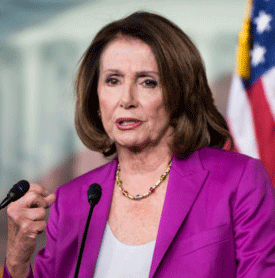
House Democratic Leader Nancy Pelosi
Two incumbents — Jim Cooper of Tennessee and Filemon Vela of Texas — and one newcomer, Joe Cunningham of South Carolina, are among 16 House members who signed a letter calling for “new leadership” in the Democratic caucus, which will take control of the House in January.
“Our majority came on the backs of candidates who said that they would support new leadership because voters in hard-win districts, and across the country, want to see real change in Washington,” the letter said. “We promised to change the status quo, and we intent to deliver on that promise.”
The anti-Pelosi rebels said they would oppose her as speaker both in the vote in which Democrats will select a speaker candidate on November and on the House floor, where Pelosi will need a majority of 218 votes to defeat the Republicans’ expected candidate, Kevin McCarthy, in January.
Democrats are on track to have 234 seats in the new House, which means Pelosi can lose a maximum of 16 Democratic votes.
In addition to the three Southern Democrats who signed the letter, another incoming freshman, Abigail Spanberger of Virginia, has said she will oppose Pelosi.
In an interview with CNN, Spanberger said that while she has “tremendous respect” for Pelosi, “one of the things that I talked about frequently on the campaign trail was the need to have new voices in Congress, the need to turn a new page in the way we engage across the aisle, and really to be able to work on the priorities that were most important to the people in my district.”
Four other incoming members — Colin Allred of Texas, Kendra Horn of Oklahoma, Lucy McBath of Georgia, and Elaine Luria of Virginia — have not taken a position on Pelosi’s speakership. All four narrowly won their races over Republican incumbents who highlighted their possible support for Pelosi in their campaigns.
The six remaining Southern Democratic freshmen — Veronica Escobar, Sylvia Garcia and Lizzie Pannill Fletcher of Texas, Donna Shalala and Debbie Mucarsel-Powell of Florida, and Jennifer Wexton of Virginia — have all said they will support Pelosi.
Escobar and Garcia won open Democratic seats. Fletcher, Shalala, Mucarsel-Powell and Wexton flipped Republican seats.
Pelosi, 78, has represented San Francisco in the House since 1987 and has led House Democrats since 2002. She served as speaker from 2007 until 2011, the first woman to hold the post.
Her long tenure as leader — 16 years and counting — and her usefulness as a bogeyman for Republicans are driving the opposition to her, which is generally not a fight over policy or ideology.
However, the rebellion against Pelosi within the Democratic caucus is not widespread, including among Southern members. Only Cooper and Vela are opposing her; 116 other returning Southern Democratic members are expected to support her.
Cooper’s opposition is not a surprise. The Nashville Democrat, who has opposed Pelosi five times in the past, told The Tennessean that new Democratic members “won their districts by tiny margins and are in danger of losing in 2020 unless we prove to voters that we are working hard to get America back on track.”
Vela, from Brownsville, had supported Pelosi’s bid for Democratic leader after the 2016 election. But he called for her to step down after the party lost a high-profile special election in Georgia in 2017 in which Republicans relentlessly tied the Democratic candidate to her.
Republican Karen Handel, the winner of that special election, in Georgia’s 6th District in suburban Atlanta, lost her seat to McBath.
No one has so far stepped forward to run against Pelosi for Democratic leader. Given that party members are highly unlikely to vote for McCarthy on the floor, it remains unclear for whom the anti-Pelosi rebels might cast their votes.
One option would be to vote “present” instead of for another candidate, which would not imperil Pelosi because she only has to win a majority of those members actually voting. However, in their letter, her opponents said they were “committed to voting for new leadership both in our Caucus meeting and on the House floor.”
Should Pelosi survive, the lone Southerner in the House Democratic leadership, Jim Clyburn of South Carolina, is expected to become the House majority whip, the No. 3 position. He is currently the only candidate for the position.
Should Pelosi be unable to secure a majority for the speakership, the scramble to replace her could upset the entire Democratic hierarchy in the House.
Decision ’18: Democrats’ net gain of 10 Southern U.S. House seats came in the suburbs
Republicans still have 2-to-1 advantage and hold the line in North Carolina, upper South
♦By Rich Shumate, ChickenFriedPolitics.com
 (CFP) — With all races now decided, Democrats have made a net gain of 10 U.S. House seats across the 14 Southern states in the November 6 election.
While that total was an improvement over their results in 2014 and 2016, Democrats flipped only about a third of the seats they targeted, and Republicans will still hold a 2-to-1 advantage in Southern seats when Congress reconvenes in January.
Democratic gains were centered in suburban areas around major cities, including Atlanta, Houston, Dallas, Richmond, Miami, the Virginia suburbs of Washington, D.C. and the Hampton Roads area of southeastern Virginia. They also carried a district that contains metro Oklahoma City and another that includes Charleston and the Low Country of South Carolina.
However, Democrats went 0-for-4 in targeted seats in North Carolina, 2-for-9 in Florida and 2-for-8 in Texas. They also fell short in targeted races in the upper South states of Arkansas, Kentucky and West Virginia, where Republicans continue to hold 12 out of 13 House seats.
Among those losses was in Kentucky’s 6th District, where Democrat Amy McGrath could not pull out a victory despite raising an astounding $7.8 million, more than any other Southern challenger in this election cycle.

McBath

Hurd
Democrats did win five of the six GOP-held Southern seats that Hillary Clinton carried in 2016; the lone exception was in Texas’s 23rd District, in West Texas, where Republican Will Hurd won a narrow victory. Democrat Lucy McBath also ousted Republican Karen Handel in Georgia’s 6th District, where Donald Trump won by just 1.5 points in 2016.
Four Republican House members, with a combined 48 years of service, went down in the Clinton districts, including Pete Sessions and John Culberson in Texas, Barbara Comstock in Virginia, and Carlos Curbelo in Florida. Republicans also lost in Florida’s 27th District in Miami-Dade, which U.S. Rep. Ileana Ros-Lehtinen had held for 30 years before deciding to retire.
Democrats kept all of the 40 seats they held going into the election. With the 10 Democratic gains, Southern Republicans will hold 102 seats to 50 for Democrats when Congress reconvenes in January.
In the last Congress, just 13 white Democrats who were not Latino or Asian represented Southern districts. That number will go up to 20 in January, as seven white Democrats displaced Republicans.
Two of the seats that flipped to Democrats were won by African-American candidates — McBath in Georgia and Colin Allred in Texas — and one by a Latina, Debbie Mucarsel-Powell, who defeated Curbelo.
Hurd, who represents a majority Latino district, will be the only African-American Republican in the new House. Three Southern Republicans are Latino — Mario Diaz-Balart of Florida, Bill Flores of Texas, and Alex Mooney of West Virginia, whose mother is Cuban.
We tweet @ChkFriPolitics Join us!
Decision ’18: Democrat Bill Nelson concedes defeat in Florida U.S. Senate race
Republican Governor Rick Scott will move from Tallahassee to Washington after winning recount
♦By Rich Shumate, ChickenFriedPolitics.com
 TALLAHASSEE (CFP) — After protests, a flurry of lawsuits and two recounts, Democratic U.S. Senator Bill Nelson has conceded defeat to Republican Governor Rick Scott, possibly bringing the curtain down on a political career that spanned more than four decades and included a trip into space.
Scott’s victory means there will be just four Democrats among the 28 senators representing Southern states, down one from the last Congress. And Florida will have two Republican senators for the first time since Reconstruction in 1875.
In a video released by his campaign, Nelson said that while he lost the Senate race, “I by no means feel defeated, and that’s because I’ve had the great privilege of serving the people of Florida and our country for most of my life.”
“It’s been a rewarding journey as well as a very humbling experience,” he said.
He also made a plea for more civility to combat “a gathering darkness” in American political life.
“We have to move beyond a politics that aims not just to defeat but to destroy, where truth is treated as disposable,” he said.
Scott, who has now won three consecutive statewide elections by thin margins, issued a statement thanking Nelson “for his years of public service.”
Nelson’s concession came after a machine recount of ballots in all 67 counties and a hand recount of ballots with under-votes or over-votes in the Senate race did not overturn Scott’s margin of victory.
Scott defeated Nelson by just 10,033 votes, out of nearly 8.2 million cast.
Scott had led on election night, but late reports of ballots from Democratic-leaning Broward and Palm Beach counties began narrowing the lead. Both Scott and President Donald Trump suggested that fraud was occurring in both counties, although evidence seemed to point to mismanagement rather than deliberate malfeasance.
In the following days, both campaigns went to court, and protests erupted outside elections offices in Broward — scenes reminiscent of the recount battle that erupted in the Sunshine State after the 2000 presidential election.
Nelson’s last hope was turning up uncounted ballots in Broward, where 25,000 fewer people voted in the Senate election than in the race for governor. But the hand recount confirmed that those ballots were indeed under-votes, which could have been caused by a flawed ballot design.
In Broward, the Senate race was listed at the bottom of a column underneath voting instructions, which could have resulted in some voters not seeing it.

Florida Governor Rick Scott
Scott, 65, went into politics after building a fortune in the health care industry. Financial disclosure reports put his net worth at around $250 million.
He won the governorship in 2010 with a margin of just 1.2 percent and won re-election in 2014 in an even closer race, 1 percent. His margin over Nelson in the Senate race was narrower still, 0.12 percent.
Scott’s win means Republicans will have at least 52 seats in the next Senate to 47 for Democrats, a net pickup of two seats. One seat remains to be decided in Mississippi, where Republicans are favored.
U.S. Senator Bill Nelson of Florida
Nelson, 76, won his first election, to the Florida House, in 1972. He served 12 years in the U.S. House and six years as Florida’s insurance commissioner before winning election to the Senate in 2000.
In 1986, while a sitting member of the House, Nelson went into space as a payload specialist on the space shuttle Columbia. His district included the Kennedy Space Center.
Just 10 days after his return, a different space shuttle, Challenger, exploded during launch, which ended NASA’s program of sending civilians into space.
With Nelson’s defeat, the only Democrats representing Southern states will be Mark Warner and Tim Kaine in Virginia, Joe Manchin in West Virginia, and Doug Jones in Alabama.
We tweet @ChkFriPolitics Join us!
Decision ’18: Florida governor’s race ends as Andrew Gillum reconcedes
Governor-elect Ron DeSantis will ascend to governorship after just four years in politics
♦By Rich Shumate, ChickenFriedPolitics.com editor
TALLAHASSEE (CFP) — The Florida governor’s race has come to an end with Democrat Andrew Gillum’s second concession to Republican Governor-elect Ron DeSantis.
Gillum — who had conceded on election night but took it back after late-reporting results showed the race tightening — took to Facebook Saturday to offer his congratulations to DeSantis and thank his supporters.
“More than 4 million of you decided that you wanted a different direction for the state of Florida,” he said. “We want you to know that we see you, we hear you, and that you voices will continue to power us.”
DeSantis responded to Gillum’s reconcession on Twitter: “This was a hard-fought campaign. Now it’s time to bring Florida together.”
After a statewide machine recount, Gillum still trailed DeSantis by 32,500 votes, which was more than the margin that would have triggered a hand recount of over-votes and under-votes that is underway in races for U.S. Senate and state agriculture commissioner.
Florida Governor-elect Ron DeSantis
When DeSantis takes the governor’s chair in January, it will mark the latest step in his swift political rise, becoming the chief executive of the nation’s third-largest state at the age of 40, after just four years in politics.
DeSantis, who has degrees from Harvard and Yale, spent six years as an attorney in the U.S. Navy. In 2012, he was elected to a U.S. House seat representing part of metro Jacksonville.
In 2016, he entered the race for U.S. Senator Marco Rubio’s seat, which he had given up to run for president. But when Rubio reversed course after losing the Republican presidential nomination to President Donald Trump, DeSantis withdrew and ran for re-election to his House seat.
After Trump became president, DeSantis became one of his strongest defenders on television — a relationship that paid huge dividends when he decided to enter the governor’s race in January,
DeSantis was considered a long shot to defeat the establishment favorite, Agriculture Commissioner Adam Putnam. Then Trump tweeted an endorsement that catapulted DeSantis to a lead in the polls over Putnam that he never relinquished.
In the primary, the DeSantis campaign aired a TV ad in which he is seen reading Trump’s autobiography to his infant son and showing his daughter how to build a wall out of blocks, an echo of Trump’s call for a physical barrier along the U.S.-Mexico border.
Trump tweeted out congratulations after Gillum’s concession: “Against all odds, he fought & fought & fought, the result being a historic victory. He never gave up and never will. He will be a great Governor!’
However, Trump — who during the campaign had accused Gillum of being a “thief” — also tweeted out kind words about the Tallahassee mayor: “He will be a strong Democrat warrior long into the future – a force to reckon with!”
Tallahassee Mayor Andrew Gillum
Gillum, 39, became mayor of Tallahassee in 2014. Like DeSantis, he also won his party’s primary over the establishment favorite, former U.S. Rep. Gwen Graham, a victory which instantly made him a national political celebrity.
In his concession, Gillum indicated that he planned to remain in the political arena, although he gave no specifics. He will step down as mayor in January.
We tweet @ChkFriPolitics Join us!
Decision ’18: Last uncalled Southern U.S. House seat heading for recount
With Georgia’s 7th District remaining to be called, Democrats have netted 10 seats in the South
♦By Rich Shumate, ChickenFriedPolitics.com
(CFP) — The South’s last uncalled U.S. House race, in Georgia’s 7th District, is headed for a recount with the Republican incumbent, Rob Woodall, holding a slender 419-vote lead over his Democratic challenger, Carolyn Bourdeaux.
With that race in the balance, Democrats’ overall gain in the South stands at 10, just a third of the total number of seats that they had targeted heading into the November 6 vote. All of those seats were in urban and suburban areas where the Democratic vote surged.

Bourdeaux

Woodall
Bourdeaux said Friday that she will ask for a recount. Under state law, a losing candidate can seek a recount if the winning margin is less than 1 percent; Woodall’s lead is 0.14 percent.
State election officials have not announced a timetable for the recount. But Georgia uses electronic voting machines without paper ballots, so recounts tend to be finished quickly.
The 7th District is located in Atlanta’s northwest suburbs, in Gwinnett and Forsyth counties.
Across the South, Democrats’ best results came in Virginia, where they ousted Republican incumbents in the 2nd, 7th and 10th Districts, which are located in the suburbs of Washington, D.C., Richmond and Hampton Roads.
Democrats also scored surprise wins in South Carolina’s 1st District, which includes Charleston, and Oklahoma’s 5th District, centered in Oklahoma City.
However, Democrats went 0-for-4 in targeted seats in North Carolina, 2-for-9 in Florida and 2-for-8 in Texas. They also fell short in targeted races in the upper South states of Arkansas, Kentucky and West Virginia, where Republicans continue to hold 12 out of 13 House seats.

McBath

Hurd
Democrats did win five of the six GOP-held Southern seats that Hillary Clinton carried in 2016; the lone exception was in Texas’s 23rd District, in West Texas, where Republican Will Hurd won a narrow victory. Democrat Lucy McBath also ousted Republican Karen Handel in Georgia’s 6th District, where Donald Trump won by just 1.5 points in 2016.
Four Republican House members, with a combined 48 years of service, went down in the Clinton districts, including Pete Sessions and John Culberson in Texas, Barbara Comstock of Virginia, and Carlos Curbelo in Florida. Republicans also lost in Florida’s 27th District, which U.S. Rep. Ileana Ros-Lehtinen had held for 30 years before deciding to retire.
Democrats kept all of the 40 seats they held going into the election. With the 10 Democratic gains, Southern Republicans will hold 102 seats to 50 for Democrats when Congress reconvenes in January.
In the last Congress, just 13 white Democrats who were not Latino or Asian represented Southern districts. That number will go up to 20 in January, as seven white Democrats displaced Republicans. Two of the flipped seats were won by African-American candidates and one by a Latina.
Hurd, who represents a majority Latino district, will be the only African-American Republican in the next House. Three Southern Republicans are Latino — Mario Diaz-Balart of Florida, Bill Flores of Texas, and Alex Mooney of West Virginia, whose mother is Cuban.

 Chicken Fried Politics