
Latest Posts
Latest Coverage
-
Symbolic solution in search of an actual problem
Support of 9 Southern Republicans for Respect for Marriage Act shows why Supreme Court isn’t about to ban same-sex marriage ♦By Rich Shumate, ChickenFriedPolitics.com editor…
-

West Virginia stubborn, or playing hard to get
U.S. Senator Joe Manchin pisses off his party yet again … to what end? ♦By Rich Shumate, ChickenFriedPolitics.com editor Also in this report: Atlanta DA…
-

2 Mississippi Republican U.S. House members forced into runoffs after weak primary showings
Michael Guest narrowly trails challenger in 3rd District; Steven Palazzo clears just 32% in 4th District ♦By Rich Shumate, ChickenFriedPolitics.com editor JACKSON, Mississippi (CFP) –…
-

Mississippi Republican U.S. Rep. Steven Palazzo facing Tuesday primary fight amid ethics investigation
6 opponents hitting “No-Show Palazzo” over inattention to district, ethics problems ♦By Rich Shumate, ChickenFriedPolitics.com editor GULFPORT (CFP) — Mississippi U.S. Rep. Steven Palazzo —…
-

Primary Wrap: Kemp, Raffensperger survive Trump’s ire; Brooks makes Alabama U.S. Senate runoff
Texas Democratic U.S. Rep. Henry Cuellar survives challenge from the left; George P. Bush gets blown out by Attorney General Ken Paxton ♦By Rich Shumate,…
-

U.S. House’s last pro-life Democrat, Texas’s Henry Cuellar, fighting to keep seat in Tuesday primary runoff
Challenger Jessica Cisneros wanted House Democratic leaders to rescind Cuellar endorsement; they refused ♦By Rich Shumate, ChickenFriedPolitics.com editor LAREDO, Texas (CFP) — Amid the newly…
Decision ’18: Time and options running out for Bill Nelson and Andrew Gillum in Florida
After machine recounts, Republicans Rick Scott and Ron DeSantis maintain leads in races for U.S. Senate, governor
♦By Rich Shumate, ChickenFriedPolitics.com editor

 TALLAHASSEE (CFP) — After a machine recount of ballots in all 67 Florida counties, Republican candidates Rick Scott and Ron DeSantis maintained leads in races for U.S. Senate and governor, with time and options running out for their Democratic rivals, Bill Nelson and Andrew Gillum.
In the Senate race, vote totals updated after the conclusion of the machine recount showed Scott with a lead of 12,600 votes over Nelson — a small enough margin that a hand recount of overvotes and undervotes in the race was ordered, with a Sunday deadline.

Ron DeSantis

Andrew Gillum
In the governor’s race, DeSantis’s lead over Gillum was 33,700, not enough to trigger a hand recount. That would seem to leave Gillum with no path to victory before final results are certified on Tuesday, unless he can successfully contest the election’s outcome in court.
However, because totals from three counties that missed a Thursday deadline for the recount — Broward, Palm Beach and Hillsborough — were not included in the revised totals, Gillum has refused to concede, saying “there are tens of thousands of votes that have yet to be counted.”
“We plan to do all we can to ensure that every voice is heard in this process,” he said in a statement. “Voters need to know that their decision to participate in this election, and every election, matters. It is not over until every legally cast vote is counted.”
But DeSantis, who has declared victory, made it clear he is now planning for his transition into the governor’s chair.
“Campaigns of ideas must give way to governing and bringing people together to secure Florida’s future,” he said in a statement. “With the campaign now over, that’s where all of my focus will be.”

Bill Nelson

Rick Scott
In the Senate race, the rival campaigns have filed a flurry of lawsuits since election night, as Scott’s lead over Nelson has steadily decreased.
Most of the contention has centered around Broward County, a Democratic bastion where late tabulation of vote totals has prompted Republican leaders, including Scott and President Donald Trump, to allege fraud.
In Broward, 25,000 fewer votes were cast in the Senate race than in the race for governor, an anomaly that Nelson’s camp hopes might turn the race around.
If those undervotes were the result of a tabulation error, then the hand recount of ballots where no vote for Senate was cast could turn up additional Nelson votes. However, if those results are the result of a flawed ballot design, the race would come to an end.
In Broward, the Senate race was tucked at the bottom of a long column on the ballot, under lengthy voting instructions, where some voters might not have seen it.
Once the recounts are over, Secretary of State Ken Detzner, a Scott appointee, will certify the votes. At that point, both Scott and Gillum have the option of going to court to contest the election, although that would require evidence of irregularities serious enough to change the outcome.
Scott’s victory in the Senate race would be a pickup for Republicans and mark the first time the GOP has held both of the state’s Senate seats in more than 100 years. DeSantis would succeed Scott in the governor’s chair.
We tweet @ChkFriPolitics Join us!
Decision ’18: Stacey Abrams “acknowledges” defeat in Georgia governor’s race but won’t concede
Abrams says she will sue over “malpractice” by Republican Brian Kemp in managing election
♦By Rich Shumate, ChickenFriedPolitics.com editor

 ATLANTA (CFP) — Saying she sees “no further remedy” to allow her to overcome Republican Brian Kemp’s lead in Georgia’s governor’s race, Democrat Stacey Abrams has acknowledged Kemp’s win but is refusing to concede and vowing to file a federal lawsuit over what she sees as his mismanagement of the election.
“This is not a speech of concession because concession means to acknowledge an action is right and proper,” she said amid a somber assembly of supporters in Atlanta Friday afternoon. “As a woman of conscience and faith, I cannot accept that.”
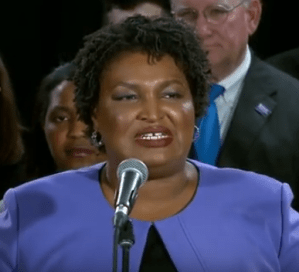
Democrat Stacey Abrams acknowledges defeat in Atlanta (From YouTube)
Abrams offered blistering criticism of Kemp, who as Georgia’s secretary of state oversaw the election until resigning two days after the November 6 vote.
“Under the watch of the now former secretary of state, democracy failed Georgia,” she said. “To watch an elected official who claims to represent the people in this state baldly pin his hopes for election on the suppression of the people’s democratic right to vote has been truly appalling.”
She announced the formation of a new group, Fair Fight Georgia, which she said would file a federal lawsuit over “gross mismanagement” of the election. It was unclear what remedy the lawsuit would seek, although Abrams indicated the suit would not seek to overturn the results in the governor’s race.
Abrams and Democrats have complained that Kemp purged eligible voters from the polls and improperly rejected registrations from voters because of relatively minor discrepancies with other records. Democrats have also hit elections officials for long lines on election day and for rejecting provisional votes based on discrepancies in handwriting on documents.
“Ballots were rejected by the handwriting police,” Abrams said. “Citizens tried to exercise their constitutional rights and were still denied the ability to elect their leaders.”
Georgia Governor-elect Brian Kemp
Kemp has denied that his office sought to suppress or intimidate voters. In his response to Abrams’s non-concession concession, he said he appreciated “her passion, hard work and commitment to public service.”
“The election is over, and hardworking Georgians are ready to move forward,” he said in a statement. “We can no longer dwell on the divisive politics of the past but must focus on Georgia’s bright and promising future.”
Abrams acknowledgement of defeat came as Kemp’s successor as secretary of state, Robyn Crittenden, was poised to certify Kemp as the winner of the governor’s race. His final margin of victory over Abrams was 55,000 votes out of 3.9 million votes cast.
Under a law unique to Georgia, Kemp needed to win a majority of the votes cast, or he would have faced a December runoff against Abrams. He cleared that threshold by about 10,500 votes.
The certification was delayed two days after a federal judge in Atlanta ordered the state to give more time for voters who cast provisional ballots that had been rejected to remedy the errors.
Abrams, 44, from Atlanta, is the former Democratic leader in the Georgia House. Had she been elected, she would have been Georgia’s first black or female governor and the first black woman in U.S. history elected as a state governor.
Kemp, 55, from Athens, served two terms as secretary of state after serving in the Georgia Senate.
Kemp’s victory keeps the governor’s office in Republican hands and marks the fifth straight GOP victory for governor in the Peach State. The incumbent, Governor Nathan Deal, was term limited.
We tweet @ChkFriPolitics Join us!
Decision ’18: Federal judge stops Georgia from certifying election results
Democrat Stacey Abrams faces daunting math in quest for runoff in governor’s race; 7th District U.S. House race still too close to call
 ATLANTA (CFP) — A federal judge has stopped Georgia’s secretary of state from certifying election results, extending for at least two more days Democrat Stacey Abrams’s slender hope of forcing her race against Republican Brian Kemp for governor into a runoff.
 Meanwhile, a different federal judge ordered elections officials in suburban Gwinnett County to stop rejecting absentee ballots with incorrect or missing birth dates. The 7th U.S. House District, in which incumbent Republican Rob Woodall holds a small lead over Democrat Carolyn Bourdeaux, is centered in Gwinnett.
Ruling in a lawsuit filed by Common Cause Georgia, U.S. District Judge Amy Totenberg delayed the state’s certification of results until at least Friday at 5 p.m. to give voters who cast provisional ballots in the November 6 election more time to validate their registration information so that their votes can count. The certification of results from the state’s 159 counties had been expected Wednesday.
Totenberg also ordered the state to create a secure phone line or website where voters who cast provisional ballots can find out if their ballot has been rejected and, if so, why. Under state law, voters who cast provisional ballots have until Friday to provide documentation that would validate their votes.
Totenberg was appointed to the federal bench by President Barack Obama. She is the sister of Nina Totenberg, NPR’s Supreme Court correspondent.
According to the Secretary of State’s office, 21,700 provisional ballots were cast statewide, usually by voters who were not listed on the registration rolls of the precinct where they tried to vote or who could not provide an accepted form of identification. However, the Abrams campaign believes the number of provisional ballots is at least 30,820.

Stacey Abrams

Brian Kemp
The latest results show Kemp with a lead of 57,863 votes over Abrams, well beyond the number of provisional ballots. But if Kemp’s margin can be reduced to the point where he no longer has a majority of votes, under a law unique to Georgia, the two would face each other again in a runoff in December.
However the math for Abrams is daunting — if there are 30,800 provisional ballots, as her campaign claims, and all of them are valid, she would have to win 83 percent of them just to get the race to a runoff. If there are 21,700, she would have to win 98 percent.
And in court filings, state elections officials have said that usually only half of provisional ballots can be verified to count. If that is the case with the outstanding provisional ballots, a runoff is a mathematical impossibility unless more provisional ballots are found.
Kemp served as secretary of state during the election but resigned after claiming victory in the governor’s race. His campaign has been insisting that Abrams has no viable path to overcome his lead. His current lead is also large enough that Abrams cannot ask for a recount.
But the Abrams camp — which had criticized Kemp’s stewardship of the election process while serving as both secretary of state and a candidate for governor — established a hotline to locate voters who say they had trouble voting on election day, hoping to locate more potential provisional ballots.
In the 7th District race, Woodall holds a 900-vote lead over Bordeaux. With no third-party candidate in the race, a runoff is not a possibility, but the race is currently close enough to trigger a runoff.
Gwinnett County, the state’s second-largest located northeast of Atlanta, is the population center of the district, which also includes parts of Fulton and Forsyth counties. The county’s handling of absentee ballots has been contentious throughout the election, amid news reports that the county was rejecting absentee ballots at a higher rate than any other county in Georgia.
Bordeaux had gone to court alleging that the county had rejected more than 1,000 absentee ballots for “trivial” reasons. United States District Judge Leigh Martin May agreed with that argument, but only for some 220 ballots that had errors in birth dates.
May is also an Obama appointee.
We tweet @ChkFriPolitics Join us!
Decision ’18: Machine recounts ordered in Florida U.S. Senate and governor’s races
Elections officials will send ballots through machines a second time and retabulate before Thursday
♦By Rich Shumate, ChickenFriedPolitics.com editor
TALLAHASSEE (CFP) — Elections officials in all of Florida’s 67 counties will recount ballots in three razor-close statewide races, amid lawsuits, claims of fraud and partisan protests reminiscent of the 2000 presidential recount battle in the Sunshine State.
On Saturday, Florida Secretary of State Ken Detzner ordered recounts in the races for U.S. Senate, governor and agriculture commissioner, after unofficial results showed all three races within the 0.5 percent margin that triggers a recount under state law.
The deadline for completing the recount is Thursday.
In the Senate race, Republican Governor Rick Scott led Democratic U.S. Senator Bill Nelson by just 13,200 votes, out of nearly 8.2 million votes cast, a margin of 0.16 percent.
In the governor’s race, Republican former U.S. Rep. Ron DeSantis led Tallahassee Mayor Andrew Gillum by 33,700 votes, a margin of 0.4 percent.
The third race headed for a recount is the contest for state agriculture commissioner, where Democrat Nikki Fried holds just a 5,300-vote lead over Republican Matt Caldwell.
Scott, DeSantis and Caldwell all led on election night but have seen their margins slip away as additional votes were reported in Broward and Palm Beach counties, both Democratic strongholds.
The slow vote-reporting process in those counties have prompted Republican officials to raise the specter of fraud, although claims of fraud have not yet been substantiated.
Scott sued election supervisors in both counties, saying he would “not sit idly by while unethical liberals try to steal this election.” Nelson in turn sued Detzner over the process being used to verify signatures on mail-in and provisional ballots.
President Donald Trump has also been stirring the pot, taking time during a visit to France to tweet, “Trying to STEAL two big elections in Florida! We are watching closely!”
Meanwhile, Gillum, who conceded to DeSantis on election night, took it back in a Saturday tweet: “I am replacing my earlier concession with an unapologetic and uncompromised call to count every vote.”
After the recounts were ordered, protestors from both camps gathered outside the office of Broward County Supervisor of Election Brenda Snipes, whose handling of the election has come in for criticism. Pro-Republican protestors offered chants of “Lock Her Up,” an apparent reference to Snipes.
Broward begins its recount of more than 700,000 ballots on Sunday morning.
After Detzner ordered the recount, Scott’s campaign called on Nelson “to accept reality and spare the state of the Florida the time, expense and discord of a recount.” State law allows Nelson to call off the recount.
But Nelson was having none of it: “We believe when every legal ballot is counted we’ll win this election,” he said in a statement.
In Florida, voters mark ballots with a pen, which are then read by optical scanning equipment. During the recount, all of the ballots cast in the election will be run through tabulating machines a second time, except for ballots where voters did not vote in a race or voted for more than one candidate.
If any of the three races is within 0.25 percent after the machine recount, the overvotes and undervotes will be examined by hand to determine voter intent.
The recounts in this year’s statewide races would be the first triggered since Florida’s election laws were rewritten after the 2000 presidential election, in which Republican George W. Bush finished with a 500-vote lead over Democrat Al Gore.
Court battles and chaos ensued, as elections officials struggled to recount votes cast with punch cards in Broward, Palm Beach and Miami-Dade counties. After an lengthy court fight that reached both the U.S. and Florida supreme courts, Bush was declared the winner.
We tweet @ChkFriPolitics Join us!
Lawsuits fly as Florida readies to recount three close statewide races
Recounts expected in contests for U.S. Senate, governor and agriculture commissioner
♦By Rich Shumate, ChickenFriedPolitics.com
TALLAHASSEE (CFP) — Eighteen years after the nation was transfixed by a vote recount in the presidential race in Florida, state officials are bracing for recounts in three statewide races, including contests for U.S. Senate and governor — a process that has already become contentious before it has even begun.
The Senate candidates, Republican Governor Rick Scott and Democratic U.S. Senator Bill Nelson, have already filed lawsuits over the election process. Meanwhile, the Democratic candidate for governor, Tallahassee Mayor Andrew Gillum has walked back the concession he made on election night to Republican Ron DeSantis, after subsequent returns from Broward and Palm Beach counties narrowed DeSantis and Scott’s leads.
President Donald Trump also weighed in Friday, calling the election process in Broward and Palm Beach counties “a disgrace” and suggesting he might have the federal government intervene.
“All of the sudden, they’re finding votes out of nowhere,” said Trump, a part-time Florida resident who owns an estate in Palm Beach.
By Saturday at noon, county election officials across the Sunshine State must submit unofficial counts from Tuesday’s election. Those counts are expected to trigger recounts in the Senate and governor’s races, as well as the race for agriculture commissioner.
In all three races, the Republican and Democrat candidates are separated by less than a percentage point.
Scott, whose small lead in the Senate race has dwindled since election night, has filed a lawsuit against election supervisors in Broward and Palm Beach counties, alleging that they are withholding documentation about the voting process. Scott’s lead has been narrowing because of changes in results in both counties, which tilt heavily Democratic
“It’s been over 48 hours since polls closed, and Broward and Palm Beach County are still finding and counting ballots, and the supervisors Brenda Snipes and Susan Bucher cannot seem to say how many ballots still exist and where these ballots came from or where they have been,” Scott said in a Thursday press conference. “I will not sit idly by while unethical liberals try to steal this election.”
Scott also asked the Florida Department of Law Enforcement to investigate the election supervisors, a move that drew criticism from Democrats. An FDLE spokesperson later said no investigation had been launched because no allegations of voter fraud had been raised.
Nelson filed his own lawsuit against Florida Secretary of State Ken Detzner alleging that the signature matching process being used to validate main-in and provision ballots is “standardless, inconsistent, and unreliable” and disproportionately affects young and minority voters who favor Nelson.
Detzner, a Republican, was appointed by former Scott. Snipes and Bucher are elected Democrats.
In Florida, if two candidates are within 0.5 percent of each other, ballots in all 67 counties will be counted again by machine, excluding ballots voided because voters either picked no candidate or more than one. That process will have to be finished by Thursday, November 15.
If a race is within 0.25 percent after Saturday’s county reports, ballots will go through a new machine count, and the overvotes and undervotes will all have to be examined by hand to determine voter intent. That process will have to be finished by Sunday, November 18.
In the Senate race, as of Friday afternoon, Scott holds a 15,000-vote lead over Nelson out of nearly 8.2 million votes, a small enough margin to trigger a hand recount. A hand recount is also expected in the agriculture commissioner race, where Democrat Nikki Fried holds just a 3,000-vote lead over Republican Matt Caldwell.
The governor’s race is not as close. Republican Ron DeSantis leads Democrat Andrew Gilllum by 36,000 votes, but that is still a small enough margin to trigger a machine recount.
Gillum, who conceded the race to DeSantis on election night, could opt not to proceed with a recount. But his campaign issued a statement indicating that he would not stop a recount and now considers his concession to have been premature.
“On Tuesday night, the Gillum for Governor campaign operated with the best information available about the number of outstanding ballots left to count. Since that time, it has become clear there are many more uncounted ballots than was originally reported,” the statement said.
“Our campaign, along with our attorney Barry Richard, is monitoring the situation closely and is ready for any outcome, including a state-mandated recount.”
The recounts in this year’s statewide races would be the first triggered since Florida’s election laws were rewritten after the 2000 presidential election, in which Republican George W. Bush finished with a 500-vote lead over Democrat Al Gore.
Court battles and chaos ensued, as elections officials struggled to recount votes cast with punch cards in Broward, Palm Beach and Miami-Dade counties.
Voters in Florida now mark their ballots with a pen, and they are then optically scanned.

 Chicken Fried Politics