
Latest Posts
Latest Coverage
-
Symbolic solution in search of an actual problem
Support of 9 Southern Republicans for Respect for Marriage Act shows why Supreme Court isn’t about to ban same-sex marriage ♦By Rich Shumate, ChickenFriedPolitics.com editor…
-

West Virginia stubborn, or playing hard to get
U.S. Senator Joe Manchin pisses off his party yet again … to what end? ♦By Rich Shumate, ChickenFriedPolitics.com editor Also in this report: Atlanta DA…
-

2 Mississippi Republican U.S. House members forced into runoffs after weak primary showings
Michael Guest narrowly trails challenger in 3rd District; Steven Palazzo clears just 32% in 4th District ♦By Rich Shumate, ChickenFriedPolitics.com editor JACKSON, Mississippi (CFP) –…
-

Mississippi Republican U.S. Rep. Steven Palazzo facing Tuesday primary fight amid ethics investigation
6 opponents hitting “No-Show Palazzo” over inattention to district, ethics problems ♦By Rich Shumate, ChickenFriedPolitics.com editor GULFPORT (CFP) — Mississippi U.S. Rep. Steven Palazzo —…
-

Primary Wrap: Kemp, Raffensperger survive Trump’s ire; Brooks makes Alabama U.S. Senate runoff
Texas Democratic U.S. Rep. Henry Cuellar survives challenge from the left; George P. Bush gets blown out by Attorney General Ken Paxton ♦By Rich Shumate,…
-

U.S. House’s last pro-life Democrat, Texas’s Henry Cuellar, fighting to keep seat in Tuesday primary runoff
Challenger Jessica Cisneros wanted House Democratic leaders to rescind Cuellar endorsement; they refused ♦By Rich Shumate, ChickenFriedPolitics.com editor LAREDO, Texas (CFP) — Amid the newly…

Atlanta City Council member Andre Dickens surges to landslide win in mayor’s runoff
Dickens easily defeats City Council President Felicia Moore for city’s top post
♦By Rich Shumate, ChickenFriedPolitics.com editor
 ATLANTA (CFP) – Atlanta City Council member Andre Dickens has come from behind to to claim a landslide victory to be the next mayor of the Deep South’s commercial and financial capital.
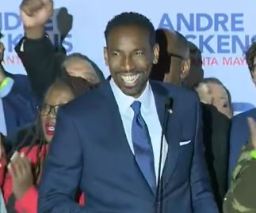
Atlanta Mayor-elect Andre Dickens celebrates win with supporters (From Fox 5 Atlanta)
Dickens, 47, a non-profit executive who has served two terms in a citywide council seat, erased a nearly 18-point deficit in the first round of voting to defeat City Council President Felicia Moore by a margin of 62% to 38% in the November 30 runoff.
He will take the helm of the city amid increasing concerns about a rise in violent crime and a campaign by residents of the wealthy Buckhead enclave to secede and form their own city.
Speaking to his supporters at an outdoor victory party, Dickens said Atlantans “voted for progress and a problem solver.”
“The people who made this victory possible — they will change Atlanta’s future,” he said. “There is no limit to Atlanta, and that’s what we’ve got to look forward to.”
Dickens had come from the back of the pack in a crowded field during the first round of voting to win a place in the runoff behind Moore, edging out former Mayor Kasim Reed.
During the runoff campaign, he snagged key endorsements from a who’s who of local political leaders — including incumbent Mayor Keisha Lance Bottoms, U.S. Rep. Nikema Williams and Fulton County District Attorney Fani Willis – and went after Moore as too negative to get along with other leaders in the city.
Moore, 60, a real estate broker and community activist, was a fixture in city politics, having served on the City Council for more than two decades and as its president for the past four.
Crime was the number one issue in the campaign, with the city’s homicide rate up nearly 57% in the past two years.
Both candidates had proposed getting more police officers on to the streets, but Moore rapped Dickens for supporting a measure that would have withheld a portion of the police budget until reforms were made.
She accused Dickens of supporting defunding the police, which he said was not the intention of the proposal.
A drive by residents in the mostly white, upscale Buckhead area to secede from the city – which could be devastating to the city’s tax base — is likely to be a key headache for Dickens as he take the city’s reins.
Bottoms — who built a national profile as mayor that landed her on Joe Biden’s vice presidential short list in 2020 — shocked the city’s political circles in May when she announced she would not seek a second term.
Her immediate predecessor, Reed, tried to launch a comeback but finished third behind Moore and Dickens in the first round of voting.
The mayor of Atlanta is a non-partisan position, but both Dickens and Moore are Democrats.
We tweet @ChkFriPolitics Join us!
Atlanta City Council member Andre Dickens surges to landslide win in mayor runoff
Dickson easily defeats City Council President Felicia Moore for city’s top post
♦By Rich Shumate, ChickenFriedPolitics.com editor
ATLANTA (CFP) – Atlanta City Council member Andre Dickens has come from behind to to claim a landslide victory to be the next mayor of the Deep South’s commercial and financial capital.
Atlanta Mayor-elect Andre Dickens celebrates win with supporters (From Fox 5 Atlanta)
Dickens, 47, a non-profit executive who has served two terms in a citywide council seat, erased a nearly 18-point deficit in the first round of voting to defeat City Council President Felicia Moore by a margin of 62% to 38% in the November 30 runoff.
He will take the helm of the city amid increasing concerns about a rise in violent crime and a campaign by residents of the wealthy Buckhead enclave to secede and form their own city.
Speaking to his supporters at an outdoor victory party, Dickens said Atlantans “voted for progress and a problem solver.”
“The people who made this victory possible — they will change Atlanta’s future,” he said. “There is no limit to Atlanta, and that’s what we’ve got to look forward to.”
Dickens had come from the back of the pack in a crowded field during the first round of voting to win a place in the runoff behind Moore, edging out former Mayor Kasim Reed.
During the runoff campaign, he snagged key endorsements from a who’s who of local political leaders — including incumbent Mayor Keisha Lance Bottoms, U.S. Rep. Nikema Williams and Fulton County District Attorney Fani Willis – and went after Moore as too negative to get along with other leaders in the city.
Moore, 60, a real estate broker and community activist, was a fixture in city politics, having served on the City Council for more than two decades and as its president for the past four.
Crime was the number one issue in the campaign, with the city’s homicide rate up nearly 57% in the past two years.
Both candidates had proposed getting more police officers on to the streets, but Moore rapped Dickens for supporting a measure that would have withheld a portion of the police budget until reforms were made.
She accused Dickens of supporting defunding the police, which he said was not the intention of the proposal.
A drive by residents in the mostly white, upscale Buckhead area to secede from the city – which could be devastating to the city’s tax base — is likely to be a key headache for Dickens as he take the city’s reins.
Bottoms — who built a national profile as mayor that landed her on Joe Biden’s vice presidential short list in 2020 — shocked the city’s political circles in May when she announced she would not seek a second term.
Her immediate predecessor, Reed, tried to launch a comeback but finished third behind Moore and Dickens in the first round of voting.
The mayor of Atlanta is a non-partisan position, but both Dickens and Moore are Democrats.
We tweet @ChkFriPolitics Join us!

West Virginia’s Jim Justice is South’s most popular governor; Georgia’s Brian Kemp the least
Morning Consult poll shows Democratic governors with aggressive COVID-19 strategies with higher approval than GOP governors who have resisted mandates
♦By Rich Shumate, ChickenFriedPolitics.com editor
 (CFP) – West Virginia Governor Jim Justice is the South’s most popular chief executive, with Alabama’s Kay Ivey close behind in new polls on gubernatorial approval from the polling firm Morning Consult.
The polls, taken over the course of the last four months and released November 11, also show that Georgia Republican Brian Kemp’s approval rating among registered voters was just 42%, making him the region’s least popular chief executive as he heads into what is expected to be a tough re-election battle next year against furious opposition from Donald Trump.
The poll in Kentucky had better news for Democrat Andy Beshear, whose approval rating stood at 54%, despite taking considerable fire from Republicans over his COVID-19 policies.
Beshear will face voters again in 2023, as will Mississippi Republican Tate Reeves. However, the approval rating for Reeves, who may face a primary challenge from House Speaker Philip Gunn, stood at just 49%, making him and Kemp the only two Southern governors with approval ratings below 50% ahead of a run for his third term.
Morning Consult did not report disapproval numbers, so it was unclear if Reeves and Kemp were actually under water in their approval numbers, with more people disapproving than approving.
The approval rating for Florida Republican Ron DeSantis, who has taken the leading in fighting mask and vaccine mandates, stood at 52% ahead of a Democratic challenge in 2022. Texas’s Greg Abbott, who has taken a similar line of resistance against mandates, had an approval rating of 50%.
Three of the region’s Democratic governors who have been more aggressive with COVID-19 mitigation measures – Beshear, North Carolina’s Roy Cooper and Louisiana’s John Bel Edwards – had higher approval ratings than DeSantis and Abbott, although within the poll’s margin of error.
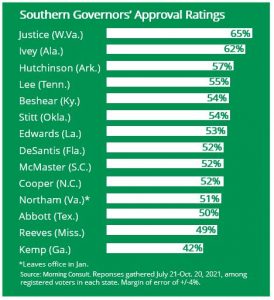 Justice’s approval rating stood at 65%, despite a string of headlines about financial and regulatory problems for companies owned by his family and an odd dispute about whether he should be hired to coach a boy’s high school basketball team.
Ivey, who became governor in 2017 when her predecessor resigned in a sex scandal, had an approval rating at 62%, as she heads into a re-election race in which she will be heavily favored.
However, she, too, has run afoul of Trump over cancellation of a June rally in Mobile, and he is reportedly trying to find a primary challenger to run against her.
Tennessee’s Bill Lee and Oklahoma’s Kevin Stitt also appear to be in strong shape for 2022, with Lee’s approval at 55% and Stitt’s at 54%.
The other Southern governor up next year, South Carolina’s Henry McMaster, stood at 52%.
Arkansas’s Asa Hutchinson has a 57% approval rating as he heads toward the exit due to term limits – despite being one of the very few elected Republicans willing to offer criticism of Trump.
Hutchinson has said he will not back Trump if he runs for the White House again in 2024 and that relitigating the 2020 election would be a “recipe for disaster.” He has raised his national profile in recent months, with numerous appearances on Sunday talk shows, prompting speculation that he might make his own presidential run in 2024.
Kemp has drawn Trump’s active wrath for refusing to go along with his efforts to overturn the 2020 election results in the Peach State. Former Republican U.S. Senator David Perdue is considering a primary challenge, and the GOP nominee will likely be facing Democrat Stacey Abrams, whom Kemp narrowly beat in 2018.
Two Southern Democratic governors who are in the middle of their second and final term – Edwards and Cooper – had positive approval ratings, at 53% and 52%, respectively.
Morning Consult gathered the responses from July 21 to October 20 among registered voters in each state. The margin of error was +/-4%.
We tweet @ChkFriPolitics Join us!

Democrat Beto O’Rourke launches run for Texas governor
Former congressman from El Paso decides to challenge Republican Governor Greg Abbott after failed bids for U.S. Senate, president
♦By Rich Shumate, ChickenFriedPolitics.com editor
 EL PASO (CFP) — Former U.S. Rep. Beto O’Rourke has announced he will run for governor of Texas, giving Democrats a high-profile candidate in their quest to unseat Republican Governor Greg Abbott.
In a video announcing his candidacy posted November 15, O’Rourke charged that “those in a position of public trust have stopped listening to, serving and paying attention to, and trusting the people of Texas.”
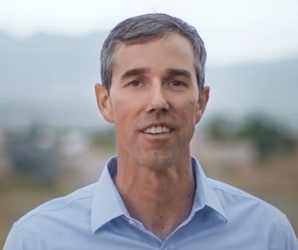
Texas Democratic governor candidate Beto O’Rourke
“They’re not focused on the things we want them to do,” he said. “Instead, they’re focused on the kind of extremist policies around abortion, or permitless carry, or even our schools that really only divide us.”
O’Rourke, 49, represented El Paso in the U.S. House from 2013 to 2019, giving up his safe seat to make a run against Republican U.S. Senator Ted Cruz in 2018.
In that race, he proved to be a prodigious fundraiser, raising $80 million, almost twice as much as Cruz. But he lost by more than 200,000 votes in what was a stellar year nationally for Democrats.
Based on the national profile he built in the Senate race, O’Rourke ran for the Democratic presidential nomination in 2020. But his campaign sputtered, and he pulled out of the race months before the Iowa caucuses.
During his White House run, O’Rourke made a comment that may come back to haunt him in gun-loving Texas, telling a debate audience that, “Hell yes, we’re going to take your AR-15, your AK-47.”
Indeed, shortly after O’Rourke announced his run for governor, Abbott took to Twitter to charge that O’Rourke wants to “take your guns,” ending with a two-word retort to his candidacy: “Bring it.”
Abbott, 64, is seeking his third term as governor of Texas, a state where governors are not term limited. While he won by more than 1 million votes for years ago, this time around he is now facing a competitive primary against two candidates running at him from the right, former GOP state chair Allen West and former State Senator Don Huffines from Dallas.
Abbott has run into political resistance for COVID-19 mitigation measures he imposed during the worst phases of the pandemic. However, more recently, he has led the charge against mask wearing in public schools and vaccine mandates for public agencies and even private businesses.
The wildcard in the race is Hollywood actor and native Texan Matthew McConaughey, who has been publicly toying with a run for governor. At this point, it remains unclear if he would run as a Democrat or an independent or enter the Republican primary, where nine candidates are already running.
We tweet @ChkFriPolitics Join us!

No end of a lesson: Democrats discover Virginia is not that “woke”
Why leftward lurch in Richmond was a misreading of the Old Dominion’s electorate, leading to Tuesday’s political catastrophe
♦By Rich Shumate, ChickenFriedPolitics.com editor
 RICHMOND (CFP) — Heading into Tuesday’s elections in Virginia, the Republicans’ theory of the case was that they could ride a backlash against two years of total Democratic rule in Richmond back into power – that voters in the suburbs were mad as hell and not going to take it anymore.
The results, if anything, may have understated the case’s potency.
Before Tuesday, Democrats held all three statewide offices and majorities in the House of Delegates and Senate. Come January, all they will have left is a one-seat margin in the Senate, where a defection from a single Democratic senator will create a tie to be broken by the new Republican lieutenant governor, Winsome Sears.
In other words, every Virginia senator can play Joe Manchin – and Democratic senators hoping to win re-election in 2023 may find it in their political interests to cooperate with Governor-elect Glenn Youngkin.
Since the Democrats’ debacle in the Old Dominion, the chattering class has been busy theorizing that the inability of Democrats in Washington to push through President Joe Biden’s domestic spending agenda is to blame. But there is a deeper, much more local, reason for what happened.
Virginia is not nearly as “woke” as Democrats had convinced themselves that it was, and they are now paying the price.
In 2019, Democrats took control of all of the levers of power in Richmond for the first time in a quarter century – and they proceeded to go off on what can only be described as a liberal toot.
Marijuana legalized. Death penalty abolished. Police chokeholds and no knock warrants gone. Background checks for gun purchases imposed. LGBTQ discrimination protections enacted. Confederate monuments removed. Waiting periods and ultrasounds before abortions eliminated. Voting rules eased.
Inexplicably, they even reached back into the 1970s to dust off the Equal Rights Amendment and ratify it – a purely symbolic gesture that will have no actual impact on policy, as its ratification deadline expired nearly 30 years ago.
The one person who might have stopped this march to the left was Governor Ralph Northam, but he was busy hanging on to his job in the face a scandal over wearing blackface in medical school that caused many in his own party to abandon him. He firmly jumped on board the leftward train.
Democrats would no doubt argue that all of those reforms they enacted were necessary, even righteous. But Virginia is still, well, Virginia — a generally conservative place populated by conventional suburban people, many of whom didn’t take kindly to being governed as if they were living in Seattle.
Whether from hubris or cluelessness, Virginia Democrats fundamentally – and fatally — misread their electorate.
The most fiery issue in the recent campaign was critical race theory, which Youngkin vowed to eradicate from public schools, even though it is not being taught in any public school in the commonwealth.
Democrats denounced Youngkin’s crusade as factually unfounded, silly and racist. But what they didn’t understand was that critical race theory was actually shorthand proxy for another concern of many parents – that teachers and schools were delving, or preparing to delve, into discussions of race and sexuality in the classroom in pursuit of a more just, tolerant society.
On Tuesday, many of these parents made it clear that they do not believe those topics are appropriate in schools, even in pursuit of admirable ends. Full stop. And they were prepared to reward Youngkin for his opposition, couched as it was in criticism of critical race theory that is taught in graduate schools, not kindergartens.
Republicans have struck a nerve here that will echo into next year’s midterms; Democrats need to come up with a counternarrative, rather than simply dismissing this heartfelt sentiment as irrelevant or racist.
Virginia Democrats’ last rampart against Republican rule is their 21-member Senate caucus, all of whom are all up for election in 2023 in a political climate they now know to be unfavorable. Their number includes Joe Morrissey, a colorful, unpredictable lawmaker from Richmond who opposes legal abortion, and Chap Petersen, a moderate from Fairfax who supports gun rights.
In other words, not much of a rampart with which to go scorched earth on Youngkin.
The statewide offices are out of Democratic hands until at least 2026, which means any comeback will need to be in legislative races.
The bright spot for Democrats in this regard is that new House and Senate maps will be drawn before the next election in 2023. Because of population growth, more seats will need to be located in the Washington, D.C. suburbs, where Democrats dominate, shifting some power away from more Republican areas.
Given that Republicans only have a two-seat House majority, and Democrats a single-seat majority in the Senate, those new maps could have a significant impact on party legislative control. And because the newly created bipartisan redistricting commission has imploded, those maps are likely to be drawn by the state Supreme Court, where partisan gerrymandering will be limited.
But even if Virginia Democrats hold their own in 2023, the total control they enjoyed for the past two years won’t come back for at least the next four – and at that point, they might do well to remember Kipling’s admonition: “We have had no end of a lesson, it will do us no end of good.”

 Chicken Fried Politics