
Latest Posts
Latest Coverage
-
Symbolic solution in search of an actual problem
Support of 9 Southern Republicans for Respect for Marriage Act shows why Supreme Court isn’t about to ban same-sex marriage ♦By Rich Shumate, ChickenFriedPolitics.com editor…
-

West Virginia stubborn, or playing hard to get
U.S. Senator Joe Manchin pisses off his party yet again … to what end? ♦By Rich Shumate, ChickenFriedPolitics.com editor Also in this report: Atlanta DA…
-
2 Mississippi Republican U.S. House members forced into runoffs after weak primary showings
Michael Guest narrowly trails challenger in 3rd District; Steven Palazzo clears just 32% in 4th District ♦By Rich Shumate, ChickenFriedPolitics.com editor JACKSON, Mississippi (CFP) –…
-
Mississippi Republican U.S. Rep. Steven Palazzo facing Tuesday primary fight amid ethics investigation
6 opponents hitting “No-Show Palazzo” over inattention to district, ethics problems ♦By Rich Shumate, ChickenFriedPolitics.com editor GULFPORT (CFP) — Mississippi U.S. Rep. Steven Palazzo —…
-

Primary Wrap: Kemp, Raffensperger survive Trump’s ire; Brooks makes Alabama U.S. Senate runoff
Texas Democratic U.S. Rep. Henry Cuellar survives challenge from the left; George P. Bush gets blown out by Attorney General Ken Paxton ♦By Rich Shumate,…
-
U.S. House’s last pro-life Democrat, Texas’s Henry Cuellar, fighting to keep seat in Tuesday primary runoff
Challenger Jessica Cisneros wanted House Democratic leaders to rescind Cuellar endorsement; they refused ♦By Rich Shumate, ChickenFriedPolitics.com editor LAREDO, Texas (CFP) — Amid the newly…
Judges won’t impose redraw of North Carolina U.S. House map before November vote
Decision sidesteps chaos that might have resulted from a new last-minute map
♦By Rich Shumate, ChickenFriedPolitics.com editor
 RALEIGH (CFP) — Less than a week after threatening to throw North Carolina’s congressional election into chaos by redrawing its electoral map, a panel of three federal judges has reversed course and decided not to move forward with a redraw before November.
In a September 4 order, the judges decided that there was not enough time to draw a new map and that altering the current election schedule “unduly disturbs the state’s electoral machinery and would probably confuse voters and reduce voter turnout.”
The order puts on hold a August 27 decision striking down the map drawn by North Carolina’s Republican-controlled legislature as an unconstitutional gerrymander designed to disadvantage Democrats. However, if that decision is upheld, a new map will have to be redrawn before the 2020 elections.
That decision ordering the lines to be redrawn came just 70 days before the November election and three months after primaries were held using the current lines.
Republican legislative leaders had vowed to appeal the ruling to the U.S. Supreme Court, which had issued a stay earlier this year to stop a similar decision by the same panel of judges.
In the majority opinion for the three-judge panel, Judge James Wynn of the 4th U.S. Circuit Court of Appeals said that by favoring Republicans, “the redistricting plan passed by the state’s GOP-controlled legislature amounted to “invidious partisanship” that that “runs contrary to the Constitution’s vesting of the power to elect Representatives in ‘the People.'”
Although North Carolina is fairly evenly divided in statewide and presidential elections, Republicans hold a 10-to-3 advantage in the House delegation. Two of those Democrats are African Americans who represent majority-minority districts drawn to comply with the Voting Rights Act.
In January, the same three-judge panel ruled against the state’s map, the first time a federal court had ever struck down a congressional map for being gerrymandered to favor one party.
But in June, the Supreme Court vacated the order and returned the case to the judges in Greensboro to reconsider their ruling in light of its own ruling in a different case.
In their second decision, the judges said their reconsideration of the case did not change their view that the map was unconstitutional.
Since the first ruling was vacated by the Supreme Court, Justice Anthony Kennedy has retired and his replacement hasn’t been confirmed, leaving the court with a 4-to-4 split between conservative and liberal factions.
If the issue of staying the new map had gone to the Supreme Court, North Carolina legislators would have needed to persuade five justices to stay the ruling, or the lower court decision would have stood.
Wynn, who previously served on the North Carolina Supreme Court, was appointed to the appeals court by President Barack Obama and was joined in his majority opinion by U.S. District Court Judge William Britt, a senior-status judge appointed by President Jimmy Carter.
The third judge on the panel, U.S. District Court Judge William Osteen Jr., was appointed by President George W. Bush; he dissented from part of the majority’s reasoning in ruling, although he concurred with the remedy of redrawing congressional lines.
Oklahoma Runoff: Kevin Stitt beats Mick Cornett for GOP governor’s nomination
Political newcomer comes from behind with call for reform
♦By Rich Shumate, ChickenFriedPolitics.com editor
 OKLAHOMA CITY (CFP) — Tulsa businessman Kevin Stitt has won the Republican nomination for Oklahoma governor in his first try for political office, defeating veteran politico Mick Cornett, who led the state’s largest city for 14 years.

Gubernatorial nominee Kevin Stitt, R-Oklahoma
Stitt took 55 percent of the vote in the August 28 runoff to 45 percent for Cornett, who had come out on top of the first round of primary voting in June.
But in a state roiled by a teachers’ strike earlier this year that shuttered classrooms, Stitt’s message of reforming state government touched a nerve among voters.
“We can demand that our state government be held accountable and transparent and unify our state for a bold new future,” Still told supporters at a victory party in Jenks. “The answers to our problems (are) not bigger government. It’s smaller government and smarter government.”
Stitt will now face former Democratic Attorney General Drew Edmonson in the race to succeed term-limited Republican Governor Mary Fallon.
Stitt, 45, the founder of Gateway Mortgage, was considered a long shot when he entered the race against a field that included Cornett and Lieutenant Governor Todd Lamb, In addition to his reform message, Stitt was helped by $3 million of his own money that he plowed into the campaign.
In the runoff, he swept Tulsa and most of the rural parts of the state, overcoming Cornett’s lead in metro Oklahoma City.

Former Oklahoma City Mayor Mick Cornett
Cornett, 59, was the better-known figure in Oklahoma politics, serving 14 years as mayor of Oklahoma City after a career as a television anchor.
Speaking to his supporters in at a watch party in the capital, Cornett said he would have “nothing but positive memories” of the campaign, although he indicated that the defeat was likely his political swan song.
“There’s a really good chance my name will never be on another ballot,” he said. “So you need to understand tonight as I step away from the political scene how much I’ve always loved the opportunity to represent you.”
While Republicans dominate Oklahoma politics — and Fallon won the last two races by double-digit margins — Democrats will have a viable nominee for governor in Edmundson, 71, who comes from a prominent Oklahoma political family and served as attorney general from 1995 to 2011.
One plus for Democrats may be Fallon’s weak approval ratings, which tumbled in the wake of the teachers’ strike. A Morning Consult survey released in July found she was the nation’s least popular chief executive, with an approval rating of just 19 percent.
Oklahomans also have a recent tradition of rotating Democrats and Republicans in the governor’s chair. Of the state’s last six chief executives, six have been Democrats and six Republicans.
Florida Primary: DeSantis wins GOP governor’s nod; Gillum is surprise winner among Democrats
Three Democratic U.S. House incumbents survive; Donna Shalala wins race for Miami seat
♦By Rich Shumate, ChickenFriedPolitics.com editor
 TALLAHASSEE (CFP) — November’s election for Florida governor will pit a Donald Trump acolyte against a Bernie Sanders-backed Democrat trying to become the first African-American ever elected to lead the Sunshine State.
In the Republican primary, U.S. Rep. Ron DeSantis easily defeated State Agriculture Commissioner Adam Putnam, who started the campaign as the front-runner but saw his chances fade after DeSantis got Trump’s endorsement.
 But the biggest surprise of the August 28 vote came on the Democratic side, where Tallahassee Mayor Andrew Gillum came from behind to defeat two self-funding millionaires and former U.S. Rep. Gwen Graham, who comes from a prominent Florida political family.
Meanwhile, three Democratic incumbent U.S. House members who faced primary challenges survived, including 9th District U.S. Rep. Darren Soto, who easily defeated former U.S. Rep. Alan Grayson, a controversial liberal firebrand trying to make a political comeback.
Also, Donna Shalala, President Bill Clinton’s health secretary, won her primary in a GOP-held district likely to flip in November.
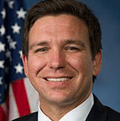
U.S. Rep. Ron DeSantis, R-Florida
In the Republican race for governor, DeSantis, 39, from Palm Coast, beat Putnam by 20 points, carrying all of the state’s large cities.
“I believe there is no limit to what we can accomplish here as long as we have the courage to lead,” he told supporters at a victory party in Orlando. “And I pledge to you as governor to work my but off to accomplish great things for this state.”
DeSantis also offered his thanks to Trump “for viewing me as someone who can be a great leader for Florida.”
The result was a significant stumble for Putnam, 44, who spent 10 years in Congress and two terms as agriculture commission with his eye on the governor’s mansion.

Putnam
Speaking to supporters in Lakeland, Putnam said he would do “any and everything we can” to help DeSantis win in November.
“He’s a veteran, he’s a solid conservative, and he will need our help,” Putnam said.
On the Democratic side, Gillum, who was vastly outspent and did not lead in a single public pre-election poll, took 34 percent to 31 percent for Graham. Former Miami Beach Mayor Philip Levine came in at 20 percent and Palm Beach billionaire real estate investor Jeff Greene at 10 percent.
Florida does not have primary runoffs, so Gillum won the nomination without a runoff.
Combined, Levine and Greene put more than $20 million of their own money into the race, to no avail.
Gillum was outspent by all of his major competitors, although he did get an infusion of cash near the end of the campaign from liberal megadonorrs George Soros and Tom Steyer. He was also endorsed by Sanders, the self-styled democratic socialist who ran an insurgent presidential campaign in 2016.
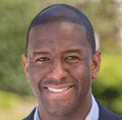
Tallahassee Mayor Andrew Gillum
“There were just a few people who said that this moment would not be possible,” Gillum told cheering supporters in Tallahassee. “And then there were a few more who believed this day was possible.”
“This thing is not about me. It never has been. It never will be,” he said. “This race is about every single one of you.”
Gillum’s victory upsets the political equation on both sides. Democrats had been hoping for a DeSantis win, seeing him as a weaker candidate against Graham, who had a moderate record during her one term in Congress. Now, both campaigns will have to adapt to a race pitting the most conservative candidate in the race against the most liberal.
Gillum is also the first African American candidate in either party to win a gubernatorial nomination in Florida and would become the state’s first black governor if he beats DeSantis in November.
One cloud on the horizon for Gillum is an ongoing FBI investigation into corruption in Tallahassee city government. He has insisted that he is not implicated in the probe, although photographs have surfaced of the mayor traveling with two FBI agents who were working undercover.
Gillum, like DeSantis, won all of the state’s major cities. The key to his victory was a collapse in Graham’s vote in Miami-Dade and Broward counties, where she didn’t break 20 percent.

Graham
Speaking to her supporters in Orlando, Graham pledged her support to Gillum, relating a phone call she had with the primary winner.
“I said, ‘Now Andrew, go out and win this damn thing because this is too important to the state of Florida,” said Graham, the daughter of former governor and U.S. Senator Bob Graham.
In the U.S. Senate race, both Democratic U.S. Senator Bill Nelson and Republican Governor Rick Scott easily won their party’s nominations for the fall election, setting up what is likely to be the nation’s most expensive Senate race this year.
In U.S. House races, three Democratic incumbents also easily turned back primary challengers.
In the 5th District, a majority-minority district that stretches across North Florida from Jacksonville to Tallahassee, U.S. Rep. Al Lawson of Tallahassee took 60 percent of the vote to defeat former Jacksonville Mayor Alvin Brown.
In the 9th District in metro Orlando, Soto easily dispatched Grayson, 66 percent to 44 percent. Grayson was trying to make a comeback after giving up the seat in 2016 to make an ill-fated bid for the U.S. Senate.
In another Orlando-area district, the 7th, U.S. Rep. Stephanie Murphy crushed Chardo Richardson, an attorney who was running as a “progressive” alternative to Murphy, taking 86 percent of the vote.
Tuesday’s primaries also set up fall matches for four battleground seats that Democrats are trying to take away in their quest to win control of the House.
In the 27th District in Miami-Dade County, Shalala, a Clinton cabinet secretary and former president of the University of Miami, took the first step in her quest to launch a political career at age 77, winning with 32 percent of the vote in a field of five candidates.
She will face Republican Maria Elvira Salazar, a former Spanish-language TV news anchor, who won the GOP race with 41 percent of the vote.
The district, which includes Miami Beach and parts of Miami, is open due to the retirement of veteran Republican U.S. Rep. Ilena Ros-Lehtinen, who has held it for 30 years. Hillary Clinton beat Trump in the district by nearly 20 points in 2016, making this one of the Democrats best pickup opportunities nationally.
However, the population of the district is more than 70 percent Latino and includes Miami’s politically potent Cuban community. Salazar is a Cuban-American born in Miami; Shalala, of Lebanese descent, was born in Ohio and moved to Miami in 2001.
In the 16th District centered on the southern side of Tampa Bay, Republican U.S. Rep. Vern Buchanan of Sarasota is seeking a seventh term in a district Trump carried by 11 points. He will face Democrat David Shapiro, a Sarasota lawyer who easily won his party’s nomination.
Shapiro has raised more than $1.3 million for the race to try to make it competitive, according to Federal Elections Commission campaign finance reports. However, Buchanan has raised $2.2 million.
In the 18th District along the Treasure Coast and northern Palm Beach County, the Democratic nominee will be Laura Baer, an attorney from Palm Beach Gardens who served as a senior adviser to secretaries of state Hillary Clinton and John Kerry. She will now take on Republican U.S. Rep. Brian Mast from Palm City in a swing district that switched parties in 2012 and 2016.
In the 26th District which takes in parts of Miami-Dade and the Florida Keys, Democrats chose Debbie Murcasel-Powell, a consultant for non-profit groups, to face Republican U.S. Rep. Carlos Curbelo.
Curbelo been a rare critic of Trump within the House Republican Caucus as he tries to hang on in a district Hillary Clinton won by 16 points.
Republicans also picked nominees for three open GOP-held seats that they will be favored to retain in November.
In the 6th District in metro Jacksonville, which DeSantis gave up to run for governor, Republicans chose Mike Waltz, an aide to former Vice President Dick Cheney. In November, he will face Democrat Nancy Soderberg, a former Bill Clinton aide who served as deputy U.N. ambassador.
In Southwest Florida’s 15th District, where Republican U.S. Rep. Dennis Ross retired, State Rep. Ross Spano won the Republican nomination and will now face Democrat Kristen Carlson, former general counsel for the Florida Department of Citrus.
And the 17th District, a rural district south of Orlando, Republicans chose State Senator Craig Steube, while Democrats chose April Freeman, a TV producer and political consultant from Cape Coral.
Chaos in Carolina: Judges strike down U.S. House map now used in Tar Heel State
Ruling could leave November 6 election in confusion unless U.S. Supreme Court intervenes
♦By Rich Shumate, ChickenFriedPolitics.com editor
RALEIGH (CFP) — A panel of three federal judges has once again struck down North Carolina’s U.S. House map as being unconstitutionally gerrymandered to favor Republicans, ordering that the lines be redrawn just 70 days before the November election and three months after primaries were held using the current lines.
The ruling could sow significant confusion into congressional races unless the U.S. Supreme Court steps in to stay the ruling, something it did with a previous ruling earlier this year. It also has implications for partisan control of the House if a redraw of the map creates more districts where Democrats can compete.
State House Speaker Tim Moore and Senate President Pro Tempore Phil Berger, both Republicans, announced they will appeal the ruling to the Supreme Court, saying in a statement that implementing the ruling “would irreparably disrupt campaigns from both major parties across the state that have been organizing, raising money and trying to win over voters.”
But Bob Phillips, the executive director of Common Cause North Carolina, one of the plaintiffs who challenged the map, hailed the court’s decision.
Although North Carolina is fairly evenly divided in statewide and presidential elections, Republicans hold a 10-to-3 advantage in the House delegation. Two of those Democrats are African Americans who represent majority-minority districts drawn to comply with the Voting Rights Act.
In January, the same three-judge panel ruled against the state’s map, the first time a federal court had ever stuck down a congressional map for being gerrymandered to favor one party.
But in June, the Supreme Court vacated the order and returned the case to the judges in Greensboro to reconsider their ruling in light of its own ruling in a different case.
In their August 27 decision, the judges said their reconsideration of the case did not change their view that the map was unconstitutional.
Since the first ruling was vacated by the Supreme Court, Justice Anthony Kennedy has retired and his replacement hasn’t been confirmed, leaving the court with a 4-to-4 split between conservative and liberal factions. If North Carolina legislators can’t persuade five justices to stay the ruling, the lower court decision will stand.
The three-judge panel declined to let November’s election go forward with the current map pending appeal, despite the fact that primaries had already been held in those districts.
Wynn suggested that the general election could proceed without primaries or that the state could hold new primaries on November 6 and then conduct the general election later.
The judges also indicated they would bring in a special master to draw a new map rather than returning it to legislators to redraw.
Attorneys in the case were given until August 31 to submit proposals for a remedial plan to comply with the ruling.
Wynn, who previously served on the North Carolina Supreme Court, was appointed to the appeals court by President Barack Obama and was joined in his majority opinion by U.S. District Court Judge William Britt, a senior-status judge appointed by President Jimmy Carter.
The third judge on the panel, U.S. District Court Judge William Osteen Jr., was appointed by President George W. Bush; he dissented from part of the majority’s reasoning in ruling, although he concurred with the remedy of redrawing congressional lines.
Dallas Woodhouse, executive director of the North Carolina Republican Party, sent a tweet accusing Wynn of being an “activist” judge who was “waging a personal, partisan war on North Carolina Republicans.”
Kentucky Governor Matt Bevin announces he’s running for re-election
Bevin’s quest for a second term in 2019 comes amid fallout over contentious teachers’ strike
♦By Rich Shumate, ChickenFriedPolitics.com editor
 LEXINGTON, Kentucky (CFP) — After months of being tight-lipped about his political plans, Kentucky Governor Matt Bevin has announced that he will run for re-election in 2019, amid the fallout from a teachers’ strike earlier this year that roiled politics across the Bluegrass State.
His decision sets up a possible battle with Democratic Attorney General Andy Beshear, who has used the powers of his office to become a significant thorn in the governor’s side over the last three years.

Governor Matt Bevin
“You bet I’m running,” Bevin told a state GOP gathering in Lexington August 25. “There was not a chance that I was going to walk away and leave the seeds that we’ve put in the ground to be trampled on or intentionally dug up by any kind of people that choose to follow behind.”
Bevin told the assembled Republicans to “buckle up, because the next five years are going to be something to watch.”
Beshear responded to Bevin’s announcement on Twitter, saying, “For the sake of public education, our teachers and public servants, and our basic values of caring and decency, we must win this election! Kentucky deserves much better.”
Bevin, 51, was a businessman with no elected experience when he won the governorship in 2015, becoming just the third Republican to serve in the post in the previous 60 years. No Republican has ever been elected to two terms since Kentucky governors became eligible to seek re-election in 1995.
Beshear has sued the governor at least eight times, including a challenge to a pension reform bill that prompted thousands of public school teachers to converge on the State Capitol in protest earlier this year. A lower court judge blocked the plan on constitutional grounds, a decision which the Bevin administration is now appealing.
Bevin drew the ire of teachers for remarks he made in April after protests shut down a number of school districts: “I guarantee you somewhere in Kentucky today, a child was sexually assaulted that was left at home because there was nobody there to watch them. I guarantee you somewhere today, a child was physically harmed or ingested poison because they were left alone because a single parent didn’t have any money to take care of them.”
The governor later apologized for the comments, which drew the ire of even his fellow Republicans in the legislature. But his statement will no doubt live on in the governor’s race.
In April, after the battle over public employee pensions, Western Kentucky University’s Big Red Poll found that Bevin’s job approval stood at just 32 percent, with 56 percent disapproving. A majority of poll respondents also said they sided with teachers in their dispute with Bevin, while just 16 percent expressed support for the governor.
Beshear was the first Democrat to announce for governor in 2019. However, several other candidates are eyeing the race, including Secretary of State Alison Lundergan Grimes, State House Minority Leader Rocky Adkins and former State Auditor Adam Edelen.
A primary battle between Grimes and Beshear would put against each other the only two Democrats holding statewide office. Grimes made an unsuccessful challenge to Senate Majority Leader Mitch McConnell in 2014 — after McConnell first crushed Bevin in a GOP primary.
Beshear is the son of Bevin’s predecessor, former Governor Steve Beshear, who served afrom 2007 to 2015.
Kentucky is one of four states that elect their governors in off years, along with Mississippi, Virginia, and New Jersey. However, state legislators are up for election this fall, and nearly three dozen public school educators have filed to run for legislative seats across the commonwealth.

 Chicken Fried Politics