
Latest Posts
Latest Coverage
-
Symbolic solution in search of an actual problem
Support of 9 Southern Republicans for Respect for Marriage Act shows why Supreme Court isn’t about to ban same-sex marriage ♦By Rich Shumate, ChickenFriedPolitics.com editor…
-

West Virginia stubborn, or playing hard to get
U.S. Senator Joe Manchin pisses off his party yet again … to what end? ♦By Rich Shumate, ChickenFriedPolitics.com editor Also in this report: Atlanta DA…
-

2 Mississippi Republican U.S. House members forced into runoffs after weak primary showings
Michael Guest narrowly trails challenger in 3rd District; Steven Palazzo clears just 32% in 4th District ♦By Rich Shumate, ChickenFriedPolitics.com editor JACKSON, Mississippi (CFP) –…
-

Mississippi Republican U.S. Rep. Steven Palazzo facing Tuesday primary fight amid ethics investigation
6 opponents hitting “No-Show Palazzo” over inattention to district, ethics problems ♦By Rich Shumate, ChickenFriedPolitics.com editor GULFPORT (CFP) — Mississippi U.S. Rep. Steven Palazzo —…
-

Primary Wrap: Kemp, Raffensperger survive Trump’s ire; Brooks makes Alabama U.S. Senate runoff
Texas Democratic U.S. Rep. Henry Cuellar survives challenge from the left; George P. Bush gets blown out by Attorney General Ken Paxton ♦By Rich Shumate,…
-

U.S. House’s last pro-life Democrat, Texas’s Henry Cuellar, fighting to keep seat in Tuesday primary runoff
Challenger Jessica Cisneros wanted House Democratic leaders to rescind Cuellar endorsement; they refused ♦By Rich Shumate, ChickenFriedPolitics.com editor LAREDO, Texas (CFP) — Amid the newly…
Retired Marine Corps general launches write-in campaign in Alabama U.S. Senate race
Report: Democrat Doug Jones outspending Republican Roy Moore 7-to-1 on TV
♦By Rich Shumate, ChickenFriedPolitics.com editor
 BIRMINGHAM (CFP) — Just two weeks before a special election to pick Alabama’s next U.S. Senator, Lee Busby, a retired Marine Corps colonel and one-time aide to White House Chief of Staff John Kelly, has launched a last-minute write-in bid for the seat as an independent.
In another development in the race, Democrat Doug Jones’s campaign has outspent embattled Republican nominee Roy Moore by a whopping 7-to-1 margin on television ads in his quest to become the first Democrat to win a Senate race in Alabama in 25 years, according to a report in Politico.

Alabama U.S. Senate candidate Lee Busby
Busby told MSNBC’s Morning Joe that he got into the race because he was dissatisfied with choosing between Moore, who has been accused of sexually pursuing teenage girls, and Jones, a former federal prosecutor from Birmingham making his first bid for political office.
“I felt like there was a lot of people in Alabama who felt like me,” Busby told the network. “The more I talked to [people], the more sense I got that there was this huge swath in the middle that feels like they’re not represented.”
Since announcing his write-in candidacy on November 27, Busby said he has been the target of a deluge of criticism on social media from Moore supporters angered by his candidacy.
“I’m either a Democratic agent or a lackey of [Senate Majority Leader] Mitch McConnell,” he said.
Busby told MSNBC that he is a registered Republican but did not support Moore during the GOP primary, well before the sexual pursuit allegations surfaced.
“I don’t know Roy Moore. I’ve never met him. But there’s a sense of self-righteousness that comes out of that campaign that bothered me, and I don’t think it represents the majority of Alabama voters,” he said.
Busby, who lives in Tuscaloosa, served 31 years in the Marine Corps and Marine Reserve, reaching the rank of colonel. After leaving the military, he has focused on his work as a sculptor, creating memorial busts of service members killed in Iraq and Afghanistan.
While in the military, Busby served as vice chief of staff to Kelly, the retired Marine general who is now Trump’s chief of staff.
Since allegations against Moore became public on November 9, Trump has refused to condemn him, instead offering pointed criticism of Jones on Twitter. However, the president has so far stopped short of traveling to Alabama to campaign with his party’s nominee.
By contrast, McConnell and most of the Republicans in the Senate have called on Moore to exit the race, even though the deadline had passed to remove his name from the ballot.

Former Alabama Chief Justice Roy Moore
Five women have come forward to say that Moore, now 70, made advances toward them when he was in his 30s and they were teenagers. One of the women, Leigh Corfman, said Moore initiated sexual contact with her back in 1979, when she was just 14.
Moore has denied the allegations and resisted pressure from Republicans to drop out of the race.
The most recent public polls, taken before Busby’s entry, have shown the race between Jones and Moore within the margin of error, which means that the polls can’t offer a conclusion as to which man is ahead. The competitiveness of the race is shocking sight in Alabama, where Republican Richard Shelby won by 28 points in 2016 and Democrats didn’t even run anybody against Republican Jeff Sessions in 2014.
Just as shocking is the disparity on the TV airwaves, with Jones airing more than 10,000 ads since the primary, compared to just 1,000 for Moore, according to figures compiled by Advertising Analytics and reported by Politico.
National Democrats had been wary of putting resources into the long-shot Alabama race, but money began pouring into Jones’s campaign after Moore won the GOP primary and the allegations against him surfaced.
The special election to fill the Senate seat is December 12.
The Alabama seat became vacant in February, when Sessions resigned to become U.S. attorney general. Republican Luther Strange was appointed to fill the seat but failed to hold it when Moore challenged him in the GOP primary to pick a nominee for a special election to elect a permanent replacement.
Moore was a controversial figure even before the allegations about his alleged sexual pursuit of teenage girls surfaced. He was twice elected as chief justice of the Alabama Supreme Court and removed both times, first for defying a federal judge’s order to remove a 10 Commandments display at the state judicial building in Montgomery and then for encouraging local officials to refuse to issue marriage licenses to same-sex couples after the U.S. Supreme Court ruling mandating marriage equality.
In 2006 and 2010, he ran poorly in GOP primaries for governor. But in the special election, he was able to parlay unhappiness with the Republican establishment in Washington into a win over Strange, who was backed by Trump and McConnell.
Watch Busby’s full interview with MSNBC:
McConnell: I believe Roy Moore’s accusers
Head of Senate GOP campaign arm says Moore should be expelled; fifth woman alleges sexual misconduct
♦By Rich Shumate, ChickenFriedPolitics.com
MONTGOMERY (CFP) — Senate Majority Leader Mitch McConnell says he believes the women who have come forward to accuse Alabama Republican U.S. Senate candidate Roy Moore of sexual misconduct, while the head of the Senate GOP’s campaign arm says Moore should be expelled from the Senate if he wins a December special election.

Senate Minority Leader Mitch McConnell
“I believe the women, yes, ” McConnell told reporters after attending a tax reform event November 12 in Louisville. “I think he should step aside.”
McConnell also said Republican leaders are looking into the feasibility of supporting a write-in candidate in the race, although he was non-committal on whether that candidate would be the man Moore defeated in the Republican primary, U.S. Senator Luther Strange.
U.S. Senator Cory Gardner, the chairman of the National Republican Senatorial Committee, took to Twitter to suggest that Republican senators might refuse to let Moore take his seat in the Senate even if he wins.
“I believe the individuals speaking out against Roy Moore spoke with courage and truth, proving he is unfit to serve in the United States Senate and he should not run for office,” Gardner said. “If he refuses to withdraw and wins, the Senate should vote to expel him, because he does not meet the ethical and moral requirements of the United States Senate.”
Former Alabama Chief Justice Roy Moore
Moore fired back on Twitter: “The person who should step aside is @SenateMajLdr Mitch McConnell. He has failed conservatives and must be replaced.”
GOP leaders are in a difficult spot. The deadline has passed for replacing Moore on the ballot, so, if he withdraws, the only option for Republicans to win would be a write-in campaign. However, if he refuses to go, a write-in campaign could split the Republican vote and clear the way for Democrat Doug Jones to win. And that would cut the GOP majority in the Senate to a single vote.
Strange, who has been filling the seat on a temporary basis since February, would be problematic as a write-in candidate because he lost to Moore in September after an acrimonious primary, leaving him an unlikely figure to unify Republicans in a battle against Jones.
Even as Republican leaders grappled over how to deal with Moore, a fifth woman came forward to allege that Moore tried to force himself on her when she was just 16 and he was a local prosecutor in Alabama. Beverly Young Nelson said she managed to fight off Moore’s advances after he offered her a ride home from a restaurant where she worked.
On November 9, The Washington Post published an allegation from another woman, Leigh Corfman, who said Moore initiated sexual contact with her back in 1979, when she was just 14 and he was 32. Three other women also told the Post that Moore pursued them when they were teenagers, although none of those women allege that any sexual contact beyond kissing took place.
Moore has strenuously denied the allegations, insisting that they are a politically motivated attack to keep him out of the Senate.
“We do not intend to let the Democrats, or establishment Republicans or anybody else behind this story stop this campaign.” Moore during an appearance at a Veteran’s Day event where he addressed the allegations. “We fully expect the people of Alabama to see through this charade.”
Suggestions of sexual impropriety pose a special problem for Moore, 70, because his legal and political careers have been built on unapologetic Christian conservatism, which is frequently on display in most of his speeches.
He was twice elected and removed as chief justice of the Alabama Supreme Court after defying federal court orders to stop displaying the Ten Commandments on public property and encouraging local officials not to license same-sex marriages after the U.S. Supreme Court had legalized them.
The allegations have further eroded Moore’s already shaky relationship with fellow Republicans in the Senate, all of whom backed Strange in the primary. Given the current climate of heightened sensitivity to allegations of sexual harassment and sexual misconduct, Republicans have been quick to put daylight between themselves and Moore.
However, Moore — who twice put his job as chief justice on the line to defy federal courts — is unlikely to heed calls to step aside, especially coming from McConnell. Moore has said loudly and often that he would vote against McConnell as Republican leader if he gets to Washington.
The imbroglio surrounding Moore marks the second time in a year that a sex scandal has rocked politics in the Yellowhammer State.
In April, former Governor Robert Bentley resigned under threat of impeachment after pleading guilty to two misdemeanors stemming from his efforts to extricate himself from a scandal over his relationship with former aide.
Strange was appointed to the Senate seat in February by Bentley after Jeff Sessions left to become U.S. attorney general. Although state law mandates that Senate vacancies be filled “forthwith,” Bentley delayed a special election until November 2018, which would have given Strange nearly two years of incumbency before he had to face voters.
But after Bentley resigned, new Alabama Governor Kay Ivey reversed course and ordered a special election this year. Moore went on to defeat Strange in a September primary runoff.
Allegations of sexual impropriety by Roy Moore roil Alabama U.S. Senate race
Woman says Moore had sexual contact with her when she was 14; three others allege he pursued them as teenagers
♦By Rich Shumate, ChickenFriedPolitics.com
MONTGOMERY (CFP) — Republican U.S. Senate candidate Roy Moore is sharply denying a published report alleging that he initiated sexual contact with a 14-year-old girl in 1979 when he was 32 and working as a prosecutor in Alabama, calling it “totally false” and a “desperate political attack.”
Alabama U.S. Senate candidate Roy Moore
Three other women also told The Washington Post that Moore pursued them when they were teenagers, although none of those women allege that any sexual contact beyond kissing took place.
The salacious allegations about Moore, coming just a month before a special election to fill the Senate seat, sparked alarm among GOP leaders, with Senate Majority Leader Mitch McConnell saying “if these allegations are true, [Moore] must step aside.”
However, if Moore were to withdraw, Alabama law would not allow Republicans to replace him on the ballot, which would force them to use a write-in campaign to prevent the coveted Senate seat from falling into the hands of Democrat Doug Jones.
Moore fought back against the allegations with a statement in which he called the story “completely false” and “a desperate political attack by the National Democrat Party and the Washington Post on this campaign.”
Noting that Moore has run public office numerous times over the last 40 years, his campaign issued another statement saying “if any of these allegations were true, they would have been made public long before now.”
“This garbage is the very definition of fake news and intentional defamation,” the statement said, noting also that the Post’s editorial board has endorsed Jones. (However, it should be noted that in American newspapers, the editorial board operates independently from news reporters.)
Suggestions of sexual impropriety could pose a special problem for Moore, 70, because his legal and political careers have been built on unapologetic Christian conservatism, which is frequently on display in most of his speeches.
Moore was twice removed as chief justice of the Alabama Supreme Court after defying federal court orders on displaying the Ten Commandments and issuing marriage licenses to same-sex couples. He is also the founder and president of the Foundation for Moral Law, which advocates social conservative views in court.
In the Post story, Leigh Corfman said Moore pursued her after meeting her outside an Alabama courthouse in 1979, when she was 14. She said they made two trips to his home, and, during the second trip, Moore touched her sexually over her underwear and had her do the same to him. At the time, Moore had not yet married his wife, Kayla.
The Post quoted a childhood friend of Corfman’s who said shetold her about her interactions with Moore around the time they happened; Corfman’s mother said her daughter told her about it a decade later, after Moore had become a local judge.
The three other women said Moore asked them out when they were teenagers. One girl’s mother forbade her from going out with the much-older Moore; the other two said their contact with Moore did not progress beyond kissing, and one said she and Moore drank wine together.
Corfman told the Post that she has voted Republican in the last three presidential elections and didn’t come forward until now because she feared the possible ramifications. The Post also reported that none of the women had made campaign donations to Jones or Moore’s Republican primary rival, U.S. Senator Luther Strange.
The allegations in the Post have further eroded Moore’s already shaky relationship with fellow Republicans in the Senate, all of whom backed Strange in the primary. And in the current climate of heightened sensitivity to allegations of sexual harassment and sexual misconduct, Republicans were quick to put daylight between themselves and Moore.
At least nine Republican senators said publicly that Moore should withdraw if the allegations are true. On Twitter, U.S. Senator John McCain went even further, calling allegations “deeply disturbing and disqualifying,” and adding that Moore “should immediately step aside and allow the people of Alabama to elect a candidate they can be proud of.”
Even Alabama’s other senator, Richard Shelby, joined the chorus; he was quoted by Politico as saying that “if that’s true, he doesn’t belong in the Senate.”
However, Moore — who twice put his job as chief justice on the line to defy federal courts — is unlikely to heed calls to step aside, especially coming from McConnell. Moore has said loudly and often that he would vote against McConnell as Republican leader if he gets to Washington.
Under Alabama law, Moore could withdraw from the race, and any votes cast for him would not count. However, the deadline to replace him on the ballot was 76 days before the December 12 election, which has come and gone.
The only possible option for Republicans would be to launch a write-in campaign, either for Strange or some other candidate. In 2010, U.S. Senator Lisa Murkowski used that technique to secure re-election in Alaska after losing a primary, although the logistics would be more difficult in Alabama, which has six times more population.
The allegations against Moore also might change the calculations for national Democrats, who have been reluctant to put money into the Alabama race despite polls showing that Jones is within striking distance.
Pressure to go all in for Jones increased after the November 7 election in Virginia, where Democrats swept three statewide races and nearly overturned the Republican majority in the lower house of the legislature.
The imbroglio surrounding Moore marks the second time in a year that a sex scandal has rocked politics in the Yellowhammer State.
In April, former Governor Robert Bentley resigned under threat of impeachment after pleading guilty to two misdemeanors stemming from his efforts to extricate himself from a scandal over his relationship with former aide Rebekah Mason.
Strange was appointed to the Senate seat in February by former Governor Robert Bentley after Jeff Sessions left to become U.S. attorney general. Although state law mandates that Senate vacancies be filled “forthwith,” Bentley delayed a special election until November 2018, which would have given Strange nearly two years of incumbency before he had to face voters.
But after Bentley resigned, new Alabama Governor Kay Ivey reversed course and ordered a special election this year. Moore went on to defeat Strange in a September primary runoff.
Earthquake in Virginia: Democrats overturn huge GOP majority in House of Delegates
Results show U.S. Rep. Barbara Comstock faces tough sledding to keep her seat in 2018
♦By Rich Shumate, ChickenFriedPolitics.com editor
 RICHMOND (CFP) — Heading into the November 7 election, Republicans enjoyed a comfortable majority in the Virginia House of Delegates, just one seat short of the two-thirds majority necessary to override the vetoes of a Democratic governor.

U.S. Rep. Barbara Comstock, R-Virginia
But after a catastrophic showing in the Washington, D.C. suburbs, they may now end up sharing power in the legislature’s lower house with Democrats. And those results spell trouble ahead for Republican U.S. Rep. Barbara Comstock, who will have to defend her seat in 2018 in the same suburban areas where Democrats rolled.
With three races still too close to call, Democrats are assured of winning at least 49 seats in the House, to 48 for Republicans. Republican candidates lead in all of the three outstanding races, but the margin in all three is small enough to trigger a recount; in one district, the GOP margin is a mere 13 votes.
If all of the races fall to the GOP, Republicans would keep control of the chamber, 51-49. But if just one flips back to the Democrats, the split will be 50-50, and neither party will have control.
State Senate races were not on the ballot; Republicans control that chamber 21 to 19.

Virginia Delegate-Elect Danica Roem
History was also made when Danica Roem, a transgender woman, won a seat in Prince William County by defeating GOP Delegate Bob Marshall, a 14-term social conservative who had described himself as Virginia’s “chief homophobe” and insisted on referring to Roem with male pronouns during the campaign.
When Roem takes office, she will be the the first transgender person in the United States to be elected and serve in a state legislature while openly acknowledging her transgender identification.
Democrats made a concerted push to cut into the 66-34 majority that Republicans held before the election, contesting 88 of the 100 seats and raising copious amounts of money, including more than $800,000 in four races. But the swing of at least 15 seats was beyond their wildest expectations.
Democratic challengers took down 12 Republican incumbents, with two more in danger in the races still too close to call. Democrats also picked up three open seats that Republicans had held, with one more open GOP seat still to be called.

Virginia Delegate-Elect Chris Hurst
Most of the carnage was in the D.C. suburbs, where seven incumbents fell, including four in Prince William County. But incumbents also lost in suburban Richmond, the Hampton Roads area, and even in a rural district near Blacksburg won by Democrat Chris Hurst, whose girlfriend, Roanoke TV reporter Alison Parker, was gunned down on live TV in 2015.
Hurst raised more than $1.1 million, a staggering summing in a constituency with just 80,000 people. And despite running in a rural Southern district, he also advocated for treating gun violence as a “public health crisis.”
Democratic Delegate candidates were helped by the top of the ticket: Lieutenant Governor Ralph Northam rolled up margins of 20 to 30 points in the northern Virginia suburbs on his way to winning the governorship over Republican Ed Gillespie, and Democratic candidates also took statewide races for lieutenant governor and attorney general.
The results in Virginia were being widely interpreted as a sign that Democrats are reaping the rewards of anger toward President Trump and congressional Republicans, particularly in suburban areas filled with upscale, college-educated voters.
Even before the November 7 election, Comstock was considered to among the most vulnerable Republicans in the U.S. House because Hillary Clinton won her 10th District in 2016 by 10 points, en route to carrying the Old Dominion, the lone Southern state in Clinton’s column.
The district stretches from Fairfax and Manassas west to the West Virginia border. However, its major population centers are in Loudon, Prince William and Fairfax counties — all areas where Northam ran up big numbers and GOP delegates fell by the wayside.
Comstock has already drawn 11 Democratic challengers. The biggest name in the pack is State Senator Jennifer Wexton from Leesburg.
Democrats roll in state elections in Virginia
Northam elected governor; Democrats sweep statewide races and make big gains in legislature
♦By Rich Shumate, ChickenFriedPolitics.com
RICHMOND (CFP) — In a huge night for Democrats, Lieutenant Governor Ralph Northam easily defeated Republican Ed Gillespie to claim Virginia’s governorship.
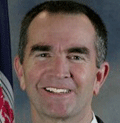
Lieutenant Governor Ralph Northam
Democrats also won two other statewide offices, and the GOP lost its once-comfortable majority in the lower house of the state legislature, a stunning feat that included election of the nation’s first-ever transgender legislator.
Northam’s 54-45 percent victory over Gillespie in the November 7 vote was nearly twice as large as Hillary Clinton’s margin of victory over Donald Trump in 2016 and was built on 20-point victories in the suburbs of Washington, D.C. and Richmond.
Holding the governorship in Virginia is a boon for Democrats frustrated by a string of heartbreaking defeats in special and off-year elections since Trump took the White House. The result, however, was a hold, not a takeaway, and it came in the lone Southern state Clinton carried.
Speaking to jubilant supporters in Fairfax, Northam offered a thinly veiled rebuke to the president’s take-no-prisoners style of politics.
“It was said that the eyes of the nation are on the commonwealth,” Northam said. “Today, Virginians have answered and have spoken. Virginia has told us to end the divisiveness, that we will not condone hatred and bigotry and to end the politics that have torn this country apart.”
After Northam was declared the winner, Trump, visiting South Korea, sent a tweet taking issue with Gillespie’s decision to distance himself from the president: “Ed Gillespie worked hard but did not embrace me or what I stand for.”
The specter of Trump hovered over the governor’s race. Gillespie did not invite the president to cross the Potomac to campaign for him, angering some in his party’s pro-Trump base, but Northam still tried to hang Trump around Gillespie’s neck, accusing the GOP nominee of figuratively “standing right next” to the president, even if literally he had not.

Ed Gillespie
In his concession speech, Gillespie thanked his campaign workers and supporters but did not mention the president.
“I felt called to serve. I hope I’ll discern what (God’s) calling is for me next,” Gillespie said.
Gillespie’s loss is his second statewide defeat in four years. In 2014, he challenged Democratic U.S. Senator Mark Warner, coming to within 18,000 votes of beating him.
In the race for lieutenant governor, Democrat Justin Fairfax, an attorney and former federal prosecutor from the D.C. suburbs, defeated Republican State Senator Jill Vogel. Democratic Attorney General Mark Herring also won his re-election race over Republican John Adams.
Perhaps the most shocking result of the night came in the races for the House of Delegates, the lower house of Virginia’s legislature. Republicans entered election day holding a 66-34 majority; Democrats ousted at least 11 incumbents and picked up three open seats that the GOP had held.
With five races still too close to call, Democrats had 48 seats and Republicans 47. Of the five races left outstanding, Republicans were ahead in three and Democrats in two. If those results hold, the chamber would be evenly divided, 50-50.
In four of the five House races still to be decided, the leads are less than 125 votes, making recounts likely.
Virginia Delegate-Elect Danica Roem
Among the winners was Danica Roem, a transgender woman who won a seat in Prince William County by defeating veteran GOP Delegate Bob Marshall, a 14-term social conservative who had described himself as Virginia’s “chief homophobe” and insisted on referring to Roem with male pronouns.
When Roem takes office, she will be the the first transgender person in the United States to be elected and serve in a state legislature while openly acknowledging her gender identity.
Northam’s win in the South’s lone off-year governor’s election gives Democrats three of the region’s 14 governorships, with Northam joining Louisiana Governor Jon Bell Edwards and North Carolina Governor Roy Cooper. The incumbent Democrat in Virginia, Governor Terry McAuliffe, was barred by state law from seeking re-election.
Northam, 58, comes to the governorship after 10 years in elected office, first as a state senator and then lieutenant governor. A former U.S. Army doctor, he has practiced pediatric neurology at a children’s hospital in Norfolk since 1992.
With his win, Democrats have now won three of the last four governor’s races in Virginia, a once solidly Republican state that has trended Democratic in recent years, primarily due to an influx of new voters into the Washington, D.C. suburbs.

 Chicken Fried Politics