
Latest Posts
Latest Coverage
-
Symbolic solution in search of an actual problem
Support of 9 Southern Republicans for Respect for Marriage Act shows why Supreme Court isn’t about to ban same-sex marriage ♦By Rich Shumate, ChickenFriedPolitics.com editor…
-

West Virginia stubborn, or playing hard to get
U.S. Senator Joe Manchin pisses off his party yet again … to what end? ♦By Rich Shumate, ChickenFriedPolitics.com editor Also in this report: Atlanta DA…
-

2 Mississippi Republican U.S. House members forced into runoffs after weak primary showings
Michael Guest narrowly trails challenger in 3rd District; Steven Palazzo clears just 32% in 4th District ♦By Rich Shumate, ChickenFriedPolitics.com editor JACKSON, Mississippi (CFP) –…
-

Mississippi Republican U.S. Rep. Steven Palazzo facing Tuesday primary fight amid ethics investigation
6 opponents hitting “No-Show Palazzo” over inattention to district, ethics problems ♦By Rich Shumate, ChickenFriedPolitics.com editor GULFPORT (CFP) — Mississippi U.S. Rep. Steven Palazzo —…
-

Primary Wrap: Kemp, Raffensperger survive Trump’s ire; Brooks makes Alabama U.S. Senate runoff
Texas Democratic U.S. Rep. Henry Cuellar survives challenge from the left; George P. Bush gets blown out by Attorney General Ken Paxton ♦By Rich Shumate,…
-

U.S. House’s last pro-life Democrat, Texas’s Henry Cuellar, fighting to keep seat in Tuesday primary runoff
Challenger Jessica Cisneros wanted House Democratic leaders to rescind Cuellar endorsement; they refused ♦By Rich Shumate, ChickenFriedPolitics.com editor LAREDO, Texas (CFP) — Amid the newly…

Florida State Sen. Annette Taddeo jumps into Democratic governor’s race
Taddeo’s entry sets up three-person race with U.S. Rep. Charlie Crist and Agriculture Commissioner Nikki Fried
♦By Rich Shumate, ChickenFriedPolitics.com editor
 TALLAHASSEE (CFP) — Florida State Senator Annette Taddeo has launched a campaign for the Democratic nomination for governor, putting a new wrinkle in what had been a two-horse race for the right to face Republican Governor Ron DeSantis.
If elected, Taddeo, 54, who represents a Miami-Dade district in the Senate, would be the state’s first Latina governor. Her entry sets up a primary battle against U.S. Rep. Charlie Crist and Agriculture Commissioner Nikki Fried.
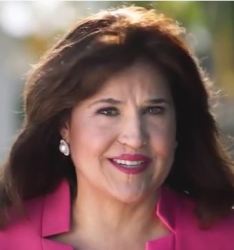
State Senator Annette Taddeo, D-Florida
At an Oct. 18 news conference in Tallahassee announcing her run, Taddeo said she entered the race after encouragement from people around the state, which she said showed her that there was “real hunger for a fighter and a leader who will actually bring the coalition that we need here to win.”
“I am somebody that really believes in Florida and who believes Florida deserves a governor who will actually govern for all Floridians and not just for a select few,” she said.
Crist and Taddeo have been together before in a governor’s race, but as allies rather than rivals. When he ran unsuccessfully for governor in 2014, he picked her as his running mate for lieutenant governor.
In a campaign kickoff, Taddeo wasted no time in going after DeSantis over his opposition to mask and vaccine mandates, which is likely to be a flashpoint in next year’s campaign.
“I’m fighting for a science-based, common sense approach to public health in this pandemic,” she said. “As a mom with a kid in public schools, and after four years of this, I believe [DeSantis’s] time is up.”
Taddeo was born on a farm in Columbia and moved to the United States when she was a teenager. She ran unsuccessfully for the U.S. House in 2008 and 2016 before winning a special election for a Florida Senate seat in 2017.
Because Florida does not have primary runoffs, the primary candidate who gets a plurality will win the Democratic nomination, which significantly changes the calculation with three major candidates in the race rather than two.
Crist is from Tampa Bay, while Taddeo and Fried are both from South Florida. Hispanic Democrats, particularly in Central Florida, are likely to be a key to winning the nomination, which could play to Taddeo’s advantage. She has been a vocal critic of the state party’s outreach to Hispanic voters.
Fried, elected as agriculture commissioner in 2018, is the only Democrat holding statewide office, and she has been a persistent critic of DeSantis’s tenure in Tallahasssee.
Crist was elected to a single term as governor in 2006 before leaving to make an ill-fated run for U.S. Senate in 2010, where he was beaten by Marco Rubio. After switching parties in 2013, he ran for governor as a Democrat and lost in 2014, bouncing back to win a seat in Congress two years later.
Crist has run for statewide office seven times since 1998, as a Republican, an independent and a Democrat. He is 3-and-3 in his previous six races.
The winner will face a formidable opponent in DeSantis, who will not only have the power of incumbency but is sitting on a warchest topping $53 million, which, unlike his Democratic rivals, he won’t have to spend in a primary.
Democrats have not won a governor’s race in Florida since 1994.
We tweet @ChkFriPolitics Join us!
Black U.S. Senate candidates in the South piling up impressive amounts of campaign cash
U.S. Senators Raphael Warnock and Tim Scott have raised more money than any other Senate candidates nationwide
♦By Rich Shumate, ChickenFriedPolitics.com editor
 (CFP) — African American candidates have historically faced a structural barrier in gaining election to high office — difficulty raising the money needed to run a competitive race. But in 2022, black candidates appear to be kicking down that barrier in Southern U.S. Senate races.
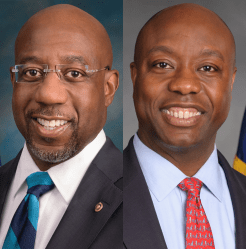
U.S. Senators Raphael Warnock and Tim Scott lead national fundraising totals
Six Southern African American candidates have each raised more than $1 million; three have raised more than $10 million. And more than a year before election day, Democratic U.S Senator Raphael Warnock of Georgia has raised more money than any other Senate candidate in the country, $44 million.
Behind Warnock is Republican U.S. Senator Tim Scott of South Carolina, at $31 million.
In the 150 years since Reconstruction, just two African Americans have been elected to represent a Southern state in the U.S. Senate — Scott and Warnock, who are both up for re-election in 2022 and amassing mountains of cash.
But the four other Southern African American candidates trying to join Scott and Warnock in the Senate are also pulling in impressive amounts of campaign money, the possession of which doesn’t ensure victory but the absence of which would certainly spell defeat.
In Georgia, Warnock is likely to face another black candidate, Republican Herschel Walker, the NFL and Georgia Bulldog great whom Donald Trump inveighed to get into the race.
In the third quarter of 2021, Warnock and Walker combined raised $13.3 million for what is likely to be among the most competitive races of the 2022 cycle; Warnock pulled in $9.5 million to $3.8 million for Walker.
Trump’s endorsement has not cleared the Republican primary field for Walker, who faces a multi-candidate primary before he can get to Warnock,. However, in his first five weeks in the race, Walker has already raised more money than any of his primary rivals.
Unlike Warnock, Scott is not facing a competitive race in the Palmetto State in 2022. But his haul during the third quarter — $8.4 million — is stoking speculation that Scott may be filling his cash cupboard for a possible 2024 run for the Republican presidential nomination.
In Florida, Democratic U.S. Rep. Val Demings — who raised her a national political profile as an House manager in the first Trump impeachment trial — raised $8.5 million in the third quarter, eclipsing the $6 million raised by her likely Republican opponent, U.S. Senator Marco Rubio. But he’s raised $19 million overall so far, compared to her $13.5 million.
Neither Demings nor Rubio appear likely at this point to face a serious primary challenge that would deplete their coffers before turning their fire on each other.
In North Carolina, former Supreme Court Chief Justice Cheri Beasley raised $1.5 million in the third quarter. While that total was not as impressive as some of the black candidates in other races, it was more than any other candidate in her race in either party, although she remains slightly behind her strongest white rival for the Democratic nomination, State Senator Jeff Jackson, in overall fundraising.
In heavily Republican Kentucky, former State Rep. Charles Booker from Louisville is considered the longest of long shots to unseat U.S. Senator Rand Paul, running as a self-styled “progressive.” But he, too, has taken in $1.7 million, tapping into national Democratic anger at some of Paul’s statements during the COVID-19 pandemic.
At this point in the cycle, five of the six Southern African American candidates — Warnock, Scott, Demings, Walker, and Booker — are likely to be their party’s nominee, while Beasley’s fundraising will make her competitive in North Carolina’s Democratic primary. That number of major party Southern African-American nominees will shatter historical precedent.
The races in Georgia, Florida, and North Carolina are also likely to be among the most hard-fought, and expensive, in the country, with African American candidates in the mix for victory, while Scott could use 2022 as a springboard to bigger and better things.
We tweet @ChkFriPolitics Join us!
First Texas U.S. House map redraw reduces number of majority-minority districts
GOP’s initial redistricting proposal also reduces number of competitive districts
♦By Rich Shumate, ChickenFriedPolitics.com editor
 AUSTIN (CFP) — Texas is getting two new seats in the U.S. House because of the state’s explosive population growth, most of which was because of increasing numbers of black, Hispanic and Asian residents over the last decade.
But the first legislative plan to redraw the state’s congressional maps, released September 27, actually reduces the number of majority-minority districts, drawing immediate howls of protest from advocacy groups and promises of protracted litigation.
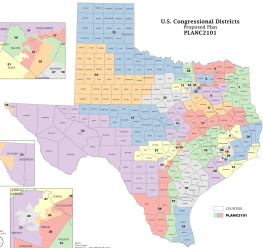
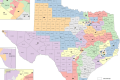
First new Texas U.S. House map proposed by GOP (From Texas Legislative Council)
The first draw of the state’s map — proposed by State Senator Joan Huffman of Houston, who heads the Senate’s redistricting committee – is the starting point of the fight over new maps, taking place in a special session that began September 20.
And while those maps are likely to change as legislative continues, the plan reflects the thinking of Republican leaders — who have total control over the reapportionment process.
Overall, the map would make life much easier for House incumbents of both parties by vastly reducing the number of competitive districts statewide.
To accomplish this, Republicans mapmakers have shifted lines to make GOP-held marginal districts more Republican friendly; as a result, however, safer Democratic seats have also been created.
The two new seats are split between the parties, with creation of a new Democratic district in liberal-leaning Austin. Overall, under this map, Republicans are likely to control 25 of 38 seats, a net gain of two seats, and have a chance at a 26th seat in South Texas, which saw a shift to the GOP in 2020.
Here is a look at some of the highlights of the new map:
- Texas is getting two additional seats because of the state’s population growth, raising the total number of seats from 36 to 38. The new map puts one of those seats in the Austin area, which will be Democratic, and another in the Houston suburbs, which will be Republican.
- In 2020, Donald Trump carried 22 districts and Joe Biden 14; the new map has 25 districts that Trump would have won and 13 that would have gone for Biden.
- In 2018 and 2020, there were as many as 10 districts in the Lone Star State that were somewhat competitive between the two parties. The new map makes these marginal GOP-held seats more Republican, with just one district where the margin between Joe Biden and Donald Trump in 2020 was less than five points. (The swing district, CD 15, is in South Texas and currently held by Democrat Vicente Gonzalez.)
- The current map includes 22 districts where a majority of voters are white; the new map has 23. The number of majority Hispanic districts falls from eight to seven, and the state’s lone majority black district is eliminated. However, the number of districts where no racial or ethnic group has a majority will rise from five to eight.
- In 2018, Democratic U.S. Reps. Colin Allred in Dallas and Lizzie Fletcher in Houston flipped long-held Republican seats, and they survived fierce GOP challenges in 2020. However, the new map makes both of their districts more Democratic by moving Republicans to adjacent districts to help GOP incumbents, which will leave Allred and Fletcher in safe seats.
- The new map puts Democrat Sylvia Garcia in the same district with Republican Dan Crenshaw in Houston and Democrats Sheila Jackson Lee and Al Green in the same district, also in Houston. However, House members aren’t required to run in the districts where they live, so all four would be able to shift to safe districts where they won’t have to run against each other.
- Texas is covered by the Voting Rights Act, which requires mapmakers to optimize electoral opportunities for minority voters, which means the reduction in majority minority districts in this map will almost certainly trigger a legal challenge if it survives the legislative process. However, because of a 2013 Supreme Court ruling, the state no longer has to get Justice Department approval for its political maps, forcing advocacy groups to use the courts to stop implementation.
We tweet @ChkFriPolitics Join us!
Candidates for Virginia governor square off in first debate
Posted September 19 (From WUSA via YouTube)

Georgia businesswoman launches GOP primary challenge to U.S. Rep. Marjorie Taylor Greene
Jennifer Strahan comes out swinging in 14th District race with broadside against “unserious” politicians
♦By Rich Shumate, ChickenFriedPolitics.com editor
 ATLANTA (CFP) — Saying “this is not the time for unserious politicians who just want to hear themselves talk,” Georgia health care consultant Jennifer Strahan has launched a Republican primary campaign to unseat U.S. Rep. Marjorie Taylor Greene, whose tumultuous tenure in Congress has trailed clouds of controversy.

Congressional candidate Jennifer Strahan, R-Georgia
“I’m a no-nonsense conservative who believes our country and our culture have gotten off track,” Strahan said in her announcement video released September 15. “Like a lot of you, I’m tired of out-of-touch people in Washington putting what’s good for themselves ahead of what’s good for the country.”
Strahan’s entry in the race will sets up what is likely to be one of the most contentious GOP primary contests of the 2022 cycle, with the polarizing Greene a magnet for campaign cash from both her detractors and her admirers.
Four Democrats have also entered the race to unseat Greene but would be long shots in the overwhelmingly Republican 14th District, which takes in the state’s northwest corner.
Strahan, who lives at the southern edge of the district, holds a doctorate in health care leadership and runs a health care consulting company. This is her first bid for political office.
Watch Strahan’s announcement video at end of article.
Responding to Strahan’s entry into the race, Greene released a statement calling herself “the most effective member of the GOP conference this session because I’ve stood on the House floor and demanded roll call votes on the Democrats’ Communist agenda and the rest of the party has joined my efforts.”
Greene said she has led efforts “to Impeach Joe Biden, Fire Tony Fauci, Expel Maxine Waters, Eliminate The ATF, and Ban Vaccine Mandates” and that if Republicans want to regain control of the House in 2022, “we aren’t going to do it with pathetic empty campaign promises written by DC consultants.”
Greene was elected to the open seat in 2020 after parachuting into the 14th District, where she did not then live, after Republican incumbent Tom Graves retired. During the campaign, she had to explain her previous dalliance with the QAnon conspiracy theory and suggestions that the Parkland school shooting in Florida was a hoax.
Arriving in Washington with a take-no-prisoners style, she led objections to President Joe Biden’s Electoral College certification, advancing unsupported claims that Donald Trump actually won the election. The House Democratic majority voted to boot her from her committee assignments after she was accused of threatening Democratic members.
Greene has also been fined twice for refusing to wear a mask on the floor of the House and raised eyebrows by telling attendees at a political event in Alabama that people might shoot Biden’s “police state friends” trying to encourage COVID-19 vaccinations. Twitter has suspended her repeatedly for posting vaccine disinformation.
She also repeatedly compared mask mandates to the Holocaust and even voted against giving the Congressional Gold Medal to police officers who protected the Capitol during the January 6th attack by a pro-Trump mob.
But Greene has also spun all of that controversy into campaign gold, raising nearly $4.8 million for her re-election contest and giving her a head start over Strahan and her other challengers.
In addition to Strahan, Republican Mark Clay is also running in the 14th District, along with Democrats Lateefah Conner, Wendy Davis, Marcus Flowers and Holly McCormack.

 Chicken Fried Politics