
Latest Posts
Latest Coverage
-
Symbolic solution in search of an actual problem
Support of 9 Southern Republicans for Respect for Marriage Act shows why Supreme Court isn’t about to ban same-sex marriage ♦By Rich Shumate, ChickenFriedPolitics.com editor…
-

West Virginia stubborn, or playing hard to get
U.S. Senator Joe Manchin pisses off his party yet again … to what end? ♦By Rich Shumate, ChickenFriedPolitics.com editor Also in this report: Atlanta DA…
-

2 Mississippi Republican U.S. House members forced into runoffs after weak primary showings
Michael Guest narrowly trails challenger in 3rd District; Steven Palazzo clears just 32% in 4th District ♦By Rich Shumate, ChickenFriedPolitics.com editor JACKSON, Mississippi (CFP) –…
-
Mississippi Republican U.S. Rep. Steven Palazzo facing Tuesday primary fight amid ethics investigation
6 opponents hitting “No-Show Palazzo” over inattention to district, ethics problems ♦By Rich Shumate, ChickenFriedPolitics.com editor GULFPORT (CFP) — Mississippi U.S. Rep. Steven Palazzo —…
-

Primary Wrap: Kemp, Raffensperger survive Trump’s ire; Brooks makes Alabama U.S. Senate runoff
Texas Democratic U.S. Rep. Henry Cuellar survives challenge from the left; George P. Bush gets blown out by Attorney General Ken Paxton ♦By Rich Shumate,…
-

U.S. House’s last pro-life Democrat, Texas’s Henry Cuellar, fighting to keep seat in Tuesday primary runoff
Challenger Jessica Cisneros wanted House Democratic leaders to rescind Cuellar endorsement; they refused ♦By Rich Shumate, ChickenFriedPolitics.com editor LAREDO, Texas (CFP) — Amid the newly…
GOP keeps South Carolina U.S. House seat with vastly decreased margin
Republican Ralph Norman defeats Democrat Archie Parnell by just 3 points
♦By Rich Shumate, ChickenFriedPolitics.com editor
 COLUMBIA, South Carolina (CFP) — Republican Ralph Norman has won the special election for South Carolina’s 5th District U.S. House seat, but Democrat Archie Parnell managed to trim more than 17 points from the GOP’s 2016 margin despite getting little support from Democrats nationally.

U.S. Rep.-Elect Ralph Norman, R-South Carolina
With all of the precincts reporting in the June 20 vote, Norman, a former state representative, won 51.1 percent to 47.9 percent for Parnell, a former Goldman Sachs executive making his first run for political office.
That 3.2-point margin showed a marked deterioration in Republican support since the November election. President Trump won the district by 19 points in 2016, while Mick Mulvaney, who gave up the seat to become director of the Office of Management and Budget, won by nearly 21 points.
The 5th District takes in the north central part of the state, stretching along the I-77 corridor from the suburbs of Charlotte down to near Columbia.
Norman, 63, is a real estate developer from Rock Hill who served two stints in the state House, first from 2005 to 2007 and then from 2009 until he resigned to run for Mulvaney’s seat. He was favored to win after dispatching State Rep. Tommy Pope in May’s Republican primary runoff.

Archie Parnell, D-Congressional candidate
Parnell, 66, from Sumter, is a South Carolina native who is currently a senior adviser to Goldman Sachs after working there as a managing director for 20 years. He is also a former tax attorney for ExxonMobil and worked in Washington as senior counsel for a House committee from 1976 to 1980.
While Parnell’s long-shot campaign won enthusiasm from South Carolina Democrats, the national party and Democratic leaning outside groups largely avoided the 5th District race, concentrating their firepower instead on a House runoff in Georgia, held the same day, that was considered more winnable.
Parnell also had the endorsement of John Spratt, the Democrat who held the seat for 28 years before being ousted by Mulvaney in the Republican wave of 2010.
Norman’s win, along with a win by Republican Karen Handel in the Georgia 6th District runoff, means Republicans have successfully defended all four of the House seats that became vacant when their occupants were appointed to positions in the Trump administration. The other elections were in Kansas and Montana.
Voters give verdict on expensive slugfest in Georgia’s 6th U.S. House District runoff
Democrat Jon Ossoff hoping to wrest away traditionally GOP seat in suburban Atlanta
♦By Rich Shumate, ChickenFriedPolitics.com editor
 ROSWELL, Georgia (CFP) — The most expensive U.S. House race in American history is drawing to a close, with Republican Karen Handel and Democrat Jon Ossoff making last-minute pitches in a special election runoff to fill Georgia’s vacant 6th District seat.
Polls in the June 20 runoff open at 7 a.m. and close at 7 p.m. EDT, with the results expected to draw outsized national attention.
A victory by Ossoff in a district the GOP has held for decades will be seen as a harbinger of potential doom for House Republicans in 2018. But a win by Handel would make Republicans three-for-three in winning House special elections this year, possibly tempering the speculation about how much President Trump’s historic unpopularity ratings are really eroding the party’s electoral health.
No matter the outcome, the competitiveness of the race wasn’t what Trump had in mind when he appointed Tom Price to head the U.S. Department of Health and Human Services, leaving an open seat that Republicans expected to defend easily.

Jon Ossoff, D, Georgia 6th District candidate
Fueled by liberal anger at Trump’s election, Ossoff — a 30-year-old filmmaker and former congressional aide seeking office for the first time — raised a staggering $23.6 million by the end of May, according to a report filed with the Federal Elections Commission. That figure doesn’t include any additional money raised during the first three weeks of June, as his runoff with Handel moved toward its climax.
Handel, a former Fulton County Commission chair and secretary of state, raised just $4.5 million by the end of May, although outside GOP-aligned groups have spent additional money on her behalf.
When all of the candidate and outside spending is tallied, the total is expected to approach $50 million, shattering all previous records for U.S. House races. To put that spending in perspective, a $50 million race would come to roughly $71 each for every man, woman and child in the district — and would be the equivalent of a $700 million statewide race in Georgia.
The 6th District arcs across Atlanta’s northern suburbs, taking in parts of Cobb, Fulton and DeKalb counties. Since its present configuration was drawn after the 1990 census, the seat has been held by Newt Gingrich, who went on to become speaker of the House; Johnny Isakson, who went on to the U.S. Senate; and Price, now in Trump’s Cabinet.
While Price won the district by 76,000 votes in November, Democrats smelled blood after Trump only managed to carry it by a scant 1.5 percent, on his way to becoming the first Republican to lose Cobb County since 1976. Trump also lost the March 2016 Republican primary in the district to U.S. Senator Marco Rubio of Florida.
Ossoff had initially begun his campaign with the slogan “Make Trump Furious.” But after coming in first in the April 19 primary, he eschewed nationalizing the campaign and sought to focus on district-specific issues.

Karen Handel, R. Georgia 6th District candidate
For Handel, 55, the second-place finish in the primary was a welcome political comeback after back-to-back losses to Governor Nathan Deal in a GOP runoff in 2010 and a Republican primary for the U.S. Senate in 2014. She served as secretary of state from 2007 to 2011 and as chair of the Fulton County Commission from 2003 to 2006.
Trump has not campaigned in person for Handel, although he did tape an anti-Ossoff robocall before the primary. But Vice President Mike Pence and Price both came down from Washington to make appearances on her behalf.
Democrat Northam, Republican Gillespie will face off in Virginia governor’s race
Northam wins easily among Democrats; Gillespie barely edges out Trump-aligned candidate
♦By Rich Shumate, ChickenFriedPolitics.com editor
 FAIRFAX, Virginia (CFP) — Lieutenant Governor Ralph Northam easily won the Democratic nomination for Virginia governor, brushing aside an anti-establishment challenge from former U.S. Rep. Tom Perriello.
But on the Republican side, former Republican National Committee chairman Ed Gillespie could only squeak out a narrow win over Corey Stewart, Donald Trump’s one-time Virginia campaign director, in a race that turned out to be much closer than pre-election polls had forecast.
The results of the June 13 primary now set up what is likely to be an expensive and hard-fought race in the fall for the South’s only open governorship.
Among Democrats, North won 55 percent, to 45 percent for Perriello. On the Republican side, Gillespie was at 44 percent, just ahead of Stewart, chair of the Prince William County Board of Supervisors, at 43 percent. State Senator Frank Wagner from Virginia Beach brought up the rear at 14 percent.
Unofficial results from the Virginia Department of Elections put Gillespie’s margin over Stewart at just 4,200 votes out of nearly 366,000 votes cast. The margin would have to be within 1 percent of the total votes cast — 3,660 — in order to trigger a recount under state law.
Because Virginia does not have primary runoffs, Gillespie only had to win a plurality to advance to the general election.
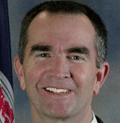
Lieutenant Governor Ralph Northam
Northam, a pediatric neurologist from Norfolk who has spent a decade in state politics, had the backing of most of Virginia’s Democratic political establishment and appeared to be cruising to an easy nomination until Perriello jumped into the race in January.
Perriello’s campaign was endorsed by 2016 presidential candidate U.S. Senator Bernie Sanders and U.S. Senator Elizabeth Warren of Massachusetts, along with a slew of former officials from Barack Obama’s administration, in which Perriello served after losing his House seat in 2010.
While Obama did not offer an endorsement, Perriello frequently reminded voters of his connection to the former president. But in the end, Perriello’s insurgent passion could not overcome Northam’s organizational and fundraising advantages.

Ed Gillespie
The Republican race also featured an outsider-versus-insider narrative, with Stewart wrapping himself in the mantle of Trump and vowing to “take back Virginia from the establishment” — a not-so-veiled shot at Gillespie, who served as a White House aide under President George W. Bush before leading the RNC.
One curious feature of the campaign was the decision by Stewart — an native of Minnesota — to publicly decry efforts to remove Confederate monuments from public spaces, which have sparked controversy in Charlottesville and other cities in the South.
The governor’s race in the Old Dominion is one of only two being held this year; the other is in New Jersey. Democratic Governor Terry McAuliffe is barred from seeking re-election.
Once reliably Republican, Virginia is the only Southern state that Hillary Clinton carried in 2016, and it has now gone to the GOP in three successive presidential elections.
Three of the commonwealth’s last four governors have been Democrats, and it is is among just three of the 14 Southern states with a Democratic chief executive, the others being West Virginia and Louisiana.
Primaries for Virginia governor echo 2016 presidential race
Establishment-versus-insurgent contests featured on both GOP and Democratic ballots
♦By Rich Shumate, ChickenFriedPolitics.com editor
RICHMOND (CFP) — The calendar may read 2017, and the names on the ballot may not be the same, but voters in Virginia can be forgiven if the commonwealth’s primaries for governor seem vaguely reminiscent of last year’s presidential contest.
On the Republican side, a party stalwart and former aide in the George W. Bush White House is running against Donald Trump’s one-time Virginia campaign director. On the Democratic side, a Bernie Sanders-backed candidate is offering a stiff challenge to a veteran officeholder who was considered to be a shoo-in just six months ago.
As voters prepare to go to the polls June 13, polls show that many voters in both races are undecided, providing a level of uncertainty and suspense in the South’s only governor’s race this year.
Polls will be open from 6 a.m. to 7 p.m.
Lieutenant Governor Ralph Northam
On the Democratic side, Lieutenant Governor Ralph Northam appeared to be cruising to his party’s nomination unmolested until January, when former U.S. Rep. Tom Perriello jumped into the race and began casting himself as the anti-establishment alternative, in contrast to the well-connected Northam.
Northam has the backing of Democratic Governor Terry McAuliffe, who is barred by Virginia law from running for re-election, along with both of the commonwealth’s U.S. Senators, Mark Warner and Tim Kaine.
Former U.S. Rep. Tom Perriello, D-Virginia
Perriello has countered with endorsements from Sanders, U.S. Senator Elizabeth Warren of Massachusetts and a slew of former officials from Barack Obama’s administration, in which Perriello served. And while Obama has not offered an endorsement, Perriello has been reminding voters of his connection to the former president every chance he gets.
Polls have shown a close race, although the large numbers of undecided voters means there is no clear leader heading into election day.
Ed Gillespie
On the Republican side, Ed Gillespie, a former Republican National Committee chairman and Bush aide who ran a surprisingly strong race for U.S. Senate in 2014, has held a lead in the polls over his two challengers, Corey Stewart, chairman of the Prince William County Board of Supervisors, and State Senator Frank Wagner, from Virginia Beach, a former U.S. Navy officer who has served in the the state legislature for 25 years.
Because Virginia does not have primary runoffs, Gillespie only has to win a plurality to advance to the general election.
GOP candidate Corey Stewart
Stewart, who was once Trump’s Virginia state chairman, has wrapped himself in the Trump mantle, positioning himself as the man who can “take back Virginia from the establishment,” a not-so-veiled reference to Gillespie.
Stewart lost his job in the Trump campaign in October 2016 after organizing a protest outside of Republican National Committee headquarters demanding that the GOP hierarchy not abandon Trump in the wake of the release of an audiotape in which Trump made sexually suggestive comments. But he still continued to support Trump.
During the campaign, Stewart — an native of Minnesota — has also come out against efforts to remove Confederate monuments, which have sparked controversy in Charlottesville and other cities in the South.
The winners of both primaries will advance to the general election, which is one of only two governor’s races being held this year. The other is in New Jersey.
Once reliably Republican, Virginia is the only Southern state that Hillary Clinton carried in 2016, and it has now gone to the GOP in three successive elections.
Three of the commonwealth’s last four governors have been Democrats — Warner, Kaine and McAuliffe — and Virginia is among just three of 14 Southern states with a Democratic chief executive, the others being West Virginia and Louisiana.
South Carolina U.S. Rep. Trey Gowdy picked to head powerful oversight panel
Gowdy will head House Oversight and Government Reform Committee
♦By Rich Shumate, ChickenFriedPolitics.com editor
WASHINGTON (CFP) — U.S. Rep. Trey Gowdy, who gained national prominence for his dogged investigation of the 2012 terrorist attack in Benghazi, Libya, has been selected to be the new chair of the House committee charged with investigating the executive branch.

U.S. Rep. Trey Gowdy, R-South Carolina
Gowdy was selected June 8 by the Republican Steering Committee to chair the Oversight and Government Reform Committee, replacing U.S. Rep. Jason Chaffetz of Utah, who is resigning from Congress.
“Oversight is constitutionally authorized and important to ensure branch integrity and equilibrium,” Gowdy said in a statement after his selection. “I look forward to working alongside the other committee members, as well as any member of Congress, as we discharge the jurisdiction assigned to us.”
Gowdy, 52, a former federal and state prosecutor in South Carolina, is in his fourth term representing the state’s 4th District, which includes the Greenville-Spartanburg metro area.
After four Americans died in a terrorist attack on a U.S. diplomatic compound in Benghazi in 2012, Gowdy was appointed by House GOP leaders to head a special committee to investigate the attack.
The primary target of that probe was Hillary Clinton, who was secretary of state at the time of the attack. Gowdy’s investigation eventually led to the disclosure that Clinton had used a private email server, which prompted an FBI investigation and dogged her throughout the 2016 presidential campaign.
After Donald Trump defeated Clinton, House Republicans shut down the Benghazi committee.


