
Home » Posts tagged 'Barbara Comstock' (Page 2)
Tag Archives: Barbara Comstock

Virginia Primary: Democrats pick nominees in GOP-held U.S. House targets
Republicans will pick candidate to face Democratic U.S. Senator Tim Kaine in November
♦By Rich Shumate, ChickenFriedPolitics.com editor

 RICHMOND (CFP) — Virginia Democrats will pick nominees for four targeted Republican-held U.S. House seats in Tuesday’s primary election, including a race in the Washington, D.C. suburbs where a large gaggle of Democrats have already raised $6.5 million to try to unseat U.S. Rep. Barbara Comstock.
Republicans will decide on a nominee for an uphill battle to unseat Democratic U.S. Senator Tim Kaine, with Corey Stewart, the controversial chair of the Prince William County Board of Supervisors, leading the pack.
Polls are open across the commonwealth Tuesday from 6 a.m. to 7 p.m.
In U.S. House contests, Democrats are making a play for four Republican-held seats in Virginia in their quest to gain the 24 seats they need nationally to capture control.
Targets include the 2nd District in Virginia Beach and Hampton Roads; the 5th District, which includes Charlottesville and much of central Virginia; the 7th District, which takes in Richmond’s eastern suburbs and areas to the north; and the 10th District, which stretches from the western Washington suburbs toward West Virginia.

U.S. Rep. Barbara Comstock, R-Virginia
The most money and attention have been lavished on the 10th District, where Comstock is seen as one of the most vulnerable Republican incumbents in a district that Hillary Clinton carried by 10 points in 2016.
Six Democrats are running and, because Virginia does not have primary runoffs, whichever candidate can cobble together the most votes Tuesday will win the nomination.
The most recent Federal Elections Commission filings show three Democrats — State Senator Jennifer Wexton, Alison Friedman, and Dan Helmer — have raised more than $1 million, while a fourth, Lindsey Davis Stover, has approached the $1 million mark.
Wexton, from Leesburg, has gotten endorsements from Governor Ralph Northam and other elected Democrats. Both Friedman and Stover served in the Obama administration. Helmer, from Fairfax, is a business strategist and former Army officer.
In all, the six Democrats have raised nearly $6.5 million for the 10th District race, a testament to Democratic enthusiasm in the wake of the party’s strong showing in state elections last year.
However, Comstock — who has turned back stiff Democratic challenges in the last three election cycles — still has far and away the biggest fundraising haul at $3.3 million.
Comstock also has a Republican challenger, Shak Hill, a primary that turned contentious in the closing days. Hill has attacked Comstock as insufficiently conservative, branding her “Beltway Barbara;” Comstock has questioned Hill’s personal history, calling him “Shady Shak.”
In the 2nd District, two Democrats are running to face freshman Republican U.S. Rep. Scott Taylor, in a district Trump carried by just 3 points in 2016: Elaine Luria, a businesswoman and former Navy officer, and Karen Mallard, a public school teacher.
Taylor also faces a GOP primary challenge from Mary Jones, a former county supervisor in James City County, who has wrapped herself in the Trump mantle and criticized Taylor for not being conservative enough.
In the 7th District, Democrats Abigail Spanberger and Daniel Ward are vying for the right to take on U.S. Rep. Dave Brat in November. Spanberger, from Glen Allen, is a retired CIA operative; Ward, from Orange, is an airline pilot and former Marine Corps officer who worked as a State Department aide during the Obama administration.
Both Democrats have each raised more than $900,000 for the race, nearly catching Brat, who is best known nationally for knocking off former House Majority Leader Eric Cantor in a 2014 primary. Trump carried the district by 7 points.
The one Democrat-targeted seat where there won’t be any suspense on primary night is the 5th District, where Democrat Leslie Cockburn won the nomination at a Democratic convention and Republican party leaders picked Denver Riggleman to run when the incumbent, U.S. Rep. Tom Garrett, pulled out in May after disclosing his alcoholism.
Cockburn, from Rappahannock County, is a former network television producer and correspondent who has raised $715,000 for the race. Riggleman, who owns a distillery near Charlottesville and made an unsuccessful bid for governor in 2017, will start the race in a significant financial hole.

GOP Senate candidate Corey Stewart
In the Republican U.S. Senate race, Stewart is facing off against State Delegate Nick Freitas from Culpeper and E.W. Jackson, an African-American Baptist pastor and social conservative activist who was the unsuccessful Republican nominee for lieutenant governor in 2013.
Stewart nearly won the GOP nomination for governor in 2017 after a campaign in which the Minnesota native championed the preservation of Confederate monuments. In announcing his Senate bid, Stewart vowed to “run the most vicious, ruthless campaign” against Kaine, the 2016 Democratic nominee for vice president.
Freitas has criticized Stewart for making an appearance alongside one of the organizers of last-year’s neo-Nazi rally in Charlottesville, calling on voters to reject Stewart’s “dog-whistling of white supremacists, anti-Semites and racists.”
Stewart responded by calling Freitas an “establishment Republican” using “leftist tactics of CNN.”
Polls have shown Kaine with a substantial lead over all three of his potential GOP challengers. Republicans haven’t won a Senate election in the Old Dominion since 2008.
Earthquake in Virginia: Democrats overturn huge GOP majority in House of Delegates
Results show U.S. Rep. Barbara Comstock faces tough sledding to keep her seat in 2018
♦By Rich Shumate, ChickenFriedPolitics.com editor
RICHMOND (CFP) — Heading into the November 7 election, Republicans enjoyed a comfortable majority in the Virginia House of Delegates, just one seat short of the two-thirds majority necessary to override the vetoes of a Democratic governor.
U.S. Rep. Barbara Comstock, R-Virginia
But after a catastrophic showing in the Washington, D.C. suburbs, they may now end up sharing power in the legislature’s lower house with Democrats. And those results spell trouble ahead for Republican U.S. Rep. Barbara Comstock, who will have to defend her seat in 2018 in the same suburban areas where Democrats rolled.
With three races still too close to call, Democrats are assured of winning at least 49 seats in the House, to 48 for Republicans. Republican candidates lead in all of the three outstanding races, but the margin in all three is small enough to trigger a recount; in one district, the GOP margin is a mere 13 votes.
If all of the races fall to the GOP, Republicans would keep control of the chamber, 51-49. But if just one flips back to the Democrats, the split will be 50-50, and neither party will have control.
State Senate races were not on the ballot; Republicans control that chamber 21 to 19.

Virginia Delegate-Elect Danica Roem
History was also made when Danica Roem, a transgender woman, won a seat in Prince William County by defeating GOP Delegate Bob Marshall, a 14-term social conservative who had described himself as Virginia’s “chief homophobe” and insisted on referring to Roem with male pronouns during the campaign.
When Roem takes office, she will be the the first transgender person in the United States to be elected and serve in a state legislature while openly acknowledging her transgender identification.
Democrats made a concerted push to cut into the 66-34 majority that Republicans held before the election, contesting 88 of the 100 seats and raising copious amounts of money, including more than $800,000 in four races. But the swing of at least 15 seats was beyond their wildest expectations.
Democratic challengers took down 12 Republican incumbents, with two more in danger in the races still too close to call. Democrats also picked up three open seats that Republicans had held, with one more open GOP seat still to be called.

Virginia Delegate-Elect Chris Hurst
Most of the carnage was in the D.C. suburbs, where seven incumbents fell, including four in Prince William County. But incumbents also lost in suburban Richmond, the Hampton Roads area, and even in a rural district near Blacksburg won by Democrat Chris Hurst, whose girlfriend, Roanoke TV reporter Alison Parker, was gunned down on live TV in 2015.
Hurst raised more than $1.1 million, a staggering summing in a constituency with just 80,000 people. And despite running in a rural Southern district, he also advocated for treating gun violence as a “public health crisis.”
Democratic Delegate candidates were helped by the top of the ticket: Lieutenant Governor Ralph Northam rolled up margins of 20 to 30 points in the northern Virginia suburbs on his way to winning the governorship over Republican Ed Gillespie, and Democratic candidates also took statewide races for lieutenant governor and attorney general.
The results in Virginia were being widely interpreted as a sign that Democrats are reaping the rewards of anger toward President Trump and congressional Republicans, particularly in suburban areas filled with upscale, college-educated voters.
Even before the November 7 election, Comstock was considered to among the most vulnerable Republicans in the U.S. House because Hillary Clinton won her 10th District in 2016 by 10 points, en route to carrying the Old Dominion, the lone Southern state in Clinton’s column.
The district stretches from Fairfax and Manassas west to the West Virginia border. However, its major population centers are in Loudon, Prince William and Fairfax counties — all areas where Northam ran up big numbers and GOP delegates fell by the wayside.
Comstock has already drawn 11 Democratic challengers. The biggest name in the pack is State Senator Jennifer Wexton from Leesburg.
Analysis: South is the GOP’s ace in the hole in stopping Democratic takeover of U.S. House
Democrats will need to flip 11 Southern seats or make make up the difference elsewhere
♦By Rich Shumate, ChickenFriedPolitics.com editor
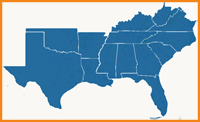 (CFP) — With President Trump’s approval ratings at historically low levels, Democrats have high hopes of taking back the U.S. House in 2018. But those hopes are tempered by a giant geographic obstacle standing in their way — namely, the South.
 To reclaim the House, Democrats need to flip 24 seats, shifting about 10 percent of the seats that Republicans now hold. And nearly half of the GOP caucus — 114 seats — is from the South, where Republican House members outnumber Democrats by 3-to-1.
So a 10 percent shift in the South would require winning 11 seats, in a region where Democrats won just two seats in 2016 (both in Florida and neither yet safe.) If Democrats fall short of that total, they will need to shift an even higher percentage of seats throughout the rest of the country — as much as 19 percent if they come up empty in the South.
And as Democrats plot and plan to add to their meager total of 40 Southern House seats, two recent special elections for open seats offer decidedly mixed omens on their chances for overturning the GOP’s hegemony.
In South Carolina’s 5th District, the swing away from Trump’s 2016 numbers in the special election was nearly 20 percent — not enough for Democrat Archie Parnell to win but a much bigger scare than Republicans had expected. Indeed, if that 20-point swing could be replicated across the South in 2018, 42 GOP-held seats could potentially be in play, more than Democrats would need to return Nancy Pelosi to the speaker’s chair.

Handel
But the results in the other race, in Georgia’s 6th District, pour substantial caution on such irrational exuberance. Republican Karen Handel kept the seat by running slightly ahead of Trump, in a race where Democrats spent a whopping $30 million and still came up short.
And this district in the northern Atlanta suburbs is exactly the kind of place where Democrats will need to compete to claw away at Republican dominance in the South next year — increasingly diverse, maturing suburbs whose upscale, educated voters, though conservative by inclination, are somewhat wary of Trump’s stewardship of the GOP brand.
If Democrats couldn’t win this race for an open seat in a low-turnout special election with a highly energized base and a president with historically low approval ratings, flipping these seats in 2018 will be a tall order indeed, particularly given Trump’s solid base of support in the South.
So where can Democrats start? Their first targets will be three majority Latino districts in metro Miami, all of which have large numbers of Cuban-American voters. Trump lost two of these districts and only narrowly won the third.
Veteran GOP U.S. Rep. Ileana Ros-Lehtinen is retiring, and Republicans will be hard pressed to keep her seat in a district Trump lost by 20 points. But in the other two districts, Democrats will have to unseat incumbents Carlos Curbelo, who has gone out of this way to distance himself from Trump, and Mario Diaz-Balart, who has been winning congressional elections with relative ease since 2002.
Democrats are also likely to target four other Southern districts where Hillary Clinton defeated Trump last year, which include three seats in Texas and one in Virginia. The GOP, however, has held three of these districts, in varying configurations, for decades.

Comstock
The Virginia seat, in the Washington D.C. suburbs, is held by Barbara Comstock, who first won it in 2014 and was narrowly re-elected in 2016. Even at this early date, she has already drawn six Democratic challengers in a district that, like the rest of Virginia, has become more hospitable to Democrats over the last decade.
In Texas, the climb for Democrats will be steeper. Clinton won the 32nd District in suburban Dallas, but that seat is held by Pete Sessions, a GOP titan who won by 52 points in 2016. She also won the 7th District in suburban Houston, where John Culberson ran well ahead of Trump to win by 12 points.
While Democrats appear eager to try to unseat both (Culberson already has seven challengers and Sessions nine), these districts have long Republican pedigrees reminiscent of Georgia’s 6th District, which was once represented by Newt Gingrich. Former President George H.W. Bush began his political career in the 7th District in 1967; former President George W. Bush’s Dallas home is in the 32nd.

Hurd
Democrats may have more luck in Texas’s 23rd District, which stretches from the suburbs of San Antonio across rural West Texas. This district is part of an ongoing legal fight over the state’s 2013 redistricting map, and a panel of federal judges is considering changes that could make it more difficult for Republican Will Hurd to hang on for a third term.
After those Clinton-won districts, the next set of seats Democrats might logically target are those where Trump’s winning margin was less than 10 points and where it would take less than a 10-point swing from the 2016 congressional results to put the seat in Democratic hands. But that list contains a scant eight seats — four in Texas, two in North Carolina and one each in Florida and Virginia. None of them are open at this point.
After that, the pickings get even slimmer — places like Arkansas’s 2nd District, where a Democrat can carry Little Rock only to get swamped by the Republican vote in the suburbs, and Florida’s 3rd District, where liberal-leaning Gainesville is subsumed in a sea of more traditional, conservative Southern voters. To be competitive in these districts, Democrats would have to commit to putting resources into races where chances of victory would appear, at the moment, to be rather remote.
So if Democrats can’t move the playing field into these second and third tiers, they have a reasonable shot at just seven Republican-held Southern seats, five of which have been in GOP hands for decades and all but one of which is likely to have an incumbent. And any anti-Trump tide that helps them in other parts of the country will likely not crest as high in the South.
With a lot of angry voters and a lot of luck, Democrats may indeed swing enough seats in 2018 to win control of the House. But as Republicans try to stop them, their ace in the hole is their dominance across the South, which should give them plenty of reason for confidence.
5 Southern Republicans break ranks to oppose House Obamacare repeal
But 5 GOP lawmakers in other potential swing districts help pass new health care law
♦By Rich Shumate, Chickenfriedpolitics.com editor
 WASHINGTON (CFP) — Five Republican members of the U.S. House defied party leaders and President Donald Trump to oppose a bill to repeal Obamacare and replace it with a new blueprint for U.S. health care, but five other GOP lawmakers holding potentially vulnerable seats took a different tack and voted to go along with the American Health Care Act.
Two of the Southern GOP no votes on May 4 came from Will Hurd of Texas and Barbara Comstock of Virginia, who both represent districts that Hillary Clinton carried in 2016. A third lawmaker from a district Clinton carried, Ileana Ros-Lehtinen of Florida, also voted no but is retiring in 2018.
Hurd
Hurd, whose district stretches across a wide swath of West Texas, issued a statement after the vote saying the plan pushed by GOP leaders “does not address the concerns of many of my constituents, including adequate protections for those with pre-existing conditions and the challenges faced by rural healthcare providers.”
Comstock
Comstock, whose district is anchored in the Washington, D.C. suburbs, said in a statement that her “goals on healthcare reform are to provide patient-centered reforms that provide better access to high quality, affordable care and cover pre-existing conditions without lifetime limits. ”
“I did not support the AHCA today because (of) the many uncertainties in achieving those goals,” she said.
The other two Republicans who voted against the bill, Thomas Massie of Kentucky and Walter Jones of North Carolina, did so not out of any fear of Democratic competition but because they believe the repeal measure doesn’t go far enough.
“As recently as a year ago, Republicans argued that mandates were unconstitutional, bailouts were immoral and subsidies would bankrupt our country,” Massie said in a statement after the vote. “Today, however, the House voted for a healthcare bill that makes these objectionable measures permanent.”
Jones had earlier said the attempt by House Republican leaders to push an Obamacare bill repeal through the House on a rushed schedule was “shameful,” and he called for scrapping the bill in its entirety and starting over.
Of the 138 Southern Republicans in the House, 133 voted in favor of the AHCA. Five of those members represent districts where Democrats could conceivably use their votes for the new health care law to try to unseat them. In fact, if any one of them had voted no, the bill — which passed by just a single vote — would have failed, which will allow Democrats to make the argument that each of them bears responsibility for its passage.

Curbelo
This group of members who supported the bill includes two of the region’s most vulnerable House Republicans, Carlos Curbelo and Brian Mast, both from Florida. Curbelo represents a district in Miami-Dade and Monroe counties that Clinton carried; Mast’s district, which includes St. Lucie, Martin and northern Palm Beach counties, has changed parties in three of the last four election cycles.

Mast
In a statement, Mast said the GOP health care plan “returns control of health care from Washington back to you and restores access to quality, affordable options that are tailored to your individual needs.” He also pushed back against Democratic criticism that a provision in the new law allowing states to waive mandates for coverage of pre-existing conditions would imperil coverage for the sickest Americans.
“This bill mandates that people cannot be denied coverage because of pre-existing conditions and allocates almost $140 billion in additional funding that will subsidize coverage for people with pre-existing conditions to ensure they costs are low,” Mast said. “Those claiming otherwise are the same people who said ‘if you like your doctor, you can keep you doctor,” and they’re putting partisan politics ahead of the people in our community.”
Also voting yes were John Culberson of Texas, whose metro Houston House district was carried by Clinton; Mario Diaz-Balart, whose majority Latino district in metro Miami and southwest Florida went for Trump by less than 2 points; and Ted Budd of North Carolina, whose Greensboro-area district went for Trump by 9 points.
In a statement, Diaz-Balart conceded the AHCA was “far from perfect.” But he said the House needed to act because Obamacare “is collapsing,” leaving just one insurance provider in two of the three counties he represents.
“Knowing the people I represent could very well lose their coverage … is disturbing,” he said. “It would be irresponsible for Congress not to act in order to prevent this from happening.”
Budd also conceded in a statement that “the legislative process is a human process with all the flaws that entails. The results of that process are never perfect, and this bill isn’t either.”
“What I believe it will do is significantly reduce insurance premiums in our state, and help put the individual insurance marketplace on a more sound financial footing,” he said.
Also voting yes was Pete Sessions of Texas, whose metro Dallas district was also won by Clinton. However, Sessions, who has been in the House since 1997 and won re-election by more than 50 points in 2016, is not considered vulnerable to a Democratic challenge.
All 40 of the Democrats representing districts in the South voted against the AHCA.
U.S. House: Democrats make a net gain of 2 Southern U.S. House seats
Charlie Crist makes a comeback in Florida, but John Mica falls; Republicans keep open seats in Florida, Louisiana
 (CFP) — Democrats made a slight, two-seat net gain in Southern Republican U.S. House seats in the November 8 election, taking down two Republican incumbents in Florida but coming up short in targeted GOP-held seats in Virginia and Texas.
Republicans also picked up an open seat along Florida’s Treasure Coast and kept an open seat in Louisiana, where two Republicans will face each other in a December 10 runoff.
Republicans still hold a commanding lead over Democrats in House seats in the South, 113 to 40, with another seat in Louisiana still to be determined.

Mica

Murphy
The night’s most prominent casualty was Republican U.S. Rep. John Mica, who lost his bid for a 12th term to Democrat Stephanie Murphy in Florida’s 7th District, which takes in central Orlando and the city’s northern suburbs.
Murphy, making her first bid for office, beat Mica by a margin of 51-49 percent.
A redraw of Florida’s U.S. House map ordered by the Florida Supreme Court added Democratic voters to Mica’s district, forcing him to run in a constituency in which 30 percent of the voters were new.

Jolly

Crist
The new map also had an effect in Florida’s 13th District, in Pinellas County, where Republican-turned-independent-turned-Democrat Charlie Crist resurrected his political career by knocking off Republican U.S. Rep. David Jolly.
Crist, who served as Florida governor from 2007 to 2011 as a Republican, won by a 52-48 percent margin after the Supreme Court added Democratic areas of St. Peterburg into what had been a swing district.
Jolly had initially decided to abandon a re-election bid in the new district and run for the U.S. Senate. But he changed course after U.S. Senator Marco Rubio changed his mind about running for a second term.
Will Hurd
Meanwhile, in Texas, Republican U.S. Rep. Will Hurd won re-election by just 3,700 voters over the man he defeated two years ago, Democrat Pete Gallego.
Hurd managed to survive in this majority Latino district, even with Donald Trump at the head of his party’s ticket. In fact, Hurd managed to increase his victory margin by about 1,300 votes over 2014.
Two other Republicans who had been targeted by Democrats for defeat, U.S. Reps. Carlos Curbelo of Florida and Barbara Comstock of Virginia, also managed to survive.
Curbelo
Curbelo defeated former Democratic U.S. Rep. Joe Garcia by a 53-41 percent margin in Florida’s 26th District, which includes part of Miami-Dade County and the Florida Keys.
His margin of victory was a significant improvement from 2014, when Curbelo defeated by Garcia by just 5,800 votes.
Comstock
Comstock defeated Democrat LuAnn Bennett by a 53-47 percent margin in Virginia’s 10th District, which starts in the western D.C. suburbs and stretches out to West Virginia.
Democrats had hoped that Trump’s candidacy would be a drag on Comstock in this suburban district in a state Hillary Clinton won. But Comstock had no difficulty.
In Florida’s 18th District, a swing seat that includes parts of Palm Beach County and the Treasure Coast, Republicans picked up the seat vacated by Democratic U.S. Rep. Patrick Murphy, who made an unsuccessful run for the Senate.
Mast
Republican Brian Mast, an Army veteran who lost both his legs while serving as a bomb disposal specialist in Afghanistan, defeated Democrat Randy Perkins, a multimillionaire businessman from Delray Beach. Mast’s margin of victory was 54-43 percent.
Republicans also kept one of their two seats in Louisiana that opened up when the incumbents ran for the Senate. In the 3rd District, which takes in the southwest part of the state, Public Service Commissioner Scott Angelle from Breaux Bridge and Clay Higgins, a law enforcement officer from Lafayette, both cleared the field in the state’s all-party “jungle” primary and will face off in the December 10 runoff.
In Louisiana’s 4th District, which takes in the northwest part of the state, Republican State Rep. Mike Johnson of Bossier Parish will face Democrat Marshall Jones, an attorney from Shreveport, in the runoff, which will be the last pickup opportunity for Democrats.
Court-ordered redraws of congressional maps affected a number of races in both Florida and Virginia.

Dunn
In Florida, Republicans picked up the 2nd District seat in the Panhandle, which became more Republican under the new map. Panama City urologist Neal Dunn defeated Democrat Walt Dartland by a margin of 67-30 percent.

Demings
However, the GOP lost the 10th District seat in Orlando, which became more Democratic. Former Orlando Police Chief Val Demings carried this seat for the Democrats over Republican Thuy Lowe by a margin of 65-35 percent.

McEachin
In Virginia, Republicans lost in the newly configured 4th District, where Democratic State Senator Donald McEachin defeated Republican Henrico County Sheriff Mike Wade by a margin of 57-45 percent.

Garrett
However, the GOP hung on to another redrawn seat in the 5th District, where Republican State Senator Tom Garrett from Buckingham County defeated Democrat Jane Dittmar, the former chair of the Albermarle County Board of Supervisors, by a margin of 58-42 percent.
 Chicken Fried Politics