
Home » Posts tagged 'Corrine Brown' (Page 2)
Tag Archives: Corrine Brown

New U.S. House map sets off scramble in Florida
As many as seven seats could be in play after a court-ordered redraw
By Rich Shumate, Chickenfriedpolitics.com editor
 GAINESVILLE, Florida (CFP) — The weather may not be the only thing that’s hot this summer in Florida.
Thanks to new House map ordered by the Florida Supreme Court, as many as seven of the state’s 27 U.S. House seats might be in play as the filing period for congressional races begins June 24.
Republicans appear poised to take away one seat that’s now Democratic; Democrats are likely to capture two GOP-held seats. Further complicating the mix are the departure of four sitting House members who are all running for an open Senate seat.
Although Florida is a quintessential swing state, Republicans hold a 17-10 advantage in the congressional delegation, thanks to maps drawn by the GOP-controlled legislature.
The Supreme Court struck down the previous map on the grounds that it violated a state constitutional amendment prohibiting gerrymandering. The new map ordered by the high court had a domino effect on districts statewide, although it put relatively few safe seats into play.
Here are seven seats to watch in November:

Graham
Florida 2: This seat, anchored in the Florida Panhandle around Tallahassee, is currently held by Democratic U.S. Rep. Gwen Graham. The court removed a chunk of black voters and part of Tallahassee from the district in order to redraw the adjacent 5th District, making what had been a swing seat substantially more Republican.
Graham, the only Democrat to take away a Republican seat anywhere in the South in 2014, looked at her odds and decided not to run again. The GOP seems poised to pick up a seat here.

Brown
Florida 5: This seat, which belongs to Democratic U.S. Rep. Corrine Brown, was the primary offender in the Supreme Court ruling that the House map was unconstitutional. As drawn by legislators, it began in Jacksonville and snaked down to Orlando–at one point, the width of a highway–to maximize its black population.
Over Brown’s strenuous objections, the justices ordered an extreme makeover; the district now starts in Jacksonville and heads due west to Tallahassee, making it less black and more Republican. But Brown is running again, and it remains to be seen whether the changes will be enough to sink her. She faces the additional hurdle of two Democratic primary challengers in the reconfigured district.

Mica
Florida 7: Republican U.S. Rep. John Mica is running again in this district in suburban Orlando. But he now has some of the Democratic voters who used to be in Brown’s 5th District, making this district much less safe that it was. The question will be whether any brand-name Democrats will file to take on the 11-term lawmaker. If not, he’s probably headed back to Washington.

Webster
Florida 10: This Orland0-area district, now held by Republican U.S. Rep. Daniel Webster, was made substantially more Democratic in the redraw–so much so that Webster opted to run for re-election in the adjacent 11th District, where U.S. Rep. Rich Nugent is retiring. This seat will most likely flip Democratic.
Florida 13: This swing district in the Tampa Bay area, now held by Republican U.S. Rep. David Jolly, was also redrawn to add a portion of St. Petersburg with a large minority population, making it more Democratic. Rather than try to defend it, Jolly opted to run for the U.S. Senate.

Crist
The big name in this race is former Florida Governor Charlie Crist, the Republican-turned-independent-turned-Democrat who is trying to make a political comeback after losing the governor’s race in 2014. Crist would seem to be the favorite here, although his recent lack of electoral success should give Republicans some hope.

Murphy
Florida 18: This seat, which includes part of Palm Beach County and the Treasure Coast, is a classic swing district now held by Democratic U.S. Rep. Patrick Murphy. Murphy is giving it up to run for the U.S. Senate, which has put this seat at the top of the GOP’s target list. Depending on who emerges from crowded primaries on both sides, this race should be a toss-up come November.

Taddeo

Garcia

Curbelo
Florida 26: Like the 18th District, this seat, which includes southwest Miami-Dade County and the Florida Keys, has gone back and forth between the parties in recent cycles. The incumbent, Republican U.S. Rep. Carlos Curbelo, is likely to face a rematch against the man he beat in 2014, former Democratic U.S. Rep. Joe Garcia, although Garcia is going to have to get past Annette Taddeo in the primary.
In what was seen as a major snub of Garcia, the Democratic Congressional Campaign Committee, the fundraising arm of House Democrats, is backing Taddeo, a party leader from Miami who was the Democratic nominee for lieutenant governor in 2014.
Democrats need to make a net gain of four seats in order to secure a majority in the Florida delegation. If the 2nd, 10th, and 13th districts flip as expected, that would give Democrats a net gain of one seat. So they would have to defeat Mica, keep Brown’s seat and take the toss-up seats in the 18th and 26th districts in order to flip control their way.
That would seem to be a tall order, although the unpredictability of the presidential race could make the improbable probable.
Florida Supreme Court strikes down state’s congressional map
High court gives state legislature 100 days to draw new map to fix problems with eight districts
♦By Rich Shumate, Chickenfriedpolitics.com editor
GAINESVILLE, Florida (CFP) — The Florida Supreme Court has struck down the state’s map of congressional districts, ruling that the Republican-controlled state legislature unconstitutionally gerrymandered the map to help the GOP’s electoral prospects.
In a 5-to-2 ruling issued July 9, the high court agreed with a lower court ruling last year that the 2011 redistricting process had been “tainted” by partisan gerrymandering, which was outlawed by Florida voters in a constitutional amendment passed in 2010.
The trial court had ordered changes in two districts, but the Supreme Court went further, ruling that eight of the state’s 27 districts were improperly drawn and giving legislators 100 days to come up with a new map that complies with the anti-gerrymandering amendment. The new map will be in place for the 2016 elections.

U.S. Rep. Corrine Brown
While the high court did not order the entire map to be redrawn, reworking the eight districts in question is likely to have an impact on many of the surrounding districts, particularly in northeast Florida, where justices ordered an oddly shaped, black plurality district represented by U.S. Rep. Corrine Brown to be completely reconfigured.
Responding to testimony in the trial court that showed Republican legislators and consultants had met behind closed doors to draw the congressional maps, the Supreme Court majority also encouraged the legislature “to conduct all meetings in which it makes decisions on the new map in public and to record any non-public meetings for preservation.”
There was no immediate word from legislative leaders as to when a special legislative session might be convened to redraw the congressional map.
The ruling was a victory for the League of Women Voters and Common Cause, which filed suit to overturn the maps. Pamela Goodman, the president of the league, called the decision a victory “against devious political scheming.”
“The Florida Supreme Court took the Florida Legislature to the woodshed,” she said in a statement. “Their egregious behavior using partisan political operatives in the redistricting process was appropriately reprimanded.”
The Republican-controlled legislature decided not to appeal the trial court’s ruling in 2014, which led to a special session of the legislature to make minor changes in the map. But the League of Women Voters appealed to the Supreme Court, arguing that those changes didn’t go far enough.
The eight districts found to be unconstitutional are equally split between Democrats and Republicans. But the changes ordered by the court are giving Democrats hopes of making inroads in Florida’s congressional delegation. Despite the state’s even political split, Republicans hold a 17-to-10 advantage among House members.
The two biggest changes ordered by the high court are in the 5th District, represented by Brown, D-Jacksonville, and the 13th District, held by U.S. Rep. David Jolly, R-St. Petersburg.
The Supreme Court ruled that Brown’s north-south district — which snakes through northeast and central Florida from Jacksonville to Orlando to pick up black voters and is at one point the width of a highway — should be redrawn in an east-west configuration from Jacksonville towards the Panhandle. The current black voting age population in the district is 48 percent.
While moving the district could create an opening for a minority candidate in the Orlando area, it might also present problems for U.S. Rep. Gwen Graham, D-Tallahassee, whose 2nd District includes areas along the Georgia border that would be shifted into the 5th District.
Brown, one of just three African-Americans in Florida’s congressional delegation, had joined with Republicans in the legislature in defending the map. She blasted the high court’s decision in a statement, saying it was “seriously flawed and entirely fails to take into consideration the rights of minority voters.”
While Brown did not indicate if she might file a federal lawsuit to stop the court-mandated redistricting, she did say that “as a people, African-Americans have fought too hard to get to where we are now, and we certainly are not taking any steps backwards.”

U.S. Rep. David Jolly
In the 13th District, which takes in most of Pinellas County, the Supreme Court held that the legislature’s decision to shift African-American voters in St. Petersburg into the neighboring 14th District, across the bay in Tampa, to make the 13th more Republican-friendly violated a requirement that districts be geographically compact wherever possible.
Shifting those voters back into the 13th District could make life more difficult for Jolly, who won the seat in a special election last year. But Jolly’s office issued a statement after the ruling saying he was not concerned about the prospect that his district might be redrawn.
“The courts and the legislature will determine next steps, and Congressman Jolly will remain focused solely on doing his job and serving all of Pinellas County,” the statement said. “If he continues to do the job he was elected to do, the politics will take care of itself.”
Here are the other districts that are affected by the Supreme Court’s ruling:
21st District and 22nd District – These two districts, in Palm Beach and Broward counties in South Florida, run parallel to each other, one along the Atlantic Coast and the other inland. The Supreme Court agreed with the plaintiffs that these two districts would be more geographically compact if they were made wider and stacked on top of each other, although the high court stopped short of ordering the legislature to adopt that configuration. The 21st District is represented by U.S. Rep. Ted Deutch, D-Boca Raton; the 22nd District by U.S. Rep. Lois Frankel, D-West Palm Beach.
25th District – The court’s objection to this district was that legislators split Hendry County, a rural county with a majority minority population, between the 25th District and the adjacent 20th District, instead of putting the county entirely in the 25th. The legislature argued that it split the county to comply with the Voting Rights Act, but the high court said legislators had not proven that putting the county in a single district would compromise the electoral prospects of minority voters. The district, which would become more Democratic if all of Hendry County is included, is represented by U.S. Rep. Mario Diaz-Balart, R-Miami.
26h District and 27th District – The court objected to the legislature’s decision to split the city of Homestead, south of Miami, between these two districts, which had the effect of creating two Republican-leaning districts, rather than one safe district for each party. The high court ordered the legislature to put all of Homestead in one district. District 26 is represented by U.S. Rep. Carlos Curbelo, R-Miami; District 27 by veteran U.S. Rep. Ileana Ros-Lehtinen, R-Miami. Whichever of them gets Homestead will have to deal with more Democratic voters, although Ros-Lehtinen said she had “no worries” about the prospect that her district lines might shift.
Florida Legislature approves changes to U.S. House map
New plan makes slight alterations to 10 districts and is unlikely to disturb delegation’s GOP tilt
♦By Rich Shumate, Chickenfriedpolitics.com editor
TALLAHASSEE, Florida (CFP) — On a largely party-line vote, the Republican-controlled Florida House and Senate have approved a bill redrawing the state’s U.S. House map, which a state judge ruled last month was unconstitutionally gerrymandered.
The new map makes only minor alterations to 10 of the state’s 27 districts that are unlikely to change the House delegation’s partisan balance. The groups that sued to strike down the map, including the League of Women Voters, are demanding more substantial changes that could trigger new districts statewide and are expected to ask the judge to reject the redrawn map.
The Senate approved the new map by a vote of 25-12 on August 11. The House gave its approval a short time later by a vote of 71-38. Lawmakers rejected a democratic alternative that would have made two GOP-held districts near Orlando more competitive.
Leon County Circuit Judge Terry Lewis ruled that two districts in northwestern and central Florida — the majority black 5th District and the Republican-leaning 10th District — violated two constitutional amendments Florida voters approved in 2010 designed to limit political gerrymandering.
Under the new rules, districts cannot be drawn to benefit any political party and must be geographically compact. However, the amendments left redistricting in the hands of legislators, rather than turning it over to an independent outside panel.
Lewis ruled that the map draw by legislators packed black voters into the oddly shaped 5th District to make surrounding districts more Republican and also added an appendage to the 10th District east of Orlando to add more Republican voters.
Lewis ordered legislators to draw a new map by August 15, although he has not said whether he will order the map to be used in this year’s congressional elections. That could throw the Sunshine State’s election process into chaos as absentee ballots have already been sent out for the August 26 primary.
While Republican leaders in the legislature decided to comply with Lewis’s order to redraw the map rather than appeal, they have said they will only support using the new map beginning in 2016 and want to continue this year’s elections under the old map.
Lewis has set a hearing for August 20 to hear arguments on implementing the new map.
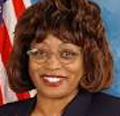
U.S. Rep. Corrine Brown
Under the original map, the 5th District, held by Democratic U.S. Rep Corrine Brown of Jacksonville, was a majority black district that meandered from Jacksonville over to Gainesville and then down to Orlando, taking in heavily black precincts to create a black majority At one point, it is the width of a highway.
In the new map, the 5th District still runs from Jacksonville to Orlando, but some black voters in the Orlando area are shifted to adjacent districts and some more rural areas are added south of Jacksonville to make the district geographically wider. The new district is 48 percent black.
Brown joined with Republicans in supporting the original map, which she said met the Voting Rights Act’s requirement to create majority minority districts wherever possible.
The new map also makes changes to the 10th District, held by U.S. Rep. Daniel Webster, and the adjacent 7th District, held by U.S. Rep. John Mica, that will make them less Republican. Because House districts must have equal population, the changes to those three districts required slight changes in seven surrounding districts in central Florida.
The League of Women Voters and the other plaintiffs are criticizing the new map, saying it doesn’t fix the geographic problems with the 5th District. They have proposed a different map that would have the 5th District running due west from Jacksonville past Tallahassee — a change that would require a wholesale revision of the map statewide.
The Democratic alternative rejected by the legislature doesn’t go as far as the plaintiff’s map, but it would have made the 7th and 10th districts more evenly split between Republicans and Democrats.
Although Florida is evenly divided politically, Republicans enjoy a 17-10 advantage in the state’s congressional delegation, largely due to their control of the redistricting process.
In his ruling striking down the map, Lewis was highly critical of the behind-the-scenes role Republican political consultants played in the redistricting process, which was supposed to be apolitical.
“They made a mockery of the legislature’s proclaimed transparent and open process of redistricting by doing all of this in the shadow of that process, utilizing the access it gave them to the decision makers, but going to great lengths to conceal from the public their plan and their participation in it,” Lewis said.
 Chicken Fried Politics