
Home » Posts tagged 'Donald Trump' (Page 27)
Tag Archives: Donald Trump

Tennessee Primary: GOP battle for governor, open U.S. House seats top ballot
U.S. Rep Diane Black tries to fend off two Republican rivals in governor’s race, without Donald Trump’s endorsement
By Rich Shumate, ChickenFriedPolitics.com

 NASHVILLE (CNN) — Voters in Tennessee are heading to the polls for a unique Thursday primary in which the Republican race for the open governor’s seat is getting the lion’s share of attention.
U.S. Rep. Diane Black, who had been considered the front-runner earlier in the race, is now facing a battle with Randy Boyd, an adviser to outgoing Governor Bill Haslam, and Bill Lee, a businessman and rancher from Williamson County.
Despite her ardent support for President Donald Trump and her work getting his tax cuts through Congress, Black has not received a coveted presidential tweet of endorsement, which has buoyed GOP candidates for governor in primaries in Georgia and Florida.
Because Tennessee doesn’t have primary runoffs, the candidate who finishes first in the six-way primary will become the nominee.

Phil Bredesen

Marsha Blackburn
In the U.S. Senate race, Republicans are expected to nominate U.S. Rep. Marsha Blackburn to face Democratic former Governor Phil Bredensen in what’s likely to become one of the fall’s hottest Senate contests.
Parties are also picking nominees for U.S. House seats given up by Black and Blackburn and the 2nd District seat that opened with the retirement of U.S. Rep. Jimmy Duncan.
In West Tennessee’s 8th District, incumbent Republican U.S. Rep. David Kustoff is facing a strong primary challenge from George Flinn, a self-funding former Shelby County commissioner making his fifth try for federal office.
Tennessee is one of only two states that do not hold their primary elections on a Tuesday, a schedule dating back to its admission as a state in 1796; Louisiana holds its primaries for state and local offices on Saturdays.
Polls open in most of Tennessee at 7 a.m., although times may vary by county. Polls close at 8 p.m. in the Eastern time zone and 7 p.m. in the Central time zone.

Bill Lee

Randy Boyd

Diane Black
The governor’s race features six Republican candidates, including Black, 67, from Gallatin, who has spent the last eight years in Congress representing the 6th District, which includes the northern Nashville suburbs and north-central Tennessee; Boyd, 58, from Knoxville, who made his fortune with a company that makes electronic fences for dogs and was an adviser to Haslam on education policy and economic development; and Lee, 58, owner of a heating and air company making his first run for political office.
Also running on the Republican side is State House Speaker Beth Harwell, 60, from Nashville, although polls showed her slightly behind the three candidates at the front of the pack. She has been in the legislature for 20 years, culminating in her selection as the first woman speaker in state history.
While President Donald Trump has waded into Republican governor primaries in Georgia and Tennessee, he did not offer an endorsement in Tennessee, something of a blow to Black, who, as chairwoman of the House Budget Committee, helped shepherd the Republicans’ tax cut bill through the House.
However, Black has been using video of Trump praising her in one of her TV ads, and she did get the endorsement of Vice President Mike Pence.
Haslam is term-limited and hasn’t endorsed anyone in the race. However, Boyd — who, like Haslam, is from Knoxville — has served in his administration, and the New York Times has reported that the Republican Governors Association, which Haslam chairs, has been lobbying Trump not to endorse Black. (The governor’s office has refused to confirm that report.)

Karl Dean
The winner of the Republican primary is expected to face former Nashville Mayor Karl Dean, who is the favorite the three-way Democratic primary.
The fall race for governor will be a crowded affair, as 26 independents have qualified for the ballot, including 13 Libertarians. Because the Libertarian Party does not have official ballot access, the party has no primary, and all 13 candidates will appear on the ballot as independents.
In U.S. House races, Republicans will be settling contested primaries in four GOP-held districts in which the Republican winner will be favored in the fall.
In Duncan’s 2nd District seat, which includes metro Knoxville and surrounding portions of East Tennessee, the GOP race features Knox County Mayor Tim Burchett; State Rep. Jimmy Matlock from Lenior City; Jason Emert, a Bount County lawyer and former chairman of the Young Republicans National Federation; and Ashley Nickloes from Rockford, who is a lieutenant colonel in the Tennessee Air National Guard.
On the Democratic side, Renee Hoyos from Knoxville, former director of the Tennessee Clean Water Network, is facing Joshua Williams, a Knoxville psychologist.
In the open race for Black’s 6th District seat, the Republican race includes John Rose from Cookeville, who served as state agriculture commissioner; Bob Corlew, a retired judge from Mount Juliet; and State Rep. Judd Matheny from Tullahoma.
Democrats running include Merrilie Winegar, a Methodist minister from Hendersonville; Pete Heffernan, a management consultant from Gallatin; and Dawn Barlow, a physician from Livingston.
In the open race for Blackburn’s 7th District seat, which includes Nashville’s southern suburbs and west-central Tennessee, State Senator Mark Green from Ashland City was the only Republican to file.
In 2017, Trump nominated Green, a physician and West Point graduate, to be Secretary of the Army, but Green withdrew the nomination amid controversy of some of his previous public statements, including an assertion in 2016 that most psychiatrists believe being transgendered is a “disease.” (The American Psychiatric Association does not classify gender non-conformity as a mental illness).
Democrats in the 7th District race include Justin Canew from College Grove, a digital media producer and two-time contestant on The Amazing Race, and Matt Reel from Primm Springs, a congressional aide who serves in the Tennessee National Guard.
In the 8th District, which includes part of Memphis city, its eastern suburbs and the Mississippi Delta, Kustoff, a former federal prosecutor from Germantown, who was elected in 2016, is facing a challenge from Flinn, a physician who also owns a string of 40 radio and television stations.
Flinn, who lost to Kustoff in the GOP primary in 2016, is making his fifth run for Congress, having run twice in the U.S. House in the 8th District, once in the Memphis-based 9th District and for the U.S. Senate in 2014. He has poured more than $3 million of his own money into the campaign, giving him a signficant fundraising advantage over Kustoff.
However, Kustoff is likely to benefit from a last-minute endorsement by Trump, whom he called “a champion for the Trump Agenda.”
The Democratic race in the 8th District is between John Boatner, a social worker from Shelby County, and Erika Stotts Pearson, the former assistant general manager of the WNBA’s Memphis Blues.
Southern congressmen join effort to impeach Deputy Attorney General Rod Rosenstein
Effort to oust official overseeing investigation of 2016 Russian election meddling fizzles after opposition from House leaders
♦By Rich Shumate, ChickenFriedPolitics.com editor
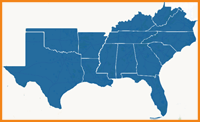 WASHINGTON (CFP) — Four Southern U.S. House members are part of a group of 11 Republicans who introduced articles of impeachment against Deputy Attorney General Rod Rosenstein, the official overseeing the investigation into Russian meddling in the 2016 election — only to back down after the plan ran into opposition from House Speaker Paul Ryan and other GOP leaders.
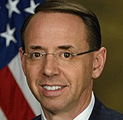
Deputy Attorney General Rod Rosenstein
Now, instead, the group will seek to hold Rosenstein in contempt of Congress if the Justice Department does not fully comply with requests for documents about the Russia probe.
U.S. Rep. Mark Meadows of North Carolina was one of the primary sponsors of the impeachment resolution filed July 25, along with Rep. Jim Jordan of Ohio. Three other Southern members — Jody Hice of Georgia, Matt Gaetz of Florida and Scott DesJarlais of Tennessee — signed on as co-sponsors.
However, the impeachment resolution was tabled the next day, after Meadows and Jordan met with House GOP leaders, including Ryan, who had said he did not support Rosenstein’s impeachment and would not bring it forward for a vote.
The congressmen who pushed the impeachment are all members of the Freedom Caucus, a group of about three dozen of the most conservative House Republicans that emerged in 2015 out of the Tea Party movement.
Members of the caucus have been among President Donald Trump’s strongest defenders in Congress — and among the harshest critics of Mueller’s investigation of possible coordination between Russian agents and Trump’s campaign, which the president has dismissed as a “witch hunt.”
The impeachment articles fault Rosenstein for not producing documents subpoenaed by a House committee and for approving a warrant request for surveillance of Carter Page, who was a national security adviser to the 2016 Trump campaign.
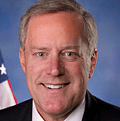
U.S. Rep. Mark Meadows, R-North Carolina
In a joint statement with Jordan and the other co-sponsors, Meadows said Rosenstein — who has been overseeing the Mueller probe since Attorney General Jeff Sessions recused himself after acknowledging contacts with the Russian ambassador — “has made every effort to obstruct legitimate attempts of Congressional oversight.”
“The stonewalling over this last year has been just as bad or worse than under the Obama administration,” he said. “It’s time to find a new Deputy Attorney General who is serious about accountability and transparency.”
Meadows represents North Carolina’s 11th District, which takes in the state’s far western panhandle.
Hice, who represents the 10th District in east-central Georgia, decried “a culture of stonewalling and misdirection” that he said has “permeated the highest levels” of the Justice Department and the FBI.
Gaetz, who represents the 1st District that in the western Florida Panhandle, said the request to put Page under surveillance was “likely improper” and that Rosenstein’s actions have “weakened Americans’ faith in the intelligence community and in seeing justice served.”
DesJarlais accused Rosenstein of refusing to produce documents “because they implicate top Department of Justice and FBI officials, including himself.”
“His own role in fraudulent warrants and wiretapping the President’s campaign is a major conflict of interest that renders him unfit to oversee the Special Counsel or DOJ,” said DesJarlias, who represents the 4th District in south-central Tennessee.
Rosenstein and the Justice Department have not commented on the impeachment articles.
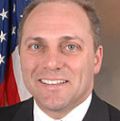
House Majority Whip Steve Scalise, R-Louisiana
While Ryan and other GOP leaders were cool to the idea of impeaching Rosenstein, the effort did get support from the highest-ranking Southerner in the House GOP caucus — Majority Whip Steve Scalise of Louisiana, who told Fox News that “putting impeachment on the table is one more tool” to get the Justice Department to provide documents.
Scalise, who represents the 1st District in suburban New Orleans, is reportedly considering a bid to succeed Ryan as speaker after he retires in January — a contest in which members of the Freedom Caucus will play a key role.
But another Southern Republican — U.S. Rep. Carlos Curbelo of Florida — had harsh words for the impeachment effort, taking to Twitter to denounce it as a “reckless publicity stunt.”
“No different from Dems who filed articles of impeachment against the President some months ago. What a sad, pathetic game of ‘how low can you go?'” Curbelo said.
Curbelo, who represents a South Florida district Hillary Clinton carried in 2016, is considered one of the most endangered House Republicans in the 2018 cycle.
Don Blankenship denied ballot slot in West Virginia U.S. Senate race
Secretary of state says “sore loser” law prevents Blankenship from running as a minor-party candidate after losing GOP primary
♦By Rich Shumate, ChickenFriedPolitics.com editor
 CHARLESTON, West Virginia (CFP) — Don Blankenship will not be allowed to run as the Constitution Party’s U.S. Senate candidate in West Virginia in November because of a state law that prohibits candidates who lose major-party primaries from making minor-party bids, the state’s top election official has decided.

Don Blankenship
The ruling by Secretary of State Mac Warner is a victory for Mountaineer State Republicans, who feared a third-party bid by Blankenship would siphon off votes from their nominee, Attorney General Patrick Morrisey, who is trying to unseat Democratic U.S. Senator Joe Manchin.
However, Blankenship has indicated he would challenge any attempt to keep him off the ballot, and Warner has already hired outside legal counsel for the expected court fight.
Blankenship, the former CEO of Massey Energy, spent a year in federal prison for violating mine safety regulations after 29 miners died in an explosion in his company’s Upper Big Branch Mine in 2010, the deadliest U.S. mine accident in the last 40 years.
Insisting that he was unfairly prosecuted by the Obama Justice Department, he launched a campaign for the Republican nomination for Manchin’s Senate seat. His candidacy unsettled GOP leaders, who feared his nomination would hand Manchin an easy re-election.
During the campaign, Blankenship carried on a nasty public feud with the top Republican in the Senate, Majority Leader Mitch McConnell, even airing a TV ad calling him “Cocaine Mitch,” a spurious charge based on a report that cocaine had been found on a ship belonging to a shipping company owned by the family of McConnell’s Chinese-American wife, Transportation Secretary Elaine Chao.
President Donald Trump also intervened before the May primary, urging his supporters not to vote for Blankenship, even though he had fashioned himself as an enthusiastic supporter of the president.
After finishing third in the Republican primary, Blankenship refused to endorse Morrisey and later accepted an offer from the Constitution Party to be its nominee. Because the party is not recognized as an official party in West Virginia, Blankenship then had to collect at least 4,400 signatures to get on the ballot.
In a July 26 letter to Blankenship, Warner, a Republican, said that while Blankenship did collect enough petition signature to qualify as the Constitution Party’s candidate, his certification was being denied state law does not allow candidates who lose a primary to change their registration to run as a member of a third party.
West Virginia is one of 40 states with “sore loser” or “sour grapes” laws that prohibit primary losers from trying to run in a general election.
Blankenship’s effort to get into the general election after running into primary difficulty is not without precedent in recent U.S. Senate elections.
In 2006, then-U.S. Senator Joe Lieberman of Connecticut created his own party to run in the general election after losing a Democratic primary. He won in November.
In 2010, in Florida, then-Governor Charlie Crist ran for the Senate as a Republican but switched to an independent candidacy after it was clear he would be unlikely to win the GOP primary against Marco Rubio. Rubio won that race; Crist was elected to the U.S. House in 2016.
Manchin — running for re-election as a Democrat in a state Trump won by 40 points in 2016 — is at the top of the Republicans’ target list. However, recent public polling has consistently shown him with a lead over Morrisey
Secretary of State Brian Kemp gets landslide win in GOP runoff for Georgia governor, will now face Stacey Abrams
Democrats pick nominees for two targeted GOP-held seats in Atlanta suburbs
♦By Rich Shumate, ChickenFriedPolitics.com editor
 ATLANTA (CFP) — With the backing of both President Donald Trump and Vice President Mike Pence, Secretary of State Brian Kemp has won the Republican nomination for Georgia governor, winning a runoff by nearly 40 points after a stunning collapse by Lieutenant Governor Casey Cagle.
Kemp’s win sets up one of the nation’s marquee governor’s races this fall against Democrat Stacey Abrams, the first African American woman ever nominated for governor by a major political party in a U.S. state, who won her nomination in May without a runoff.
Georgia Democrats have also settled on nominees for two Republican-held U.S. House seats in metro Atlanta being targeted this fall, picking Lucy McBath in the 6th District and Carolyn Bourdeaux in the 7th District.
McBath will now face U.S. Rep. Karen Handel, while Bourdeaux will take on U.S. Rep. Rob Woodall.
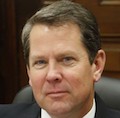
Secretary of State Brian Kemp
In the GOP governor’s race, Kemp took 69 percent of the vote in the July 24 runoff to 31 percent for Cagle, who had finished 13 points ahead of Kemp in the first round of voting in May but saw his support collapse in the final weeks of the race.
“We have earned a clear and convincing victory,” Kemp told supporters at a election night rally in Athens. “We had the momentum in this race, and those endorsements by the president and vice president — they poured gasoline on the fire.”
Although both men had vied for the Trump vote, the president endorsed Kemp a week before the runoff, and Pence traveled to Georgia to campaign with him. Cagle, serving his third term as lieutenant governor, was endorsed by incumbent Republican Governor Nathan Deal, who is term limited.
During the campaign, Kemp drew criticism for a humorous ad in which he points a shotgun at a young man who wants to date one of his daughters and gets him to acknowledge “a healthy appreciation for the Second Amendment, sir.” Kemp was unapologetic, saying in a statement that “liberal media and radical, left-wing activists — who have probably never even held a firearm — are freaking out and creating fake controversy.”
The National Rifle Association had earlier endorsed Cagle after the lieutenant governor proposed stripping a lucrative tax exemption from Atlanta-based Delta Airlines to retaliate against the company for ending a discount program for NRA members in the wake of the massacre of high school students in Parkland, Florida.
The turning point in the race may have been release of secretly recorded audio in June in which Cagle admitted that he had supported “bad public policy” in the legislature to undercut one of his primary rivals and complained that the Republican primary had devolved into a contest of “who had the biggest gun, who had the biggest truck and who could be the craziest.”
In a concession speech to supporters in Atlanta, Cagle promised his “full, undivided support” for Kemp in the general election.
“It didn’t turn out the way we wanted it, but at the end of the day, I can promise you my life is so rich,” he said.
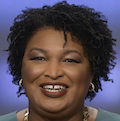
Democratic nominee Stacey Abrams
Democrats, who have not won a governor’s race in Georgia since 1998, are hoping to turn those fortunes around with Abrams, 44, a Yale-educated Atlanta lawyer who served six years as minority leader of the Georgia House.
During the Democratic primary, Abrams had argued that the way to reclaim the governor’s mansion was to energize and expand the electorate, rather than trying to appeal to Republican-leaning voters by offering more moderate stands. That strategy will be put to the test against Kemp, 54, a conservative businessman from Athens who has been secretary of state since 2011.
Kemp went after Abrams in his victory speech, calling her an “out-of-touch radical liberal who cares more for her billionaire backers than for you all.”
“This election is going to be for the soul of our state,” Kemp said. “It is going to be about our values, and it is going to be literally a fight for the future of the great state of Georgia.”
While Republicans have dominated Georgia politics for nearly two decades, demographic changes — particularly an influx of new minority voters — have begun to shift the political calculus. In 2004, George W. Bush carried Georgia by 16 points; Trump only won by 5 points in 2016, and he lost two large suburban Atlanta counties — Cobb and Gwinnett — that had not gone Democratic in a generation.
Both of the U.S. House races where Democrats may have a shot this fall are anchored in those same suburbs. In the 6th District, which takes in Cobb, North Fulton and North DeKalb counties, Trump won by just 1.5 points; in the 7th District, which includes Gwinnett and Forsyth counties, he won by just 6 points.

Lucy McBath

Karen Handel
Handel won the 6th District seat in a special election in 2017 that became nationalized amid rising resistance to Trump. More than $50 million was spent on that race, making it the most expensive House election in history.
The Democrat who Handel defeated in that race, Jon Ossoff, decided against a rematch, leaving her to face McBath, a retired flight attendant and gun control activist from Cobb County, who took 54 percent in the runoff to defeat Kevin Abel, a Sandy Springs businessman, who took 46 percent.
McBath’s son, Jordan Davis, was shot and killed in 2012 by a man at a gas station in Jacksonville, Florida, over a dispute over loud hip-hop music. His case became part of the nationwide campaign against deadly violence aimed at young African-American men. The shooter, Michael David Dunn, was later convicted of first-degree murder and sentenced to life without parole.

Rob Woodall

Carolyn Bourdeaux
In the 7th District, Woodall will face Bourdeaux, from Suwanee, a professor at Georgia State University and former budget analyst for the Georgia Senate. In the runoff, she took 52 percent of the vote to defeat Duluth businessman David Kim with 48 percent.
In the runoff, Republicans also settled on their nominees for the posts of lieutenant governor and secretary of state given up by Cagle and Kemp.
In the lieutenant governor’s race, former State Rep. Geoff Duncan from Cumming, a former professional baseball player, edged out State Senator David Shafer from Duluth. However, the two candidates were separated by less than 1,700 votes, which could trigger a runoff.
Duncan will now face the Democratic nominee, Kennesaw businesswoman Sarah Riggs Amico.
In the secretary of state’s race, State Rep. Brad Raffensperger from Johns Creek defeated Alpharetta Mayor David Belle Isle. He will now face former U.S. Rep. John Barrow from Athens, who was the last white Democrat left in Georgia’s congressional delegation until he was defeated in 2014.
U.S. Rep. Martha Roby survives GOP primary runoff in Alabama
Trump endorsement helps Roby overcome backlash for her criticism of him during 2016 campaign
♦By Rich Shumate, ChickenFriedPoitics.com editor
 MONTGOMERY (CFP) — Republican U.S. Rep. Martha Roby has easily survived a Republican runoff in her southeast Alabama district, overcoming a backlash over her critical comments of then-candidate Donald Trump in 2016 that threatened to bounce her out of Washington.

U.S. Rep. Martha Roby, R-Alabama
Roby took 68 percent in the July 17 runoff to 32 percent for Bobby Bright, a former Montgomery mayor who held the 2nd District seat as a Democrat before losing it to Roby in 2010. He switched to the GOP earlier this year to challenge her in the primary.
Roby will now face Democrat Tabitha Isner, a business analyst and pastor’s wife from Montgomery. Roby will be a prohibitive favorite in the heavily Republican district, which takes in much of Montgomery and its northern suburbs, along with the Wiregrass Country in the southeastern corner of the state.
In the first round of primary voting in June, Roby took just 39 percent of the vote, which was seen as a rebuke to Roby by Trump voters, who have been furious over her decision in October 2016 to rescind her endorsement of him after the infamous Access Hollywood tape surfaced in which Trump bragged about sexually accosting women.
At the time, Roby said she would not vote for Trump because his “behavior makes him unacceptable as a candidate for president.”
However, she has since tempered her criticism of the president, and he gave her a coveted tweeted presidential endorsement ahead of the runoff, in which he pointedly noted that Bright was “a recent Nancy Pelosi voting Democrat.”
Roby’s survival contrasts with the fate of another House member critical of Trump — U.S. Rep. Mark Sanford of South Carolina — who lost his primary in June. In that race, Trump endorsed his opponent, State Rep. Katie Arrington, on election day.
Roby, 41, is seeking her fifth term in Congress.

