
Home » Posts tagged 'Donald Trump' (Page 36)
Tag Archives: Donald Trump

Southern GOP, Democratic senators split on using “nuclear option” in Gorsuch fight
Senate eliminates filibusters of Supreme Court nominees in party-line vote
 WASHINGTON (CFP) — With the support of all 24 Southern Republicans, the U.S. Senate has changed its rules to eliminate filibusters for Supreme Court nominations, clearing the way for confirmation of Neil Gorsuch to a lifetime seat on the high court.

Supreme Court nominee Neil Gorsuch
After Democrats blocked Gorsuch’s nomination with a filibuster, the Republican majority used a parliamentary maneuver to change Senate rules, eliminating the need to reach 60 votes to overcome a filibuster.
That vote fell along party lines, with 52 Republicans in favor, 46 Democrats opposed and two independents who caucus with Democrats also voting against the move.
With the filibuster out of the way, Gorsuch was confirmed by a vote of 54 to 45, with just three Democrats supporting him, including Joe Manchin of West Virginia
Three of the four Southern Democratic senators — Bill Nelson of Florida and Mark Warner and Tim Kaine of Virginia — supported the filibuster and voted against confirming Gorsuch. While Manchin did not join the filibuster and voted for confirmation, he did not support the move by Republican leaders to eliminate filibusters for Supreme Court nominees.

U.S. Senator Joe Manchin of West Virginia
Manchin released a statement blistering both sides for “hypocrisy” and charging that the filibuster fight illustrates “precisely what is wrong with Washington.”
“Frustratingly, both parties have traded talking points: Republicans say it’s about obstructionism and Democrats say it’s a power grab. Their shifting positions and hypocrisy is the one thing that unites them,” he said.
Manchin also noted that in 2013, when Democrats used their majority to end filibusters for executive branch nominees, “every Republican Senator joined me in opposing the rules change then, but now, they stand united to do exactly what they opposed.”
Manchin is up for re-election in 2018 in a state President Donald Trump carried by a whopping 32 points. Warner and Kaine’s opposition to Trump’s first Supreme Court nominee presents less political risk in Virginia, the only Southern state Trump failed to carry last November.
Nelson, however, is also up for re-election in 2018 in a state Trump won and could be facing a formidable Republican foe in Florida Governor Rick Scott.
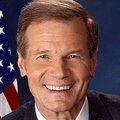
U.S. Senator Bill Nelson of Florida
In a statement announcing his decision to oppose Gorsuch, Nelson said he has “real concerns with (Gorsuch’s) thinking on protecting the right to vote and allowing unlimited money in political campaigns. In addition, the judge has consistently sided with corporations over employees.”
“I will vote no on the motion to invoke cloture (to end the filibuster) and, if that succeeds, I will vote no on his confirmation,” Nelson said.
The National Republican Senatorial Committee immediately released a statement noting that Nelson had opposed a previous Democratic filibuster of Supreme Court Justice Samuel Alito in 2006 and had previously voted to confirm Gorsuch to a seat on the Denver-based 10th U.S. Circuit Court of Appeals.
“Nelson proved to Floridians today that he no longer shares their values, and instead is more politically aligned with the liberal elite of Washington,” said Katie Martin, an NRSC spokeswoman. “Nelson has been in Washington too long and his move to ignore the will of voters in Florida will cost him his job in 2018.”
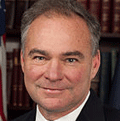
U.S. Senator Tim Kaine
Kaine, who is also up for re-election in 2018, is also being pounded by Republicans, particularly over a remark he made during the 2016 campaign saying he would support the “nuclear option” if Republicans filibustered any of Hillary Clinton’s Supreme Court nominees. At the time, Kaine was Clinton’s running mate.
In a lengthy statement explaining his support for the filibuster, Kaine noted that Republicans refused to consider President Obama’s selection of Merrick Garland for the Supreme Court vacancy created by the death of Justice Antonin Scalia in 2016, for which Gorsuch was nominated. He also said the filibuster, which Gorsuch would need 60 votes to overcome, ensures that high court nominees “receive significant bipartisan support.”
“That is especially important now given the many important issues pending before the court and the clear need to fill a position long held vacant through blatant partisan politics with someone who can bring independence and non-partisanship to the job,” Kaine said.
3 of 4 Southern Senate Democrats supporting Gorsuch filibuster
U.S. Senator Joe Manchin of West Virginia sole supporter of Trump Supreme Court nominee
WASHINGTON (CFP) — With the U.S. Senate headed for an epic showdown over a Democratic filibuster of President Trump’s first Supreme Court nominee, three of the four Democrats who represent Southern states in the Senate have lined up against Neil Gorsuch’s confirmation.
Supreme Court nominee Neil Gorsuch
Senators Bill Nelson of Florida and Mark Warner and Tim Kaine of Virginia have all announced they will support a Democratic filibuster designed to stop the Gorsuch nomination, which will likely prompt GOP leaders to end filibusters for Supreme Court nominees, a move that has come to be known as the “nuclear option.”
The lone supporter of Gorsuch left among Southern Democrats is Senator Joe Manchin of West Virginia. All 24 Southern Republicans in the Senate are expected to vote to end the filibuster and confirm Gorsuch.
Manchin — up for re-election in 2018 in a state Trump carried by a whopping 32 points — said in a statement that Gorsuch “has been consistently rated as a well-qualified jurist, the highest rating a jurist can receive, and I have found him to be an honest and thoughtful man.”
“I hold no illusions that I will agree with every decision Judge Gorsuch may issue in the future, but I have not found any reasons why this jurist should not be a Supreme Court Justice,” he said.
Warner and Kaine’s opposition to Trump’s nominee presents less political risk in Virginia, the only Southern state Trump failed to carry last November. Nelson, however, is up for re-election in 2018 in a state Trump won and could be facing a formidable Republican foe in Florida Governor Rick Scott.
U.S. Senator Bill Nelson of Florida
In a statement announcing his decision to oppose Gorsuch, Nelson said he has “real concerns with (Gorsuch’s) thinking on protecting the right to vote and allowing unlimited money in political campaigns. In addition, the judge has consistently sided with corporations over employees.”
“I will vote no on the motion to invoke cloture (to end the filibuster) and, if that succeeds, I will vote no on his confirmation,” Nelson said.
The National Republican Senatorial Committee immediately released a statement noting that Nelson had opposed a previous Democratic filibuster of Supreme Court Justice Samuel Alito in 2006 and had previously voted to confirm Gorsuch to a seat on the Denver-based 10th U.S. Circuit Court of Appeals.
“Nelson proved to Floridians today that he no longer shares their values, and instead is more politically aligned with the liberal elite of Washington,” said Katie Martin, an NRSC spokeswoman. “Nelson has been in Washington too long and his move to ignore the will of voters in Florida will cost him his job in 2018.”
U.S. Senator Tim Kaine
Kaine, who is also up for re-election in 2018, is also being pounded by Republicans, particularly over a remark he made during the 2016 campaign saying he would support the “nuclear option” if Republicans filibustered any of Hillary Clinton’s Supreme Court nominees. At the time, Kaine was Clinton’s running mate.
In a lengthy statement explaining his support for the filibuster, Kaine noted that Republicans refused to consider President Obama’s selection of Merrick Garland for the Supreme Court vacancy created by the death of Justice Antonin Scalia in 2016, for which Gorsuch has now been nominated. He also said the filibuster, which Gorsuch would need 60 votes to overcome, ensures that high court nominees “receive significant bipartisan support.”
“That is especially important now given the many important issues pending before the court and the clear need to fill a position long held vacant through blatant partisan politics with someone who can bring independence and non-partisanship to the job,” Kaine said.
If Republicans are unable to get 60 votes to end the filibuster against Garland, Republican leaders are expected to change Senate rules to end filibusters for Supreme Court nominees and allow them to be confirmed by a simple majority.
In 2013 when Democrats controlled the Senate, they invoked the so-called “nuclear option” to end filibusters for nominees for positions in the executive branch, after minority Republicans thwarted several of President Obama’s appointments.
Oklahoma U.S. Rep. Tom Cole: Trump owes Obama an apology
Oklahoma Republican calls Trump’s wiretap charge against Obama “reckless”
 WASHINGTON (CFP) — Donald Trump may have carried U.S. Rep. Tom Cole’s district by 38 points in November, but the Oklahoma Republican is mincing no words in calling for Trump to apologize to former President Barack Obama over claims that Obama wiretapped Trump Tower during the presidential campaign.
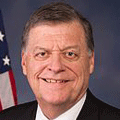
U.S. Rep. Tom Cole, R-Oklahoma
Speaking to reporters in the Capitol March 17, Cole said there is “no indication” that Trump’s allegation against Obama is true.
“It’s not a charge I would ever have made. And frankly, unless you can produce some pretty compelling proof, then I think … President Obama is owed an apology,” said Cole.
“If (Obama) didn’t do it, we shouldn’t be reckless in accusations that he did.”
In a March 4 tweet, Trump claimed that Obama has his “wires tapped” in Trump Tower, his New York home. He followed that up with additional tweets comparing Obama’s conduct to the Watergate scandal that brought down Richard Nixon in 1974.
Trump has so far offered no evidence to back that claim, but he has not retracted it. Leaders of the House and Senate intelligence committees from both parties have said the claim is unsubstantiated. Obama administration officials have also said the claim has no merit.
While other Republican leaders have distanced themselves from Trump’s wiretapping claim, none of them have gone as far as Cole in calling for an apology.
Cole has a place in the GOP leadership as a deputy whip to House Majority Whip Steve Scalise of Louisiana. From 2006 to 2008, he served as chair of the National Republican Congressional Committee, the party’s House campaign arm.
Cole, from Moore, represents Oklahoma’s 4th District, which stretches from the southern Oklahoma City suburbs south to the Texas border. He has held the seat since 2003.
A college history professor before entering politics, Cole, a member of the Chickasaw Nation, is one of only two Native Americans currently serving in Congress. The other is U.S. Rep. Markwayne Mullin, a Republican who represents Oklahoma’s 2nd District.
In the 2016 election, Trump carried 66 percent of the vote in the 4th District, to just 28 percent for Democrat Hillary Clinton.
Analysis: Results in Confederate namesake counties show role of race in Democratic decline
Trump accelerates Republican shift in counties named for Jefferson Davis and Robert E. Lee
♦By Rich Shumate, Chickenfriedpolitics.com editor
(CFP) — Jefferson Davis and Robert E. Lee loom large as icons of the Southern Confederacy, so much so that 11 Southern counties and one Louisiana parish bear their names. But if these lions of the South are aware of what is happening in their namesake counties today, they may be rotating in their graves.
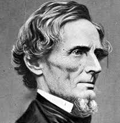
Confederate President Jefferson Davis
Changes in presidential voting in these counties over the past 40 years illustrate just how far the Black Republicans against which Lee and Davis fought are now transcendent—and the alarming (for Democrats) degree to which white Southerners have forsaken their traditional political roots.
Of course, the South’s march toward the GOP is not news. Today, the term “Solid South” has an entirely different connotation than it did during the days of FDR or Lyndon Johnson. However, these namesake counties do provide a window into how these shifts in party preference have occurred over time and the role that race played in them.

Confederate General Robert E. Lee
The 2016 presidential results also show that the Republicanization of the South is accelerating in these counties that bear the mark of Southern heritage, which bodes ill for future Democratic prospects.
In 1976, when Democrat Jimmy Carter became the first Southerner to win the White House since Zachary Taylor in 1848, he carried nine of the 12 Davis and Lee counties. By 1992, Bill Clinton and George H.W. Bush were splitting them six-to-six.
By 2000, Republican George W. Bush had flipped nine of the 12 namesake counties his way; his average share of the total votes cast for the two major party candidates in those counties that year was an impressive 64 percent. But in 2016, Trump trumped the younger Bush, carrying those same nine counties with an average of 70 percent of the two-party vote.
In 1976, Republican President Gerald Ford’s share of the two-party vote topped 50 percent in just three namesake counties (in Florida, Alabama, and Kentucky). But by 2016, Trump’s share of the two-party vote was more than 50 percent in nine counties and parishes; above 60 percent in eight; above 70 percent in four; and above a whopping 80 percent in two (Georgia and Kentucky).
The most dramatic changes were in Jeff Davis County, Georgia, where native Georgian Carter carried 79 percent of the vote in 1976 and Trump won 81 percent in 2016, and Jefferson Davis Parish, Louisiana, where Carter won 62 percent and Trump 75 percent. However, even in majority black Lee County, Arkansas, Trump’s 16-point loss in 2016 was less than half of Ford’s 38-point defeat.
In addition to Lee County, Arkansas, the only namesake counties Trump lost in 2016 were Jefferson Davis County, Mississippi, and Lee County, South Carolina, which are also majority black. However, even in these three counties, Trump carried a larger share of the two-party vote in 2016 than Mitt Romney did in 2012.
In fact, Trump improved on Romney’s result in 11 of the 12 namesake counties, save only Jeff Davis County, Texas, where Trump had to settle for merely matching Romney’s total.
The results in these namesake counties over time also illustrate the role race has played in the political realignment of the South.
In all seven of the overwhelmingly white namesake counties, the Republican share of the two-party vote was higher in 2016 than in 1976, by an average of 29 percent. Trump did better than Romney by an average of 4 percent.
By contrast, in majority-black Lee counties in Mississippi and South Carolina, the Republican two-party share fell by an average 2.5 percent from 1976 to 2016, but Trump outperformed Romney by the same 2.5 percent. These results indicate that the white Southern shift to the Republicans appears stronger than the corresponding black shift to the Democrats.
This is borne out by the results in Lee County, Arkansas, which has the smallest African-American population of any of the majority-black namesake counties (55 percent). There, the Republican share of the two-party vote actually climbed 11 percent between 1976 and 2016, and Trump beat Romney’s total by 5 percent.
Two of the namesake counties—Lee County, Florida, and Jeff Davis County, Texas—are outliers in that they have significant Latino populations. The Republican share of the two-party vote in both of those counties was higher in 2016 than it was in 1976, but Trump’s results were down from the numbers put up in 2000 and 2004 by George W. Bush, who, for a Republican, ran strongly with Latino voters.
The results in the namesake counties also illustrate the mountain which Democrats need to climb if they are to reduce Republican hegemony in the South.
The Democratic base once included small towns and rural areas across the Southern landscape, as well as urban areas. In 2016, Democrats still held the cities (with newfound and welcome signs of life in suburban Atlanta and Houston) and the mostly small rural counties with majority black populations, such as the namesake counties in Arkansas, Mississippi and South Carolina. Democrats also do well in college towns such as Athens, Georgia, and Gainesville, Florida.
But Democrats’ failure to compete for the votes of small town and rural white voters is what is killing them electorally, as the results in the Davis and Lee namesake counties without black majorities vividly illustrates.
Only one of these namesake counties is urban—Lee County, Florida, which includes Fort Myers—and Lee County, Alabama, contains Auburn University. The rest of these counties and parishes are all rural, white areas where Messrs. Davis and Lee are no doubt remembered fondly and Jimmy Carter ran reasonably well—and where Hillary Clinton couldn’t get elected dog catcher if she handed out $20 bills at the polling booth.
As a barometer of the past, these namesake counties illustrate how far Democrats have fallen in their former strongholds. But if Trump’s improved results over Romney’s are a barometer of the future, the bottom may not yet have been reached.
Trump nominates Florida law school dean Alex Acosta as labor secretary
Acosta selected after Trump’s first nominee for labor post, Andrew Puzder, pulled out
♦By Rich Shumate, Chickenfriedpolitics.com editor
 WASHINGTON (CFP) — Alex Acosta, the dean of Florida International University’s law school and a former federal prosecutor in Miami, has been named by President Donald Trump to be the nation’s next labor secretary.
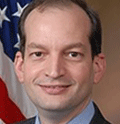
FIU Law Dean Alex Acosta
The selection of Acosta to head the U.S. Department of Labor came a day after Trump’s first pick for the post, fast food magnate Andrew Puzder, withdrew from consideration after it became clear that he lacked enough votes for Senate confirmation.
Trump made the announcement February 16 during a media appearance at the White House, which Acosta did not attend.
“I think he’ll be a tremendous secretary of labor,” Trump said, after briefly ticking off items from Acosta’s resume, including the fact that he had already been confirmed by the U.S. Senate to three executive department posts.
If confirmed, Acosta will be the first, and so far only, Latino in the Trump cabinet.
Acosta, 48, a Cuban-American, has been dean at FIU’s law school since 2009. From 2005 to 2009, he served as U.S. attorney for the Southern District of Florida, which comprises nine counties in the southeastern part of the state.
From 2003 to 2005, Acosta headed up the U.S. Department of Justice’s Civil Rights Division in Washington, the first Latino to serve in that position. From 2002 to 2003, he was a member of the National Labor Relations Board.
Acosta was also a law clerk to now-U.S. Supreme Court Justice Samuel Alito from 1994 to 1995, when Alito was serving on the 3rd U.S. Circuit Court of Appeals.
His two positions in the Justice Department and his stint at the NLRB all required Senate confirmation. One of the senators who will decide on Acosta’s nomination for the labor post, Florida’s Marco Rubio said he was “a phenomenal choice” and predicted he would be approved.
“I look forward to his confirmation hearing, where I’m confident he will impress my colleagues and secure the support necessary to be the next secretary of labor,” Rubio said in a statement.

