
Home » Posts tagged 'Doug Jones' (Page 3)
Tag Archives: Doug Jones


Decision 18: Final U.S. Senate race will be decided in Mississippi Tuesday
Republican U.S. Senator Cindy Hyde-Smith tries to withstand controversies dogging her during the runoff with Democrat Mike Espy
♦By Rich Shumate, ChickenFriedPolitics.com
 JACKSON, Mississippi (CFP) — In the three weeks since the first round of voting in Mississippi’s special U.S. Senate election, Republican Cindy Hyde-Smith has faced a barrage of negative headlines in the national media and apologized for making a joke about attending a public hanging.

Cindy Hyde-Smith in 2014 Facebook photo at Beauvoir, Jefferson Davis’s home
And in a world where nothing on the internet ever goes away, a Facebook photo surfaced of Hyde-Smith — during a visit to the home of Jefferson Davis — wearing a Confederate cap, holding a rifle and calling the tableau “Mississippi history at its best.”
All of this was too much for Wal-Mart, which asked for its campaign contribution back.
But the question to be answered in Tuesday’s runoff is, will any of that be enough to allow her Democratic African-American opponent, Mike Espy, to defeat her in a bright red state where a Democrat hasn’t won a Senate race in 36 years?
Or to overcome very visible support from President Donald Trump, who is making visits to Tupelo and Biloxi on election eve to rally the base for Hyde-Smith?
Hyde-Smith is facing Espy in a special election to fill the remaining two years of the term of Republican Thad Cochran, the Mississippi icon who resigned in April due to ill health. She was appointed by Governor Phil Bryant to serve in the Senate temporarily until voters pick a permanent replacement in the special election.
Hyde-Smith, 59, from Brookhaven, was Mississippi’s agriculture commissioner until being appointed to the Senate. She was originally elected to the state Senate in 2000 as a Democrat but switched parties in 2010.

Former Agriculture Secretary Mike Espy
Espy, 64, from Jackson, served three terms in the U.S. House before being picked by President Bill Clinton as agriculture secretary in 1993. He resigned in 1994 amid allegations that he had received improper gifts. He was later acquitted of federal corruption charges.
During the first round of voting November 6, Hyde-Smith and Espy tied at 41 percent, with another Republican in the race, State Senator Chris McDaniel, coming in third.
Given the overwhelming Republican tilt of the Magnolia State, Hyde-Smith was seen as a prohibitive favorite in the runoff. Indeed, McDaniel, who nearly beat Cochran in 2014, was seen as the biggest hurdle to her continued tenure in the Senate.
However, a series of controversies that have dogged her since the first round of voting have given Democrats hope that they might replicate the success they had in Alabama in 2017, when Democrat Doug Jones defeated Republican Roy Moore amid allegations of sexual impropriety.
First, five days after the election, a video surfaced in which Hyde-Smith is heard telling a supporter that if he invited her to a public hanging, she would be in the front row. She insisted the remark was a joke, but her critics charged it was a racially insensitive remark to make in a state with a history of lynchings of African-Americans.
During their only campaign debate, Hyde-Smith apologized “to anyone who was offended by my comments,” insisting there was “no ill will” and that her record as senator and agriculture commissioner shows she harbors no racial animus.
“This comment was twisted, and it was turned into a weapon to be used against me — a political weapon used for nothing but personal, political gain by my opponent,” she said.
Another video surfaced November 15 in which Hyde-Smith says it would be a “great idea” to make it more difficult for liberals to vote, which her campaign insisted was a joke made to supporters and not advocacy of voter suppression.
Then a week before the runoff, news organizations began reporting a photo posted in 2014 on Hyde-Smith’s Facebook account, where she is donning a Confederate cap and carrying a rifle at Davis’s home in Biloxi.
The caption read: “I enjoyed my tour of Beauvoir. The Jefferson Davis Home and Presidential Library located in Biloxi. This is a must see. Currently on display are artifacts connected to the daily life of the Confederate Soldier including weapons. Mississippi history at its best!”
Her campaign did not offer any comment in the photo. But a spokeswoman pushed back hard when the Jackson Free Press reported that Hyde-Smith had attended a high school in the 1970s originally founded to allow white parents to avoid sending their children to segregated schools. The story included photos of a teenage Hyde-Smith posing with her cheerleading pom-poms.
“In their latest attempt to help Mike Espy, the gotcha liberal media has taken leave of their senses,” said spokeswoman Melissa Scallan. “They have stooped to a new low, attacking her entire family and trying to destroy her personally instead of focusing on the clear differences on the issues between Cindy Hyde-Smith and her far-left opponent.”
What won’t be clear until Tuesday is how much any of these controversies will affect the outcome of this race. Many white Mississippians of Hyde-Smith’s generation attended so-called “segregation academies” when they were young. And wearing a Confederate cap has a different connotation in a place where the state flag still contains the Confederate battle emblem than it does in media and political circles in Washington or New York.
Also, none of the controversies dogging Hyde-Smith comes anywhere close to the situation in Alabama, where Moore was accused of sexual misconduct with underage girls, which he denied.
Mississippi has the largest percentage of African-American residents of any state, 37 percent. So the result of the runoff will likely hinge on the turnout among African-American voters, who are expected to go Democratic in large numbers.
If African-Americans make up 30 percent of the electorate Tuesday, as they did in the first round of voting, Espy would need about a third of the white vote to get to a majority. If they make up 35 percent, he would need about a quarter of the white vote.
We tweet @ChkFriPolitics Join us!
Decision ’18: Democrat Bill Nelson concedes defeat in Florida U.S. Senate race
Republican Governor Rick Scott will move from Tallahassee to Washington after winning recount
♦By Rich Shumate, ChickenFriedPolitics.com
 TALLAHASSEE (CFP) — After protests, a flurry of lawsuits and two recounts, Democratic U.S. Senator Bill Nelson has conceded defeat to Republican Governor Rick Scott, possibly bringing the curtain down on a political career that spanned more than four decades and included a trip into space.
 Scott’s victory means there will be just four Democrats among the 28 senators representing Southern states, down one from the last Congress. And Florida will have two Republican senators for the first time since Reconstruction in 1875.
In a video released by his campaign, Nelson said that while he lost the Senate race, “I by no means feel defeated, and that’s because I’ve had the great privilege of serving the people of Florida and our country for most of my life.”
“It’s been a rewarding journey as well as a very humbling experience,” he said.
He also made a plea for more civility to combat “a gathering darkness” in American political life.
“We have to move beyond a politics that aims not just to defeat but to destroy, where truth is treated as disposable,” he said.
Scott, who has now won three consecutive statewide elections by thin margins, issued a statement thanking Nelson “for his years of public service.”
Nelson’s concession came after a machine recount of ballots in all 67 counties and a hand recount of ballots with under-votes or over-votes in the Senate race did not overturn Scott’s margin of victory.
Scott defeated Nelson by just 10,033 votes, out of nearly 8.2 million cast.
Scott had led on election night, but late reports of ballots from Democratic-leaning Broward and Palm Beach counties began narrowing the lead. Both Scott and President Donald Trump suggested that fraud was occurring in both counties, although evidence seemed to point to mismanagement rather than deliberate malfeasance.
In the following days, both campaigns went to court, and protests erupted outside elections offices in Broward — scenes reminiscent of the recount battle that erupted in the Sunshine State after the 2000 presidential election.
Nelson’s last hope was turning up uncounted ballots in Broward, where 25,000 fewer people voted in the Senate election than in the race for governor. But the hand recount confirmed that those ballots were indeed under-votes, which could have been caused by a flawed ballot design.
In Broward, the Senate race was listed at the bottom of a column underneath voting instructions, which could have resulted in some voters not seeing it.

Florida Governor Rick Scott
Scott, 65, went into politics after building a fortune in the health care industry. Financial disclosure reports put his net worth at around $250 million.
He won the governorship in 2010 with a margin of just 1.2 percent and won re-election in 2014 in an even closer race, 1 percent. His margin over Nelson in the Senate race was narrower still, 0.12 percent.
Scott’s win means Republicans will have at least 52 seats in the next Senate to 47 for Democrats, a net pickup of two seats. One seat remains to be decided in Mississippi, where Republicans are favored.
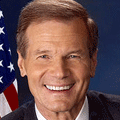
U.S. Senator Bill Nelson of Florida
Nelson, 76, won his first election, to the Florida House, in 1972. He served 12 years in the U.S. House and six years as Florida’s insurance commissioner before winning election to the Senate in 2000.
In 1986, while a sitting member of the House, Nelson went into space as a payload specialist on the space shuttle Columbia. His district included the Kennedy Space Center.
Just 10 days after his return, a different space shuttle, Challenger, exploded during launch, which ended NASA’s program of sending civilians into space.
With Nelson’s defeat, the only Democrats representing Southern states will be Mark Warner and Tim Kaine in Virginia, Joe Manchin in West Virginia, and Doug Jones in Alabama.
We tweet @ChkFriPolitics Join us!
West Virginia U.S. Senator Joe Manchin breaks with party to support Kavanaugh confirmation
Manchin’s decision all but ensures that President Trump’s nominee will get seat on U.S. Supreme Court
♦By Rich Shumate, ChickenFriedPolitics.com editor
 WASHINGTON (CFP) — U.S. Senator Joe Manchin of West Virginia says he will vote to confirm Brett Kavanaugh to the U.S. Supreme Court, the only Senate Democrat to break with his party to support President Trump’s embattled nominee.

U.S. Senator Joe Manchin
Manchin’s decision virtually ensures that Kavanuagh will be confirmed when the Senate takes a final vote on the nomination, a week after the jurist angrily denied allegations that he sexually assaulted a girl when they were teenagers in the 1980s.
The vote on the nomination was delayed a week while the FBI investigated the allegations.
In a statement announcing his decision, Manchin said he has “reservations about this vote given the serious accusations against Judge Kavanaugh and the temperament he displayed in the hearing.”
“My heart goes out to anyone who has experienced sexual assault,” Manchin said. “However, based on all the information I have available to me, including the recently concluded FBI report, I have found Judge Kavanaugh to be a qualified jurist who will follow the Constitution and determine cases based on the legal findings before him.”
But Machin also said he hoped Kavanaugh “would not let the partisan nature this process took follow him on to the court.”
After supporting Kavanaugh in a procedural vote, Manchin had to make he way past a crowd of angry protestors inside the Capitol.
Machin is the only Democratic senator to support Kavanaugh. His vote became more important for the confirmation after one of the Senate’s 51 Republicans, Lisa Murkowski of Alaska, announced that she would vote no.
Four other Southern Democrats opposed the nomination — Mark Warner and Tim Kaine of Virginia, Bill Nelson of Florida, and Doug Jones of Alabama. All 23 Southern Republicans supported Kavanaugh’s confirmation.
Machin — running for re-election in November in a state Trump carried by 40 points in 2016 — was under considerable pressure to back Kavanaugh. He previously supported Trump’s first nominee to the court, Neil Gorsuch.
Polls have consistently shown Manchin with a lead over his Republican opponent, Attorney General Patrick Morrisey.
On Twitter, Morrisey accused Manchin of making “a craven political calculation” in supporting Kavanaugh and said he “owes West Virginia an apology for watching, doing nothing, as Democrats sought to destroy Judge Kavanaugh.”
Nelson and Kaine are also up for re-election in November; Warner and Jones will be on the ballot in 2020.
Follow us on Twitter @ChkFriPolitics or at Facebook.com/chickenfriedpolitics.
Florida Governor Rick Scott announces U.S. Senate run
Race between Scott and incumbent U.S. Senator Bill Nelson could be nation’s most expensive
♦By Rich Shumate, ChickenFriedPolitics.com
 ORLANDO (CFP) — Republican Florida Governor Rick Scott has made official what was widely expected — he will challenge Democratic incumbent U.S. Senator Bill Nelson in November.
Florida Governor Rick Scott
Scott’s decision, announced April 9 in Orlando, sets up what is likely to be a hard-fought and hugely expensive battle for Florida’s seat, with control of the Senate hanging in the balance.
Calling Washington “dysfunctional” and slamming “career politicians,” Scott called on Floridians to “stop sending talkers to Washington. Let’s send doers to Washington.”
“We shouldn’t be sending the same type of people to Washington. We should say we’re going to make change,” Scott said. “We can change Washington. We must change Washington. We will change Washington.”
The emphasis on changing the culture of Washington was a direct slap at Nelson, who has served in the Senate for 18 years after serving 12 years in the U.S. House.
Scott, who kicked off his campaign at a construction company that has expanded during his eight years in Tallahassee, also touted his record as a “jobs” governor, taking credit for creating 1.5 million new jobs and cutting taxes by $10 billion.
“People are flocking to Florida because this is where you can live the dream of this country,” he said. “Now, we’ve got to take that same mission to D.C.”
Scott, 65, a multimillionaire former for-profit hospital executive, was a political newcomer when he was first elected governor in 2010 after pouring more than $70 million of his own money into the race. He was re-elected by a narrow margin in 2014.
U.S. Senator Bill Nelson of Florida
Nelson, 75, was first elected to the Senate in 2000 and won re-election easily in 2006 and 2012. He is one of just five Democrats representing Southern states, along with U.S. Senators Doug Jones of Alabama, Tim Kaine and Mark Warner of Virginia, and Joe Manchin of West Virginia.
Nelson and Machin, who both represent states President Donald Trump carried in 2016, are among the top Republican targets in the 2018 election cycle. Trump had been publicly urging Scott to run against Nelson.
In response to Scott’s announcement, Nelson issued a statement saying he has “always run every race like there’s no tomorrow — regardless of my opponent” and adding that Scott “will say or do anything to get elected.”
“I’ve always believed that if you just do the right thing, the politics will take care of itself,” he said.
The race in Florida, a state that is closely divided politically and has 10 television markets, is expected to approach or break spending records, particularly because of the personal fortune Scott can bring to bear.
The most expensive Senate race in history was in Pennsylvania in 2016, where more than $160 million was spent by candidates and outside groups.
Democrats will no doubt try to tie Scott to Trump, which could have unpredictable results in what’s shaping up to be a Democratic year. Another wildcard will be the effect of Scott’s support for new restrictions on gun purchases that passed the Florida legislature after 17 people died in a mass shooting at a high school in Parkland.
The new restrictions have drawn the ire of the National Rifle Association and other gun-rights groups, although supporters of stronger controls on guns faulted the measure passed by Florida lawmakers for not going far enough.
Republicans current have a narrow 51-to-49 seat advantage in the Senate, which means all of the seats up in 2018 could be pivotal in deciding which party is in control.
Among Southern seats, Democrats’ best targets are in Texas, Tennessee and a special election for a vacant seat in Mississippi. For Republicans, Nelson and Manchin are at the top of the target list, with an outside shot at Kaine.
No other Southern states have Senate races this year.
Alabama Democratic U.S. Senator Doug Jones sworn in
Jones is first Alabama Democrat to sit in the Senate since 1997
 WASHINGTON (CFP) — Democrat Doug Jones has been officially sworn in as a U.S. senator, capping the remarkable and improbable political feat of capturing a Senate seat in one of the nation’s most Republican states.

U.S. Senator Doug Jones is sworn in. (Courtesy C-SPAN)
Jones, flanked by former Vice President Joe Biden, was sworn in on January 3 by Vice President Mike Pence, alongside Democrat Tina Smith, who assumed the Senate seat from Minnesota vacated by Al Franken. The ceremony was then re-enacted in the Old Senate Chamber, where Jones was accompanied by his family.
Jones assumed the seat once held by his mentor and former boss, the late U.S. Senator Howell Heflin, who was the last Democrat to represent the Yellowhammer State when he retired in 1997.
With Jones in the Senate, Republicans will hold a scant 51-49 advantage. With Pence available to break ties, Democrats need just two Republican votes to stop the majority from passing legislation.
Jones, 63, a former federal prosecutor from Birmingham, was given little chance to win the seat when a special election was called in April to pick a permanent replacement for Republican Jeff Sessions, who resigned to become U.S. attorney general.
But interest in Jones began picking up after the man picked to fill Session’s seat on a temporary basis, Luther Strange, was defeated in a Republican primary runoff by Roy Moore, the controversial former chief justice of the Alabama Supreme Court. And then, a month before the December 12 election, the race was rocked by allegations that Moore had sexually pursued teenage girls when he was in his 30s.
Moore vehemently denied the charges. But GOP Senate leaders quickly disavowed him and tried to push him out of the race, to no avail. Alabama Republican U.S. Senator Richard Shelby was among Moore’s detractors, saying publicly that he would not vote for Moore.
Almost alone among Republicans, President Donald Trump stood by Moore, telling his supporters that letting a “liberal” like Jones into the Senate would harm his agenda. But Republican defections, coupled with a strong turnout by African American voters, put Jones over the top by 22,000 votes.
Jones is one of only five Democrats representing Southern states in the Senate, joining U.S. Senators Mark Warner and Tim Kaine of Virginia, Joe Manchin of West Virginia, and Bill Nelson of Florida. The other 23 Southern senators are Republicans.
Jones will now serve the remainder of Sessions term, which comes up for election again in 2020.
 Chicken Fried Politics